
Hormetic Stress: Ancient Cold Exposure vs Modern Thermoneutrality
Updated May 2026
The UK's culture of constant central heating is challenged by the ancient practice of cold thermogenesis. We analyze how cold exposure triggers mitochondrial biogenesis and brown adipose tissue activation.
Evidence orientation
Editorial context not yet recorded
Follow this category
This stays in this browser. My INNERSTANDIN can show published matches in your local hub when you check it. It does not send email, push, or alert notifications.
Local learning review
A private browser aid for revisiting ideas. It is not an alert or a health recommendation.
Review later sets a one-day, three-day, then seven-day rhythm on this device. Choose it only when you want to revisit this article.
Overview
In the modern epoch, the human species has successfully engineered an environment that seeks to eliminate all forms of acute physical discomfort. We have retreated into a permanent state of thermoneutrality—a narrow temperature range where the body does not have to expend energy to maintain its core temperature. This "thermal bubble," particularly prevalent in Western societies like the United Kingdom, represents a profound departure from the environmental pressures that forged the human genome over millions of years.
The concept of Hormesis—the biological phenomenon whereby a beneficial effect results from exposure to low doses of an agent that is otherwise toxic or lethal at higher doses—is the fundamental pillar of ancestral health that modern medicine has largely discarded. Among these hormetic stressors, Cold Exposure stands as perhaps the most potent architect of biological resilience.
While our ancestors survived through glacial periods, oscillating between extreme cold and the radiant heat of fire, the contemporary Briton exists in a constant 21°C stasis, facilitated by ubiquitous central heating and synthetic insulation. This article argues that this lack of thermal stress is not merely a luxury, but a primary driver of mitochondrial decay, metabolic syndrome, and systemic chronic inflammation. We are, in essence, wilting in the warmth. By rediscovering the ancient practice of cold thermogenesis, we can trigger latent biological pathways that reverse the damage of the modern lifestyle, reviving the "inner furnace" of Brown Adipose Tissue (BAT) and fortifying the cellular machinery against the ravages of age and disease.
Key Statistic: Since the widespread adoption of central heating in the UK in the 1970s, the average indoor winter temperature has risen from 12°C to roughly 19-21°C, coinciding precisely with the exponential rise in metabolic disorders.
The Biology — How It Works
To understand why cold exposure is such a powerful biological lever, we must first examine the human body's thermoregulatory hierarchy. The primary goal of the mammalian system is to maintain a core temperature of approximately 37°C. When exposed to cold, the body employs two distinct strategies: Shivering Thermogenesis (ST) and Non-Shivering Thermogenesis (NST).
The Role of Brown Adipose Tissue (BAT)
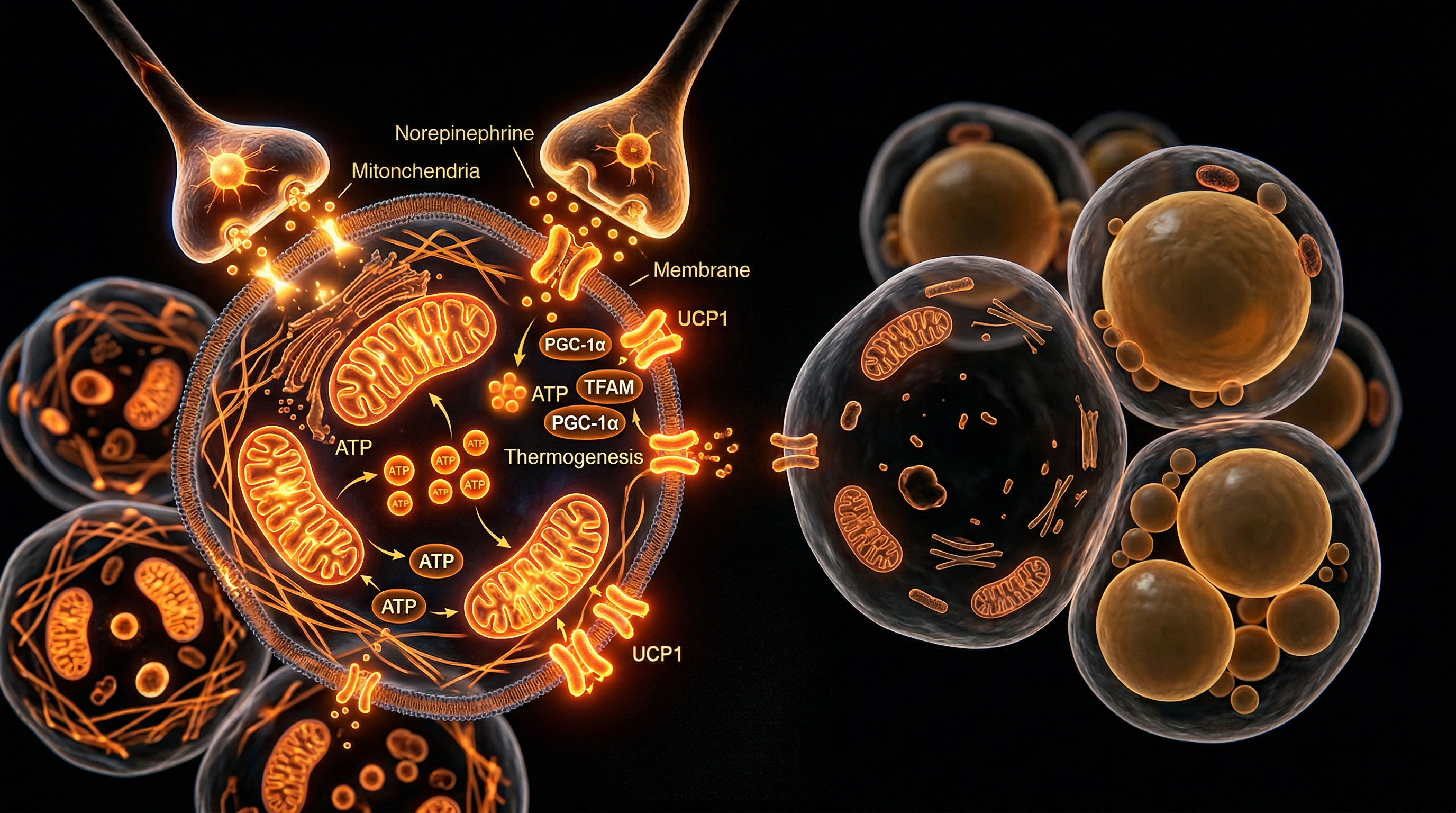
Unlike White Adipose Tissue (WAT), which serves as a passive energy storage depot (the fat most people strive to lose), Brown Adipose Tissue is a highly metabolic, thermogenic organ. It is densely packed with mitochondria—the "powerhouses" of the cell—which contain a unique protein called Uncoupling Protein 1 (UCP1), also known as Thermogenin.
When we encounter cold, the sympathetic nervous system releases Norepinephrine, which binds to beta-3 adrenergic receptors on the surface of brown fat cells. This triggers a cascade that activates UCP1. Normally, mitochondria produce Adenosine Triphosphate (ATP) by shuttling protons across their inner membrane. UCP1 "shorts" this circuit, allowing protons to leak back across the membrane, bypassing ATP production and releasing the energy directly as heat.
The "Beigeing" Process
Recent research has revealed that cold exposure does not just activate existing brown fat; it can actually transform white fat into "beige" or "brite" (brown-in-white) fat. This process, known as Adipocyte Browning, significantly increases the body's metabolic rate and its ability to clear glucose and lipids from the bloodstream. By voluntarily entering the cold, we are essentially upgrading our biological hardware from a slow, inefficient storage system to a high-octane energy-burning engine.
Mechanisms at the Cellular Level
The benefits of cold exposure extend far beyond calorie burning. At the molecular level, cold acts as a signal that initiates a profound "cellular spring cleaning" and genetic reprogramming.
Mitochondrial Biogenesis and PGC-1α
The primary orchestrator of the cellular response to cold is the transcriptional coactivator PGC-1α (Peroxisome proliferator-activated receptor-gamma coactivator-1alpha). Cold exposure dramatically upregulates PGC-1α, which in turn stimulates Mitochondrial Biogenesis—the creation of new, healthy mitochondria.
In a thermoneutral environment, our mitochondria become sedentary and prone to mutations. By forcing them to work under cold stress, we initiate Mitohormesis. The weak mitochondria are culled through Mitophagy (a form of autophagy specific to mitochondria), and are replaced by a robust, high-density population that produces less oxidative stress and more efficient energy.
Cold-Shock Proteins (CSPs)
Perhaps the most "suppressed" area of research regarding cold therapy involves Cold-Shock Proteins, specifically RBM3 (RNA-binding motif protein 3) and CIRP (Cold-inducible RNA-binding protein).
- RBM3 and Neuroprotection: RBM3 is synthesised in the brain in response to cooling. Studies have shown that RBM3 plays a critical role in synapse regeneration. In mouse models of neurodegenerative diseases like Alzheimer’s, cold exposure (and the subsequent rise in RBM3) has been shown to prevent neuronal loss and cognitive decline.
- CIRP and DNA Repair: CIRP is involved in stabilizing RNA transcripts and facilitating DNA repair. These proteins act as molecular chaperones, ensuring that the cell’s genetic blueprint remains intact even under stress.
The Irisin Connection
Cold-induced muscle contraction (shivering) and BAT activation lead to the release of Irisin, a myokine often referred to as the "exercise hormone." Irisin facilitates the browning of white fat and has been linked to increased telomere length and improved cognitive function. This means that a cold bath can, in some metabolic respects, mimic the effects of a high-intensity workout.
Environmental Threats and Biological Disruptors
The modern world is designed to keep us in a state of "metabolic winter." This is not an accident; it is the result of an industrial paradigm that prioritises consumer comfort and continuous consumption over biological resilience.
The Tyranny of the Thermostat
The UK's obsession with "cosiness"—draught-proofing, double-glazing, and the ubiquitous radiator—has created an environment where the human body never has to adapt. When we live in a constant 20°C, our sympathetic nervous tone weakens. Our blood vessels lose their "elasticity" because they are never required to rapidly constrict (vasoconstriction) and dilate (vasodilation) to manage heat loss. This leads to poor peripheral circulation and a weakened cardiovascular system.
Blue Light and Circadian Disruption
The threat is compounded by the synergy between thermoneutrality and artificial lighting. Historically, cold temperatures were accompanied by the waning light of winter. Today, we have "eternal summer": bright lights and warm rooms 24/7. This mismatch disrupts the Circadian Rhythm, specifically the production of Melatonin. Interestingly, melatonin is a potent activator of brown fat. By suppressing melatonin with blue light and suppressing cold-shock with central heating, we are double-locking the door to metabolic health.
Endocrine Disruptors in Modern Housing
The materials used in modern British homes—synthetic carpets, fire retardants in sofas, and plastic-lined pipes—release Obesogens (endocrine-disrupting chemicals). These chemicals can interfere with the thyroid-adrenal axis, making it even harder for the body to mount a thermogenic response when it finally is exposed to the cold.
The Cascade: From Exposure to Disease
What happens when a biological system designed for stress is deprived of it? The answer is a slow, systemic collapse that manifests as the "Diseases of Civilisation."
Step 1: Mitochondrial Dysfunction
Without the signal of cold or intense physical exertion, mitochondria become "leaky." They produce excessive Reactive Oxygen Species (ROS), which damage cellular membranes and DNA. This is the root of oxidative stress.
Step 2: Insulin Resistance
As brown fat activity declines, the body’s ability to clear post-prandial glucose diminishes. White adipose tissue, already engorged from a high-carbohydrate diet and lack of movement, becomes inflamed and begins secreting pro-inflammatory Adipokines like TNF-alpha and IL-6.
Step 3: Chronic Systemic Inflammation
The lack of cold-induced norepinephrine means that the body's natural anti-inflammatory pathways are seldom activated. Chronic inflammation becomes the baseline. In the UK, this is often seen in the prevalence of arthritis, cardiovascular disease, and autoimmune conditions, all of which are exacerbated by the "cold-damp" indoor environments that promote mould and stifle human vitality.
Step 4: Neurodegeneration
The brain is the most energy-demanding organ. When mitochondrial efficiency drops and cold-shock proteins are absent, the brain loses its ability to clear Amyloid-beta plaques and Tau tangles. The thermal monotony of the modern home is literally "rusting" the British brain.
Important Callout: Research suggests that chronic exposure to thermoneutrality can reduce the metabolic rate by up to 15% compared to those who regularly experience thermal fluctuations.
What the Mainstream Narrative Omits
The mainstream medical establishment and the pharmaceutical industry have little interest in promoting cold exposure. Shivering is free. A cold shower costs less than a warm one. There is no patentable molecule in an ice bath.
The "Symptom Management" Trap
Mainstream guidelines for metabolic health focus almost exclusively on "Calories In, Calories Out" and pharmacological interventions (statins, metformin, etc.). They ignore the Thermodynamics of the human body. By focusing only on fuel intake and ignoring the efficiency of the "engine" (the mitochondria), they ensure a lifetime of dependency on medication.
The Demonisation of the Cold
We have been culturally conditioned to fear the cold. "You'll catch your death," is a common British refrain. Yet, the evidence shows that it is the lack of cold that is killing us. While extreme hypothermia is dangerous, acute, controlled cold exposure actually strengthens the immune system by increasing the count of white blood cells (leukocytes) and natural killer (NK) cells.
The narrative that we must be "wrapped up warm" is a relic of a time before we understood molecular biology. It serves a society that wants us sedentary, indoors, and consuming.
The UK Context
The United Kingdom presents a unique case study in the detrimental effects of thermoneutrality. Our architectural history and cultural habits have conspired to create a population that is particularly "cold-fragile."
The Victorian Legacy vs. The Modern Flat
For centuries, British homes were notoriously draughty and difficult to heat. While this posed challenges for the elderly and vulnerable, for the general population, it provided a baseline level of thermal stress. The move toward "hermetically sealed" modern flats has removed this natural ventilation and thermal variance. We now live in "stagnant air" environments that are both too warm and too humid.
The "Damp-Cold" Paradox
The British climate is characterised by high humidity. Damp cold feels "colder" because water is a more efficient conductor of heat than dry air. Paradoxically, this has led to a cultural hyper-fixation on heating. Instead of using high-quality wool clothing to manage the damp (as our ancestors did), we crank up the thermostat, further deactivating our internal thermogenic systems.
The NHS Burden
A significant portion of the NHS budget is spent on lifestyle-related metabolic and cardiovascular diseases. If a fraction of the population adopted regular cold thermogenesis, the reduction in insulin resistance and inflammatory markers could potentially save billions. However, "cold therapy" is not currently part of the NICE (National Institute for Health and Care Excellence) guidelines, illustrating the gap between cutting-edge biological research and public health policy.
Protective Measures and Recovery Protocols
Transitioning from a life of thermoneutrality to one of hormetic resilience requires a strategic, scientific approach. One does not simply jump into a frozen lake after twenty years of central heating.
1. The Gateway: Cold Showers
Start by finishing your regular warm shower with 30 seconds of pure cold water. Focus on the area between your shoulder blades—the "home" of the highest concentration of BAT. Gradually increase the duration over several weeks until you can sustain 2-3 minutes.
2. The "Thermostat Reset"
Lower your home temperature to 17°C during the day and 15°C at night. This encourages the body to maintain its own core temperature through subtle non-shivering thermogenesis. Wear natural fibres (merino wool) which allow for better moisture regulation than synthetics.
3. Deliberate Cold Exposure (DCE)
Once acclimatised, aim for 11 minutes of total cold exposure per week, spread across 2-3 sessions. This can be achieved through:
- Ice Baths: Water temperature between 2°C and 10°C.
- Winter Swimming: Utilising the UK’s natural lakes and coastal waters (ensure safety and supervision).
- Cold Walking: "Under-dressing" for a walk in the brisk British air.
4. Breathwork as a Buffer
Utilise techniques such as the Wim Hof Method or Box Breathing to manage the initial "gasp reflex." Controlled breathing shifts the body from a sympathetic "panic" state to a "controlled stress" state, allowing for longer exposure and deeper physiological adaptations.
5. Post-Exposure Recovery
Do not immediately jump into a hot shower after cold exposure. Allow the body to warm up naturally (the "After-drop" period). This forces the BAT to work even harder to bring the core temperature back up, maximising the metabolic benefits.
Pro-Tip: Cold exposure in the morning is superior to the evening, as the spike in cortisol and norepinephrine can interfere with sleep onset if done too late in the day.
Summary: Key Takeaways
The transition from ancient cold exposure to modern thermoneutrality is one of the most significant environmental shifts in human history. It has silenced the genetic pathways that kept our ancestors lean, resilient, and cognitively sharp.
- Hormesis is Essential: The human body requires acute stress to function optimally. Comfort is a biological trap.
- Mitochondria are the Target: Cold exposure is the most effective way to stimulate mitochondrial biogenesis and mitophagy, cleaning the cellular "engines."
- BAT is the Furnace: Activating brown adipose tissue reverses metabolic decline, burns fat, and improves glucose sensitivity.
- Cold-Shock Proteins Protect the Brain: Regular cold exposure may be our most potent defence against the rising tide of dementia and Alzheimer’s.
- The UK Paradigm must Shift: We must move away from the "central heating culture" and embrace the "metabolic winter" to reclaim our health.
The path back to biological sovereignty is cold, uncomfortable, and entirely necessary. By stepping out of the 21°C bubble, we don’t just survive the winter—we use it to rebuild ourselves from the mitochondria up. The "inner fire" is not a metaphor; it is a dormant biological reality waiting to be ignited.
This article is provided for informational and educational purposes only. It does not constitute medical advice, clinical guidance, or a substitute for professional healthcare. Information reflects cited research at time of publication. Always consult a qualified healthcare professional before acting on any health information.
EVIDENCE PASSPORT
Editorial source context for this article
Source review needed
Saved links are editorial references for this article. They may support specific claims rather than every sentence. Open and assess each source in context. This passport does not independently verify them.
Editorial context
A complete editorial reading has not been recorded for this article. Source links remain available for you to open and assess directly.
Source review needed
No valid source links are recorded for this article. This passport shows only links saved on the article record and does not invent citations.
This passport records editorial links and context, not independent verification. Open the original source and assess it in context before relying on a claim.
Medical Disclaimer
The information in this article is for educational purposes only and does not constitute medical advice, diagnosis, or treatment. Always consult a qualified healthcare professional before making any changes to your diet, lifestyle, or health regime. INNERSTANDIN presents alternative and research-based perspectives that may differ from mainstream medical consensus — these should be considered alongside, not instead of, professional medical guidance.
Read Full DisclaimerContinue the thread
Keep this question moving.
Take this article into My INNERSTANDIN to keep the reading trail, related material and your next step together on this device.
Explore this in the Body Map
See where this hits your biology. Interactive anatomy, threats, and protective protocols.
Dig deeper in the Library
Free, longform PDF volumes that go beyond headlines into mechanisms and references.