
Intellectual Disability Assessment Tools
Updated May 2026
The standard methods used by psychologists to assess cognitive function and adaptive behavior.
Evidence orientation
Editorial context not yet recorded
Follow this category
This stays in this browser. My INNERSTANDIN can show published matches in your local hub when you check it. It does not send email, push, or alert notifications.
Local learning review
A private browser aid for revisiting ideas. It is not an alert or a health recommendation.
Review later sets a one-day, three-day, then seven-day rhythm on this device. Choose it only when you want to revisit this article.
Introduction: Defining the Scope of Intellectual Disability
In the United Kingdom, the term ‘Learning Disability’ is frequently used in clinical and social care settings to describe what is internationally classified as an ‘Intellectual Disability’ (ID) by the World Health Organisation (ICD-11) and the American Psychiatric Association (DSM-5-TR). For the purpose of this authoritative review, we will use the term Intellectual Disability to ensure alignment with international diagnostic standards while contextualising the tools within the UK’s National Health Service (NHS) and educational frameworks.
Intellectual Disability is a neurodevelopmental condition characterised by significant limitations both in intellectual functioning and in adaptive behaviour, which covers many everyday social and practical skills. This condition originates before the age of 18. In the UK, the assessment of ID is a high-stakes process; it determines access to Education, Health and Care Plans (EHCPs), disability benefits (such as DLA or PIP), and specialist social care support under the Care Act 2014.
An authoritative assessment is never based on a single test score. It is a multi-dimensional process requiring clinical judgement, standardised psychometric testing, and a thorough developmental history.
1. The Statutory and Clinical Framework in the UK
Assessments in the UK are guided by several key frameworks:
- NICE Guidelines (NG54): Focuses on the mental health problems in people with learning disabilities, emphasising the need for adapted assessment tools.
- The SEND Code of Practice (2015): Governs how local authorities and schools identify and assess children with special educational needs.
- The British Psychological Society (BPS) Guidelines: Provides the ethical and professional standards for administering psychometric tests.
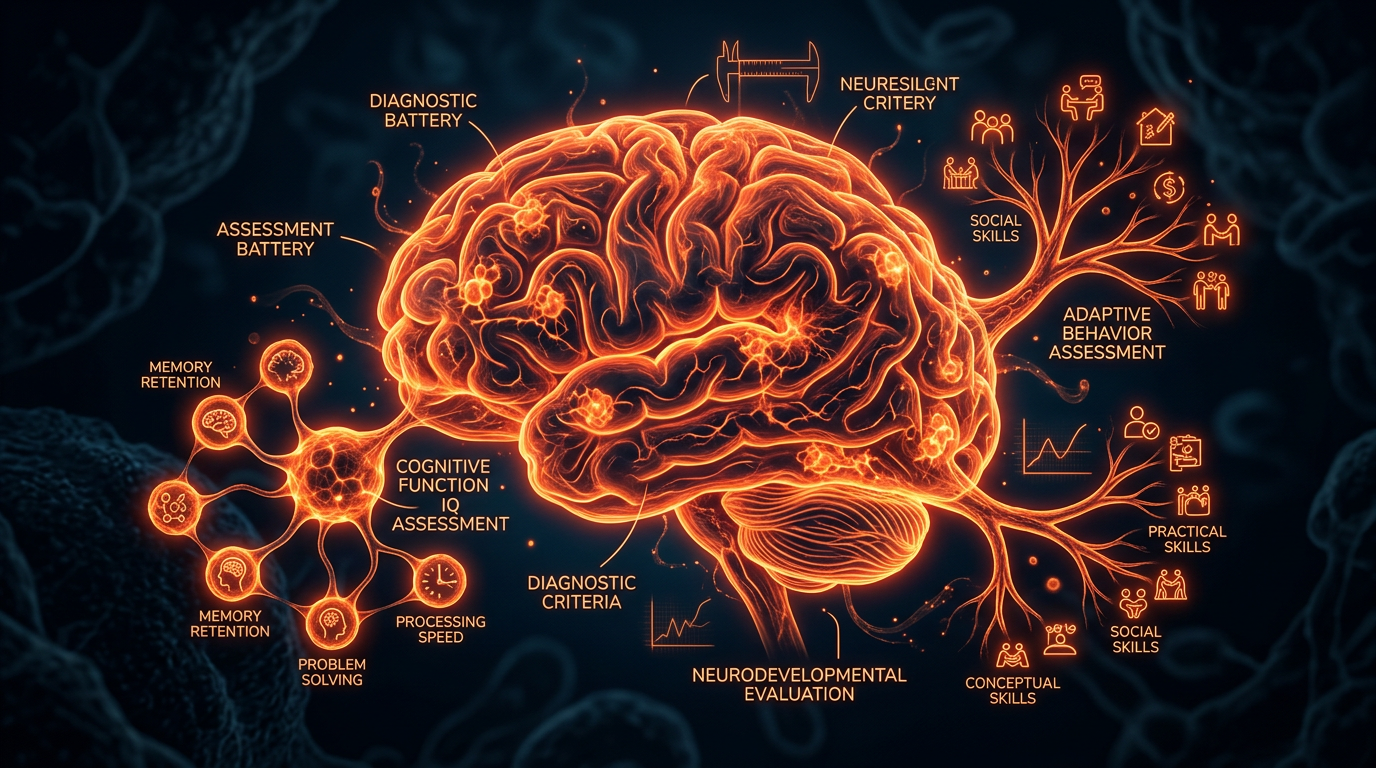
A robust assessment must address two primary domains: Intellectual Functioning (IQ) and Adaptive Functioning.
2. Tools for Assessing Intellectual Functioning (Cognitive Battery)
Intellectual functioning—or intelligence—refers to mental capacity for learning, reasoning, and problem-solving. In the UK, the ‘Gold Standard’ for this assessment involves the Wechsler scales.
2.1. Wechsler Intelligence Scale for Children – Fifth UK Edition (WISC-V UK)
The WISC-V is the most widely used tool for children aged 6 to 16. It provides a Full Scale IQ (FSIQ) and five primary index scores:
- Verbal Comprehension Index (VCI): Measures the ability to access and apply acquired word knowledge.
- Visual Spatial Index (VSI): Measures the ability to evaluate visual details and understand visual-spatial relationships.
- Fluid Reasoning Index (FRI): Measures the ability to detect the underlying conceptual relationship among visual objects.
- Working Memory Index (WMI): Measures the ability to register, maintain, and manipulate visual and auditory information.
- Processing Speed Index (PSI): Measures speed and accuracy of visual identification.
In ID assessments, clinicians often look for a "flat profile" where all indices are significantly below average (typically <70), rather than the "spiky profile" often seen in specific learning difficulties like dyslexia.
2.2. Wechsler Adult Intelligence Scale – Fourth UK Edition (WAIS-IV UK)
For individuals aged 16 to 90, the WAIS-IV is the primary tool. It follows a similar structure to the WISC but is normed for an adult population. In the context of the UK’s ‘Transition to Adulthood’ pathways, a WAIS-IV assessment is often required to confirm continued eligibility for adult social care services.
2.3. Wechsler Preschool and Primary Scale of Intelligence (WPPSI-IV UK)
Used for children aged 2 years 6 months to 7 years 7 months. Early identification via the WPPSI is crucial for early intervention, though clinicians remain cautious about long-term stability of IQ scores at this young age.
2.4. Stanford-Binet Intelligence Scales (SB5)
While less common in the UK than Wechsler, the SB5 is highly valued for ID assessments because it has a lower "floor" and a higher "ceiling." It is particularly effective for individuals with very low cognitive ability, as it provides more granular data at the lower end of the spectrum where Wechsler scores may simply report "<40."
2.5. Leiter International Performance Scale (Leiter-3)
A critical tool in the UK’s diverse landscape, the Leiter-3 is a completely non-verbal measure of intelligence. It is essential for:
- Non-verbal children or those with severe speech and language impairments.
- Individuals where English is an Additional Language (EAL).
- Individuals with Autism who may struggle with the social-verbal demands of the Wechsler scales.
3. Tools for Assessing Adaptive Functioning
A diagnosis of Intellectual Disability cannot be made on IQ alone. An individual must also show significant deficits in adaptive behaviour—the collection of conceptual, social, and practical skills that are learned and performed by people in their everyday lives.
3.1. Vineland Adaptive Behavior Scales (Vineland-3)
The Vineland-3 is the UK’s leading tool for measuring adaptive behaviour. Unlike IQ tests, it is usually completed via an interview with a parent, carer, or teacher. It covers:
- Communication: Receptive, expressive, and written language.
- Daily Living Skills: Personal hygiene, domestic tasks, and community navigation.
- Socialization: Interpersonal relationships, play, and coping skills.
- Motor Skills: Gross and fine motor coordination.
The Vineland-3 is vital because it measures what an individual actually does in daily life, rather than what they are capable of doing in a controlled testing environment.
3.2. Adaptive Behavior Assessment System (ABAS-3)
The ABAS-3 is a comprehensive, norm-referenced assessment of adaptive skills. It is often used in the UK to provide a "General Adaptive Composite" (GAC) score. It is particularly useful for identifying specific areas of need for an EHCP or a social care support plan. It breaks down skills into:
- Conceptual: Communication, functional academics, self-direction.
- Social: Social interaction and leisure.
- Practical: Community use, home/school living, health and safety, self-care.
4. The Intersection of ID, ADHD, and Neurodevelopmental Conditions
In the UK, there is an increasing recognition of "diagnostic overshadowing"—where a person’s ID causes clinicians to overlook comorbid conditions like ADHD or Autism.
4.1. Assessing ADHD in the Context of ID
ADHD is significantly more prevalent in the ID population than in the general population. However, standard ADHD tools like the Conners 4 or the SNAP-IV must be interpreted with extreme caution.
- The Challenge: A child with an ID may have a short attention span because the material presented to them is cognitively too difficult, not necessarily because they have ADHD.
- The Solution: Clinicians use the Developmental Behaviour Checklist (DBC) or the Aberrant Behavior Checklist (ABC), which are specifically normed for individuals with intellectual and developmental disabilities. These tools help distinguish between "typical" ID behaviours and those indicative of ADHD.
4.2. Assessing Autism (ASD) in the Context of ID
Overlapping features between ID and Autism (such as delayed speech and social difficulties) require specialist tools:
- ADOS-2 (Autism Diagnostic Observation Schedule): The UK's gold standard observation tool. Modules 1 and 2 are specifically designed for individuals with limited expressive language, often seen in moderate to severe ID.
- ADI-R (Autism Diagnostic Interview-Revised): A structured parent interview that helps distinguish whether social deficits are "in line" with the child's developmental age (suggesting ID) or "atypical" for their developmental age (suggesting ASD).
5. Specialist Assessment Tools for Severe to Profound ID
For individuals with profound and multiple learning disabilities (PMLD), standard psychometric tests (IQ >40) are often inapplicable.
5.1. The Pre-Verbal Communication Schedule (PVCS)
This tool assesses the non-verbal communication skills of children and adults who have not yet developed formal language. It looks at visual attention, auditory response, and tactile exploration.
5.2. The Routes for Learning (RfL)
Developed originally in Wales and widely used across the UK, this is a formative assessment tool for learners with PMLD. It focuses on the development of early communication and cognitive skills, such as cause-and-effect and object permanence.
6. The Assessment Process in the UK: A Multi-Disciplinary Approach
In the UK, an assessment for Intellectual Disability is rarely conducted by one professional in isolation. It typically involves:
- Educational Psychologists (EPs): Usually the first point of contact within the school system. They administer the WISC-V and Vineland-3 to support EHCP applications.
- Clinical Psychologists: Often found in NHS Child and Adolescent Mental Health Services (CAMHS) or Adult Learning Disability Teams (ALDT). They focus on complex diagnostic questions and comorbid mental health conditions.
- Speech and Language Therapists (SLT): Essential for assessing the communication component of adaptive functioning. They use tools like the CELF-5 UK (Clinical Evaluation of Language Fundamentals) to differentiate between a language disorder and a global intellectual disability.
- Occupational Therapists (OT): Assess the "Practical" domain of adaptive functioning, looking at sensory processing and fine motor skills necessary for independence.
- Paediatricians/Psychiatrists: Rule out underlying medical or genetic causes (e.g., Fragile X Syndrome, Down Syndrome, or Fetal Alcohol Spectrum Disorder) and manage medication for comorbidities like ADHD.
7. Diagnostic Challenges and Considerations
7.1. The "Flynn Effect" and Test Obsolescence
The Flynn Effect is the observed rise in average IQ scores over time. In the UK, clinicians must use the most recent editions of tests (e.g., using WISC-V rather than WISC-IV). Using outdated norms can lead to overestimating an individual's IQ, potentially denying them essential support services.
7.2. Cultural and Linguistic Bias
Many assessment tools were historically normed on Western, middle-class populations. In the UK’s multicultural society, clinicians must be wary of "penalising" children from diverse backgrounds. The Raven’s Progressive Matrices is often used as a supplementary "culture-fair" test, as it relies on non-verbal pattern matching rather than linguistic or cultural knowledge.
7.3. The Floor Effect
As mentioned, some tests do not distinguish between levels of impairment at the very low end of the scale. A child who scores the minimum on every subtest of the WISC-V might be better assessed using the Bayley Scales of Infant and Toddler Development (Bayley-4), even if they are chronologically older, to identify their "developmental age."
7.4. Trauma and Socio-economic Factors
In the UK, there is a strong correlation between socio-economic deprivation and the identification of Mild Intellectual Disability. Clinicians must distinguish between a biological neurodevelopmental condition and "environmental" developmental delay caused by a lack of stimulation, poor nutrition, or "Adverse Childhood Experiences" (ACEs).
8. From Assessment to Support: The EHCP and Beyond
Once an assessment is complete, the results are synthesised into a report. In the UK, this report is a vital document for the Education, Health and Care Plan (EHCP).
8.1. Interpreting the Scores for Educators
An IQ of 65 (Standardised Score) corresponds to the 1st percentile. For a teacher, this means that 99% of children the same age have higher cognitive scores. The assessment tools must therefore translate into practical recommendations:
- Scaffolding: Breaking tasks into smaller steps.
- Visual Supports: Using Widgit or PCS symbols to support communication.
- Overlearning: The need for significantly more repetition to move information into long-term memory.
8.2. Mental Capacity Act (2005)
For individuals over 16, assessment tools take on a legal dimension regarding the Mental Capacity Act. A WAIS-IV or Vineland-3 assessment might be used as evidence in a capacity assessment to determine if an individual can make specific decisions (e.g., regarding finances, residence, or medical treatment).
9. Future Directions in ID Assessment
The landscape of ID assessment in the UK is shifting toward a more "Neurodiversity-Affirming" model.
9.1. Digital and Tablet-Based Testing
The Q-interactive system by Pearson Clinical is now widely used in the UK. Administering the WISC-V on iPads allows for more accurate timing of subtests and can be more engaging for children who find paper-and-pencil tasks clinical and intimidating.
9.2. Focus on "Support Needs"
There is a movement away from categorising by "Deficit" (what the person can't do) toward "Support Needs" (what the person needs to thrive). The Supports Intensity Scale (SIS) is gaining traction as a tool that focuses on the intensity of support required for a person to participate in community life, rather than just their IQ score.
9.3. Genetic Advancements
With the NHS Genomic Medicine Service, more individuals are receiving a genetic diagnosis (e.g., SYNGAP1 or 16p11.2 deletion). Future assessment tools may become more phenotype-specific, helping clinicians predict the specific cognitive profile associated with certain genetic syndromes.
10. Summary Table: Key Tools at a Glance
| Tool | Age Range | Domain | Primary Use in UK | | :--- | :--- | :--- | :--- | | WISC-V UK | 6:0 – 16:11 | Cognitive (IQ) | Identifying ID in school-age children for EHCPs. | | WAIS-IV UK | 16:0 – 90:11 | Cognitive (IQ) | Assessing adults for social care and capacity. | | Vineland-3 | Birth – 90+ | Adaptive | Measuring real-world independence and life skills. | | Leiter-3 | 3:0 – 75+ | Cognitive (Non-verbal) | Assessing individuals with severe language delay or EAL. | | ABAS-3 | Birth – 89 | Adaptive | Profiling specific practical and social skill deficits. | | ADOS-2 | 12 months+ | Social/Comm | Distinguishing Autism from global ID. | | CELF-5 UK | 5:0 – 21:11 | Language | Distinguishing DLD from Intellectual Disability. |
Conclusion
Assessment tools for Intellectual Disability are the cornerstone of neurodevelopmental practice in the United Kingdom. From the foundational Wechsler scales to adaptive measures like the Vineland-3, these instruments provide the objective data required to navigate the UK’s complex health and education systems.
However, the "authoritative" nature of an assessment does not come from the tools alone, but from the clinician's ability to weave together psychometric data, observations, and the lived experience of the individual and their family. As we move toward a more integrated, multi-disciplinary approach within the NHS and local authorities, the focus remains on using these tools not just for diagnosis, but as a roadmap for enabling individuals with intellectual disabilities to lead fulfilling, supported, and autonomous lives.
The role of the practitioner is to ensure that the "label" provided by these tools opens doors to support rather than acting as a ceiling to potential. In the context of ADHD and other neurodevelopmental conditions, the careful, nuanced use of these assessment tools ensures that every facet of a person’s cognitive and behavioural profile is understood, respected, and supported.
References and Further Reading (UK Context)
- British Psychological Society (BPS). (2015). Guidance on the Assessment and Diagnosis of Intellectual Disabilities and Contextualised Admissions.
- Department for Education. (2015). Special educational needs and disability code of practice: 0 to 25 years.
- NICE. (2016). Mental health problems in people with learning disabilities: prevention, assessment and management (NG54).
- Pearson Clinical UK. WISC-V UK and WAIS-IV UK Technical Manuals.
- The Challenging Behaviour Foundation. Information on Assessment and Diagnosis for Families.
This article is provided for informational and educational purposes only. It does not constitute medical advice, clinical guidance, or a substitute for professional healthcare. Information reflects cited research at time of publication. Always consult a qualified healthcare professional before acting on any health information.
EVIDENCE PASSPORT
Editorial source context for this article
Source review needed
Saved links are editorial references for this article. They may support specific claims rather than every sentence. Open and assess each source in context. This passport does not independently verify them.
Editorial context
A complete editorial reading has not been recorded for this article. Source links remain available for you to open and assess directly.
Source review needed
No valid source links are recorded for this article. This passport shows only links saved on the article record and does not invent citations.
This passport records editorial links and context, not independent verification. Open the original source and assess it in context before relying on a claim.
Medical Disclaimer
The information in this article is for educational purposes only and does not constitute medical advice, diagnosis, or treatment. Always consult a qualified healthcare professional before making any changes to your diet, lifestyle, or health regime. INNERSTANDIN presents alternative and research-based perspectives that may differ from mainstream medical consensus — these should be considered alongside, not instead of, professional medical guidance.
Read Full DisclaimerContinue the thread
Keep this question moving.
Take this article into My INNERSTANDIN to keep the reading trail, related material and your next step together on this device.
Explore this in the Body Map
See where this hits your biology. Interactive anatomy, threats, and protective protocols.
Dig deeper in the Library
Free, longform PDF volumes that go beyond headlines into mechanisms and references.