
Mitochondrial Bioenergetics: The Cellular Engine of Vitality and Repair
Updated May 2026
Mitochondria are the organelles responsible for producing Adenosine Triphosphate (ATP), the universal energy currency of life. Optimising mitochondrial function is essential for maintaining physical stamina, cognitive sharpness, and cellular integrity.
Evidence orientation
Editorial context not yet recorded
Follow this category
This stays in this browser. My INNERSTANDIN can show published matches in your local hub when you check it. It does not send email, push, or alert notifications.
Local learning review
A private browser aid for revisiting ideas. It is not an alert or a health recommendation.
Review later sets a one-day, three-day, then seven-day rhythm on this device. Choose it only when you want to revisit this article.
Overview
Within the microscopic architecture of the human body lies an ancient, intricate, and arguably "alien" system that dictates the boundary between life and death, health and decay. For decades, school children have been taught the reductionist mantra that mitochondria are the "powerhouse of the cell." While technically accurate, this simplified slogan masks a biological reality far more profound and alarming. The mitochondria are not merely passive furnaces; they are the sophisticated, sentient sensors of our cellular environment, acting as the ultimate arbiters of whether a cell thrives, survives, or undergoes programmed self-destruction.
Mitochondrial bioenergetics—the study of how these organelles transform nutrients and oxygen into Adenosine Triphosphate (ATP)—is the foundation of all physiological function. Every heartbeat, every synaptic firing in the brain, every immune response, and every act of DNA repair is funded by the "energy currency" generated within the mitochondrial inner membrane. However, we are currently witnessing a silent epidemic across the United Kingdom and the Western world: a systematic collapse of mitochondrial efficiency.
This collapse is not an accident of nature. It is the direct consequence of a modern environment that is fundamentally mismatched with our evolutionary biology. From the chemical-laden food supply to the ubiquitous presence of non-native electromagnetic fields (nnEMFs) and the suppression of natural light cycles, our cellular engines are being "clogged" and "stalled" at an unprecedented rate. This article aims to expose the mechanisms of this decline and provide the scientific blueprint for reclaiming your cellular vitality. To understand health at the macro level, one must first master the bioenergetics of the micro level.
Fact: The average human body contains approximately 10 quadrillion mitochondria. In high-demand organs like the heart and brain, a single cell can contain upwards of 2,000 to 5,000 mitochondria, reflecting the immense energy requirements of these tissues.
##
The Biology — How It Works
To grasp the magnitude of mitochondrial function, we must look at the endosymbiotic theory. Roughly 1.5 billion years ago, a primitive eukaryotic cell engulfed a specialised bacterium. Instead of digesting it, the two formed a symbiotic relationship: the bacterium provided efficient energy production via oxygen, and the host cell provided protection and nutrients. This legacy remains today; mitochondria possess their own circular DNA (mtDNA), separate from the nuclear DNA (nDNA) found in the cell’s nucleus. This unique genetic heritage makes them exceptionally sensitive to environmental stressors.
The Anatomy of Energy
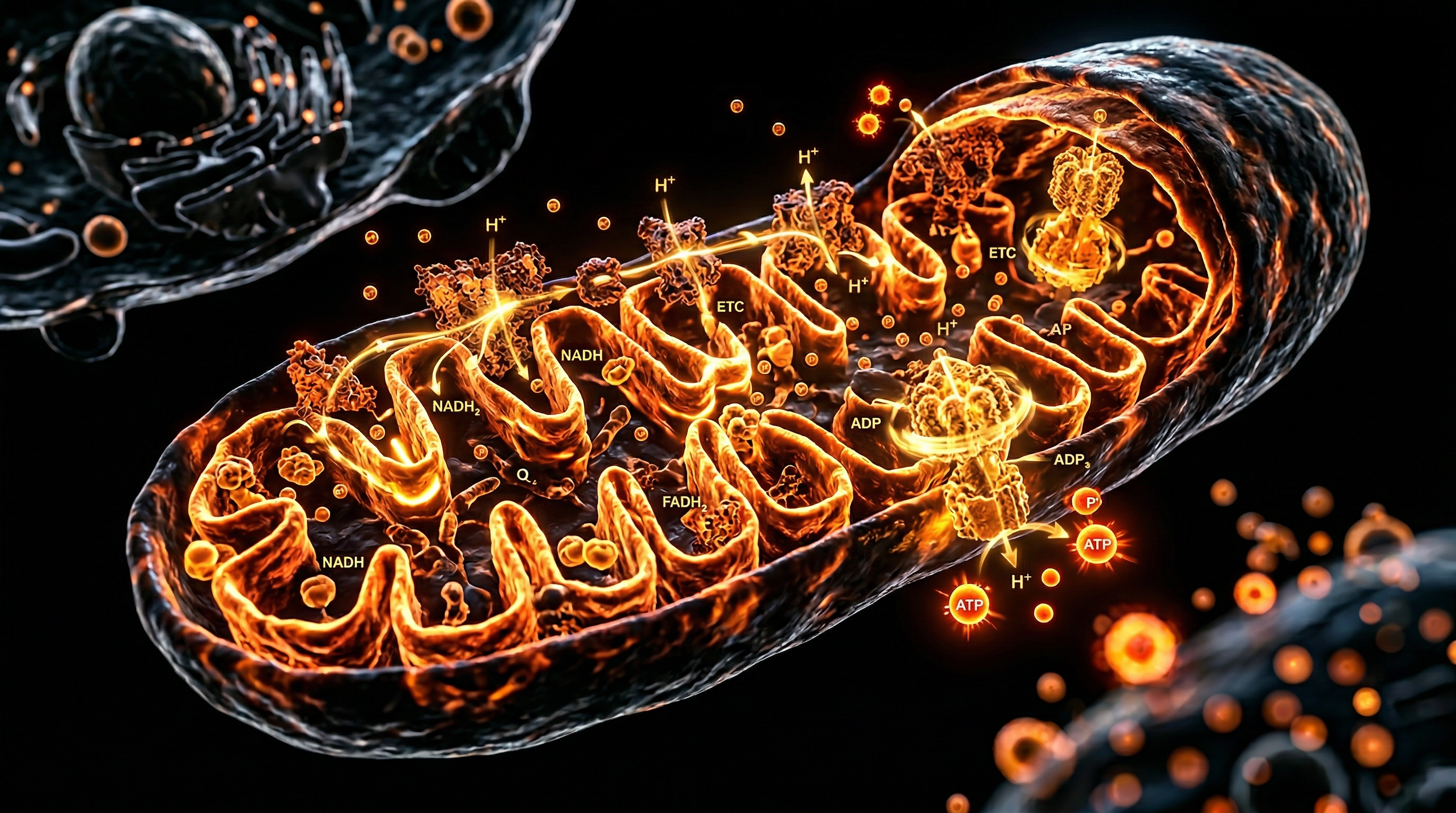
The mitochondrion is defined by its double-membrane structure. The Outer Mitochondrial Membrane (OMM) acts as a gatekeeper, while the Inner Mitochondrial Membrane (IMM) is where the "magic" of bioenergetics occurs. The IMM is folded into numerous ridges called cristae, which vastly increase the surface area available for chemical reactions. Inside the IMM is the matrix, a dense soup of enzymes, ribosomes, and mtDNA.
The Krebs Cycle (The TCA Cycle)
The process begins in the matrix with the Tricarboxylic Acid (TCA) Cycle, or Krebs Cycle. Whether you consume carbohydrates, fats, or proteins, they are eventually broken down into Acetyl-CoA. This molecule enters the Krebs Cycle, undergoing a series of enzymatic transformations that strip away high-energy electrons. These electrons are loaded onto "carrier" molecules: NADH (Nicotinamide Adenine Dinucleotide) and FADH2. While the Krebs Cycle produces a small amount of ATP directly, its primary role is to supply the raw materials for the next, more powerful stage: the Electron Transport Chain.
The Electron Transport Chain (ETC)
The ETC is the pinnacle of biological engineering. It consists of four protein complexes (I, II, III, and IV) embedded in the IMM.
- Complex I (NADH Dehydrogenase): Accepts electrons from NADH, pumping protons (H+) from the matrix into the intermembrane space.
- Complex II (Succinate Dehydrogenase): Accepts electrons from FADH2.
- Complex III (Cytochrome bc1 Complex): Passes electrons further along, pumping more protons.
- Complex IV (Cytochrome c Oxidase): The final destination for electrons, where they combine with oxygen and hydrogen to form water. This is why we breathe oxygen—to serve as the final electron acceptor in this chain.
As electrons flow through these complexes, they act like a current, powering the "pumps" that move protons into the intermembrane space. This creates an immense electrochemical gradient—a biological battery.
ATP Synthase: The Molecular Turbine
The final player is Complex V, or ATP Synthase. This is a literal molecular motor that rotates at speeds of up to 150 revolutions per second. Driven by the pressure of the proton gradient, protons flow back into the matrix through ATP Synthase, causing it to spin. This mechanical energy is used to "snap" a phosphate group onto Adenosine Diphosphate (ADP), creating ATP.
Critical Insight: A healthy adult produces their own body weight in ATP every single day. However, ATP is not "stored" in large quantities; it is consumed almost instantly. This means that any interruption in mitochondrial flow results in immediate cellular dysfunction.
##
Mechanisms at the Cellular Level
The role of mitochondria extends far beyond the simple production of ATP. They are the command centres for cellular signalling and homeostasis.
Mitochondrial Dynamics: Fusion and Fission
Mitochondria are not static "beans"; they are a fluid, social network. They constantly undergo fusion (joining together to share resources and dilute damaged DNA) and fission (splitting apart to isolate damaged segments). This process, known as mitochondrial dynamics, is essential for quality control. When fission occurs to isolate a terminally damaged mitochondrion, the cell undergoes mitophagy—a targeted form of autophagy where the broken organelle is "eaten" and recycled. Failure in these dynamics is a hallmark of neurodegenerative diseases and aging.
Reactive Oxygen Species (ROS) and Redox Signalling
A common misconception is that Reactive Oxygen Species (ROS), often called "free radicals," are purely toxic byproducts. In reality, at low levels, ROS are vital signalling molecules. They tell the nucleus which genes to turn on for repair and adaptation. This is known as hormesis. However, when the ETC becomes inefficient—a state known as electron leakage—ROS production sky-rockets. This leads to oxidative stress, where the ROS overwhelm the cell’s antioxidant defences (such as glutathione and superoxide dismutase), causing irreversible damage to lipids, proteins, and mtDNA.
The Cell Danger Response (CDR)
Research by Dr. Robert Naviaux has identified the Cell Danger Response (CDR) as a fundamental metabolic reflex. When a mitochondrion detects a threat—be it a virus, a toxin, or physical trauma—it shifts its function. It stops focusing on energy production and begins focusing on cellular defence, hardening its membranes and releasing signalling molecules to alert neighbouring cells. While this is protective in the short term, many modern chronic illnesses are characterised by a cell being "stuck" in the CDR, unable to return to its normal bioenergetic state.
Apoptosis: The Final Decision
Mitochondria also hold the keys to the "kill switch." If a cell is too damaged to repair, the OMM becomes permeable (a process called MOMP), releasing Cytochrome c into the cytoplasm. This triggers apoptosis (programmed cell death). If the mitochondria are too weak to even trigger apoptosis, the cell may instead become senescent—a "zombie cell" that refuses to die and secretes inflammatory cytokines, poisoning the surrounding tissue.
##
Environmental Threats and Biological Disruptors
The modern world is a minefield for mitochondrial health. The "Mainstream" medical community often ignores these sub-lethal stressors, yet their cumulative impact is devastating.
Iatrogenic Damage: The Pharmaceutical Toll
Many commonly prescribed medications in the UK are "mitotoxins."
- Statins: While prescribed to lower cholesterol, they inhibit the enzyme HMG-CoA reductase, which is also required for the synthesis of Coenzyme Q10 (CoQ10). CoQ10 is an essential electron carrier in the ETC. Depleting it is like removing the spark plugs from an engine.
- Antibiotics: Because mitochondria share a bacterial ancestry, many antibiotics (especially fluoroquinolones like Ciprofloxacin) inadvertently target mitochondrial ribosomes and mtDNA, leading to long-term fatigue and connective tissue damage.
- NSAIDs: Common painkillers like Ibuprofen can uncouple oxidative phosphorylation, making energy production less efficient and increasing ROS.
The Glyphosate Factor
The UK’s agricultural reliance on glyphosate-based herbicides (like Roundup) is a bioenergetic catastrophe. While the "official" narrative from the Food Standards Agency (FSA) is that glyphosate is safe because it targets the Shikimate pathway (which humans don't have), this ignores its role as a mineral chelator. Glyphosate binds to essential minerals like manganese, magnesium, and zinc—all of which are required as cofactors for mitochondrial enzymes. Furthermore, emerging evidence suggests glyphosate can disrupt the mitochondrial membrane potential directly.
Heavy Metal Accumulation
Mitochondria are "magnets" for heavy metals. Aluminium (found in many UK water supplies and deodorants), Mercury (from dental amalgams and certain fish), and Cadmium (from cigarette smoke and industrial pollution) can substitute for essential minerals in the ETC protein complexes. This effectively "jams" the electronic flow, leading to massive ROS production and mitochondrial arrest.
Non-Native Electromagnetic Fields (nnEMFs)
The rollout of high-frequency 5G and ubiquitous Wi-Fi across UK cities has introduced a new stressor. Research indicates that nnEMFs can trigger Voltage-Gated Calcium Channels (VGCCs) on the cell membrane, causing an influx of calcium into the cell. This calcium overload travels to the mitochondria, disrupting the electrochemical gradient and triggering the Cell Danger Response.
Alarming Statistic: Studies have shown that exposure to high levels of artificial blue light after sunset can reduce mitochondrial melatonin production. Unlike the melatonin produced by the pineal gland, mitochondrial melatonin is a potent antioxidant produced within the organelle to repair damage during the night. Blocking it is a recipe for rapid aging.
##
The Cascade: From Exposure to Disease
When mitochondrial bioenergetics fail, the body doesn't just "feel tired." It begins a slow, systemic collapse that manifests as the "diseases of civilisation."
Neurodegeneration: The Brain on Empty
The brain is the most energy-demanding organ. When mitochondria in neurons fail, the cells cannot maintain their electrical charge. This leads to the accumulation of misfolded proteins (amyloid plaques and tau tangles). Many researchers now refer to Alzheimer’s Disease as "Type 3 Diabetes"—a state of brain-specific insulin resistance and mitochondrial starvation.
Metabolic Syndrome and Obesity
Obesity is often not a problem of "too many calories" but "too little energy utilization." If the mitochondria are damaged, they cannot efficiently burn fatty acids (a process called Beta-Oxidation). The body, sensing an energy deficit despite plenty of stored fuel, triggers hunger signals. This creates a vicious cycle where the individual consumes more fuel that their "broken engines" cannot process, leading to further fat storage and systemic inflammation.
The Warburg Effect and Cancer
In 1931, Otto Warburg won the Nobel Prize for discovering that cancer cells shift their metabolism. Instead of using the efficient mitochondrial ETC, they revert to primitive glycolysis (fermentation) in the cytoplasm, even in the presence of oxygen. This is now recognised as a hallmark of cancer. Chronic mitochondrial damage forces the cell into this "survival mode" fermentation, which facilitates the rapid, uncontrolled growth characteristic of tumours.
Chronic Fatigue Syndrome (ME/CFS) and Fibromyalgia
In the UK, thousands suffer from ME/CFS, often dismissed by the NHS as a psychological issue or "post-viral fatigue." However, bioenergetic testing often reveals a profound "metabolic trap." These patients frequently have inhibited Pyruvate Dehydrogenase (the gatekeeper enzyme to the Krebs Cycle), meaning their cells literally cannot access the energy they need to function, leading to the characteristic "post-exertional malaise."
##
What the Mainstream Narrative Omits
The UK’s medical and regulatory infrastructure is largely built on a 20th-century model of "one drug for one symptom." This approach is fundamentally incapable of addressing mitochondrial decay.
The Omission of Bio-Individual Nutrient Density
The NHS "Eatwell Guide" continues to promote high-carbohydrate diets (bread, pasta, potatoes) which, for an individual with mitochondrial dysfunction, acts as "dirty fuel." Carbohydrate metabolism generates more ROS per unit of ATP than fat metabolism. The mainstream narrative fails to acknowledge that many people require a "mitochondrial reset" through ketogenic or carnivore protocols to bypass damaged glucose-processing pathways.
The Light Pollution Crisis
Public health bodies focus on "skin cancer" from the sun while ignoring the metabolic disaster of indoor-living. We are "light-starved" and "blue-light poisoned." Natural sunlight contains Infrared (IR) light, which has been shown to stimulate Cytochrome c Oxidase (Complex IV), effectively "charging" our mitochondria. Artificial LED lighting in UK offices and homes lacks this IR component and is heavily weighted toward the stressful blue spectrum, which damages the retina and the mitochondria simultaneously.
The Myth of the "Safe Limit"
Regulatory bodies like the MHRA and Environment Agency set "safe limits" for toxins based on acute toxicity. They rarely, if ever, consider the synergistic effect of multiple low-dose toxins (e.g., fluoride in water + glyphosate in bread + aluminium in deodorant) on the delicate proton gradient of the mitochondria. There is no "safe limit" for a substance that disrupts the quantum flow of electrons in your cells.
##
The UK Context
Living in Britain presents unique challenges for mitochondrial health.
The "SICK" UK Diet
The UK has the highest consumption of Ultra-Processed Foods (UPFs) in Europe. These foods are devoid of mitochondrial cofactors like magnesium, B-vitamins, and manganese. Furthermore, they are loaded with industrial seed oils (refined vegetable oils), which are high in linoleic acid. This unstable fat is incorporated into the mitochondrial membrane (specifically into a phospholipid called cardiolipin). When cardiolipin oxidises due to seed oil consumption, the cristae collapse, and the mitochondria "leak" protons, leading to systemic metabolic failure.
Soil Depletion
British soil has been farmed intensively for decades, leading to a massive decline in mineral content. A carrot grown in the UK today has significantly less magnesium and copper than one grown in the 1940s. Since these minerals are the "hardware" of the mitochondrial complexes, even those "eating healthy" may be bioenergetically starved.
Fluoridation and Water Quality
While much of the UK does not have artificial water fluoridation, several major regions do. Fluoride is a known mitochondrial toxin; it inhibits several enzymes in the Krebs Cycle and competes with magnesium. Furthermore, the presence of "forever chemicals" (PFAS) in UK waterways—which the Environment Agency has been slow to regulate—poses a direct threat to the fatty acid metabolism within the mitochondria.
The NHS Stance on Supplementation
The NHS generally discourages the use of high-quality supplements unless a clinical deficiency (like scurvy or rickets) is present. This ignores the concept of "sub-clinical insufficiency," where a patient has enough magnesium to stay alive, but not enough to maintain optimal mitochondrial voltage. Consequently, British patients are rarely tested for CoQ10 levels, Magnesium RBC, or NAD+ levels—the very metrics that define vitality.
##
Protective Measures and Recovery Protocols
Reversing mitochondrial decay requires a multi-pronged "bio-hacking" approach that addresses the environment, nutrition, and lifestyle.
1. Nutritional Fortification
- The Mitochondrial Diet: Shift toward a diet rich in healthy fats (grass-fed tallow, butter, avocado) and high-quality proteins. This provides "clean-burning" fuel and the phospholipids needed to repair mitochondrial membranes.
- Eliminate Seed Oils: Remove sunflower, rapeseed, and "vegetable" oils. These are the primary drivers of cardiolipin oxidation.
- Polyphenol Power: Consume dark berries, cacao, and green tea. These contain phytochemicals that trigger mitophagy (the clearing of old mitochondria) and biogenesis (the creation of new ones).
2. Strategic Supplementation
- Coenzyme Q10 (Ubiquinol): 100-200mg daily to support electron transport, especially if on statins.
- Magnesium Bisglycinate/Malate: 400-600mg daily. Magnesium is required for every single ATP-related reaction.
- PQQ (Pyrroloquinoline Quinone): Known to stimulate mitochondrial biogenesis (growing new power plants).
- NAD+ Precursors: (NMN or NR) to support the DNA repair enzymes (PARPs) and sirtuins that manage mitochondrial health.
- Alpha-Lipoic Acid (ALA): A "universal antioxidant" that can cross into the mitochondria to neutralise ROS.
3. Hormetic Stressors
- Cold Thermogenesis: Brief exposure to cold (cold showers, ice baths) triggers the production of PGC-1alpha, the master regulator of mitochondrial biogenesis. It also stimulates "brown fat," which is densely packed with mitochondria that burn fuel for heat.
- Heat Shock Proteins: Regular sauna use (3-4 times a week) helps repair misfolded proteins and improves mitochondrial efficiency.
- Intermittent Fasting: Giving the body a break from digestion (16:8 or OMAD) triggers autophagy and forces the mitochondria to become more "flexible" in switching between fuel sources.
4. Circadian and Light Hygiene
- Morning Sunlight: Get 10-15 minutes of natural light in your eyes (without sunglasses) as soon as possible after waking. This sets your circadian clock and pre-conditions your mitochondria for the day.
- Block Blue Light: Use "amber" or "red" glasses after sunset to protect your mitochondrial melatonin production.
- Grounding (Earthing): Connecting your bare skin to the earth (grass or sand) allows for the transfer of free electrons from the Earth's surface into your body, which can help neutralise ROS.
##
Summary: Key Takeaways
The path to sovereign health begins with the realisation that you are not a collection of symptoms, but a collection of quadrillions of bio-turbines. When these turbines spin freely, you experience the "INNERSTANDING" of true vitality—mental clarity, physical resilience, and a body that can repair itself.
- Mitochondria are the primary sensors of your environment; they respond to light, toxins, and thoughts.
- ATP production is a quantum process that requires a precise electrochemical gradient and healthy membranes.
- Modern "Western" living (UPFs, blue light, nnEMFs, and pharmaceuticals) is a direct assault on mitochondrial integrity.
- Mainstream medicine ignores bioenergetics in favour of symptomatic management, often exacerbating the problem.
- Recovery is possible through mineral replenishment, the elimination of "dirty" fuels/fats, and re-aligning with natural cycles (light, temperature, and fasting).
The British people are currently facing a crisis of exhaustion and chronic illness. The solution will not come from a new pharmaceutical "silver bullet," but from a return to the fundamental principles of mitochondrial bioenergetics. Charge your cellular batteries, protect your DNA, and reclaim the energy that is your biological birthright.
This article is provided for informational and educational purposes only. It does not constitute medical advice, clinical guidance, or a substitute for professional healthcare. Information reflects cited research at time of publication. Always consult a qualified healthcare professional before acting on any health information.
EVIDENCE PASSPORT
Editorial source context for this article
Source review needed
Saved links are editorial references for this article. They may support specific claims rather than every sentence. Open and assess each source in context. This passport does not independently verify them.
Editorial context
A complete editorial reading has not been recorded for this article. Source links remain available for you to open and assess directly.
Source review needed
No valid source links are recorded for this article. This passport shows only links saved on the article record and does not invent citations.
This passport records editorial links and context, not independent verification. Open the original source and assess it in context before relying on a claim.
Medical Disclaimer
The information in this article is for educational purposes only and does not constitute medical advice, diagnosis, or treatment. Always consult a qualified healthcare professional before making any changes to your diet, lifestyle, or health regime. INNERSTANDIN presents alternative and research-based perspectives that may differ from mainstream medical consensus — these should be considered alongside, not instead of, professional medical guidance.
Read Full DisclaimerContinue the thread
Keep this question moving.
Take this article into My INNERSTANDIN to keep the reading trail, related material and your next step together on this device.
Explore this in the Body Map
See where this hits your biology. Interactive anatomy, threats, and protective protocols.
Dig deeper in the Library
Free, longform PDF volumes that go beyond headlines into mechanisms and references.