
Myofascial Meridians Exposed
Updated May 2026
Mapping the interconnected chains of fascia reveals how tension in the foot can cause migraines in the head. We dissect the scientific evidence behind myofascial lines and their role in force transmission.
Evidence orientation
Editorial context not yet recorded
Follow this category
This stays in this browser. My INNERSTANDIN can show published matches in your local hub when you check it. It does not send email, push, or alert notifications.
Local learning review
A private browser aid for revisiting ideas. It is not an alert or a health recommendation.
Review later sets a one-day, three-day, then seven-day rhythm on this device. Choose it only when you want to revisit this article.
Overview
For over a century, the Western medical establishment has operated under a reductionist paradigm, viewing the human body as a collection of isolated parts—a machine composed of independent levers (bones) and motors (muscles). This "anatomist’s scalpel" approach, while useful for surgical precision, has fundamentally blinded us to the systemic reality of human movement and chronic pain. By cutting away the "fuzz" to reach the "important" organs and muscles, we have discarded the very substance that unifies the organism: the fascial system.
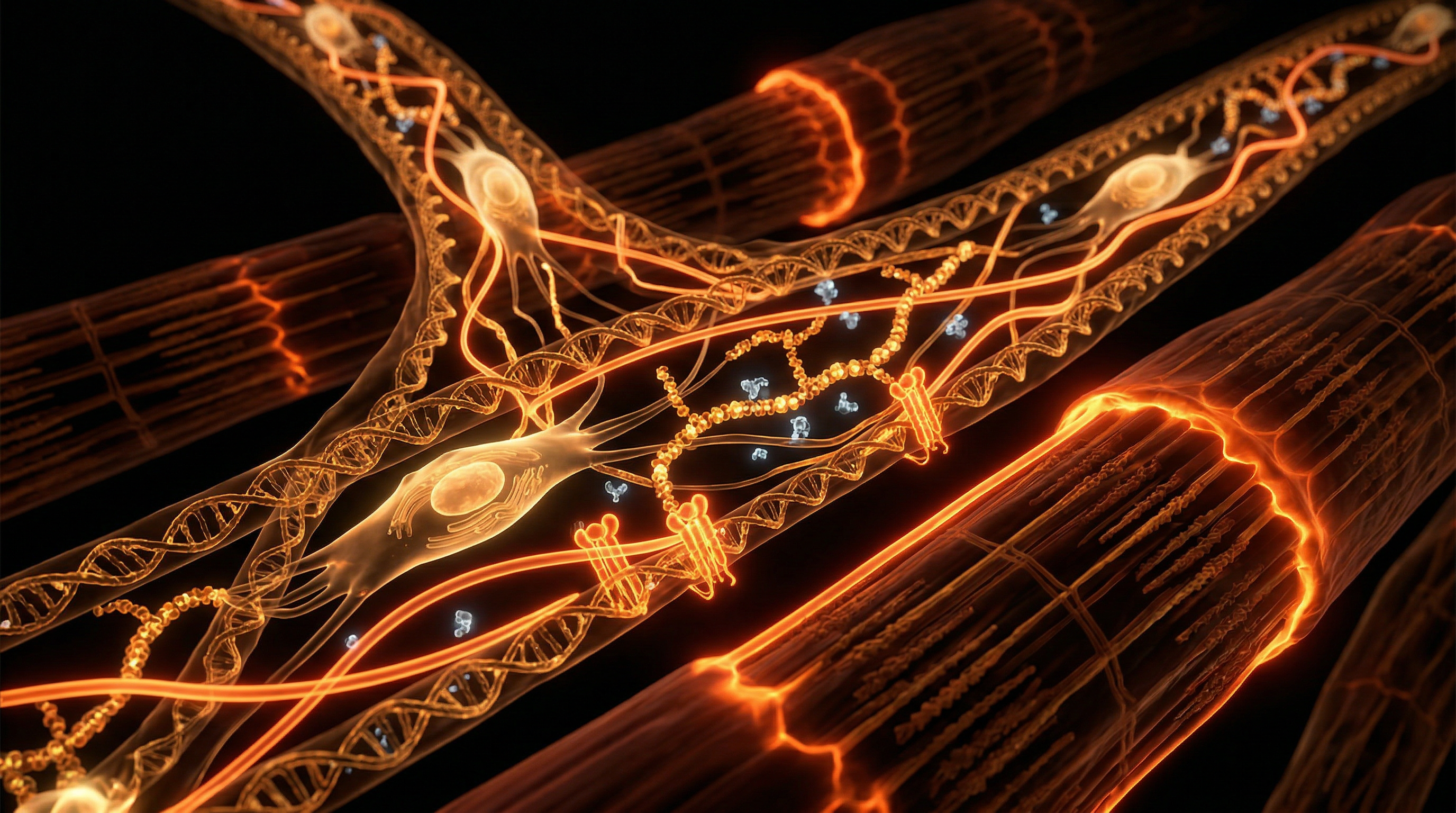
The emergence of the Myofascial Meridian theory—most notably codified by Thomas Myers in his seminal work Anatomy Trains—represents a seismic shift in biological understanding. These meridians are not metaphorical energy lines borrowed from Eastern tradition; they are quantifiable, dissectible, and functional chains of connective tissue that span the entire length of the body. They explain why a restriction in the plantar fascia of the foot can manifest as a debilitating migraine, or why chronic pelvic tilt is often the true culprit behind cervical spine degeneration.
This article exposes the hidden network of the Extracellular Matrix (ECM) and the myofascial lines that govern force transmission. We will explore how the body functions as a tensegrity structure, where tension is distributed globally rather than locally. In an era of rising chronic musculoskeletal (MSK) disorders, understanding the myofascial web is no longer an elective pursuit for the curious; it is a vital necessity for anyone seeking to reclaim biological sovereignty from a system that treats symptoms while ignoring systemic structural collapse.
The Biology — How It Works
To understand myofascial meridians, one must first redefine fascia. It is not merely a "wrapping" for muscles. It is a continuous, three-dimensional web of fibrous, gluey, and wet proteins that permeates every corner of the body. From the macroscopic level of the epimysium to the microscopic level of the endomysium, there is no "end" to fascia; it is a single, uninterrupted organ of stability and communication.
The Theory of Biotensegrity
Traditional biomechanics relies on the "column" model: weight is stacked, and muscles pull on bones to move them. Myofascial meridians operate on the principle of Biotensegrity (biological tension-integrity). In a tensegrity structure, the "bones" are floating compression members, held in place by a continuous sea of "fascial" tension. This explains why the human body does not collapse like a house of cards when one muscle is inhibited. The tension is distributed across the meridians.
The Primary Myofascial Lines
Research into kinetic chains has identified several key meridians that facilitate force transmission:
- The Superficial Back Line (SBL): This line runs from the underside of the toes, up the calves, hamstrings, and sacrotuberous ligament, along the erector spinae, and over the epicranium to the brow ridge.
Fact: Scientific studies using fresh cadaver dissections have proven that tension applied to the hamstrings directly alters the tension in the cervical fascia, validating the SBL's role in global force transmission.
- The Superficial Front Line (SFL): Connecting the tops of the feet to the shins, quads, rectus abdominis, and up to the mastoid process. This line is responsible for the "startle reflex" and governs our ability to stand upright against gravity.
- The Lateral Line (LL): Running up the sides of the legs (IT band), the obliques, and the intercostals. It functions as a stabiliser for the frontal and sagittal planes.
- The Spiral Line (SL): A double-helix that wraps around the body, governing rotation and ensuring that the arches of the feet are linked to the positioning of the pelvis.
The Fluid Dynamics of Movement
Fascia is thixotropic. This means it changes its state based on energy input. When sedentary, the ground substance (the "gel" of the fascia) becomes viscous and thick. When we move, it becomes more fluid (sol state). The myofascial meridians act as a hydraulic system, distributing "interstitial fluid" and ensuring that the "glide and slide" between muscular layers is maintained.
Mechanisms at the Cellular Level
While the macroscopic lines provide the "map," the "engine" of the myofascial system resides at the cellular level. The primary actor here is the fibroblast.
The Fibroblast: The Architect of Form
Fibroblasts are the sentinel cells of the connective tissue. They are remarkably sensitive to mechanical loads. Through a process called mechanotransduction, fibroblasts "feel" the tension in the myofascial meridian. If a specific line is under-utilised, the fibroblasts produce less collagen and more "fuzz," leading to adhesions. If a line is chronically over-tensioned, the fibroblasts thicken the tissue, creating fibrosis.
The Role of Hyaluronan
Between the layers of fascia (such as the deep fascia and the muscle epimysium) sits a thin layer of hyaluronan (hyaluronic acid). In a healthy myofascial meridian, this acts as a high-tech lubricant.
Scientific Callout: Research has shown that when hyaluronan becomes "sticky" due to pH changes or lack of movement, the myofascial meridians "lock," preventing the independent sliding of tissues. This is often the root cause of what we perceive as "muscle knots."
Integrins and the Cytoskeleton
The connection goes deeper than the extracellular level. Integrins are transmembrane proteins that link the ECM directly to the cell's internal skeleton (the cytoskeleton). This means that a tug on the fascia at the ankle literally pulls on the nucleus of a cell in the lower back. This "hard-wired" connection allows for instantaneous communication throughout the meridian, far faster than the nervous system's electrical impulses.
Environmental Threats and Biological Disruptors
The modern environment is a direct assault on the integrity of our myofascial meridians. We are currently living through an evolutionary mismatch where our "biological hardware" (designed for movement and varied terrain) is being crushed by "cultural software" (sedentary, screen-based existence).
The "Digital Hunch" and Postural Collapse
The most pervasive disruptor is the Superficial Front Line (SFL) collapse. Prolonged sitting shortens the SFL—the quads, psoas, and rectus abdominis become "locked short." To compensate, the Superficial Back Line (SBL) must "lock long" to prevent the body from falling forward. This creates a state of chronic eccentric load on the back muscles, leading to the "epidemic" of lower back pain that costs the global economy billions.
Dehydration and the Loss of "Glide"
Fascia is roughly 70% water. However, this is not just "bulk water"; it is structured water (EZ water) held within the collagen matrix. Modern "dead" water, combined with a lack of movement, leads to fascial dehydration. Without water, the collagen fibres in the meridians become brittle and prone to micro-tears.
Chemical Disruptors and Glycation
Dietary toxins, particularly high-fructose corn syrup and processed seed oils, lead to Advanced Glycation End-products (AGEs).
- Glycation is essentially the "caramelisation" of the body’s proteins.
- In the myofascial meridians, sugar molecules cross-link with collagen fibres, making the fascia stiff and unresponsive.
- This "sugar-coated" fascia loses its ability to transmit force efficiently, leading to "clunky" movement and increased injury risk.
Electromagnetic Fields (EMFs)
Emerging research suggests that the piezo-electric nature of collagen makes fascia highly sensitive to external EMFs. Collagen is a semi-conductor; it carries a charge. Constant exposure to non-native EMFs may disrupt the delicate electrical signalling that occurs within the myofascial web, potentially interfering with tissue repair and cellular communication.
The Cascade: From Exposure to Disease
The failure of a myofascial meridian is rarely an isolated event. It follows a predictable cascade that eventually manifests as "disease" in the eyes of mainstream medicine.
Phase 1: The Compensation Pattern
It begins with a "silent" restriction. Perhaps an old ankle sprain was never fully rehabilitated. The fibroblasts in the lower end of the SBL create a dense patch of connective tissue. The body, being a master of survival, compensates. It shifts the load to the Lateral Line.
Phase 2: Distal Dysfunction
Because the myofascial meridians are continuous, the tension travels. The restriction at the ankle pulls on the hamstring, which tilts the pelvis, which in turn causes the erector spinae to work overtime. The patient presents with chronic tension headaches. A traditional doctor looks at the neck; a myofascial specialist looks at the foot.
Phase 3: The Inflammatory Feedback Loop
Where there is no movement, there is stagnation. Stagnant fascia becomes a reservoir for metabolic waste. The lack of "glide" creates friction, which triggers a low-grade inflammatory response. Over time, this systemic inflammation can contribute to:
- Fibromyalgia: Now increasingly viewed as a disorder of fascial densification.
- Chronic Fatigue Syndrome: The energetic cost of fighting one's own "tight suit" of fascia is immense.
- Joint Degeneration: When the "tensional" system fails, the "compression" system (joints/cartilage) takes the hit. This is the true origin of osteoarthritis.
What the Mainstream Narrative Omits
The suppression of fascial science is one of the great oversights of modern medicine. There are several reasons why this critical system has been omitted from the mainstream narrative.
The "Cadaver Bias"
For centuries, anatomy has been taught using "embalmed" cadavers. In a preserved cadaver, the fascia becomes a tough, leathery, and indistinguishable mass. To the traditional anatomist, it was "gristle" to be removed so they could see the "real" anatomy beneath.
Fact: We have been studying "pickled" humans and assuming that’s how living bodies work. It was only with the advent of live-tissue imaging (using endoscopes) that we realised fascia is a shimmering, pulsing, fluid-filled network.
The Pharmaceutical Blind Spot
There is no "pill" for a twisted myofascial meridian. Fascial health requires movement, manual therapy, and lifestyle changes—none of which are particularly profitable for the "Big Pharma" industrial complex. It is far more lucrative to sell anti-inflammatories and painkillers for "back pain" than it is to teach a patient how to re-hydrate their SBL through proprioceptive movement.
The Siloing of Specialties
The medical system is divided into silos: orthopaedics for bones, neurology for nerves, podiatry for feet. Myofascial meridians, by their very nature, "break" these silos. They connect the foot to the head. This "wholistic" reality is threatening to a system built on ultra-specialisation.
The UK Context
In the United Kingdom, the approach to MSK health is particularly antiquated. The NHS, while a cornerstone of British life, is heavily reliant on a "bio-medical" model that prioritises scans (MRIs/X-rays) over functional movement analysis.
The "Scan-First" Trap
In the UK, a patient with chronic back pain is often sent for an MRI. If a "bulging disc" is found, it is blamed for the pain. However, numerous studies have shown that a high percentage of pain-free individuals also have bulging discs. The disc is often the "victim" of a collapsed myofascial meridian (usually the Deep Front Line), yet the "criminal" (the fascial tension) is never investigated because it doesn't show up clearly on standard imaging.
The British Sedentary Crisis
The UK has some of the highest rates of sedentary behaviour in Europe. The "commuter culture" in cities like London and Manchester—where individuals spend hours in "bucket seats" on trains or in cars—is a recipe for myofascial disaster. This "C-shape" posture causes a systemic shortening of the Front Line, leading to what is locally termed "The British Slump."
The Rise of Independent Bodywork in Britain
Because the mainstream system is failing to address these structural issues, there has been a massive surge in the UK for alternative therapies like Rolfing (Structural Integration), McTimoney Chiropractic, and Myofascial Release. British citizens are increasingly looking outside the GP surgery to find practitioners who understand that the site of the pain is rarely the source of the problem.
Protective Measures and Recovery Protocols
Reclaiming the health of your myofascial meridians requires a multi-pronged approach that addresses both the structural and chemical aspects of the tissue.
1. Proprioceptive Movement (Not Just Exercise)
Gym-based weightlifting often reinforces "isolated" muscle thinking. To engage the meridians, one must use whole-body movements.
- Yoga and Pilates: When practiced with an emphasis on "lines" rather than "poses," these are excellent for fascial health.
- Varied Loading: Walking on uneven terrain (beaches, forest trails) forces the Lateral and Spiral lines to fire, preventing the stagnation of "flat-surface" walking.
2. Manual Therapy and "Search and Destroy"
Sometimes, the "fuzz" between fascial layers is too thick for movement alone to break.
- Self-Myofascial Release (SMR): Using foam rollers or lacrosse balls. The key is not "rolling" fast but "melting" into the tissue to trigger the thixotropic shift from gel to sol.
- Structural Integration: Seeking a practitioner who can "map" your meridians and manually release the "locked" segments of the chain.
3. Nutritional Support for Collagen
To build healthy meridians, the body needs the raw materials:
- Vitamin C: Essential for collagen synthesis.
- Silica: Often overlooked, silica is the "glue" that gives fascia its tensile strength.
- Glycine and Proline: Found in abundance in bone broths and collagen peptides.
- Hydration with Electrolytes: Water alone won't hydrate fascia; it needs the minerals (magnesium, potassium, sodium) to pull that water into the extracellular matrix.
4. Re-wilding Your Posture
- Micro-breaks: Every 20 minutes of sitting should be followed by 2 minutes of "opening" the Superficial Front Line (gentle backbends).
- Barefoot Movement: Engaging the "sensory" fascia in the soles of the feet to wake up the entire Superficial Back Line.
Summary: Key Takeaways
The exposure of myofascial meridians reveals that we are not a collection of parts, but a single, integrated "tensegrity" organism. When we ignore this, we fall into the trap of chronic pain and "unexplainable" degeneration.
- The Body is One: A restriction in the foot is a restriction in the neck. The myofascial lines are the physical evidence of this connection.
- Fascia is Alive: It is a sensory organ, a hydraulic system, and a structural web that responds to every movement—or lack thereof.
- Modernity is a Threat: Sedentary lifestyles, sugar-rich diets, and postural collapse are actively "gluing" our meridians together.
- The NHS Model is Incomplete: Traditional UK medicine focuses on the "parts" and ignores the "web." True recovery requires a systemic approach.
- Sovereignty is Structural: By maintaining the fluidity and integrity of our fascia, we ensure not just mobility, but the efficient functioning of our nervous and circulatory systems.
The myofascial system is the "Cinderella of Anatomy"—the ignored, hardworking tissue that makes everything else possible. It is time we brought it to the ball. Understanding your Anatomy Trains is the first step in moving from a state of structural collapse to one of biological resilience.
This article is provided for informational and educational purposes only. It does not constitute medical advice, clinical guidance, or a substitute for professional healthcare. Information reflects cited research at time of publication. Always consult a qualified healthcare professional before acting on any health information.
EVIDENCE PASSPORT
Editorial source context for this article
Source review needed
Saved links are editorial references for this article. They may support specific claims rather than every sentence. Open and assess each source in context. This passport does not independently verify them.
Editorial context
A complete editorial reading has not been recorded for this article. Source links remain available for you to open and assess directly.
Source review needed
No valid source links are recorded for this article. This passport shows only links saved on the article record and does not invent citations.
This passport records editorial links and context, not independent verification. Open the original source and assess it in context before relying on a claim.
Medical Disclaimer
The information in this article is for educational purposes only and does not constitute medical advice, diagnosis, or treatment. Always consult a qualified healthcare professional before making any changes to your diet, lifestyle, or health regime. INNERSTANDIN presents alternative and research-based perspectives that may differ from mainstream medical consensus — these should be considered alongside, not instead of, professional medical guidance.
Read Full DisclaimerContinue the thread
Keep this question moving.
Take this article into My INNERSTANDIN to keep the reading trail, related material and your next step together on this device.
Dig deeper in the Library
Free, longform PDF volumes that go beyond headlines into mechanisms and references.