
Nanopesticides: Impact on UK Soil Microorganisms
Updated May 2026
Reviewing the increased toxicity of nanoscale pesticide delivery systems used in British agriculture. These formulations often persist longer and penetrate deeper into the soil than traditional chemicals.
Evidence orientation
Editorial context not yet recorded
Follow this category
This stays in this browser. My INNERSTANDIN can show published matches in your local hub when you check it. It does not send email, push, or alert notifications.
Local learning review
A private browser aid for revisiting ideas. It is not an alert or a health recommendation.
Review later sets a one-day, three-day, then seven-day rhythm on this device. Choose it only when you want to revisit this article.
Overview
In the verdant landscapes of the United Kingdom, from the rolling hills of the Cotswolds to the intensive arable plains of East Anglia, a silent, invisible revolution is underway. This is the era of the "Green Revolution 2.0," underpinned not by mechanical giants, but by the infinitesimal power of nanotechnology. As a senior biological researcher for INNERSTANDING, I have observed the rapid deployment of nanopesticides across British soil with growing trepidation. While the mainstream agricultural narrative promises "precision," "efficiency," and "reduced chemical footprints," the biological reality beneath our feet tells a far more harrowing story.
Nanopesticides are defined as any pesticide formulation that intentionally employs nanotechnology to enhance the efficacy of active ingredients. These particles, typically ranging from 1 to 100 nanometres in size, possess unique physicochemical properties—increased surface area, enhanced reactivity, and the ability to bypass biological barriers—that distinguish them from their "bulk" or macro-scale counterparts. In the UK, where Brexit has provided a unique, albeit precarious, regulatory window, the push for these "smart" delivery systems is accelerating.
However, the very traits that make nanopesticides effective at eradicating pests—persistence, deep soil penetration, and high bioavailability—are the same traits that threaten the foundational architecture of our terrestrial ecosystems: the soil microbiome. This article serves as an exhaustive investigation into the molecular and ecological consequences of nanopesticide application, exposing the systemic risks that are currently being overlooked by regulatory bodies and industrial proponents.
Fact: A single gram of healthy UK topsoil contains up to one billion bacterial cells and several kilometres of fungal hyphae, all of which are now directly in the firing line of nano-scale synthetic biology.
The Biology — How It Works
To understand the threat, we must first dissect the engineering behind these substances. Traditional pesticides often suffer from rapid degradation due to UV exposure, leaching, or microbial breakdown. Nanotechnology "solves" this by encapsulating active ingredients (such as glyphosate, neonicotinoids, or pyrethroids) or by using metallic nanoparticles (silver, copper, zinc) as the pesticide itself.
Nano-Encapsulation and Polymeric Carriers
The most common form of nanopesticide involves nanocapsules or nanospheres. These are often constructed from synthetic polymers like polycaprolactone (PCL) or natural polymers like chitosan. These shells protect the pesticide, allowing for a "controlled release" over weeks or months.
- Slow Release: By shielding the active ingredient from the environment, nanopesticides ensure that the toxin remains active in the soil for significantly longer periods than traditional sprays.
- Targeted Adhesion: Nanoparticles are often engineered with specific surface charges to "stick" to plant leaves or soil particles, preventing them from being washed away by the frequent British rain.
Metallic and Metal-Oxide Nanoparticles (MeNPs)
Unlike encapsulated organic pesticides, MeNPs like Nano-Silver (nAg), Titanium Dioxide (nTiO2), and Copper Oxide (nCuO) act as the biocidal agent. These are increasingly used in the UK for their potent antifungal and antibacterial properties. Their toxicity is derived from their high surface-area-to-volume ratio, which allows for a massive release of ions into the soil solution.
Nano-Emulsions and Nano-Suspensions
These are lipid-based delivery systems designed to increase the solubility of hydrophobic pesticides. By breaking down chemicals into droplets of 20–200 nm, manufacturers ensure that the pesticide can penetrate deep into the waxy cuticles of plants and the protective membranes of soil-dwelling organisms.
Mechanisms at the Cellular Level
The "precision" of nanopesticides is a marketing myth; at the cellular level, they are indiscriminate agents of chaos. When these particles encounter soil microorganisms—the bacteria, archaea, and fungi that drive nutrient cycling—they trigger a cascade of lethal biochemical events.
Oxidative Stress and Reactive Oxygen Species (ROS)
The primary mechanism of nano-toxicity is the induction of Oxidative Stress. Upon entering a microbial cell, nanoparticles react with cellular components to produce Reactive Oxygen Species (ROS), such as hydroxyl radicals and hydrogen peroxide.
- Protein Denaturation: ROS attack the protein structures within the cell, unfolding enzymes critical for nitrogen fixation and carbon sequestration.
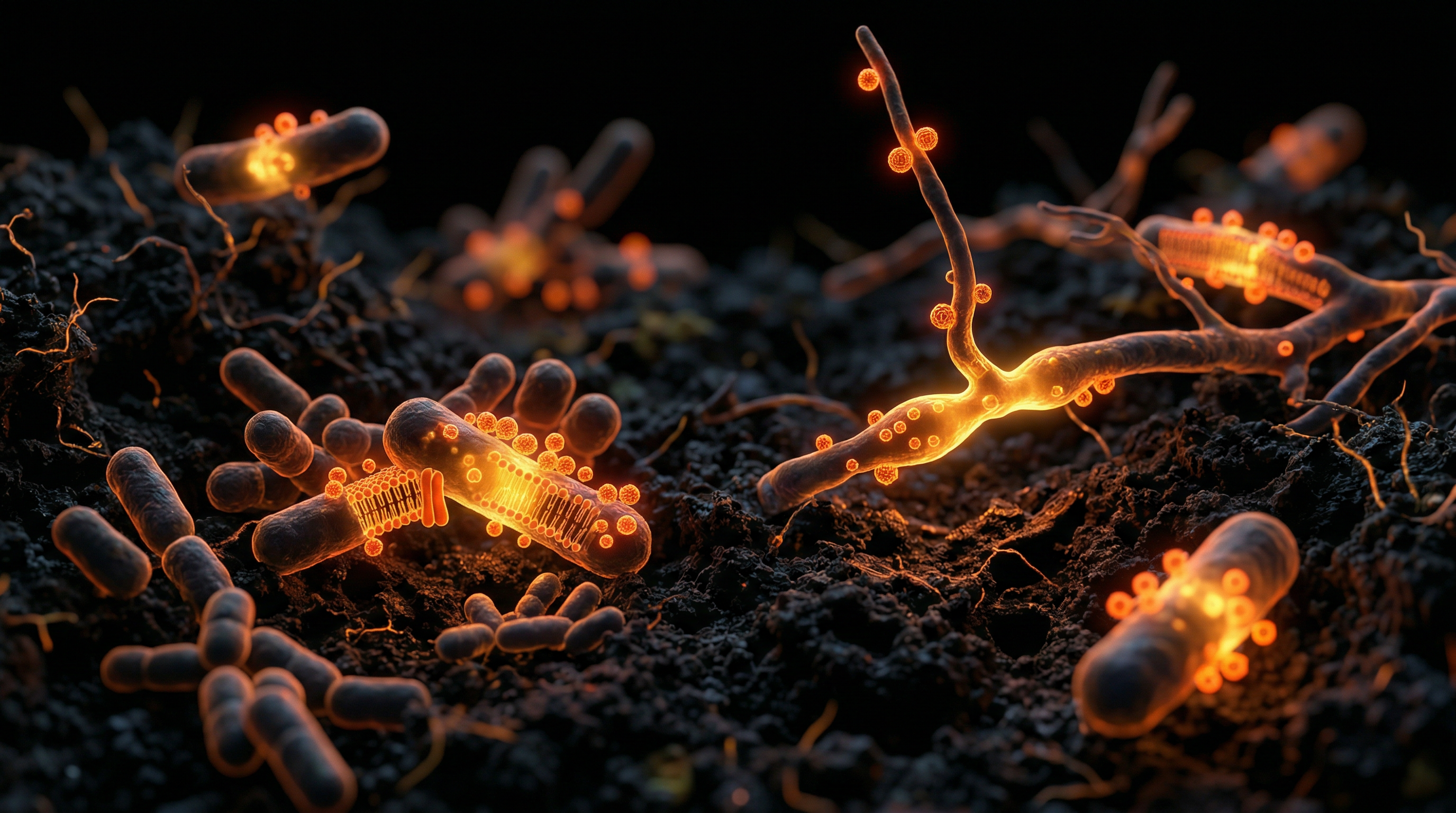
- Lipid Peroxidation: The "nano-shrapnel" attacks the lipid bilayer of cell membranes. This leads to a loss of membrane integrity, effectively "disembowelling" the microbe and causing its internal contents to leak out.
Membrane Disruption and "Trojan Horse" Effects
Nanoparticles are small enough to be mistaken for nutrients or to simply diffuse through the porous cell walls of bacteria. Once inside, they act as a "Trojan Horse," releasing concentrated doses of toxins directly into the cytoplasm. For UK soils, which are often rich in organic matter, these particles can bind to humic acids, creating complexes that are even more readily absorbed by unsuspecting microbes.
Interference with Horizontal Gene Transfer (HGT)
Perhaps the most alarming discovery in recent synthetic biology research is the impact of nanoparticles on Horizontal Gene Transfer. Bacteria share genetic information (such as antibiotic resistance or metabolic capabilities) through HGT. Research suggests that certain metallic nanoparticles can either hyper-stimulate or completely inhibit this process by damaging the pili (the "bridges" between bacteria) or by binding to the extracellular DNA.
Statistic: Studies have shown that exposure to high concentrations of Nano-Copper can reduce the metabolic activity of Pseudomonas fluorescens—a key UK soil bacterium—by up to 60% within 48 hours.
Environmental Threats and Biological Disruptors
The UK's soil health is already in a state of "critical decline," according to the Environment Agency. The introduction of nanopesticides exacerbates this by targeting the very organisms responsible for soil fertility.
The Destruction of Mycorrhizal Networks
In British woodlands and wheat fields alike, Arbuscular Mycorrhizal Fungi (AMF) form symbiotic relationships with plant roots. They exchange phosphorus and water for plant-derived sugars. Nanopesticides, particularly those containing silver or copper, are highly toxic to fungal hyphae.
- Consequence: Without AMF, crops become "addicted" to synthetic fertilisers, as they lose their natural ability to scavenge nutrients. This creates a feedback loop that benefits chemical manufacturers while depleting soil carbon.
Impact on Nitrogen-Fixing Bacteria
The UK relies heavily on legumes and crop rotation to maintain nitrogen levels. Bacteria like Rhizobium reside in root nodules and "fix" atmospheric nitrogen into a form plants can use. Nanopesticides have been shown to:
- Inhibit the signalling molecules (flavonoids) sent by plants to attract these bacteria.
- Reduce the number of nodules formed on roots.
- Decrease the efficiency of the nitrogenase enzyme.
Bioaccumulation in Earthworms (Lumbricus terrestris)
As the "engineers" of British soil, earthworms ingest vast quantities of earth. Nanopesticides do not simply pass through them; they accumulate in their tissues.
- Deeper Penetration: Unlike bulk chemicals that remain in the top few centimetres, nanopesticides move through the soil profile via macropores created by worms, reaching the groundwater and deeper microbial communities that have never before been exposed to synthetic toxins.
The Cascade: From Exposure to Disease
The disruption of soil microorganisms is not merely an "environmental" issue; it is a direct threat to human health through the Soil-Human Microbiome Axis.
Nutrient Density Collapse
When soil microbes are suppressed by nanoparticles, the plant's uptake of essential minerals (zinc, magnesium, selenium) is compromised. Even if the plant appears healthy, it is "hollow" in terms of nutritional value. The UK population, already suffering from "hidden hunger" or micronutrient deficiencies, is consuming food grown in increasingly sterile, nano-poisoned environments.
The Gut Connection
There is a profound biological symmetry between the soil microbiome and the human gut microbiome. Evidence suggests that residual nanopesticides on crops can survive the digestive process and reach the human gut.
- Microbiome Dysbiosis: Just as they kill beneficial soil bacteria, these particles can disrupt the delicate balance of Lactobacillus and Bifidobacterium in the human gut.
- Inflammatory Response: The chronic induction of ROS in the gut lining by nano-residues is a suspected factor in the rise of Crohn’s disease, Ulcerative Colitis, and other autoimmune conditions across Britain.
Emerging Pathogens
By wiping out the "peacekeeper" microbes in the soil, nanopesticides create an ecological void. This void is often filled by opportunistic, pathogenic fungi and bacteria that are resistant to the nanoparticles. We are essentially breeding the next generation of soil-borne plant pathogens and potentially zoonotic diseases.
What the Mainstream Narrative Omits
The UK government and agricultural bodies often cite "equivalence" in their safety assessments—the idea that if the active ingredient is safe at the macro scale, it must be safe at the nano scale. This is a scientific fallacy.
The "Cocktail Effect"
Current regulatory protocols test chemicals in isolation. In the real-world conditions of a British farm, nanopesticides interact with legacy pesticides, heavy metals, and microplastics already present in the soil. The small size of nanoparticles allows them to act as "carriers" for other toxins, pulling them deeper into the biological system. This Synergistic Toxicity is almost entirely ignored in DEFRA (Department for Environment, Food & Rural Affairs) assessments.
Persistence and the "Forever" Problem
Mainstream science suggests that nanoparticles eventually aggregate and become inert. However, recent longitudinal studies indicate that in the presence of natural organic matter (common in UK clay soils), these particles can remain "dispersed" and bioactive for years. We are building a reservoir of nano-toxicity that will persist long after the current farming season ends.
Lack of Monitoring Infrastructure
The UK currently lacks the laboratory infrastructure to monitor nanopesticide concentrations in soil in real-time. Traditional mass spectrometry often fails to distinguish between naturally occurring minerals and engineered nanoparticles.
Callout: We are essentially flying blind, deploying advanced synthetic biology into our food system without the "radar" necessary to track its accumulation or impact.
The UK Context
The United Kingdom presents a unique case study for nanopesticide impact due to its specific soil types, climate, and post-Brexit regulatory landscape.
Soil Variability: From Peat to Clay
The high organic matter content in Scottish and Northern English peatlands makes them particularly susceptible to "nano-immobilisation," where particles are trapped but remain toxic. Conversely, the heavy clay soils of the Midlands can lead to rapid runoff, where nanopesticides enter the river systems—such as the Severn and the Trent—disrupting aquatic microbial communities.
The Brexit Regulatory Divergence
Since leaving the EU, the UK has the power to set its own pesticide standards. While the EU has moved toward a more "Precautionary Principle" regarding nanotechnology, the UK's "Pro-Innovation" stance risks turning the British countryside into a testing ground for agrochemical giants. The Retained EU Law (Revocation and Reform) Act has created a vacuum where specific nano-safety data is often not required for "new formulations" of old chemicals.
Focus on Arable "Breadbaskets"
In regions like Lincolnshire and East Anglia, where intensive wheat and sugar beet farming dominate, the application of nanopesticides is highest. These areas also hold some of the UK's most degraded soils. The continued use of nano-scale delivery systems threatens to push these soils past the "tipping point" where they can no longer support life without massive external chemical inputs.
Protective Measures and Recovery Protocols
As a researcher committed to the restoration of biological integrity, I believe that while the threat is severe, it is not yet irreversible. We must adopt a multi-pronged approach to protect British soil.
1. Microbial Inoculation and Bio-Augmentation
To counter the "sterilising" effect of nanopesticides, farmers must move toward Bio-remediation. This involves introducing specific strains of "extremophile" bacteria and fungi that have been shown to break down polymeric nanocapsules or sequester metallic nanoparticles.
- Biochar Application: Biochar acts as a "nano-sponge," adsorbing nanoparticles and preventing them from reaching the root zone or the wider microbiome.
2. Transition to Regenerative Agriculture
The only long-term solution is to reduce the "chemical load." Regenerative practices—no-till farming, diverse cover cropping, and integrated pest management (IPM)—foster a robust microbiome that can naturally resist pests, rendering nanopesticides unnecessary.
3. Policy Reform: The "Nano-Specific" Mandate
The UK must implement a mandatory "Nano-Safety Data Sheet" for all agricultural products. This should include:
- Pore-water concentration tests.
- Impact studies on non-target soil microbes (AMF and Rhizobia).
- Bioaccumulation assessments in soil invertebrates.
4. Soil Testing for the Modern Era
Farmers should be encouraged to move beyond simple N-P-K (Nitrogen, Phosphorus, Potassium) testing. We need widespread adoption of Metagenomic Soil Testing, which sequences the DNA of the soil to monitor the health and diversity of the microbial population in real-time.
Summary: Key Takeaways
The emergence of nanopesticides represents a profound shift in how we interact with the Earth's biological foundation. While sold as a miracle of modern science, the reality is far more complex and dangerous.
- Unprecedented Toxicity: Nanopesticides bypass natural biological filters, causing oxidative stress and membrane damage to the essential microbes that maintain soil fertility.
- Deep Persistence: Their engineered nature allows them to persist and penetrate deeper into British soils than any previous generation of chemicals.
- The Human Link: Degradation of soil health directly translates to a decline in human nutritional density and gut health, linking agricultural policy to the national health crisis.
- Regulatory Failure: Current UK assessments are inadequate, failing to account for the "Cocktail Effect" or the unique behaviour of particles at the 1-100nm scale.
- Regenerative Hope: Restoration is possible through the adoption of microbial-focused farming practices and rigorous new safety standards.
The British soil is not a sterile substrate; it is a living, breathing organism. If we continue to assault it with nano-scale synthetic biology, we risk a "silent spring" far more permanent than the one Rachel Carson once warned us of. It is time for a radical re-evaluation of our relationship with the microscopic world. We must choose: do we want a countryside of sterile, high-tech "production units," or a thriving, biodiverse landscape that can sustain generations to come?
"Innerstanding is the first step toward restoration."
This article is provided for informational and educational purposes only. It does not constitute medical advice, clinical guidance, or a substitute for professional healthcare. Information reflects cited research at time of publication. Always consult a qualified healthcare professional before acting on any health information.
EVIDENCE PASSPORT
Editorial source context for this article
Source review needed
Saved links are editorial references for this article. They may support specific claims rather than every sentence. Open and assess each source in context. This passport does not independently verify them.
Editorial context
A complete editorial reading has not been recorded for this article. Source links remain available for you to open and assess directly.
Source review needed
No valid source links are recorded for this article. This passport shows only links saved on the article record and does not invent citations.
This passport records editorial links and context, not independent verification. Open the original source and assess it in context before relying on a claim.
Medical Disclaimer
The information in this article is for educational purposes only and does not constitute medical advice, diagnosis, or treatment. Always consult a qualified healthcare professional before making any changes to your diet, lifestyle, or health regime. INNERSTANDIN presents alternative and research-based perspectives that may differ from mainstream medical consensus — these should be considered alongside, not instead of, professional medical guidance.
Read Full DisclaimerContinue the thread
Keep this question moving.
Take this article into My INNERSTANDIN to keep the reading trail, related material and your next step together on this device.
Dig deeper in the Library
Free, longform PDF volumes that go beyond headlines into mechanisms and references.