
Parenting Strategies for Neurodivergent Kids
Updated May 2026
Evidence-based techniques for managing behavior and fostering confidence in neurodivergent children.
Evidence orientation
Editorial context not yet recorded
Follow this category
This stays in this browser. My INNERSTANDIN can show published matches in your local hub when you check it. It does not send email, push, or alert notifications.
Local learning review
A private browser aid for revisiting ideas. It is not an alert or a health recommendation.
Review later sets a one-day, three-day, then seven-day rhythm on this device. Choose it only when you want to revisit this article.
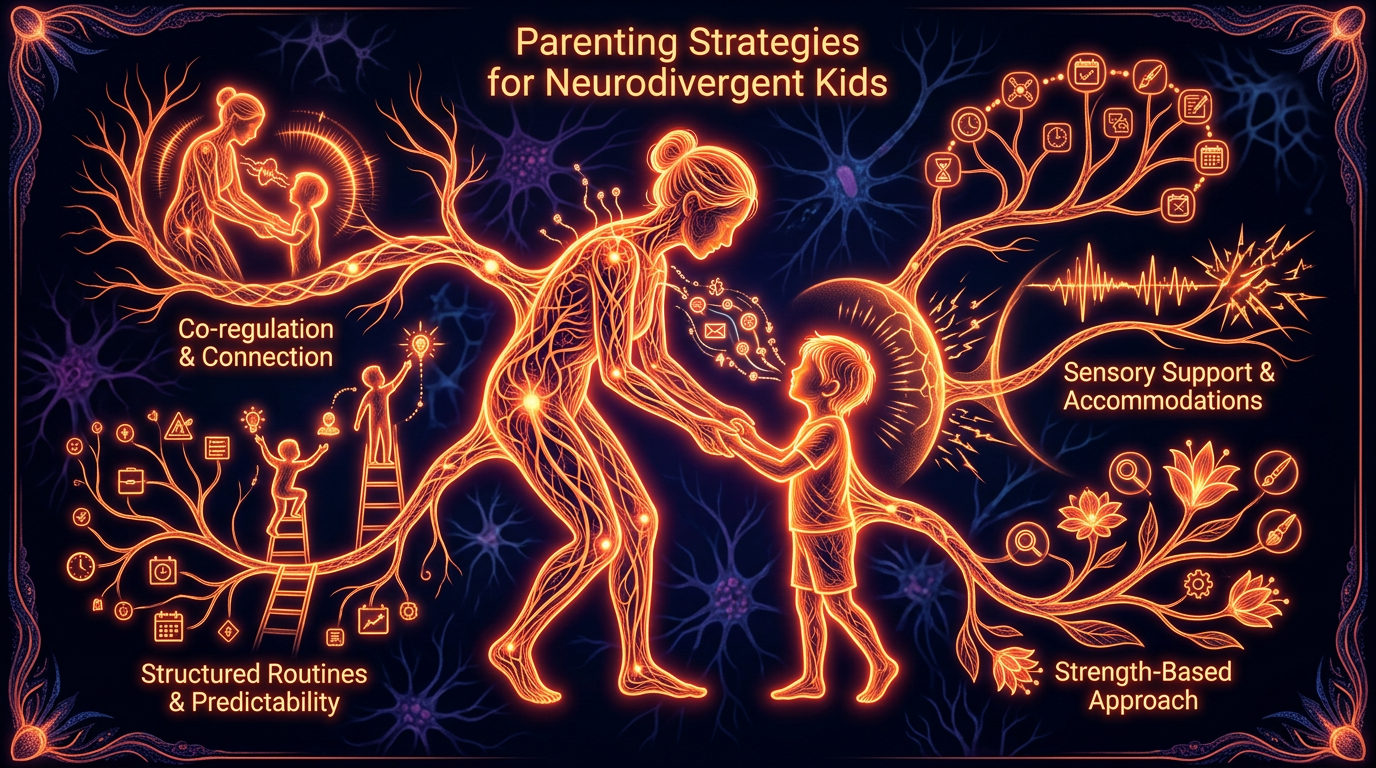
In the contemporary landscape of UK parenting, the term ‘neurodiversity’ has transitioned from a niche sociological concept to a vital framework for understanding how children think, learn, and interact with the world. For parents of children with Attention Deficit Hyperactivity Disorder (ADHD), Autism Spectrum Condition (ASC), Dyspraxia (DCD), and other neurodevelopmental profiles, the journey often begins with a sense of confusion or ‘otherness’.
However, moving from a deficit-based model—which asks "What is wrong with my child?"—to a neuro-affirming model—which asks "How does my child’s brain work?"—is the single most transformative step a parent can take. This article provides an authoritative guide to navigating the complexities of raising neurodivergent children within the UK context, offering strategies rooted in clinical insight, educational advocacy, and compassionate care.
Part 1: Navigating the UK Diagnostic and Support Landscape
The Path to Understanding
In the UK, the journey usually begins via the NHS or, increasingly, through 'Right to Choose' pathways. Whether your child has a formal diagnosis or is currently on a waiting list (which, as many parents know, can be extensive), the strategy remains the same: support the child, not the label.
In the UK system, the General Practitioner (GP) is the gatekeeper, referring families to Child and Adolescent Mental Health Services (CAMHS) or community paediatricians. Understanding that a diagnosis is a "passport to support" rather than a "definition of identity" is crucial. It opens doors to Education, Health and Care Plans (EHCPs) and Pupil Premium funding, but the parenting strategies must begin long before the paperwork is finalised.
The Power of Advocacy
British parents must become "informed advocates." This means understanding the SEND (Special Educational Needs and Disability) Code of Practice. Your strategy at home is inextricably linked to your strategy at school. An authoritative parent in this context is one who knows their child's legal rights under the Equality Act 2010, ensuring that "reasonable adjustments" are made to prevent the child from being disadvantaged.
Part 2: The Neuro-Affirming Mindset
Moving Beyond Compliance
Traditional parenting often relies on a "command and control" structure: I tell you to do something, and you do it to avoid punishment or gain a reward. For a neurodivergent brain—particularly one with ADHD or Pathological Demand Avoidance (PDA) traits—this model frequently fails.
The neuro-affirming strategy shifts from compliance to collaboration. Neurodivergent children often have a high sense of social justice and a need for autonomy. When we demand blind compliance, we often trigger the "fight, flight, or freeze" response. Instead, authoritative parenting involves explaining the "why," offering choices, and treating the child as a partner in problem-solving.
The "Ferrari Engine, Bicycle Brakes" Analogy
Dr Edward Hallowell’s famous description of ADHD—a Ferrari engine of a brain with bicycle brakes—is a vital mental model for UK parents. Strategy shouldn't be about slowing down the engine (the creativity, the hyper-focus, the energy); it should be about strengthening the brakes (executive function, emotional regulation) and teaching the driver how to navigate the track.
Part 3: Executive Functioning and Environmental Engineering
Executive functions are the "management system" of the brain. They include working memory, cognitive flexibility, and impulse control. For children with neurodevelopmental conditions, these skills are often delayed by three to five years.
1. Externalising Information
A neurodivergent child’s working memory is often like a sieve. An authoritative strategy is to stop nag-parenting and start environmental engineering.
- Visual Timetables: Do not rely on verbal instructions. Use "Now, Next, Later" boards.
- Body Doubling: This is a key ADHD strategy. Simply sitting in the room while your child tidies their Lego or does homework can provide the "anchoring" their brain needs to stay on task.
- Point-of-Performance Cues: If they forget to brush their teeth, don’t shout from the kitchen. Put a visual prompt on the bathroom mirror.
2. Time Blindness
Children with ADHD often live in two times: "Now" and "Not Now." This makes the transition to school or bedtime incredibly stressful.
- Strategy: Use visual timers (like Time Timers) that show the passage of time red-disappearing discs. This makes an abstract concept concrete.
- The "Five-Minute Buffer": In the UK, our schedules are often rigid. Build in "buffer time" for the inevitable "lost shoe" or sensory meltdown.
3. Scaffolding Independence
Authoritative parenting isn't about doing things for the child, but scaffolding the task. If a child cannot tidy their room, the strategy isn't to do it for them, nor is it to punish them. It is to break it down: "First, let’s just find all the blue things." This reduces the cognitive load that leads to paralysis.
Part 4: Sensory Processing and Regulation
Many neurodivergent children experience the world with the "volume turned up." Sensory Processing Disorder (SPD) often co-occurs with ADHD and Autism.
The Sensory Audit
To support your child, conduct a sensory audit of your UK home.
- Auditory: Is the hum of the fridge or the ticking of a clock causing "sensory overload"? Consider noise-cancelling headphones for homework time.
- Tactile: UK school uniforms are a notorious hurdle. Scratchy wool jumpers and stiff shirt collars can be physically painful for a child with tactile defensiveness. Opt for "sensory-friendly" ranges (now available at major UK retailers like Marks & Spencer) that feature soft seams and no tags.
- Visual: Cluttered environments lead to cluttered minds. Use closed storage to reduce visual "noise."
Emotional Regulation: The "Window of Tolerance"
Neurodivergent children often fluctuate between hyper-arousal (meltdowns, aggression) and hypo-arousal (shutting down, withdrawal).
- Co-regulation before Self-regulation: A child cannot calm themselves down if their nervous system is in a state of high alert. An authoritative parent remains the "calm in the storm." You cannot fire-fight fire. Your calm presence helps "reset" their nervous system.
- The "Incredible 5-Point Scale": Use a 1–5 scale to help your child identify their internal state before they reach a 5 (the meltdown). Strategy: What does a "Level 2" feel like? Maybe a tight chest? What can we do then? (e.g., a heavy blanket or "wall pushes").
Part 5: Communication and the "Double Empathy Problem"
Historically, neurodivergent children were thought to lack empathy. Modern research, particularly the "Double Empathy Problem" theory by Dr Damian Milton, suggests that communication breakdowns occur because neurotypical and neurodivergent people speak different "social languages."
Direct Communication
Neurodivergent children often struggle with sarcasm, idioms, or vague instructions.
- Instead of: "Could you please think about starting your homework?" (which is a suggestion).
- Try: "It is 4:00 PM. Please open your maths book at the kitchen table." (which is a clear instruction).
Validating the Experience
If your child says, "The lights in this supermarket are screaming," don't respond with "Don't be silly, lights don't make noise." To their brain, they do. Validating their reality builds trust and reduces the shame that often leads to low self-esteem in ADHD and Autistic children.
Part 6: Navigating the UK Education System (SEND)
The UK school system can be a challenge for neurodivergent thinkers. The National Curriculum is often rigid, and the sensory environment of a busy primary school is taxing.
Working with the SENCO
The Special Educational Needs Co-ordinator (SENCO) is your primary ally.
- Strategy: Schedule regular "check-ins," not just when there is a crisis. Ensure the Individual Education Plan (IEP) or Learning Plan is being followed.
- Reasonable Adjustments: Examples include "movement breaks," "fiddle toys," "extra time in exams," or "a quiet space at lunchtime."
The EHCP Process
If your child's needs exceed what a mainstream school can provide from its basic budget, you may need an Education, Health and Care Plan (EHCP).
- Authoritative Tip: Document everything. Keep a "paper trail" of every incident, every sensory trigger, and every struggle with homework. In the UK system, data is your strongest tool in securing funding and specialist support.
Part 7: Managing the "Spiky Profile"
Neurodivergent children often have a "spiky profile"—they may be exceptionally gifted in some areas (e.g., verbal reasoning, artistic design, computer coding) while struggling significantly with basic tasks (e.g., tying shoelaces, remembering a three-step instruction).
Focus on Strengths
A common pitfall is to spend 90% of our energy trying to "fix" the weaknesses. This leads to a child who feels like a "broken version of a normal person."
- Strategy: Use the "80/20 Rule." Spend 80% of your energy fostering their "Super-Interests." If your child is obsessed with Minecraft, use Minecraft to teach maths or storytelling. Success in a "Super-Interest" builds the resilience needed to tackle the difficult 20%.
Rejection Sensitive Dysphoria (RSD)
Common in ADHD, RSD is an extreme emotional pain experienced in response to perceived rejection or criticism.
- Strategy: Use "Praise Coupons" or "Positive Reinforcement." Research suggests children with ADHD receive significantly more negative feedback than their peers. Aim for a ratio of 5 positive comments for every 1 corrective comment to maintain their self-worth.
Part 8: The Parent’s Wellbeing: Putting on Your Own Oxygen Mask
Parenting a neurodivergent child in the UK can be isolating. You may face judgement from other parents at the school gate or feel "gaslit" by professionals who suggest your child’s behaviour is a result of "poor discipline."
1. Rejecting Parent Guilt
Neurodivergence is genetic and neurological. It is not caused by "too much screen time" or "too much sugar." Once you accept that your child’s brain is wired differently, you can let go of the guilt that you are doing something wrong.
2. Finding Your Tribe
Connect with UK-based organisations like ADHD UK, the National Autistic Society, or local Parent Carer Forums. Speaking to people who "get it" is the best antidote to the burnout that often affects SEND parents.
3. Radical Self-Care
This isn't about bubble baths; it’s about "energy management." If you are dysregulated, you cannot help your child regulate. Recognise your own sensory triggers. If your child’s "stimming" or loud play is triggering your own sensory overload, it is okay to step away for five minutes to breathe.
Part 9: Puberty, Transitions, and the Future
In the UK context, the transition from Primary (Year 6) to Secondary school (Year 7) is often a "cliff edge" for neurodivergent children. The increase in executive function demands—moving between classrooms, managing a timetable, keeping track of equipment—can lead to "Year 7 Burnout."
Preparing for Change
- Strategy: Start the transition early. Visit the new school multiple times. Take photos of the corridors, the lockers, and the canteen. Meet the new SENCO in the summer term of Year 6.
- Life Skills: As your child enters their teens, shift the focus toward "functional independence." It is more important that they know how to manage their medication or use a calendar than it is for them to get an 'A' in a subject they find torturous.
Part 10: Conclusion – The Authoritative Vision
The goal of parenting a neurodivergent child is not to make them "indistinguishable from their peers." That path leads to masking, anxiety, and depression. Instead, the goal is to raise a child who understands their own brain, knows how to ask for help, and is proud of their unique perspective.
By adopting a neuro-affirming mindset, engineering the environment for success, and navigating the UK’s educational and health systems with informed persistence, you are not just "managing" a condition. You are raising a child who can contribute their "out-of-the-box" thinking to a world that desperately needs it.
The journey is rarely linear. There will be days of "meltdown" and days of "magic." But through it all, your role as the authoritative, affirming parent is to be the bridge between their brilliant, complex brain and a world that is still learning how to accommodate them.
Summary of Key Parenting Strategies:
- Prioritise Connection over Correction: Your relationship is the most powerful tool you have.
- Externalise Executive Function: Use visuals, timers, and "body doubling" to support their brain’s "management system."
- Adapt the Environment: Conduct a sensory audit and make your home a "safe harbour."
- Collaborative Problem Solving: Work with your child to find solutions to recurring challenges.
- Be an Informed Advocate: Master the UK SEND system to ensure your child’s rights are respected.
In the end, neurodivergence is not a tragedy to be cured, but a diversity to be championed. With the right strategies, your child will not just survive their neurodivergence; they will thrive because of it.
Useful UK Resources for Parents:
- IPSEA (Independent Provider of Special Education Advice): For legal advice on EHCPs and school support.
- The National Autistic Society (NAS): Comprehensive guides on autism-specific parenting.
- ADHD Foundation: Resources for supporting executive function and ADHD-specific neurobiology.
- Contact (For families with disabled children): Support for the practicalities of raising a child with additional needs.
- YoungMinds: For support with the mental health challenges that often co-occur with neurodivergence.
This article is provided for informational and educational purposes only. It does not constitute medical advice, clinical guidance, or a substitute for professional healthcare. Information reflects cited research at time of publication. Always consult a qualified healthcare professional before acting on any health information.
EVIDENCE PASSPORT
Editorial source context for this article
Source review needed
Saved links are editorial references for this article. They may support specific claims rather than every sentence. Open and assess each source in context. This passport does not independently verify them.
Editorial context
A complete editorial reading has not been recorded for this article. Source links remain available for you to open and assess directly.
Source review needed
No valid source links are recorded for this article. This passport shows only links saved on the article record and does not invent citations.
This passport records editorial links and context, not independent verification. Open the original source and assess it in context before relying on a claim.
Medical Disclaimer
The information in this article is for educational purposes only and does not constitute medical advice, diagnosis, or treatment. Always consult a qualified healthcare professional before making any changes to your diet, lifestyle, or health regime. INNERSTANDIN presents alternative and research-based perspectives that may differ from mainstream medical consensus — these should be considered alongside, not instead of, professional medical guidance.
Read Full DisclaimerContinue the thread
Keep this question moving.
Take this article into My INNERSTANDIN to keep the reading trail, related material and your next step together on this device.
Explore this in the Body Map
See where this hits your biology. Interactive anatomy, threats, and protective protocols.
Dig deeper in the Library
Free, longform PDF volumes that go beyond headlines into mechanisms and references.