
Peptide YY: Mastering the Satiety Mechanism for Weight Control
Updated May 2026
Peptide YY is released in the gut to signal fullness to the brain. Understanding this mechanism is key to reversing the UK's obesity epidemic through biological appetite regulation.
Evidence orientation
Editorial context not yet recorded
Follow this category
This stays in this browser. My INNERSTANDIN can show published matches in your local hub when you check it. It does not send email, push, or alert notifications.
Local learning review
A private browser aid for revisiting ideas. It is not an alert or a health recommendation.
Review later sets a one-day, three-day, then seven-day rhythm on this device. Choose it only when you want to revisit this article.
Overview
In the grand architecture of human survival, the sensation of hunger has long been identified as a primary driver of evolutionary success. However, in the modern epoch, particularly within the United Kingdom’s increasingly pathogenic food environment, the crisis is no longer one of scarcity, but of satiety dysregulation. At the heart of this metabolic breakdown lies a 36-amino acid peptide known as Peptide YY (PYY).
Produced primarily by the L-cells of the gastrointestinal tract, PYY serves as the biological "off switch" for eating. It is the sentinel of the gut-brain axis, communicating directly with the hypothalamus to signal that the body has received sufficient energy. Yet, despite its critical importance, PYY is rarely discussed in primary care settings or public health campaigns. Instead, the narrative remains fixated on the reductionist "Calories In, Calories Out" (CICO) model—a framework that ignores the complex endocrine signalling required to manage human appetite in a world designed to overstimulate it.
For the INNERSTANDING reader, it is essential to recognise that the obesity epidemic is not a failure of willpower; it is a failure of biological signalling. PYY is being silenced by environmental factors, industrial food processing, and chronic metabolic stress. To master PYY is to reclaim sovereignty over one’s own physiology. This article provides a deep dive into the molecular machinery of PYY, the forces conspiring to suppress it, and the protocols required to restore this essential satiety mechanism.
Fact: Research indicates that individuals with obesity often exhibit significantly lower circulating levels of PYY compared to lean counterparts, even when consuming the same caloric load. This suggests a systemic "PYY resistance" or a failure in post-prandial release.
The Biology — How It Works
Peptide YY belongs to the PP-fold family of peptides, which also includes Neuropeptide Y (NPY) and Pancreatic Polypeptide (PP). Discovered in the early 1980s by Tatemoto and colleagues, it was named for its tyrosine residues at both the N-terminal and C-terminal ends (Y being the biochemical abbreviation for tyrosine).
The Dual Forms: PYY 1-36 and PYY 3-36
PYY is released into the bloodstream in two primary forms. The initial form secreted by the L-cells is PYY 1-36. However, it is rapidly cleaved by the enzyme dipeptidyl peptidase-IV (DPP-IV)—the same enzyme targeted by certain diabetes medications—to create the more potent PYY 3-36.
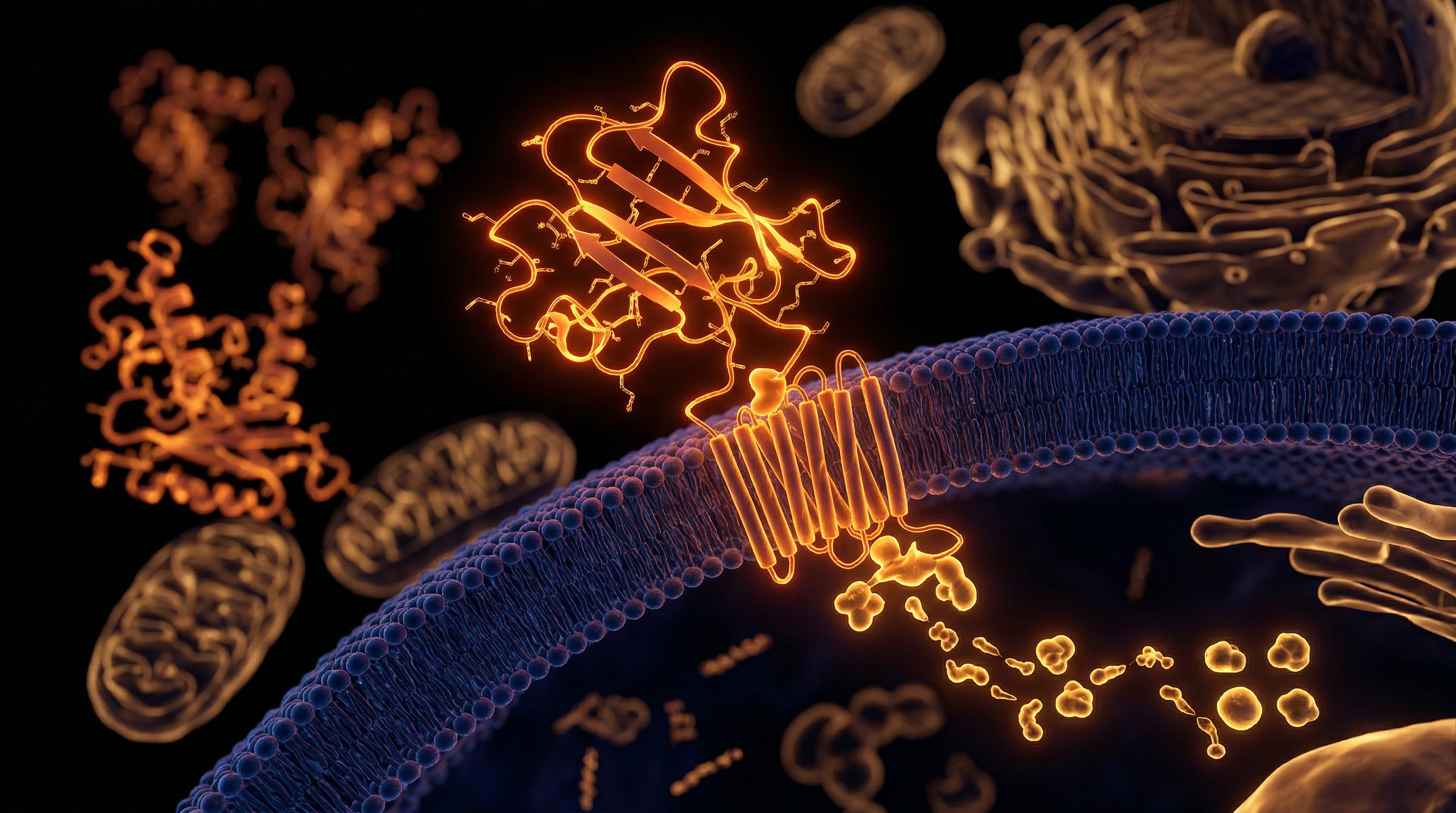
While PYY 1-36 can bind to several receptors, it is PYY 3-36 that is the true master of satiety. It has a high affinity for the Y2 receptor (Y2R), a GPCR (G-protein coupled receptor) located in the Arcuate Nucleus (ARC) of the hypothalamus.
The Gut-Brain Communication Axis
The journey of PYY from the gut to the brain is a dual-route system:
- Endocrine Route: PYY travels through the systemic circulation, crosses the blood-brain barrier at the median eminence, and binds to receptors in the hypothalamus.
- Neural Route: PYY binds to Y2 receptors on the Vagus Nerve, which sends immediate electrical signals to the Nucleus Tractus Solitarius (NTS) in the brainstem, bypassing the slower circulatory route.
The Ileal Brake
The release of PYY is often described as part of the "Ileal Brake" mechanism. When undigested nutrients, particularly lipids and proteins, reach the distal parts of the small intestine (the ileum) and the colon, PYY is released to slow down gastric emptying. This ensures that the body has enough time to absorb nutrients and, crucially, sends a sustained signal to the brain that "the tank is full." Without an efficient PYY response, the brake fails, leading to rapid eating and overconsumption before the brain can register a caloric surplus.
Mechanisms at the Cellular Level
To understand how PYY is mastered, we must look at the Enteroendocrine L-cell. These cells are not merely passive linings; they are sophisticated sensors equipped with a battery of receptors designed to "taste" the chemical composition of your meal.
Nutrient Sensing via GPCRs
The L-cell identifies nutrients through specific receptors:
- GPR120 and GPR40: These receptors sense long-chain fatty acids. When you consume healthy fats, these receptors trigger the calcium signalling necessary to exocytose PYY into the blood.
- GPR41 and GPR43 (FFA3 and FFA2): These are the Short-Chain Fatty Acid (SCFA) receptors. They do not respond to food directly, but to the byproducts of bacterial fermentation (like acetate, propionate, and butyrate). This links the gut microbiome directly to satiety.
- Peptide Transporters (PepT1): These sense the breakdown products of protein. Protein is the most potent stimulator of PYY release, explaining the high satiety value of amino-acid-dense diets.
The Intracellular Cascade
Once a nutrient binds to its respective receptor on the L-cell, it triggers an increase in intracellular Calcium (Ca2+) and Cyclic AMP (cAMP). This causes the storage vesicles containing PYY to fuse with the cell membrane and release their contents into the capillary bed.
The Hypothalamic Battleground
In the brain’s Arcuate Nucleus, two populations of neurons compete for control:
- NPY/AgRP Neurons: These are orexigenic (hunger-promoting). They tell you to eat.
- POMC/CART Neurons: These are anorexigenic (satiety-promoting). They tell you to stop.
PYY 3-36 acts as a molecular "double agent." It binds to the Y2 inhibitory autoreceptors on the NPY/AgRP neurons. By inhibiting the "hunger neurons," it effectively removes the inhibition on the "satiety neurons" (POMC). This is a masterstroke of biological engineering: PYY simultaneously turns off hunger and allows satiety to flourish.
Key Term: Anorexigenic – A substance or biological signal that suppresses appetite. PYY is one of the most powerful endogenous anorexigenic hormones in the human body.
Environmental Threats and Biological Disruptors
The modern landscape is hostile to PYY. While our genetics have remained largely unchanged for 50,000 years, our chemical environment has undergone a radical shift. This disconnect is creating a state of "Satiety Blindness."
Ultra-Processed Foods (UPFs) and the "Bliss Point"
The food industry employs "craveability" engineers to design foods that bypass the PYY response. By manipulating the ratio of sugar, salt, and fat, they create a "Bliss Point" that overstimulates the dopamine reward system while providing little to no signals to the L-cells. Because UPFs are often pre-digested or lack cellular structure (fiber), they are absorbed in the upper duodenum, never reaching the ileum where the PYY "brake" is located.
Emulsifiers and the Mucus Barrier
Common industrial additives like Polysorbate 80 and Carboxymethylcellulose (found in "low-fat" yoghurts, ice creams, and plant milks) have been shown to erode the protective mucus layer of the gut. When this barrier is compromised, the L-cells become desensitised or "hidden" from the nutrients they are supposed to sense. This leads to a blunted post-prandial PYY spike.
The Role of Glyphosate and Herbicides
The pervasive use of glyphosate in industrial agriculture (particularly on wheat and soy) disrupts the gut microbiome. Since PYY release is partially dependent on SCFA production by beneficial bacteria, the "decimation" of these microbial colonies by pesticide residues directly impairs our ability to feel full.
Artificial Sweeteners: The Metabolic Deception
Non-caloric sweeteners like Aspartame and Sucralose present a unique threat. They activate the sweet taste receptors on L-cells, potentially causing a premature or "false" release of PYY and GLP-1. Over time, this "crying wolf" effect can lead to receptor downregulation, where the body stops responding to the signals because they are no longer correlated with actual energy intake.
The Cascade: From Exposure to Disease
When the PYY mechanism is disrupted, it sets off a catastrophic hormonal cascade that extends far beyond simple weight gain. This is the progression from environmental exposure to chronic disease.
Phase 1: Hyperphagia and Reward Dysfunction
In the absence of a robust PYY signal, the brain remains in a state of perceived starvation. This leads to Hyperphagia (excessive eating). Because the physiological "off switch" is broken, the individual relies on the hedonic (pleasure) system to decide when to stop eating. This shifts the drive for food from "homeostatic" to "hedonic," making the individual a slave to food cravings.
Phase 2: Insulin Resistance and Hyperinsulinaemia
As overconsumption continues, the liver and adipose tissues become saturated. The resulting surge in insulin further complicates the satiety landscape. High levels of insulin can interfere with the brain's ability to sense PYY and Leptin, creating a state of Leptin Resistance. At this point, the individual is biologically incapable of feeling satisfied, regardless of how much body fat they carry.
Phase 3: The Pro-Inflammatory State
Low PYY levels are often associated with increased levels of Zonulin, a protein that modulates gut permeability. A "leaky gut" allows lipopolysaccharides (LPS)—bacterial toxins—to enter the bloodstream. This triggers Metabolic Endotoxaemia, a state of low-grade systemic inflammation that further damages the hypothalamus, particularly the POMC neurons responsible for satiety.
Phase 4: Full Metabolic Syndrome
The final stage of this cascade is the manifestation of Type 2 Diabetes, Non-Alcoholic Fatty Liver Disease (NAFLD), and cardiovascular pathology. By the time a patient in the UK is diagnosed with these conditions, their PYY-signalling system has usually been dysfunctional for decades.
What the Mainstream Narrative Omits
The "Standard Medical Model" regarding weight management is significantly flawed, often by design. There are several suppressed or ignored truths concerning PYY and satiety.
The GLP-1 Obsession
Currently, the pharmaceutical industry is reaping billions from GLP-1 agonists like Semaglutide (Wegovy). While these drugs are effective, they focus almost exclusively on one peptide. PYY is GLP-1’s "partner in satiety." Both are co-secreted by the L-cell. The mainstream narrative omits the fact that you can naturally upregulate PYY without the side effects (such as gastroparesis or muscle loss) associated with synthetic injections. Why fund research into "food as medicine" when you can sell a lifetime subscription to a weekly injection?
The Protein Leverage Hypothesis
Mainstream dietary guidelines (like the NHS Eatwell Guide) often emphasize carbohydrates while keeping protein recommendations relatively low. However, the Protein Leverage Hypothesis suggests that humans will continue to eat until they meet a specific protein threshold. Because protein is the most potent stimulator of PYY, a low-protein/high-carb diet is a recipe for PYY suppression and perpetual hunger. The failure to emphasize protein density is perhaps the greatest omission in public health history.
The Sleep-Satiety Connection
Public health messaging rarely connects the bedroom to the kitchen. Sleep deprivation significantly suppresses PYY levels and elevates Ghrelin (the hunger hormone). A single night of poor sleep can reduce post-prandial PYY by up to 20%, yet this is almost never addressed as a primary pillar of weight control.
Fact: A study published in the Journal of Clinical Endocrinology & Metabolism showed that even moderate sleep restriction (5.5 hours) significantly blunts the PYY response to a high-fat meal, leading to an increased caloric intake the following day.
The UK Context
The United Kingdom is currently facing an unprecedented obesity crisis, with nearly 28% of adults classified as obese and another 36% as overweight. The "British environment" is uniquely engineered to destroy PYY signalling.
The "Meal Deal" Culture
Unique to the UK is the ubiquitous "Meal Deal"—a highly processed sandwich, a bag of crisps, and a sugary drink. This combination is a "PYY killer." It provides high-intensity calories with zero fiber and minimal high-quality protein, ensuring that the consumer is hungry again within two hours. This is not just a convenience; it is a metabolic trap that has become a staple of the British working-class diet.
The Socioeconomic Divide in Satiety
In the UK, the cost of protein-rich, whole foods has skyrocketed, while the cost of UPFs has remained relatively stable. This has created a socioeconomic "Satiety Gap." Those in lower income brackets are forced to rely on foods that provide the least PYY stimulation, leading to higher rates of obesity despite potentially lower total spending on food.
The NHS Failure
The NHS approach to obesity remains largely "behavioural" (counselling and calorie counting) or "surgical" (bariatric surgery). Bariatric surgery—specifically Gastric Bypass—actually works primarily by massively increasing PYY and GLP-1 levels because food hits the ileum faster. It is high time we asked: Can we achieve these hormonal results through targeted nutrition and lifestyle interventions instead of invasive surgery?
Protective Measures and Recovery Protocols
Mastering PYY requires a multi-pronged approach to "re-sensitise" the gut and "re-programme" the brain. The following protocols are designed to restore the endogenous satiety mechanism.
1. The Protein Threshold
To trigger a robust PYY response, one must prioritise bio-available protein.
- Protocol: Aim for a minimum of 30 grams of protein per meal. Focus on ruminant meats, eggs, and wild-caught fish. These contain the specific amino acids (like Leucine and Phenylalanine) that are most effective at stimulating L-cell secretion.
- Why: High protein intake increases the "thermically induced" satiety and ensures the PYY "brake" is firmly applied.
2. Resistance Starch and Microbial Fermentation
Since SCFAs trigger PYY through GPR41/43, we must feed the "PYY-producing" bacteria.
- Protocol: Include resistant starch (cooked and cooled potatoes/white rice) and fermented foods (unpasteurised sauerkraut, kefir).
- Why: These foods bypass the small intestine and ferment in the colon, providing a "second wave" of PYY release hours after the meal is finished.
3. The "First Bite" Rule
The order in which you eat your food matters for the hormonal response.
- Protocol: Always consume your protein and fiber before any carbohydrates.
- Why: This ensures that the L-cells are activated by the "satiety-inducing" nutrients first, slowing the absorption of glucose and preventing the insulin spike that can blunt PYY sensitivity.
4. Elimination of Endocrine Disruptors
Restore the integrity of the gut lining to allow L-cells to "see" the food.
- Protocol: Eliminate all industrial seed oils (omega-6 rich oils like rapeseed and sunflower) and emulsifiers (polysorbates, carrageenan).
- Why: These substances cause gut inflammation and erode the mucus layer, effectively "blinding" your satiety sensors.
5. Strategic Intermittent Fasting
Constant grazing prevents the PYY system from resetting.
- Protocol: Implement a 16:8 or 14:10 fasting window.
- Why: Fasting increases the sensitivity of the Y2 receptors in the brain. It also allows the Migrating Motor Complex (MMC) to clear the gut, ensuring that L-cells are ready to respond to the next nutrient load.
6. Cold Exposure and Vagal Tone
Since the Vagus nerve is a major pathway for PYY signalling, increasing "Vagal Tone" is essential.
- Protocol: Cold showers or face immersion in ice water.
- Why: Cold exposure stimulates the parasympathetic nervous system, enhancing the gut-brain communication link.
Summary: Key Takeaways
The mastery of Peptide YY represents a shift from "fighting" hunger to "eliminating" it through biological alignment. If you do not control your PYY, the food industry will control you.
- PYY is the "Off Switch": It is a 36-amino acid peptide that signals the brain to stop eating by inhibiting NPY "hunger" neurons.
- The L-Cell is the Sensor: Your gut "tastes" the meal; if it tastes ultra-processed sludge, it won't release enough PYY.
- Protein is King: No other nutrient stimulates PYY release as effectively as high-quality animal protein.
- Environment matters: The UK’s food environment is designed to bypass PYY. Avoiding "Meal Deal" culture and industrial additives is a prerequisite for metabolic health.
- Mastering the Brake: By using the "Ileal Brake" (sending undigested nutrients to the distal gut), you can achieve natural, effortless weight control without the need for pharmacological intervention.
The obesity epidemic in the UK is a symphony of silent signals. By understanding and amplifying the PYY signal, we can break the cycle of overconsumption and reclaim our biological heritage of health and vitality. The truth is not found in a calorie counter, but in the sophisticated dialogue between your gut and your brain. Listen to the peptide. Master the mechanism. Stop the hunger.
This article is provided for informational and educational purposes only. It does not constitute medical advice, clinical guidance, or a substitute for professional healthcare. Information reflects cited research at time of publication. Always consult a qualified healthcare professional before acting on any health information.
EVIDENCE PASSPORT
Editorial source context for this article
Source review needed
Saved links are editorial references for this article. They may support specific claims rather than every sentence. Open and assess each source in context. This passport does not independently verify them.
Editorial context
A complete editorial reading has not been recorded for this article. Source links remain available for you to open and assess directly.
Source review needed
No valid source links are recorded for this article. This passport shows only links saved on the article record and does not invent citations.
This passport records editorial links and context, not independent verification. Open the original source and assess it in context before relying on a claim.
Medical Disclaimer
The information in this article is for educational purposes only and does not constitute medical advice, diagnosis, or treatment. Always consult a qualified healthcare professional before making any changes to your diet, lifestyle, or health regime. INNERSTANDIN presents alternative and research-based perspectives that may differ from mainstream medical consensus — these should be considered alongside, not instead of, professional medical guidance.
Read Full DisclaimerContinue the thread
Keep this question moving.
Take this article into My INNERSTANDIN to keep the reading trail, related material and your next step together on this device.
Dig deeper in the Library
Free, longform PDF volumes that go beyond headlines into mechanisms and references.