
Phytotherapy for the Gut-Brain Axis: A New Frontier in Mental Health
Updated May 2026
Investigating how targeted herbal interventions for microbiome health can significantly impact neurological function, mood, and cognitive clarity.
Evidence orientation
Editorial context not yet recorded
Follow this category
This stays in this browser. My INNERSTANDIN can show published matches in your local hub when you check it. It does not send email, push, or alert notifications.
Local learning review
A private browser aid for revisiting ideas. It is not an alert or a health recommendation.
Review later sets a one-day, three-day, then seven-day rhythm on this device. Choose it only when you want to revisit this article.
The Silent Architect: Rediscovering the Second Brain
For decades, the Western psychiatric paradigm has operated under a reductionist fallacy: the notion that mental health disorders are exclusively ‘chemical imbalances’ contained within the boney vault of the cranium. This neurological isolationism has led to a reliance on mono-target pharmaceutical interventions—SSRIs and benzodiazepines—that frequently fail to address the systemic etiology of the pathology.
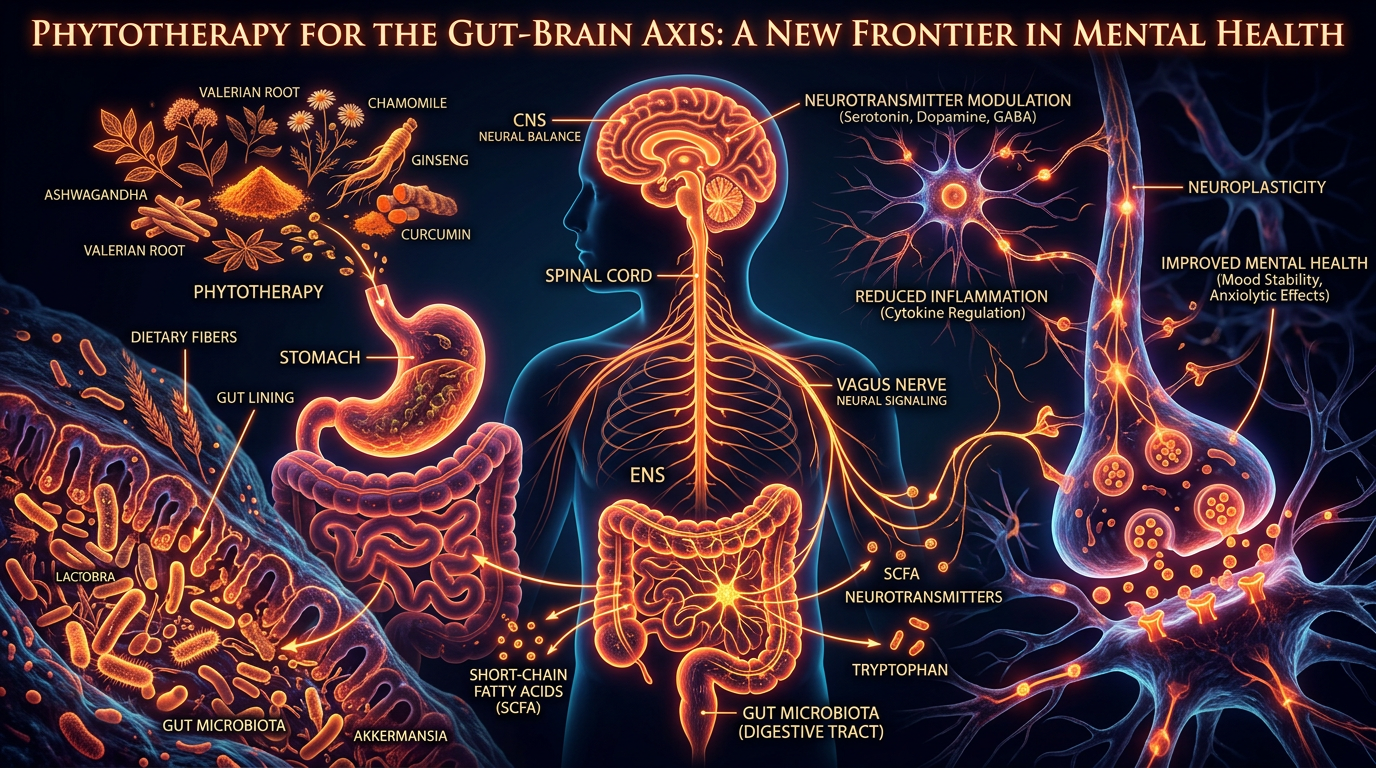
However, emerging research into the Microbiome-Gut-Brain Axis (MGBA) is dismantling this dogma. We now understand that the gastrointestinal tract, often termed the ‘enteric nervous system’ or the ‘second brain’, possesses more neurons than the spinal cord and produces approximately 95% of the body's serotonin. The communication is bidirectional; the gut does not merely follow orders from the brain—it dictates the neurochemical climate of the mind.
Phytotherapy, the use of standardised plant extracts to achieve therapeutic effects, offers a sophisticated, multi-target approach to this axis. Unlike synthetic drugs, botanical compounds possess 'polypharmacology'—the ability to modulate multiple biological pathways simultaneously, repairing the gut lining while soothing the nervous system.
According to the Mental Health Foundation, one in six people in England report experiencing a common mental health problem (such as anxiety and depression) in any given week. Concurrently, NHS prescriptions for antidepressants have risen to over 85 million items annually, highlighting a systemic failure to address root causes.
Biological Mechanisms: The Trinity of Communication
To understand how phytotherapy heals the mind, we must first map the three primary pathways of the Gut-Brain Axis.
1. The Vagus Nerve: The Bio-Electrical Superhighway
The Vagus nerve is the longest cranial nerve, acting as the primary physical conduit between the gut and the brain. It transmits signals regarding inflammatory status and nutrient availability. Phytotherapeutic agents that increase ‘vagal tone’—the efficiency of the Vagus nerve—can switch the body from a sympathetic (fight-or-flight) state to a parasympathetic (rest-and-digest) state.
2. The Neuroendocrine Pathway and SCFAs
The gut microbiota ferments dietary fibres into Short-Chain Fatty Acids (SCFAs) like butyrate, acetate, and propionate. These SCFAs cross the blood-brain barrier, acting as epigenetic modulators that reduce neuroinflammation. Botanical fibres (prebiotics) are the essential fuel for this process.
3. The Cytokine Storm: Systemic Inflammation
The ‘Leaky Gut’ phenomenon—medically known as increased intestinal permeability—allows lipopolysaccharides (LPS) from bacteria to enter the bloodstream. This triggers a systemic inflammatory response. Pro-inflammatory cytokines can then breach the blood-brain barrier, leading to 'Leaky Brain,' manifested as brain fog, depression, and cognitive decline.
Environmental Disruptors: The Modern Assault on the Axis
The current epidemic of mental ill-health is not a biological accident; it is the inevitable consequence of an environment hostile to the human microbiome.
- Glyphosate and Agricultural Chemicals: The UK’s widespread use of glyphosate-based herbicides disrupts the ‘Shikimate pathway’ in gut bacteria. While humans do not have this pathway, our microbiome does. Its disruption leads to a depletion of essential amino acids like tryptophan—the precursor to serotonin.
- Ultra-Processed Emulsifiers: Common additives in British supermarkets, such as carboxymethylcellulose and polysorbate 80, have been shown to erode the protective mucus layer of the gut, inviting systemic inflammation.
- The Antibiotic Legacy: The over-prescription of broad-spectrum antibiotics in the UK has decimated microbial diversity. A single course can alter the gut landscape for months, if not years, directly correlating with increased risks of anxiety and depression.
- Chronic Psycho-Social Stress: High-cortisol environments inhibit gastric acid production and alter gut motility, creating a feedback loop where stress kills the ‘good’ bacteria, and the lack of bacteria increases stress.
Phytotherapeutic Solutions: The Herbal Arsenal
Phytotherapy does not seek to suppress symptoms but to restore the equilibrium of the MGBA. We categorise these botanicals into three functional groups: Psychobiotics, Adaptogens, and Mucilages.
Psychobiotics: Bacteria-Modulating Botanicals
Traditional medicine has long utilised 'bitters' to stimulate digestion. Modern science reveals these herbs, such as *Gentian (Gentiana lutea) and Artichoke (Cynara scolymus)*, modify the microbial environment.
- *Turmeric (Curcuma longa): Curcumin is a potent anti-inflammatory that reduces intestinal permeability. Crucially, it acts as a prebiotic, increasing the populations of Bifidobacterium and Lactobacillus*, which are associated with lower anxiety scores.
Adaptogens: Calibrating the HPA Axis
Adaptogens are a unique class of herbs that increase the body’s non-specific resistance to stress.
- *Ashwagandha (Withania somnifera):* Extensive clinical trials demonstrate its ability to lower serum cortisol. By stabilising the Hypothalamic-Pituitary-Adrenal (HPA) axis, it prevents the stress-induced 'leaking' of the gut barrier.
- *Holy Basil (Ocimum sanctum):* Known as Tulsi, it possesses neuroprotective properties and helps the brain adapt to oxidative stress caused by gut-derived toxins.
Nervines and Trophorestoratives: Healing the Tissues
- *Lemon Balm (Melissa officinalis):* A British garden staple, Lemon Balm inhibits the enzyme GABA-transaminase, increasing the availability of GABA—the brain’s primary inhibitory (calming) neurotransmitter—produced in the gut.
- *Marshmallow Root (Althaea officinalis):* Rich in mucilage, this herb provides a physical protective coating to the gut wall, allowing the delicate epithelial lining to heal and preventing the translocation of inflammatory markers to the brain.
Recent data from the British Society of Gastroenterology suggests that up to 20% of the UK population suffers from Irritable Bowel Syndrome (IBS), a condition now widely recognised as a disorder of the gut-brain interaction, with high comorbidity with clinical anxiety.
The Recovery Protocol: Restoring the Axis
To transition from mental distress to cognitive sovereignty, a structured phytotherapeutic approach is required. This is not a "one pill" solution, but a biological recalibration.
Phase I: Seal and Soothe (Weeks 1–4)
The priority is to address intestinal permeability to stop the influx of neurotoxins.
- Protocol: High-dose mucilaginous herbs (Slippery Elm or Marshmallow Root) combined with Zinc Carnosine.
- Objective: Restore the mucosal barrier and reduce 'Leaky Brain' symptoms.
Phase II: Modulate and Eradicate (Weeks 5–8)
Once the barrier is stabilised, we must address dysbiosis (overgrowth of 'bad' bacteria).
- Protocol: Introduction of mild antimicrobial botanicals like Oregano oil or Berberine, followed by prebiotic-rich herbs like Inulin (from Chicory root) to feed beneficial strains.
- Objective: Re-establish a diverse microbial landscape capable of producing neuroactive metabolites.
Phase III: Tonify and Stabilise (Week 9 onwards)
The final stage focuses on long-term nervous system resilience.
- Protocol: Daily use of adaptogens (Ashwagandha or Rhodiola) and nervines (Skullcap or Lemon Balm).
- Objective: High vagal tone and a robust HPA axis that can withstand environmental stressors without triggering gut dysfunction.
The Truth Exposed: Beyond the Pharmaceutical Monopoly
The current mental health crisis in the United Kingdom is, in many ways, a crisis of the internal environment. The pharmaceutical industry profits from the "chronic patient" model—providing synthetic molecules that manage symptoms while the underlying gut-brain degradation continues unabated.
Phytotherapy represents a threat to this model because it empowers the individual. By understanding that a depressed mood may be the result of a damaged microbiome or a glyphosate-laden diet, the "patient" becomes an informed "steward" of their own biology.
The evidence is undeniable: the gut and brain are a singular, integrated system. To treat one without the other is not science; it is negligence. True mental health recovery lies in the soil, the gut, and the sophisticated botanical compounds that have evolved alongside us for millennia.
Conclusion: A New Paradigm of Innerstanding
The frontier of mental health is not a new synthetic drug; it is the ancient wisdom of phytotherapy viewed through the lens of modern molecular biology. By addressing the gut-brain axis, we move beyond the suppression of the human experience and toward the restoration of human potential.
We must stop asking "what is wrong with the brain?" and start asking "what is happening in the ecosystem of the body?" In the answer to that question, facilitated by the power of plant medicine, lies the future of psychiatry.
- Key Takeaway: Mental health is systemic, not local.
- Actionable Step: Support the gut barrier to protect the mind.
- The Ultimate Goal: Cognitive sovereignty through biological harmony.
This article is provided for informational and educational purposes only. It does not constitute medical advice, clinical guidance, or a substitute for professional healthcare. Information reflects cited research at time of publication. Always consult a qualified healthcare professional before acting on any health information.
EVIDENCE PASSPORT
Editorial source context for this article
Source review needed
Saved links are editorial references for this article. They may support specific claims rather than every sentence. Open and assess each source in context. This passport does not independently verify them.
Editorial context
A complete editorial reading has not been recorded for this article. Source links remain available for you to open and assess directly.
Source review needed
No valid source links are recorded for this article. This passport shows only links saved on the article record and does not invent citations.
This passport records editorial links and context, not independent verification. Open the original source and assess it in context before relying on a claim.
Medical Disclaimer
The information in this article is for educational purposes only and does not constitute medical advice, diagnosis, or treatment. Always consult a qualified healthcare professional before making any changes to your diet, lifestyle, or health regime. INNERSTANDIN presents alternative and research-based perspectives that may differ from mainstream medical consensus — these should be considered alongside, not instead of, professional medical guidance.
Read Full DisclaimerContinue the thread
Keep this question moving.
Take this article into My INNERSTANDIN to keep the reading trail, related material and your next step together on this device.
Explore this in the Body Map
See where this hits your biology. Interactive anatomy, threats, and protective protocols.
Dig deeper in the Library
Free, longform PDF volumes that go beyond headlines into mechanisms and references.