
Red Light Therapy (670nm): Recharging Photoreceptor Mitochondria for Aging Eyes
Updated May 2026
Exploring how deep red light exposure can improve declining color vision and retinal sensitivity in older adults. This photobiomodulation technique stimulates ATP production within the metabolically demanding retina.
Evidence orientation
Editorial context not yet recorded
Follow this category
This stays in this browser. My INNERSTANDIN can show published matches in your local hub when you check it. It does not send email, push, or alert notifications.
Local learning review
A private browser aid for revisiting ideas. It is not an alert or a health recommendation.
Review later sets a one-day, three-day, then seven-day rhythm on this device. Choose it only when you want to revisit this article.
Overview
In the modern landscape of clinical ophthalmology, we are witnessing a silent epidemic of visual decline that far exceeds the natural benchmarks of chronological ageing. While the mainstream medical establishment continues to frame age-related macular degeneration (AMD) and declining retinal sensitivity as "inevitable" consequences of getting older, a burgeoning field of bio-energetic research is revealing a different truth. The human eye, specifically the retina, is not merely a passive lens; it is the most metabolically demanding tissue in the entire body. Its failure is not an accident of time, but a crisis of energy.
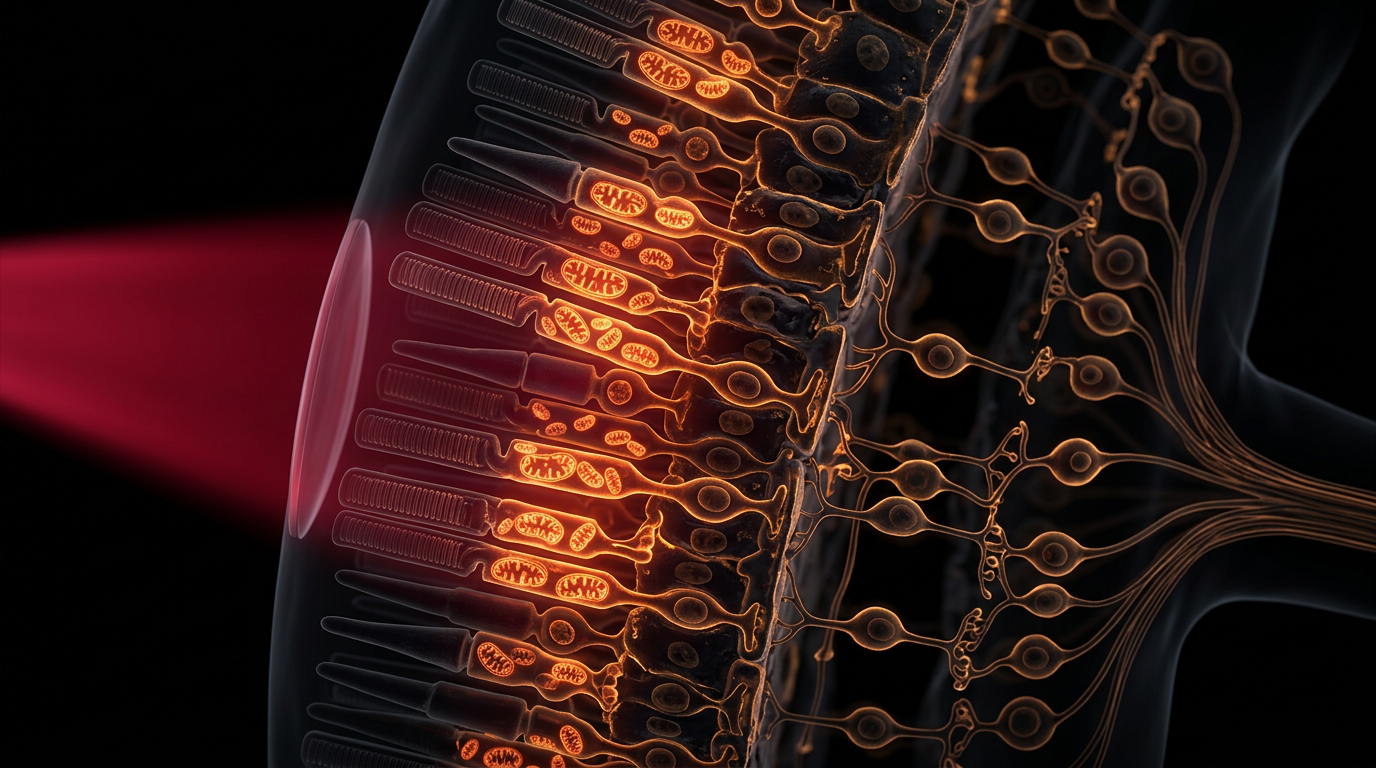
At the heart of this crisis lies the mitochondrion—the cellular powerhouse. As we cross the threshold of 40, our mitochondrial efficiency begins to plummet. In the retina, this translates to a precipitous drop in Adenosine Triphosphate (ATP) production, leading to a loss of photoreceptor function and a gradual "dimming" of our visual world.
However, emerging research—pioneered largely in the United Kingdom—has identified a specific biological "hack" to reverse this decline. By utilising narrow-band deep red light at a wavelength of 670 nanometres (nm), we can directly stimulate the mitochondrial respiratory chain, effectively "recharging" the cells of the retina. This technique, known as Photobiomodulation (PBM), offers a non-invasive, drug-free pathway to restoring colour vision and contrast sensitivity in the ageing population. This article explores the profound biological mechanisms behind 670nm therapy and exposes why this low-cost, high-impact intervention remains on the periphery of conventional eye care.
Fact: The retina has a higher metabolic rate and oxygen consumption than even the heart or the brain, making it uniquely sensitive to mitochondrial dysfunction.
The Biology — How It Works
To understand why 670nm light is so transformative, one must first appreciate the staggering energy requirements of the human visual system. The retina is an extension of the central nervous system, populated by millions of specialised neurons known as photoreceptors (rods and cones). These cells are tasked with the Herculean labour of converting photons of light into electrical signals—a process called phototransduction.
The Retinal Energy Crisis
Phototransduction is an energy-intensive process. It requires a constant flux of ions across cell membranes, a mechanism driven by ATP-dependent pumps. Consequently, photoreceptors are packed with mitochondria. In fact, the density of mitochondria in retinal cells is among the highest in the known biological world.
As we age, these mitochondrial engines begin to "rust." This is primarily due to the accumulation of Reactive Oxygen Species (ROS)—byproducts of energy production that damage mitochondrial DNA and the delicate membranes of the cell. By age 70, the average person has lost approximately 30% of their central photoreceptors, and the remaining cells are operating at a fraction of their youthful capacity. This manifests as "night blindness," a loss of vibrant colour perception (specifically in the blue/yellow axis), and increased difficulty reading in low light.
The 670nm "Sweet Spot"
Why 670nm? Light exists on a spectrum, but not all wavelengths are created equal in the eyes of biology. Shorter wavelengths (blue light) are high-energy and potentially damaging, while longer wavelengths (infrared) provide heat. The deep red spectrum, specifically around 670nm, sits in a "biological window" where it can penetrate deep into the ocular tissue without causing thermal damage or ionising stress.
Research from University College London (UCL) has demonstrated that 670nm light is optimally absorbed by a specific enzyme within the mitochondria. When these photons hit the retina, they trigger a cascade of bio-chemical events that essentially "prime" the cell for energy production, clearing the metaphorical soot from the mitochondrial engine.
Fact: Retinal ATP (energy) levels can drop by up to 70% over a lifetime, but brief exposure to 670nm light has been shown to increase ATP production by over 20% in the aged retina.
Mechanisms at the Cellular Level
The efficacy of Red Light Therapy is not a placebo effect; it is rooted in the fundamental laws of quantum biology and bio-energetics. There are three primary mechanisms through which 670nm light recharges the ageing eye: the activation of Cytochrome c Oxidase, the reduction of oxidative stress, and the modulation of water viscosity.
1. The Cytochrome c Oxidase (CCO) Catalyst
The most critical mechanism involves Cytochrome c Oxidase (CCO), the terminal enzyme in the mitochondrial electron transport chain (the "assembly line" that creates ATP). CCO contains copper and iron atoms that act as chromophores—light-absorbing molecules.
In an ageing or stressed cell, Nitric Oxide (NO) often binds to CCO, displacing oxygen and effectively "clogging" the assembly line. This stops ATP production and increases the output of harmful free radicals. When 670nm light photons hit the CCO enzyme, they cause the photodissociation of Nitric Oxide. This allows oxygen to re-bind to the enzyme, restarting the flow of electrons and dramatically increasing the synthesis of ATP.
2. Mitigating Oxidative Stress and Inflammation
The ageing retina is often in a state of chronic, low-grade inflammation, known as "inflammaging." This is exacerbated by the failure of the Retinal Pigment Epithelium (RPE)—a layer of cells that provides nutrients to photoreceptors and clears away metabolic waste. When RPE cells fail, toxic "drusen" deposits build up, leading to AMD.
670nm light has been shown to reduce the expression of pro-inflammatory cytokines and lower the levels of ROS. By improving mitochondrial efficiency, the cell produces fewer "waste" byproducts, and the RPE is better equipped to perform its "housekeeping" duties, protecting the macula from degeneration.
3. The 4th Phase of Water (Exclusion Zone Water)
A more vanguard theory in photobiomodulation involves the interaction of red light with cellular water. Mitochondria are surrounded by water. Research, notably by Dr Gerald Pollack, suggests that red and near-infrared light increases the thickness of the "Exclusion Zone" (EZ) water layer around biological membranes.
This EZ water is less viscous (thinner) than bulk water. In the confined space of the mitochondrial turbine (the ATP synthase), thinner water allows the molecular "motor" to spin with less resistance. By reducing the viscosity of the water surrounding the mitochondrial machinery, 670nm light allows the cell to produce more energy with less effort.
Fact: Cytochrome c Oxidase is the primary "photo-acceptor" in the human body, specifically designed by evolution to capture and utilise energy from the red/near-infrared spectrum of sunlight.
Environmental Threats and Biological Disruptors
The reason 670nm therapy is becoming a biological necessity is that our modern environment is "light deficient." For most of human history, our eyes were bathed in the full spectrum of natural sunlight, which contains massive amounts of red and near-infrared light—especially at dawn and dusk.
The Blue Light Siege
Today, we live in a world dominated by Correlated Colour Temperature (CCT) lighting—LEDs and fluorescent bulbs. These light sources are "blue-heavy." Blue light (400–480nm) is high-energy; it is useful for setting our circadian rhythm during the day, but it is also metabolically taxing.
Chronic exposure to "naked" blue light (light without the protective balance of red/infrared) creates a state of oxidative stress in the retina. Unlike the incandescent bulbs of the past, which were essentially heaters that gave off light as a byproduct (rich in infrared), modern LEDs provide zero restorative red light. We are effectively starving our retinal mitochondria of the restorative frequencies they evolved to require.
The Shielding of the Modern World
Furthermore, we have built a world that actively blocks the beneficial red spectrum. Modern window glass is often coated with "Low-E" films designed to reflect infrared heat to improve energy efficiency. While this is good for the environment, it is disastrous for the eye. We spend 90% of our time indoors, behind glass that strips away the very wavelengths (670nm–850nm) that would naturally repair the damage caused by our screens and overhead lights.
Nutritional Deficiencies
The impact of light is compounded by nutritional gaps. The retina requires high concentrations of carotenoids (lutein, zeaxanthin, and astaxanthin) to act as internal filters and antioxidants. In the UK, the average diet is woefully deficient in these compounds. Without the proper nutritional "shield" and without the restorative "charge" of red light, the retinal mitochondria are left undefended against the onslaught of modern environmental stressors.
The Cascade: From Exposure to Disease
What happens when these mitochondrial engines fail? The progression from cellular "tiredness" to clinical blindness is a predictable, albeit tragic, cascade.
Phase 1: Loss of Sensitivity (Tritanopia)
The first sign of retinal energy depletion is usually a loss of colour sensitivity. Cones (the colour-sensing cells) are more energy-hungry than rods. Specifically, the "S-cones" (sensitive to blue/short-wavelength light) are often the first to fail. This results in a condition where the individual finds it harder to distinguish between shades of blue and green, or yellow and violet. The world begins to look "washed out."
Phase 2: Contrast and Night Vision Decline
As ATP levels continue to drop, the "dark adaptation" process of the rods becomes sluggish. This is why many older adults find driving at night increasingly stressful. The retina simply cannot recycle its photopigments fast enough because the energy-dependent pumps are failing.
Phase 3: The Path to Macular Degeneration (AMD)
The final stage of this energy crisis is the death of the cells. When the RPE can no longer process the metabolic "sludge" of the eye, it begins to atrophy (Dry AMD) or trigger the growth of "leaky" new blood vessels (Wet AMD) in a desperate attempt to bring more oxygen to the starved tissue. At this point, mainstream medicine usually intervenes with expensive, invasive intraocular injections. However, these treatments address the symptom (the leaky vessels) rather than the cause (the mitochondrial energy crisis).
Fact: Research from the University College London (UCL) found that just three minutes of exposure to 670nm light once a week could improve colour vision by up to 20% in those over 40.
What the Mainstream Narrative Omits
In the UK and across the Western world, the "medical-industrial complex" has a vested interest in pharmaceutical and surgical interventions. Red Light Therapy (PBM) represents a fundamental threat to the status quo for several reasons.
1. The Cost-Effectiveness Problem
A high-quality 670nm device is a one-time purchase that can last for years. Compare this to the cost of anti-VEGF injections for Wet AMD, which can cost the NHS thousands of pounds per patient, per year. There is little profit in a "light bulb" that allows the body to heal itself.
2. The "Simple" Fallacy
Mainstream science often dismisses PBM because the mechanism seems "too simple." The idea that shining a red light into the eye for a few minutes can have the same impact as complex drugs is often met with skepticism by those trained in a "molecule-first" paradigm of medicine. Yet, at a quantum level, we are light-beings; our biology is governed by the interaction of photons and electrons.
3. The Lack of Large-Scale Pharmaceutical Funding
Clinical trials are expensive. Most are funded by pharmaceutical companies who seek a patentable product. You cannot patent a wavelength of light. Consequently, while independent university studies (like those at UCL) show incredible promise, they lack the massive marketing budgets required to change the "standard of care" in GP surgeries and high-street opticians.
4. The Sunlight Censorship
There is a pervasive narrative that "all light is bad" and that we must wear sunglasses at all times. While UV protection is important, this narrative ignores the restorative role of the red spectrum. By wearing sunglasses that block the entire spectrum, we are preventing the restorative red and near-infrared light from reaching the retina, potentially accelerating the very degeneration we seek to avoid.
The UK Context
The United Kingdom is uniquely positioned at the forefront of this research, yet also uniquely vulnerable to the conditions that make 670nm therapy necessary.
The UCL Breakthrough
The most significant study into 670nm light and retinal health was conducted by Professor Glen Jeffery and his team at the Institute of Ophthalmology, University College London (UCL). Their 2020 study, published in The Journals of Gerontology, was a landmark moment. It proved that brief exposure to 670nm light significantly improved colour contrast sensitivity in older adults. Their subsequent 2021 study refined the protocol, showing that morning exposure was significantly more effective than afternoon exposure, due to the circadian rhythms of mitochondrial activity.
The "Grey Britain" Factor
In the UK, we suffer from a chronic lack of high-intensity sunlight for much of the year. Our northern latitude means that for six months, the sun rarely rises high enough in the sky to provide the necessary "dose" of red and near-infrared light required for retinal maintenance. Coupled with the UK’s aging population and the strain on the NHS's ophthalmology departments—which are currently facing massive backlogs—low-cost, at-home photobiomodulation could save the taxpayer millions and preserve the independence of thousands of seniors.
The NHS Stance
Currently, the NHS does not offer Red Light Therapy as a standard treatment for aging eyes. It remains a "private" bio-hacking initiative. However, as the evidence base grows, the pressure to integrate this into primary care is mounting. For now, the British public must take their "ocular health" into their own hands.
Fact: The UCL study revealed that the most profound improvements occurred in the "Blue" (S-cone) part of the spectrum, which is the most sensitive to aging and mitochondrial decline.
Protective Measures and Recovery Protocols
If you are over the age of 40, or if you spend more than four hours a day looking at digital screens, a proactive protocol for mitochondrial "recharging" is essential. Based on the current clinical consensus, here is the most effective way to implement 670nm therapy and general ocular protection.
1. The 670nm Exposure Protocol
To replicate the success of the UCL trials, precision is required.
- Wavelength: Ensure the device is specifically calibrated to 670nm. While 630nm or 660nm (common in skin-care red lights) may have some benefit, 670nm has the deepest penetration and the specific absorption peak for CCO in the retina.
- Timing: Perform the session in the morning (between 8 am and 10 am). The mitochondria are most "receptive" to light therapy after waking. Afternoon sessions have shown significantly less efficacy.
- Duration: 3 to 5 minutes per session.
- Frequency: Once or twice a week is sufficient. The "recharging" effect on the mitochondria persists for several days. Daily use is not necessarily better and may lead to diminishing returns.
- Method: Close your eyes. The 670nm light is powerful enough to penetrate the eyelid. You do not need to look directly at the LEDs with an open eye. Sit approximately 10–20cm from the light source.
2. Environmental Lighting Hygiene
- Ditch the "Cool White" LEDs: Replace the lightbulbs in your home (especially in the rooms where you spend your evenings) with "Warm White" or, ideally, incandescent/halogen bulbs which have a higher red-to-blue ratio.
- Software Filters: Use "Night Shift" on Apple devices or "f.lux" on PCs to shift the colour temperature of your screens toward the red spectrum.
- Blue-Blocker Glasses: When working under artificial lights or on computers, wear glasses that filter out the 400–450nm range.
3. Nutritional Fortification
Light therapy works best when the cellular "machinery" has the raw materials it needs.
- Lutein and Zeaxanthin: Found in leafy greens like kale and spinach. These pigments concentrate in the macula and protect against oxidative stress.
- Omega-3 Fatty Acids (DHA): The photoreceptors are made largely of DHA. Without adequate healthy fats, the cell membranes become "stiff" and less responsive to light.
- Mitochondrial Cofactors: Supplementing with CoQ10, Magnesium, and PQQ can further support the energy production process that 670nm light initiates.
4. Natural Sunlight Exposure
Nothing replaces the sun. Aim for 10–15 minutes of "un-shielded" (no sunglasses, no contact lenses) sunlight exposure in the early morning. This provides a natural dose of the full red/infrared spectrum, helping to set your circadian clock and prime your retinal mitochondria for the day ahead.
Summary: Key Takeaways
The science is clear: we are not victims of our age, but of our environment. The "dimming" of vision as we grow older is a biological signal that our retinal mitochondria are starving for energy.
- Mitochondria are the Key: Retinal health is fundamentally an energy problem. ATP decline is the primary driver of visual loss.
- 670nm is the Fuel: This specific wavelength of deep red light "un-clogs" the mitochondrial engine (Cytochrome c Oxidase), allowing for a surge in energy production.
- Modern Light is Toxic: The "Blue Light Revolution" and the lack of infrared in our indoor environments are accelerating retinal aging.
- Timing Matters: For 670nm therapy to be effective, it must be administered in the morning, aligning with our biological rhythms.
- A New Paradigm: While the mainstream narrative focuses on late-stage surgical interventions, photobiomodulation offers a preventative, bio-energetic approach that is both cost-effective and scientifically validated.
As we move forward, the adoption of 670nm therapy represents more than just a "health tip"—it is a necessary adaptation for survival in a technologically advanced, but light-impoverished world. By reclaiming the red spectrum, we can preserve the clarity and vibrancy of our vision well into our later years, ensuring that the "windows to our soul" remain bright and functional.
Fact: Unlike pharmaceutical interventions, there have been no reported negative side effects from the 670nm protocol when used at the recommended intensities, making it one of the safest anti-aging interventions available today.
This article is provided for informational and educational purposes only. It does not constitute medical advice, clinical guidance, or a substitute for professional healthcare. Information reflects cited research at time of publication. Always consult a qualified healthcare professional before acting on any health information.
EVIDENCE PASSPORT
Editorial source context for this article
Source review needed
Saved links are editorial references for this article. They may support specific claims rather than every sentence. Open and assess each source in context. This passport does not independently verify them.
Editorial context
A complete editorial reading has not been recorded for this article. Source links remain available for you to open and assess directly.
Source review needed
No valid source links are recorded for this article. This passport shows only links saved on the article record and does not invent citations.
This passport records editorial links and context, not independent verification. Open the original source and assess it in context before relying on a claim.
Medical Disclaimer
The information in this article is for educational purposes only and does not constitute medical advice, diagnosis, or treatment. Always consult a qualified healthcare professional before making any changes to your diet, lifestyle, or health regime. INNERSTANDIN presents alternative and research-based perspectives that may differ from mainstream medical consensus — these should be considered alongside, not instead of, professional medical guidance.
Read Full DisclaimerContinue the thread
Keep this question moving.
Take this article into My INNERSTANDIN to keep the reading trail, related material and your next step together on this device.