
Regenerative Grazing: Restoring UK Topsoil Through Ruminant Integration
Updated May 2026
Discusses how rotational grazing in the UK sequesters carbon and restores mineral density to depleted soils. It contrasts this with the ecological cost of monocrop tillage.
Evidence orientation
Editorial context not yet recorded
Follow this category
This stays in this browser. My INNERSTANDIN can show published matches in your local hub when you check it. It does not send email, push, or alert notifications.
Local learning review
A private browser aid for revisiting ideas. It is not an alert or a health recommendation.
Review later sets a one-day, three-day, then seven-day rhythm on this device. Choose it only when you want to revisit this article.
Overview
The United Kingdom is currently facing a silent biological catastrophe. Beneath the verdant, rolling hills that define the British landscape lies a decaying foundation: our topsoil. According to the UK Environment Agency, the country is roughly 30 to 60 harvests away from total soil infertility in many regions. This is not a natural degradation but a systemic failure of industrialised, chemical-led agriculture. For decades, the mainstream agricultural narrative has prioritised yield over vitality, relying on the aggressive application of synthetic fertilisers and the relentless tillage of monocrop systems.
The result is a landscape that is functionally dead. Modern soil is no longer a biological powerhouse; it has been reduced to a mere substrate, a physical medium used to hold plants upright while they are intravenously fed fossil-fuel-derived chemicals. However, a scientific and ecological renaissance is emerging under the banner of Regenerative Grazing. By reintroducing ruminants—cattle, sheep, and goats—into a managed, rotational system, we can mimic the ancestral movements of wild herds that originally built the world’s most fertile grasslands.
This article explores the profound biological mechanisms through which ruminant integration restores soil mineral density, sequesters atmospheric carbon into the lithosphere, and repairs the broken nutrient cycles of the British Isles. We will contrast this with the catastrophic "extractive" model of monocrop tillage and expose the biological fallacies inherent in the push for plant-based, lab-grown, and industrialised food systems.
Key Statistic: The UK loses an estimated 2.2 million tonnes of topsoil each year due to erosion and intensive farming, costing the economy roughly £1.2 billion annually.
The Biology — How It Works
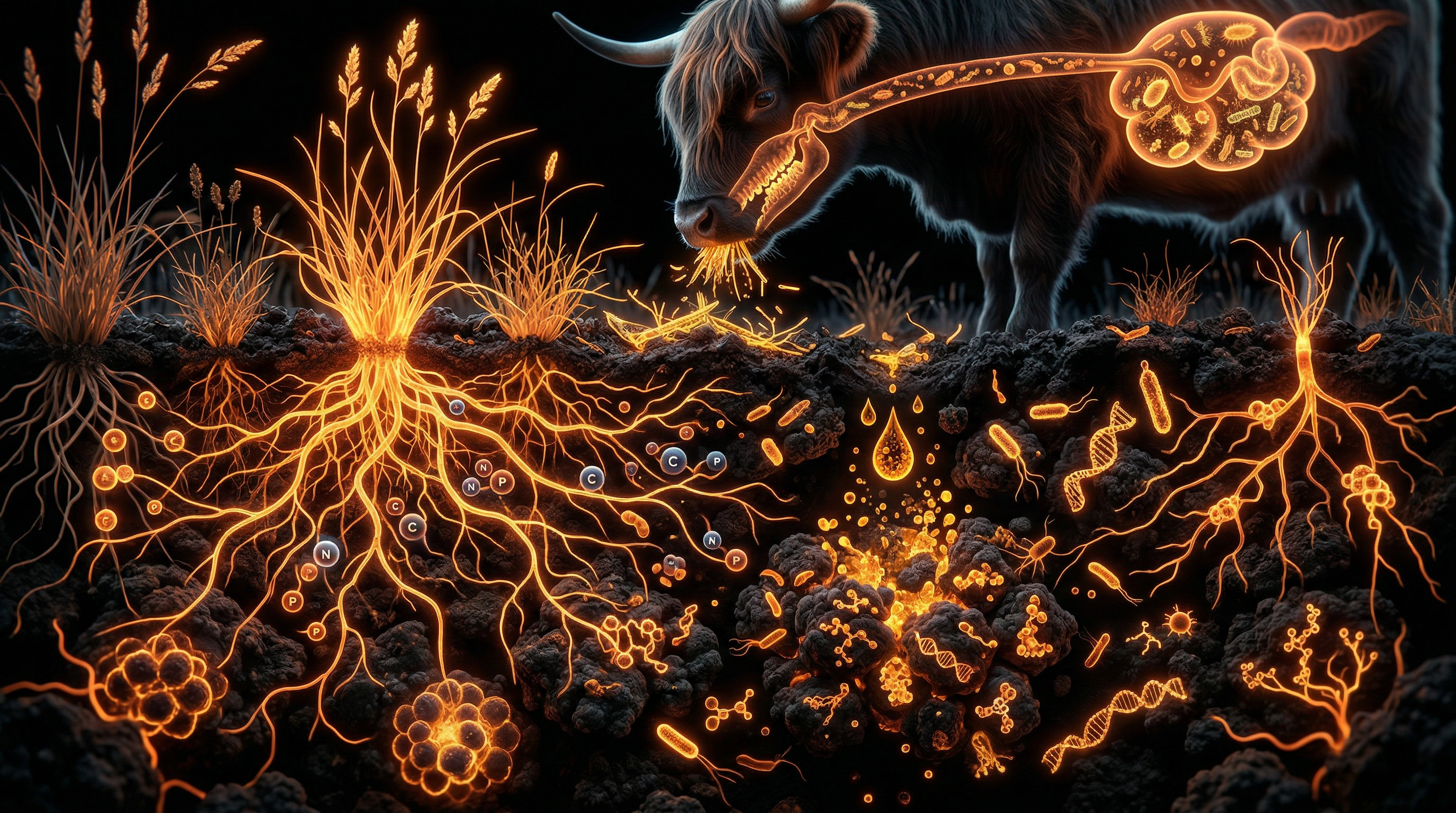
To understand regenerative grazing, one must first view the pasture not as a collection of individual plants, but as a single, complex, symbiotic organism. In this system, the ruminant is not a "consumer" in the destructive sense, but a vital biological catalyst.
The Ruminant as a Mobile Bioreactor
The bovine rumen is arguably the most sophisticated fermentation vat on Earth. It contains billions of bacteria, protozoa, and fungi that break down cellulose—a substance humans cannot digest—into high-quality proteins and fats. When a cow grazes, it performs several essential biological functions:
- Mechanical Stimulation: The act of biting a plant sends a hormonal signal to the roots. To compensate for the loss of leaf area, the plant sheds a portion of its root mass. This decaying root matter becomes food for soil microbes, effectively "pumping" carbon into the earth.
- The Inoculation Cycle: As the animal moves, it deposits dung and urine. This is not "waste"; it is a concentrated dose of nitrogen, phosphorus, potassium, and, most importantly, microbial diversity. Ruminant manure inoculates the soil with the very bacteria needed to break down organic matter.
- The Trample Effect: High-density, short-duration grazing (often called "Mob Grazing") ensures that a portion of the forage is trodden into the ground. This creates a "mulch" layer that protects the soil surface from solar radiation and moisture loss.
The Photosynthetic Pump
The core of soil restoration is the Liquid Carbon Pathway. Through photosynthesis, plants take atmospheric CO2 and convert it into simple sugars. While some of these sugars power the plant’s growth, up to 40% are excreted through the roots as "exudates." These exudates are a "currency" used to trade with soil fungi and bacteria in exchange for minerals like magnesium, zinc, and selenium. In a healthy regenerative system, the presence of the grazing animal accelerates this trade, forcing the plant to pump more carbon downward to rebuild its structural integrity.
Mechanisms at the Cellular Level
The restoration of topsoil is, at its heart, a microbiological event. When we observe the soil under a microscope, the difference between tilled, monocrop soil and regenerative pasture is the difference between a desert and a rainforest.
Mycorrhizal Fungi and Glomalin
The most critical player at the cellular level is Arbuscular Mycorrhizal Fungi (AMF). These fungi form a symbiotic relationship with plant roots, extending the reach of the root system by up to 1,000 times.
- Glomalin: Discovered only in 1996, glomalin is a "soil glue" produced by AMF. It is a glycoprotein that binds soil particles together into "aggregates."
- Soil Aggregation: These aggregates create pore spaces in the soil, allowing for oxygen infiltration and water retention. Without glomalin, soil becomes a fine powder that either blows away in the wind or turns into impenetrable "hardpan" when wet.
- Carbon Storage: Glomalin contains 30-40% carbon and is incredibly stable, staying in the soil for decades. Regenerative grazing is the only known way to rapidly increase glomalin levels across large-scale landscapes.
The Rumen-Soil Connection: Quorum Sensing
There is an emerging field of research regarding Quorum Sensing—a method of communication between bacteria via signalling molecules. Recent studies suggest that the microbial signals found in ruminant saliva actually stimulate the plant's immune system. When a cow licks a blade of grass, it transmits enzymes and microbes that trigger a systemic increase in the plant’s production of secondary metabolites (antioxidants). This makes the plant—and subsequently the animal and the human who eats it—more resilient to disease.
Nutrient Density and the Mineral Bridge
In a chemical-led system, the plant is fed NPK (Nitrogen, Phosphorus, Potassium) in a water-soluble form. This bypasses the microbial "negotiation" mentioned earlier. While the plant grows large and green, it is functionally "hollow"—devoid of the trace minerals like Boron, Manganese, and Molybdenum that can only be extracted from rock particles by healthy microbial colonies. Regenerative grazing restores this "Mineral Bridge," ensuring that the grass (and the meat) contains the full spectrum of elements required for mammalian health.
Environmental Threats and Biological Disruptors
The primary obstacle to soil restoration is the current industrialised paradigm, which treats the farm as a factory rather than a biological system.
The Tillage Trap
Monocrop tillage—the mechanical turning of the soil—is an ecological act of violence. Every time a plough cuts through the earth:
- Mycelial networks are severed: The delicate fungal "internet" that transports nutrients is destroyed.
- Carbon is oxidised: Carbon stored in the soil is exposed to oxygen and released back into the atmosphere as CO2.
- The "Soil Shield" is lost: The bare earth is exposed to the elements, leading to the "baking" of the soil surface and massive runoff during rain.
Chemical Warfare: Nitrogen and Glyphosate
The UK's reliance on synthetic nitrogen fertilisers (produced via the energy-intensive Haber-Bosch process) has created a "Nitrogen Burn." Excessive nitrogen stimulates bacteria that eat organic matter so quickly they eventually consume the soil's humus itself, leaving the ground structurally weak.
Furthermore, the widespread use of Glyphosate (the active ingredient in many herbicides) acts as a potent mineral chelator and antibiotic. It kills the very soil microbes (specifically the shikimate pathway in bacteria and fungi) that are essential for nutrient cycling. In the UK, glyphosate is often used as a desiccant on grain crops, meaning it is sprayed directly onto the food we eat just before harvest.
Fact: Research has shown that glyphosate residues in the soil can inhibit the uptake of manganese and iron in plants, leading to "hidden hunger"—where animals and humans are calorically satisfied but nutritionally starved.
The Cascade: From Exposure to Disease
The degradation of UK topsoil is not merely an environmental issue; it is the root cause of the modern metabolic health crisis. There is a direct, unbroken line between soil health and human pathology.
The Gut-Soil Axis
Human health is governed by the gut microbiome. We now know that the diversity of our internal flora is a reflection of the diversity of the soil in which our food is grown.
- Microbial Depletion: Industrialised food comes from sterile, chemicalised environments. By consuming food grown in "dead" soil, we are failing to replenish our own microbial diversity, leading to a rise in autoimmune conditions, allergies, and inflammatory bowel diseases.
- The Protein Fallacy: Industrial monocrops (soy, corn, wheat) provide "empty" protein. They lack the complex amino acid profiles and co-factors (like Vitamin B12 and K2) found in ruminant meat.
The Rise of Metabolic Syndrome
The UK has seen an explosion in Type 2 Diabetes and non-alcoholic fatty liver disease. This is driven by a diet high in processed carbohydrates (from tilled monocrops) and "seed oils" (industrial vegetable oils) used to replace healthy animal fats.
- Oxidative Stress: Plants grown in depleted soil produce fewer protective phytochemicals. When we consume these plants, we lack the antioxidant protection needed to combat the oxidative stress caused by modern environmental toxins.
- Mineral Deficiencies: Magnesium deficiency—linked to anxiety, heart disease, and sleep disorders—is now rampant in the British population precisely because our soils no longer contain the microbial life required to make magnesium bioavailable to plants.
What the Mainstream Narrative Omits
The current mainstream discourse on "sustainability" is frequently decoupled from biological reality. We are told that cows are the primary drivers of climate change and that we must transition to a "plant-based" or "lab-grown" future to save the planet. This narrative is not only flawed; it is dangerously reductive.
The Methane Myth
The argument against ruminants focuses heavily on methane (CH4). However, this ignores the Biogenic Carbon Cycle. The carbon emitted by a cow as methane was already in the atmosphere (captured by the grass she ate). Within 10-12 years, that methane breaks down into CO2 and water, which is then re-absorbed by the grass. This is a closed-loop system. Contrast this with the CO2 released by burning fossil fuels to create synthetic fertiliser or to power the massive machinery required for monocrop tillage. That is "new" carbon being added to the atmosphere from deep underground.
The Veganic Impossibility
Many "plant-based" advocates suggest "veganic" farming—growing crops without any animal inputs. Biologically, this is an impossibility at scale. Without animal manure and the systemic stimulation of grazing, the soil requires massive inputs of synthetic fertilisers. A "vegan" world is a world entirely dependent on the chemical industry and fossil fuels.
The Corporate Capture of "Meat Alternatives"
"Lab-grown" meat and ultra-processed plant burgers are being marketed as the pinnacle of sustainability. In reality, these products are:
- Energy Intensive: They require massive bioreactors kept at constant temperatures.
- Nutritionally Inferior: They are "chemical soups" designed to mimic the texture of meat but lack the complex bioavailable nutrient matrix of grass-finished beef (e.g., CLA, Omega-3s, Taurine, Creatine).
- The Ultimate Monocrop Product: They rely on soy and pea protein isolates, which are the primary drivers of the very tillage and chemical use that is destroying UK topsoil.
The UK Context
The United Kingdom is uniquely positioned to lead the world in regenerative grazing. Our temperate climate, consistent rainfall, and historical "permanent pasture" are our greatest biological assets.
The British Landscape: A Grass-Growing Engine
Unlike the arid regions of the US or Australia, the UK has an abundance of "marginal land"—hilly, rocky, or wet areas that are unsuitable for growing crops but perfect for growing grass.
- 60% of UK Farmland: Roughly 60% of our agricultural land is only suitable for grass. If we remove ruminants from these areas, we lose our ability to produce food from that land entirely.
- Historical Heritage: British breeds like the Hereford, Aberdeen Angus, and Highland cattle were specifically bred to thrive on these forages. These "heritage" breeds are more resilient and better suited to regenerative systems than the high-output, grain-dependent breeds used in industrial feedlots.
The Policy Disconnect: ELMS and Net Zero
The UK government’s current "Environmental Land Management schemes" (ELMS) and "Net Zero" targets often incentivise "rewilding" over regenerative farming. While rewilding has its place, simply "leaving land alone" in a British context often leads to an overgrowth of invasive species and a loss of biodiversity. Controlled, high-impact grazing is a superior tool for maintaining the "mosaic" habitats (grassland, scrub, and woodland) that support British wildlife like the grey partridge and the skylark.
The "Pasture Fed" Revolution
Organisations like the Pasture-Fed Livestock Association (PFLA) are leading the charge in the UK. They certify farms that use 100% grass and forage diets. This is crucial because "Grass-Fed" is not a protected term in the UK; many "grass-fed" cattle are finished on grain in their final months, which changes the fatty acid profile of the meat and disrupts the regenerative cycle of the farm.
Protective Measures and Recovery Protocols
As individuals, we are not powerless against the degradation of our soil and our health. We can opt out of the industrialised system and support the biological restoration of the British Isles.
For the Consumer: The Regenerative Audit
To support the restoration of UK topsoil, one must change their relationship with food.
- Source Direct: Buy meat from farms that practice "Holistic Planned Grazing" or "Mob Grazing." Look for the "Pasture for Life" certification.
- Nose-to-Tail Consumption: Eat the whole animal. Organ meats (liver, heart, kidney) are the most nutrient-dense parts and were traditionally the most prized. By eating nose-to-tail, you honour the life of the animal and maximise the nutrient density of your diet.
- Reject the Monocrop: Reduce or eliminate reliance on ultra-processed "plant-based" alternatives. These are the products of the tillage system that is destroying our earth.
- Understand the Seasonality: Real food has seasons. Regenerative beef and lamb are at their most nutrient-dense when the grass is at its peak growth.
For the Farmer: The Transition to Biology
Farmers wishing to exit the "Chemical Treadmill" must undergo a paradigm shift.
- Stop Tilling: Adopt "No-Till" or "Min-Till" strategies to preserve the fungal networks.
- Diversify the Sward: Move away from "Ryegrass Monocultures." Plant diverse herbal leys containing chicory, plantain, and sainfoin. These deep-rooting plants bring up minerals from deep in the subsoil.
- Increase Stocking Density, Decrease Duration: Move animals frequently. This prevents overgrazing (which kills roots) and ensures even distribution of manure and "trample" organic matter.
Recovery Protocol for the Human Microbiome
If you have been consuming a diet from the industrialised system, your "internal soil" may be depleted.
- Bone Broth: Rich in glycine and collagen to repair the gut lining damaged by glyphosate and gluten.
- Fermented Foods: Traditional ferments (sauerkraut, kefir) can help re-inoculate the gut with the diversity lost through sterile food chains.
- High-Quality Animal Fats: Saturated fats from grass-finished ruminants (tallow, suet) are essential for cellular membrane health and the absorption of fat-soluble vitamins (A, D, E, K2).
Summary: Key Takeaways
The restoration of the UK’s topsoil is not a matter of "better technology" but of "better biology." We must stop viewing the ruminant as a problem and start seeing it as the solution.
- Soil is a Living Organism: It requires biological inputs (dung, saliva, trampling) and continuous cover to thrive. Tillage and chemicals are its primary predators.
- The Ruminant is Essential: There is no known way to build topsoil at the scale and speed required without the integration of grazing animals.
- Nutrient Density follows Soil Health: The "epidemic" of modern metabolic disease is a direct symptom of mineral-depleted soil and the replacement of animal fats with industrial seed oils and sugars.
- The UK is a Grassland Paradise: Our climate and geography make the British Isles the ideal location for a global model of regenerative agriculture.
- The Narrative is Manipulated: The push for "meatless" diets serves the interests of the chemical and processed-food industries, not the planet or the human population.
By embracing a Nose-to-Tail, animal-based nutritional framework and supporting Regenerative Grazing, we can literally rebuild the ground beneath our feet. This is the only path toward true sustainability, food security, and the restoration of British vitality. The "60 harvests" clock is ticking, but the solution is grazing in the fields right in front of us.
This article is provided for informational and educational purposes only. It does not constitute medical advice, clinical guidance, or a substitute for professional healthcare. Information reflects cited research at time of publication. Always consult a qualified healthcare professional before acting on any health information.
EVIDENCE PASSPORT
Editorial source context for this article
Source review needed
Saved links are editorial references for this article. They may support specific claims rather than every sentence. Open and assess each source in context. This passport does not independently verify them.
Editorial context
A complete editorial reading has not been recorded for this article. Source links remain available for you to open and assess directly.
Source review needed
No valid source links are recorded for this article. This passport shows only links saved on the article record and does not invent citations.
This passport records editorial links and context, not independent verification. Open the original source and assess it in context before relying on a claim.
Medical Disclaimer
The information in this article is for educational purposes only and does not constitute medical advice, diagnosis, or treatment. Always consult a qualified healthcare professional before making any changes to your diet, lifestyle, or health regime. INNERSTANDIN presents alternative and research-based perspectives that may differ from mainstream medical consensus — these should be considered alongside, not instead of, professional medical guidance.
Read Full DisclaimerContinue the thread
Keep this question moving.
Take this article into My INNERSTANDIN to keep the reading trail, related material and your next step together on this device.
Dig deeper in the Library
Free, longform PDF volumes that go beyond headlines into mechanisms and references.