
Soil Longevity: The Impact of Persistent Herbicide Residues
Updated May 2026
Examining how residual herbicides like glyphosate affect soil microbiome health, nutrient cycling, and the long-term sustainability of agricultural land.
Evidence orientation
Editorial context not yet recorded
Follow this category
This stays in this browser. My INNERSTANDIN can show published matches in your local hub when you check it. It does not send email, push, or alert notifications.
Local learning review
A private browser aid for revisiting ideas. It is not an alert or a health recommendation.
Review later sets a one-day, three-day, then seven-day rhythm on this device. Choose it only when you want to revisit this article.
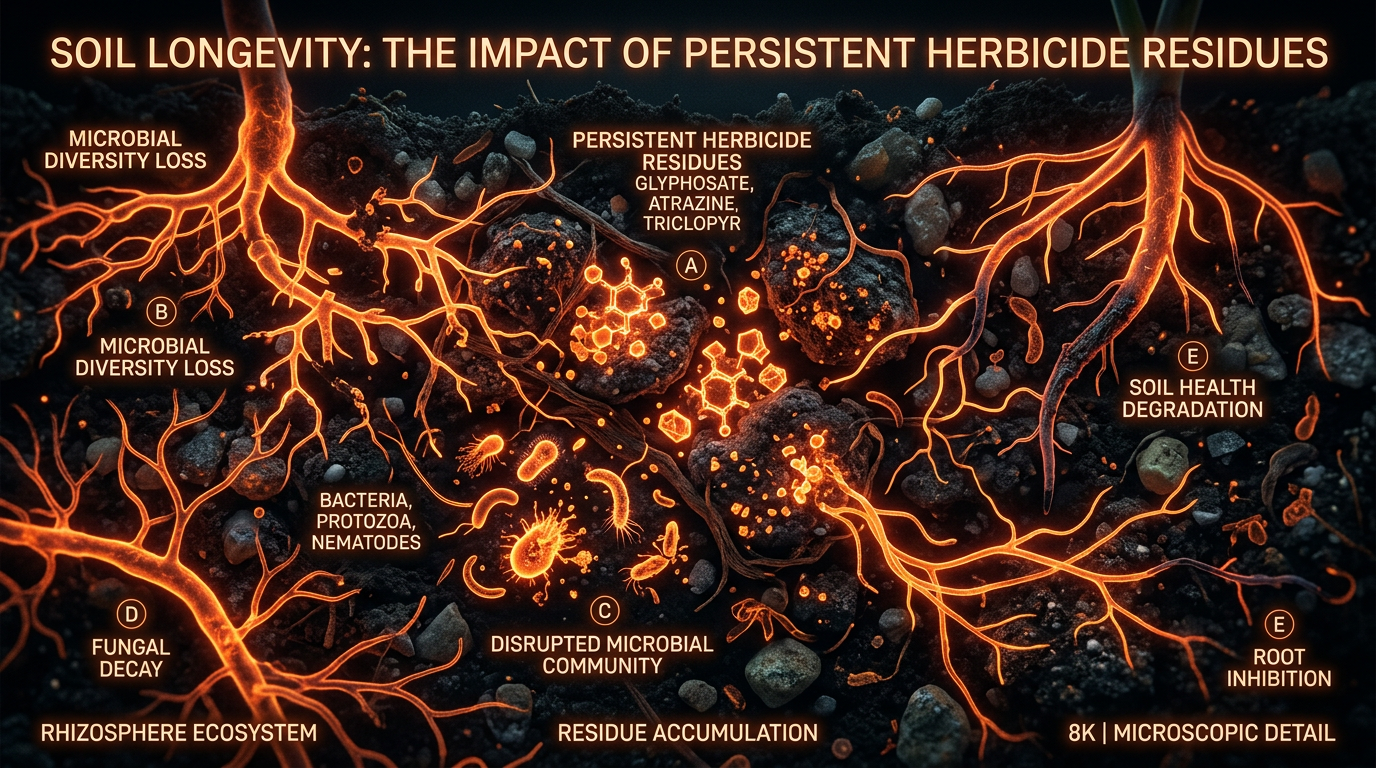
The foundation of terrestrial life is not the sun, nor the rain, but the thin, fragile layer of topsoil that blankets the Earth’s crust. This biological matrix, often dismissed as mere ‘dirt’ in industrial paradigms, is a complex, living organism. However, the integrity of this resource is currently under siege. As we transition further into the 21st century, the concept of Soil Longevity—the capacity of soil to maintain its biological productivity and structural integrity over geological timescales—is being compromised by the systemic accumulation of persistent herbicide residues.
For decades, the agricultural narrative has been dominated by the efficacy of synthetic chemistry. Yet, the ‘truth-exposing’ reality suggests that the very tools designed to protect crops are now the primary agents of soil senescence. This piece explores the hidden mechanisms of chemical persistence, the disruption of subterranean ecosystems, and the urgent protocols required for pedological recovery.
The Myth of Rapid Degradation: The Half-Life Deception
The regulatory approval of most modern herbicides, most notably glyphosate-based formulations and synthetic auxins, was predicated on the assumption of rapid biodegradation. Industry literature frequently cites a ‘half-life’—the time taken for half of the compound to break down—ranging from a few days to several weeks. However, these figures are often derived from laboratory conditions that fail to account for the complexities of field ecology.
In the reality of the British landscape, where soil temperatures fluctuate and anaerobic conditions often prevail in heavy clays, these residues exhibit a far more stubborn character.
UK Perspective: Recent monitoring by the UK’s Pesticide Action Network (PAN UK) and various environmental agencies suggests that residues of glyphosate and its primary metabolite, AMPA (aminomethylphosphonic acid), can be detected in over 60% of topsoil samples across arable land, even months after the last application.
The persistence of these chemicals is not merely a matter of presence; it is a matter of cumulative toxicity. When the rate of application exceeds the rate of microbial degradation, the soil enters a state of ‘chemical saturation.’ This disrupts the soil’s cation exchange capacity (CEC) and creates a legacy of toxicity that affects subsequent crop rotations and the wider biodiversity of the rhizosphere.
Biological Mechanisms: The Silent Decimation of the Microbiome
To understand the impact on soil longevity, one must look beneath the surface at the microbial level. The soil microbiome is the digestive system of the Earth. It facilitates nutrient cycling, builds soil structure through glomalin production, and provides the primary immune response for plants.
The Shikimate Pathway Disruption
The primary mechanism of glyphosate is the inhibition of the 5-enolpyruvylshikimate-3-phosphate (EPSP) synthase enzyme, a key component of the shikimate pathway. For years, the scientific consensus (largely funded by agrochemical interests) maintained that because humans lack this pathway, the chemical was essentially benign.
This ignores the fundamental truth: the soil microbiome is almost entirely dependent on the shikimate pathway.
- Fungal Suppression: Mycorrhizal fungi, which form symbiotic networks with plant roots to exchange phosphorus for carbon, are highly sensitive to glyphosate residues. Their suppression leads to 'lazy' plants that are more susceptible to drought and disease.
- Bacterial Imbalance: Herbicide residues act as a selective antibiotic. They decimate beneficial, sensitive bacteria (such as Rhizobium involved in nitrogen fixation) while allowing pathogenic, resistant strains (such as Fusarium) to proliferate.
- Microbial Starvation: By killing the ‘weeds’ (non-crop biomass), herbicides remove the diverse root exudates that feed a varied microbial population, leading to a homogenised, weakened soil food web.
Mineral Chelation and Nutrient Lock-out
Glyphosate was originally patented as a powerful chelator. In the soil, this means it binds to essential minerals—Manganese, Magnesium, Iron, and Zinc—making them unavailable to the plant. Even if a soil test shows high mineral content, persistent residues can render these nutrients 'locked,' leading to nutrient-dense food becoming a relic of the past. This mineral deficiency in the soil translates directly to mineral deficiency in the human population.
Environmental Disruptors: Beyond the Field Boundary
The impact of herbicide residues is rarely contained within the target area. The longevity of the soil is intrinsically linked to the longevity of the surrounding watershed and the geological strata beneath.
Horizontal and Vertical Mobility
While some herbicides bind tightly to soil particles, others are highly mobile. Synthetic auxins, such as aminopyralid and clopyralid, are notorious for their persistence and mobility. These compounds can survive the digestive tracts of livestock and the high temperatures of commercial composting, leading to the infamous ‘contaminated manure’ crises that have plagued British gardeners and organic farmers.
Statistical Insight: Data from the UK’s Department for Environment, Food & Rural Affairs (DEFRA) indicates that groundwater monitoring frequently detects herbicide metabolites at levels exceeding the ‘safe’ thresholds for drinking water, suggesting that soil is no longer acting as an effective filter but as a conduit for chemical leaching.
Soil Structure and Erosion
Chemical-heavy management leads to a loss of soil ‘aggregate stability.’ When the microbial ‘glue’ (glomalin) disappears due to fungal suppression, the soil loses its ability to hold together. This results in:
- Capping: The surface becomes a hard crust, preventing water infiltration.
- Compaction: Lower layers become anaerobic, stifling root growth.
- Erosion: During heavy UK rainfall, the topsoil—laden with residues—simply washes away into the river systems, taking the potential for future longevity with it.
The Consequences: A Tipping Point for Food Security
The true cost of persistent residues is the gradual sterilisation of the land. As the soil loses its biological vitality, farmers are forced into a ‘vicious cycle’ of increasing chemical inputs to compensate for the lost natural fertility. This is not sustainable agriculture; it is an extraction of future potential to pay for present-day yields.
- Reduced Resilience: Soils with high residue loads are significantly less resilient to climate extremes. They cannot hold water during droughts, nor can they drain effectively during floods.
- Pathogen Pressure: The disruption of the soil microbiome leaves plants vulnerable. With their ‘immune system’ (the rhizosphere) compromised, they require more fungicides and pesticides, further escalating the chemical load.
- Economic Decline: For the British farmer, the long-term degradation of soil health represents a massive hidden liability on the balance sheet.
Recovery Protocols: Restoring the Living Matrix
If we are to ensure soil longevity, we must move beyond the ‘business as usual’ approach of the industrial era. Recovery is possible, but it requires a sophisticated understanding of biological remediation. The following protocols represent the cutting edge of regenerative soil science.
1. Carbon Sequestration and Biochar
Carbon is the ‘sponge’ of the soil. Increasing soil organic matter (SOM) is the first step in buffering against herbicide residues.
- Biochar Inoculation: High-quality biochar, when ‘charged’ with microbial life, can act as a permanent site for cation exchange. It can also adsorb herbicide residues, effectively taking them out of the biological loop while providing a habitat for beneficial microbes.
2. Mycoremediation
Fungi are nature’s premier decomposers. Certain species of white-rot fungi produce enzymes (lignin peroxidases) capable of breaking down the complex aromatic rings found in many persistent herbicides.
- Protocol: Integrating fungal-dominated compost teas and encouraging the growth of native saprophytic fungi can accelerate the breakdown of chemical legacies that would otherwise persist for decades.
3. Humic and Fulvic Acid Application
These organic acids are the ‘gold’ of soil health. They act as natural chelators, but unlike glyphosate, they make minerals more available to the plant.
- Action: Regular application of humic substances can help to de-complex residues and stimulate the microbial activity necessary for total biodegradation.
4. Diverse Cover Cropping (The ‘Living Bridge’)
To heal the soil, it must never be left bare. Cover crops serve as a ‘living bridge’ that feeds the microbiome through the winter.
- Species Diversity: Using a mix of legumes, brassicas, and grasses ensures a wide array of root exudates, which encourages a more diverse microbial population capable of degrading various chemical compounds.
5. Transitioning to ‘Innerstanding’ Stewardship
True soil longevity requires a shift in consciousness. We must stop viewing soil as a substrate for chemical reactions and start viewing it as a living, breathing community.
The Reality Check: In the UK, the transition toward Environmental Land Management schemes (ELMs) is a step in the right direction, but it must be underpinned by a rigorous commitment to reducing the ‘chemical burden’ rather than just managing it.
Conclusion: The Path Forward
The evidence is clear: the persistent use of herbicides is not a neutral act. It is a slow-motion disruption of the biological processes that have sustained life for millennia. To ensure Soil Longevity, we must expose the myth of the ‘inert’ residue and acknowledge the profound impact of these chemicals on the subterranean world.
The recovery of our soils is not merely an environmental goal; it is a civilisational necessity. By employing advanced biological protocols—from mycoremediation to the strategic use of humic substances—we can begin to purge the chemical legacy from our land. We must return to a science that respects the complexity of the soil matrix, ensuring that the ground beneath our feet remains a source of life, rather than a repository of industrial waste.
The longevity of our society depends entirely on the longevity of our soil. It is time we treated it with the reverence and scientific rigour it deserves.
Summary of Key Mechanisms
- Persistence: Residues last far longer in the field than in the lab, especially in the UK’s cool, damp climate.
- Shikimate Disruption: Herbicides act as broad-spectrum antibiotics for the soil, killing the beneficial fungi and bacteria that drive plant health.
- Nutrient Lock-out: Chelation properties of residues prevent plants from absorbing essential minerals.
- Structural Failure: Loss of microbial life leads to erosion, compaction, and loss of water-holding capacity.
Recommended Recovery Actions
- Test: Conduct comprehensive soil tests that look for residue levels, not just NPK.
- Inoculate: Use fungal-rich composts and biochar to jumpstart biological activity.
- Protect: Maintain continuous ground cover to feed the microbiome.
- Reduce: Phasing out persistent synthetic chemicals is the only long-term solution for true soil health.
This article is provided for informational and educational purposes only. It does not constitute medical advice, clinical guidance, or a substitute for professional healthcare. Information reflects cited research at time of publication. Always consult a qualified healthcare professional before acting on any health information.
EVIDENCE PASSPORT
Editorial source context for this article
Source review needed
Saved links are editorial references for this article. They may support specific claims rather than every sentence. Open and assess each source in context. This passport does not independently verify them.
Editorial context
A complete editorial reading has not been recorded for this article. Source links remain available for you to open and assess directly.
Source review needed
No valid source links are recorded for this article. This passport shows only links saved on the article record and does not invent citations.
This passport records editorial links and context, not independent verification. Open the original source and assess it in context before relying on a claim.
Medical Disclaimer
The information in this article is for educational purposes only and does not constitute medical advice, diagnosis, or treatment. Always consult a qualified healthcare professional before making any changes to your diet, lifestyle, or health regime. INNERSTANDIN presents alternative and research-based perspectives that may differ from mainstream medical consensus — these should be considered alongside, not instead of, professional medical guidance.
Read Full DisclaimerContinue the thread
Keep this question moving.
Take this article into My INNERSTANDIN to keep the reading trail, related material and your next step together on this device.
Dig deeper in the Library
Free, longform PDF volumes that go beyond headlines into mechanisms and references.