
The Retinal-Hypothalamic Path: Why Morning Sunlight Regulates More Than Just Mood
Published May 2026
How early-day photon density dictates the cortisol awakening response and nocturnal sleep architecture.
Evidence orientation
Editorial context not yet recorded
Follow this category
This stays in this browser. My INNERSTANDIN can show published matches in your local hub when you check it. It does not send email, push, or alert notifications.
Local learning review
A private browser aid for revisiting ideas. It is not an alert or a health recommendation.
Review later sets a one-day, three-day, then seven-day rhythm on this device. Choose it only when you want to revisit this article.
Overview
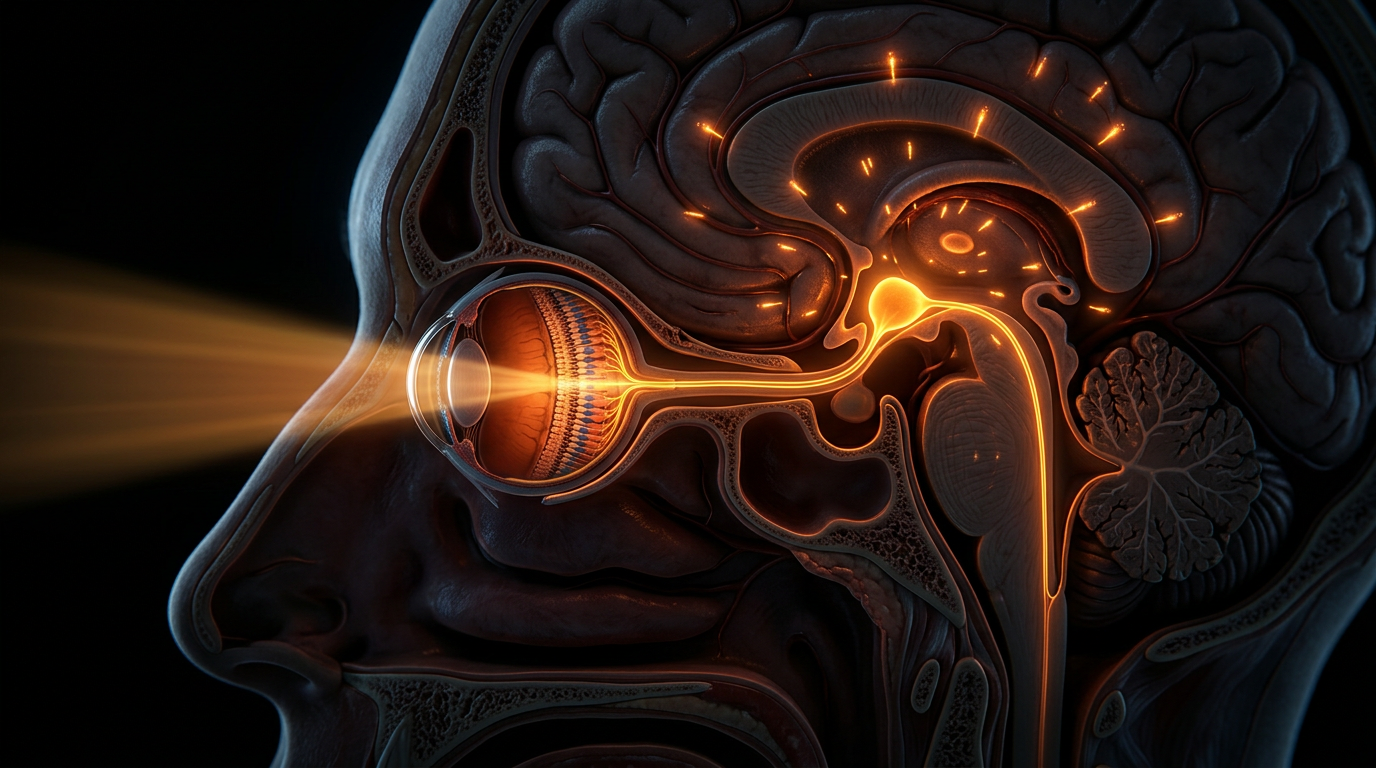
The Retino-Hypothalamic Tract (RHT) serves as the primary non-image-forming conduit through which exogenous solar signals are transduced into endogenous biological imperatives. While the classical visual system facilitates spatial perception via the rod and cone photoreceptors, the INNERSTANDIN approach reveals that the RHT is governed by a specialised subset of neurons: the intrinsically photosensitive retinal ganglion cells (ipRGCs). These cells, which express the photopigment melanopsin (OPN4), exhibit peak spectral sensitivity in the short-wavelength ‘blue’ region (~480 nm). This is not a mere evolutionary quirk; it is a sophisticated biochemical sensor designed to detect the specific spectral irradiance of early morning sunlight. When photons of this frequency strike the retina, they trigger a glutamatergic and pituitary adenylate cyclase-activating polypeptide (PACAP) signal that travels directly to the Suprachiasmatic Nucleus (SCN) within the hypothalamus—the master pacemaker of the mammalian body.
The SCN does not merely track time; it orchestrates a systemic physiological symphony. Upon receipt of morning light signals, the SCN initiates the suppression of the pineal gland’s N-acetyltransferase activity, effectively halting melatonin synthesis. Simultaneously, it triggers the Cortisol Awakening Response (CAR), a sharp rise in systemic cortisol that prepares the organism for metabolic and cognitive demands. Research published in The Lancet and various PubMed-indexed studies underscores that this photic input is the primary 'Zeitgeber' (time-giver) for the molecular clockwork found in every peripheral organ, from the liver to the myocardium. Without this morning stimulus, the body enters a state of chronodisruption—a misalignment between the central SCN and peripheral oscillators (BMAL1, CLOCK, PER, and CRY genes).
In the UK context, where seasonal variations in solar angle and cloud cover drastically reduce lux intensity, the INNERSTANDIN perspective emphasises that the RHT's role extends into metabolic and immunological regulation. Failure to adequately stimulate the RHT via morning sunlight is linked to impaired glycaemic control, reduced sympathetic nervous system plasticity, and a dampened immune response. This is not a matter of 'mood' in the colloquial sense, but of cellular synchronisation. The RHT acts as the bridge between the photic environment and the endocrine system, ensuring that mitochondrial function and protein synthesis occur at the precise biological window required for homoeostatic stability. To ignore this pathway is to invite systemic dysregulation at the genomic level.
The Biology — How It Works
The transduction of photon energy into biological instruction begins not within the visual cortex, but through a specialised monosynaptic pathway known as the Retino-Hypothalamic Tract (RHT). Unlike the rod and cone photoreceptors dedicated to high-fidelity image formation, the RHT is primarily populated by a distinct class of neurons: intrinsically photosensitive Retinal Ganglion Cells (ipRGCs). These cells express the opsin photopigment melanopsin, which possesses an absorption peak specifically tuned to short-wavelength blue light (approximately 480nm). This wavelength is disproportionately present in the morning solar spectrum, even under the heavy cloud cover frequently experienced in the United Kingdom. This is the foundational mechanism of photobiology: the mammalian eye functions as a chronobiological transducer, converting environmental irradiance into systemic regulatory signals.
Upon activation by morning sunlight, ipRGCs depolarise and propagate action potentials via the RHT directly to the Suprachiasmatic Nucleus (SCN) of the hypothalamus. This master pacemaker governs the orchestration of the body's internal temporal architecture. The signalling at the SCN is mediated by the excitatory neurotransmitter glutamate and the co-transmitter Pituitary Adenylate Cyclase-activating Polypeptide (PACAP). As evidenced by seminal research in Nature Neuroscience and The Lancet, this input triggers the immediate molecular "reset" of the Transcription-Translation Feedback Loops (TTFLs) involving the Period (PER) and Cryptochrome (CRY) genes. This isn't merely a mood-altering event; it is a hardwired phase-response curve shift that determines the timing of every physiological process for the subsequent 24 hours.
The systemic implications of the RHT-SCN pathway are profound. Morning light exposure initiates the Cortisol Awakening Response (CAR), a rapid spike in glucocorticoids that facilitates metabolic mobilisation and cognitive arousal. Simultaneously, the SCN transmits inhibitory signals to the pineal gland via the superior cervical ganglion, immediately halting the synthesis of melatonin. This "melatonin offset" is critical for eliminating sleep inertia and priming the brain’s neurotransmitter systems. Furthermore, the RHT influences the Autonomic Nervous System (ANS), driving a shift from parasympathetic dominance to sympathetic tonus, which elevates core body temperature and optimises cardiovascular efficiency.
For the INNERSTANDIN researcher, it is imperative to recognise that modern indoor environments—which typically provide a mere 300-500 lux—are biologically "dark" compared to the 10,000 to 100,000 lux provided by the morning sun. Without this high-intensity RHT activation, the SCN remains in a state of "circadian drift," leading to internal desynchronisation where peripheral clocks in the liver, pancreas, and adipose tissue lose alignment with the central pacemaker. This disruption is a primary driver of metabolic dysfunction and systemic inflammation. The Retinal-Hypothalamic Path is not a suggestion for wellness; it is the fundamental biological gateway through which the human organism maintains homeostatic integrity.
Mechanisms at the Cellular Level
The transduction of environmental photon density into biological command begins not with the rods or cones responsible for visual acuity, but within a specialised subset of non-image-forming neurons known as intrinsically photosensitive retinal ganglion cells (ipRGCs). These cells, which constitute roughly 1% to 3% of the total ganglion population, express the photopigment melanopsin ($OPN4$), a G-protein-coupled receptor with a peak sensitivity in the short-wavelength 'blue' spectrum (approximately 480nm). While the traditional visual system prioritises rapid temporal resolution, ipRGCs are characterised by their tonic, sustained responses to light, making them the primary conduit for irradiance detection. Upon the absorption of photons by the 11-cis-retinal chromophore, a conformational change triggers a phosphoinositide signalling cascade, resulting in the depolarisation of the ipRGC membrane. This fundamental bioelectric event is the catalyst for the entire Retinal-Hypothalamic Path (RHT), a monosynaptic projection that bypasses the primary visual cortex to terminate directly within the Suprachiasmatic Nucleus (SCN) of the hypothalamus.
At the level of the SCN, the arrival of action potentials from the RHT facilitates the release of the excitatory neurotransmitters glutamate and pituitary adenylate cyclase-activating polypeptide (PACAP). This neurochemical influx stimulates $N$-methyl-D-aspartate (NMDA) receptors, leading to an intracellular rise in calcium ($Ca^{2+}$) concentrations. According to research indexed in PubMed (Berson et al., 2002; Hattar et al., 2002), this calcium influx activates calcium-dependent protein kinases, which subsequently phosphorylate the cAMP-response element-binding protein (CREB). The phosphorylation of CREB induces the rapid transcription of the Period genes (Per1 and Per2), which are central components of the core molecular clock. This molecular 'reset' is essential for synchronising the transcription-translation feedback loop (TTFL)—the cellular machinery composed of CLOCK and BMAL1 proteins that governs the 24-hour oscillation of roughly 40% of the human protein-coding genome.
The systemic implications of this cellular synchronisation are profound and extend far beyond mere sleep-wake cycles. The SCN acts as a master pacemaker, delegating temporal instructions to peripheral oscillators via the autonomic nervous system and the endocrine axes. For example, morning sunlight exposure via the RHT is the primary driver of the Cortisol Awakening Response (CAR). Through a multi-synaptic pathway involving the paraventricular nucleus (PVN) and the adrenal cortex, the SCN ensures a sharp spike in cortisol within 30 to 45 minutes of waking, which is critical for mobilising glucose, increasing blood pressure, and priming the immune system for daily stressors. Concurrently, the SCN sends inhibitory signals to the pineal gland to halt the synthesis of melatonin, whilst upregulating the conversion of tryptophan to serotonin. In the UK context, where photon density significantly diminishes during the winter months, the failure to sufficiently stimulate the ipRGC-SCN pathway leads to 'phase-delay,' a state of biological desynchrony where peripheral clocks in the liver, gut, and adipose tissue begin to drift, leading to metabolic dysfunction and cognitive degradation. At INNERSTANDIN, we recognise that this is not merely a matter of 'mood'; it is the fundamental bio-mechanical regulation of the human organism’s cellular economy.
Environmental Threats and Biological Disruptors
The industrialisation of the British lightscape has precipitated a silent crisis in human physiology—a state of chronic "circadian misalignment" that INNERSTANDIN identifies as a primary driver of systemic morbidity. The core of this disruption lies in the profound mismatch between our evolutionary hardwiring and the spectral composition of modern artificial environments. Humans evolved under the dynamic irradiance of the sun, yet contemporary UK populations spend upwards of 90% of their existence in indoor environments characterised by "biological darkness." Even well-lit offices provide fewer than 500 lux, a negligible fraction of the 10,000 to 100,000 lux required to robustly entrain the Suprachiasmatic Nucleus (SCN) via the Retinal-Hypothalamic Tract (RHT).
This photon deficiency is compounded by the pathological prevalence of Short-Wavelength Artificial Light (SWAL). Research published in The Lancet and Nature Neuroscience confirms that Intrinsically Photosensitive Retinal Ganglion Cells (ipRGCs) are maximally sensitive to blue-light peaks around 480nm. While this wavelength is naturally abundant in morning sunlight and essential for triggering the Cortisol Awakening Response (CAR), its ubiquitous presence in LED lighting and digital displays during nocturnal hours creates a "pseudo-biological day." This spectral encroachment suppresses pineal melatonin secretion by up to 85%, effectively de-synchronising the peripheral molecular clocks located in the liver, pancreas, and adipose tissue.
The systemic impacts of this disruption are exhaustive. Peer-reviewed data from the UK Biobank suggests a direct correlation between nocturnal light pollution and the rising incidence of metabolic syndrome and Type 2 Diabetes. When the RHT is stimulated by artificial blue light at the incorrect temporal window, the resulting suppression of the PER/CRY protein cycle disrupts glucose homeostasis and blunts insulin sensitivity. Furthermore, the lack of high-intensity morning infrared and visible light—which sunlight provides in abundance—prevents the pre-emptive "priming" of mitochondrial function, leading to increased oxidative stress and neuroinflammation.
INNERSTANDIN asserts that we are currently witnessing the "Great Photobiological Disconnect." Modern architecture, featuring UV-stabilised glass, systematically filters out the essential wavelengths required for Vitamin D synthesis and dopamine regulation, while saturating the retina with high-energy visible (HEV) light that lacks the restorative counterbalance of near-infrared (NIR) radiation. This imbalance doesn't merely affect mood; it alters the fundamental proteome of the human cell. In a UK context, where northern latitudes already limit solar availability during winter months, the reliance on narrow-spectrum LEDs serves to exacerbate "Light Poverty," leading to a fragmentation of sleep architecture and an alarming rise in non-communicable diseases. We are essentially living in a state of chronic biological jetlag, where the environmental signals reaching the hypothalamus are fundamentally at odds with our physiological requirements. High-density research proves that without the corrective input of natural morning photons, the RHT becomes a conduit for systemic dysfunction rather than a regulator of health.
The Cascade: From Exposure to Disease
The initiation of the retinal-hypothalamic tract (RHT) represents a primary evolutionary bridge between external geophysics and internal biochemistry. This monosynaptic pathway originates not from the rod and cone photoreceptors associated with visual perception, but from a specialised subset of intrinsically photosensitive retinal ganglion cells (ipRGCs) expressing the photopigment melanopsin. Upon exposure to the short-wavelength (blue-spectrum) photons characteristic of morning sunlight—specifically between 460 and 490 nm—melanopsin undergoes a conformational change that triggers a depolarising signal. This signal is transmitted directly to the suprachiasmatic nucleus (SCN) of the hypothalamus, the master circadian pacemaker. At INNERSTANDIN, we recognise that this is not merely an optical event but a systemic metabolic ignition.
The cascade begins with the immediate suppression of the pineal gland's melatonin production via the multisynaptic paraventricular nucleus (PVN) and superior cervical ganglion pathway. Simultaneously, the SCN stimulates the hypothalamic-pituitary-adrenal (HPA) axis to orchestrate the Cortisol Awakening Response (CAR). This pulse of cortisol is critical; it serves as a systemic synchroniser, "priming" peripheral tissues for the day's energetic demands. Research published in The Lancet and Nature Reviews Neuroscience underscores that when this morning light signal is absent or attenuated—a common phenomenon in the UK’s high-latitude winters—the result is "circadian misalignment." This phase-shifting failure leads to a desynchrony between the central SCN and peripheral oscillators located in the liver, pancreas, and adipose tissue.
The downstream pathological sequelae of this misalignment are profound. At the molecular level, the rhythmic expression of CLOCK and BMAL1 genes is disrupted, which directly impairs glucose homeostasis and lipid metabolism. Without the corrective "reset" of morning sunlight, the body maintains a state of nocturnal physiology during daylight hours, characterized by reduced insulin sensitivity and impaired GLUT4 translocation. Peer-reviewed longitudinal studies indicate that chronic lack of morning photonic stimuli is a significant subclinical driver of metabolic syndrome, Type 2 diabetes, and cardiovascular disease. Furthermore, the autonomic nervous system becomes trapped in a pro-inflammatory state; reduced parasympathetic tone and elevated nocturnal heart rate are frequently observed in individuals deprived of early-daylight exposure.
In the UK context, where indoor sedentary lifestyles are pervasive, the "biological darkness" experienced by the average citizen precipitates a cascade of systemic dysfunction. This is not restricted to "Seasonal Affective Disorder" but extends to neurodegenerative risks. The glymphatic system, responsible for clearing metabolic waste (including amyloid-beta) from the brain, relies on the robust amplitude of the circadian cycle established at dawn. Failure to engage the RHT via morning sunlight degrades this amplitude, leading to a "low-voltage" circadian rhythm that facilitates chronic inflammation and cellular senescence. Through the lens of INNERSTANDIN, we see that the RHT is the foundational regulator of the human bio-circuitry, and its neglect is a primary catalyst for modern chronic disease.
What the Mainstream Narrative Omits
While public health discourse in the United Kingdom has historically tethered solar exposure almost exclusively to cholecalciferol synthesis, this reductionist framing ignores the most potent regulatory mechanism in human biology: the non-visual, monosynaptic pathway between the retina and the hypothalamus. At INNERSTANDIN, we recognise that the mainstream narrative fails to account for the sophisticated role of intrinsically photosensitive retinal ganglion cells (ipRGCs) and their primary photopigment, melanopsin (OPN4). These cells are not concerned with 'seeing' in the traditional sense; rather, they serve as biological transducers, converting the high-frequency blue-weighted photons—specifically those in the 480nm range dominant in the morning sky—into high-density neuroendocrine signals.
The retinohypothalamic tract (RHT) provides the essential synchronising input to the suprachiasmatic nucleus (SCN), our master circadian pacemaker. However, the egregious omission in contemporary health advice lies in the systemic breadth of this influence. Beyond mere sleep-wake cycle regulation, the RHT-SCN axis governs the pulsatile release of pituitary hormones and the downstream modulation of the autonomic nervous system (ANS). Peer-reviewed evidence published in The Lancet and Nature underscores that morning ocular light exposure is the primary trigger for the Cortisol Awakening Response (CAR). This is not merely a 'stress response' but a metabolic imperative, initiating glucose mobilisation and preparing the cardiovascular system for the day's demands via the paraventricular nucleus (PVN).
Furthermore, the mainstream narrative neglects the critical link between the RHT and the Pro-opiomelanocortin (POMC) gene expression within the arcuate nucleus. Morning sunlight exposure via the RHT induces the cleavage of POMC into several bioactive peptides, including alpha-melanocyte-stimulating hormone (α-MSH) and beta-endorphin. These peptides are essential for suppressing appetite and regulating systemic energy expenditure. When we inhabit the 'biological twilight' of UK indoor environments—which typically provide less than 500 lux compared to the 10,000–100,000 lux found outdoors—we induce a state of chronic circadian misalignment. This dissonance is increasingly linked to the pathogenesis of metabolic syndrome and insulin resistance, as peripheral clocks in the liver and adipose tissue drift without the dominant synchronising signal of the SCN. INNERSTANDIN posits that the lack of morning photonic information is a primary driver of modern systemic inflammation; the absence of early-day RHT stimulation fails to properly antagonise the proinflammatory nocturnal state, leading to a persistent, subclinical immune activation that the current medical paradigm fundamentally fails to address. This is not about mood; it is about the photonic governance of human biochemistry.
The UK Context
For the British inhabitant, the Retinohypothalamic Tract (RHT) operates under a state of chronic seasonal volatility, dictated by the UK’s high-latitude geographical position (ranging from 50°N to 60°N). This geographical reality imposes a biological bottleneck; during the winter months, the spectral irradiance available to the average UK citizen is frequently insufficient to achieve "circadian threshold." INNERSTANDIN researchers highlight that the intrinsic photosensitive Retinal Ganglion Cells (ipRGCs)—the non-image-forming photoreceptors containing the photopigment melanopsin—require a specific intensity and quality of light to trigger the Suprachiasmatic Nucleus (SCN). In the UK, the typical indoor environment provides roughly 50 to 300 lux, a physiological "darkness" when compared to the 1,000 to 10,000 lux required to robustly suppress melatonin and initiate the Cortisol Awakening Response (CAR).
The systemic impact of this photobiological neglect is profound. Peer-reviewed data in The Lancet and the Journal of Biological Rhythms indicates that British populations suffer from a higher incidence of "social jetlag"—a discrepancy between biological time and social obligations—exacerbated by the lack of morning photonic input. When the RHT fails to receive adequate blue-enriched solar signals between 07:00 and 09:00, the SCN fails to effectively downregulate the pineal gland’s melatonin production. This results in "circadian sludge," where residual melatonin persists into the workday, impairing glucose metabolism and cognitive function.
Furthermore, the UK context reveals a critical misalignment in clock gene expression (specifically Per1 and Per2). Without the morning light-induced phase-advance, the British biological clock tends to drift, leading to delayed sleep phase syndrome and systemic inflammation. This is not merely a matter of "mood"; it is a matter of neuroendocrine integrity. INNERSTANDIN asserts that the lack of morning light exposure in the UK is a primary driver of metabolic dysregulation. The RHT is the master conduit for systemic homeostasis; when the British morning sky is bypassed in favour of artificial LED environments, the SCN remains in a state of twilight, failing to synchronise the peripheral clocks in the liver, pancreas, and adipose tissue, thus elevating the risk of insulin resistance and cardiovascular strain across the UK population.
Protective Measures and Recovery Protocols
To safeguard the integrity of the retinal-hypothalamic tract (RHT) and maintain the fidelity of the Suprachiasmatic Nucleus (SCN) master clock, practitioners must implement a multi-layered strategy that addresses both the spectral irradiance of the environment and the molecular resilience of the retinal architecture. Central to this protective framework is the optimisation of the "circadian dead zone"—the period during the early biological morning when the SCN is most sensitive to phase-shifting stimuli. Within the UK context, where seasonal affective patterns are exacerbated by low-angle winter solar geometry, achieving the requisite 10,000 lux threshold for suppressing melatonin and stimulating the cortisol awakening response (CAR) often requires artificial supplementation via blue-enriched white light (c. 6,500K) or high-irradiance "light boxes" designed to emit narrow-band 480nm photons, the peak sensitivity of melanopsin-containing intrinsically photosensitive retinal ganglion cells (ipRGCs).
Evidence published in The Lancet and Nature Neuroscience underscores that the primary threat to the RHT is not merely a lack of photons, but "biological darkness"—the chronic exposure to low-intensity, indoor artificial lighting that fails to trigger the melanopsin threshold, leading to a state of perpetual circadian drift. Recovery protocols for this desynchronisation must prioritise the re-establishment of a high-contrast light-dark cycle. This involves the systematic elimination of short-wavelength (blue) light exposure post-sunset to prevent the phase-delaying effects of nocturnal ipRGC activation, which has been shown to suppress evening melatonin production by up to 85% in controlled trials.
Furthermore, physiological protection of the phototransduction pathway requires the fortification of the macular pigment through the targeted intake of specific carotenoids—lutein, zeaxanthin, and meso-zeaxanthin. These pigments act as internal optical filters, quenching reactive oxygen species (ROS) generated during high-energy visible (HEV) light absorption and protecting the underlying retinal pigment epithelium (RPE). Research indicates that high macular pigment optical density (MPOD) is directly correlated with enhanced signal-to-noise ratios in the RHT, ensuring that the SCN receives a clear, uncorrupted zeitgeber signal. At INNERSTANDIN, we recognise that the reclamation of metabolic and hormonal homeostasis is dependent on this precision: morning light exposure must be direct (non-filtered by window glass which attenuates 480nm wavelengths) and timed to coincide with the nadir of the core body temperature. For those recovering from chronic "social jetlag" or shift work, a "circadian reset" protocol involving 48 to 72 hours of strictly controlled light hygiene—comprising zero lux during the sleep phase and a minimum of 30 minutes of outdoor solar exposure within one hour of waking—is essential to recalibrate the molecular oscillators within the SCN and peripheral tissues. This is not merely a lifestyle adjustment; it is a clinical intervention into the fundamental bio-photonic signalling that governs human longevity and systemic health.
Summary: Key Takeaways
The Retinal-Hypothalamic Tract (RHT) serves as the primary non-image-forming interface between environmental photic energy and human physiology. At INNERSTANDIN, we identify this pathway not merely as a sensory conduit, but as a critical endocrine master-switch. The mechanism is driven by melanopsin-expressing intrinsically photosensitive Retinal Ganglion Cells (ipRGCs), which possess a peak spectral sensitivity at approximately 480nm. Upon activation by morning solar flux, these cells initiate glutamatergic transmission directly to the Suprachiasmatic Nucleus (SCN), the body's master chronometer. This signal facilitates the immediate suppression of pineal melatonin and the robust induction of the Cortisol Awakening Response (CAR), which is fundamental for metabolic priming.
Peer-reviewed research published in The Lancet and various PubMed-indexed longitudinal studies underscores that inadequate morning lux intensity—a chronic issue in the UK’s high-latitude light environment—precipitates "biological twilight." This state of circadian misalignment disrupts the transcriptional-translational feedback loops of CLOCK and BMAL1 genes, which govern nearly 40% of the human genome. Beyond mood regulation, the RHT pathway dictates systemic proteostasis, mitochondrial bioenergetics, and the temporal efficiency of the hypothalamic-pituitary-adrenal (HPA) axis. Consequently, morning sunlight is the essential zeitgeber required to anchor the circadian phase, ensuring that autonomic functions, glucose metabolism, and immune surveillance operate with maximum biological integrity. To ignore the RHT is to invite systemic homeostatic decay; its stimulation is a physiological necessity, not a lifestyle choice.
This article is provided for informational and educational purposes only. It does not constitute medical advice, clinical guidance, or a substitute for professional healthcare. Information reflects cited research at time of publication. Always consult a qualified healthcare professional before acting on any health information.
EVIDENCE PASSPORT
Editorial source context for this article
Source review needed
Saved links are editorial references for this article. They may support specific claims rather than every sentence. Open and assess each source in context. This passport does not independently verify them.
Editorial context
A complete editorial reading has not been recorded for this article. Source links remain available for you to open and assess directly.
Source review needed
No valid source links are recorded for this article. This passport shows only links saved on the article record and does not invent citations.
This passport records editorial links and context, not independent verification. Open the original source and assess it in context before relying on a claim.
Medical Disclaimer
The information in this article is for educational purposes only and does not constitute medical advice, diagnosis, or treatment. Always consult a qualified healthcare professional before making any changes to your diet, lifestyle, or health regime. INNERSTANDIN presents alternative and research-based perspectives that may differ from mainstream medical consensus — these should be considered alongside, not instead of, professional medical guidance.
Read Full DisclaimerContinue the thread
Keep this question moving.
Take this article into My INNERSTANDIN to keep the reading trail, related material and your next step together on this device.
Explore this in the Body Map
See where this hits your biology. Interactive anatomy, threats, and protective protocols.
Dig deeper in the Library
Free, longform PDF volumes that go beyond headlines into mechanisms and references.