
Reverse Osmosis: The Pros and Cons of Stripped Water
Updated May 2026
Evaluates the common UK practice of using RO filters and the resulting dead water. It provides solutions for restructuring and remineralizing filtered water for health.
Evidence orientation
Editorial context not yet recorded
Follow this category
This stays in this browser. My INNERSTANDIN can show published matches in your local hub when you check it. It does not send email, push, or alert notifications.
Local learning review
A private browser aid for revisiting ideas. It is not an alert or a health recommendation.
Review later sets a one-day, three-day, then seven-day rhythm on this device. Choose it only when you want to revisit this article.
Overview
In the contemporary landscape of health and wellness, water is often reduced to a simple chemical formula: H₂O. However, as we delve deeper into the bio-energetic and molecular realities of hydration, we discover that water is far more than a solvent. It is a biological medium, a carrier of information, and the primary battery of the human body. As the global industrial complex continues to saturate our natural aquifers with a cocktail of heavy metals, pharmaceuticals, and synthetic chemicals, the quest for "pure" water has led many to the door of Reverse Osmosis (RO).
Reverse Osmosis is widely regarded as the gold standard of domestic and industrial water purification. In the United Kingdom, where aging infrastructure and intensive agricultural runoff have compromised tap water quality, RO systems are increasingly marketed as the ultimate solution for health-conscious citizens. Yet, there is a profound biological paradox at play. While RO is unparalleled in its ability to strip water of its toxic burden, it simultaneously renders the water "dead"—physically, chemically, and energetically.
The resulting fluid is aggressive, demineralised, and structurally chaotic. It lacks the crystalline coherence found in natural spring water and possesses a high degree of "solvency," which, if left unaddressed, can lead to the leaching of vital minerals from the human host. This article explores the intricate dance between purity and vitality, exposing the hidden dangers of "stripped" water and providing a scientific roadmap for restoring the biological integrity of our most precious resource.
The Biology — How It Works
To understand the impact of Reverse Osmosis on human biology, we must first understand the mechanical process itself. Reverse Osmosis is an inversion of a natural biological phenomenon. In nature, osmosis occurs when a solvent (water) passes through a semi-permeable membrane from a region of low solute concentration to a region of high solute concentration to achieve equilibrium.
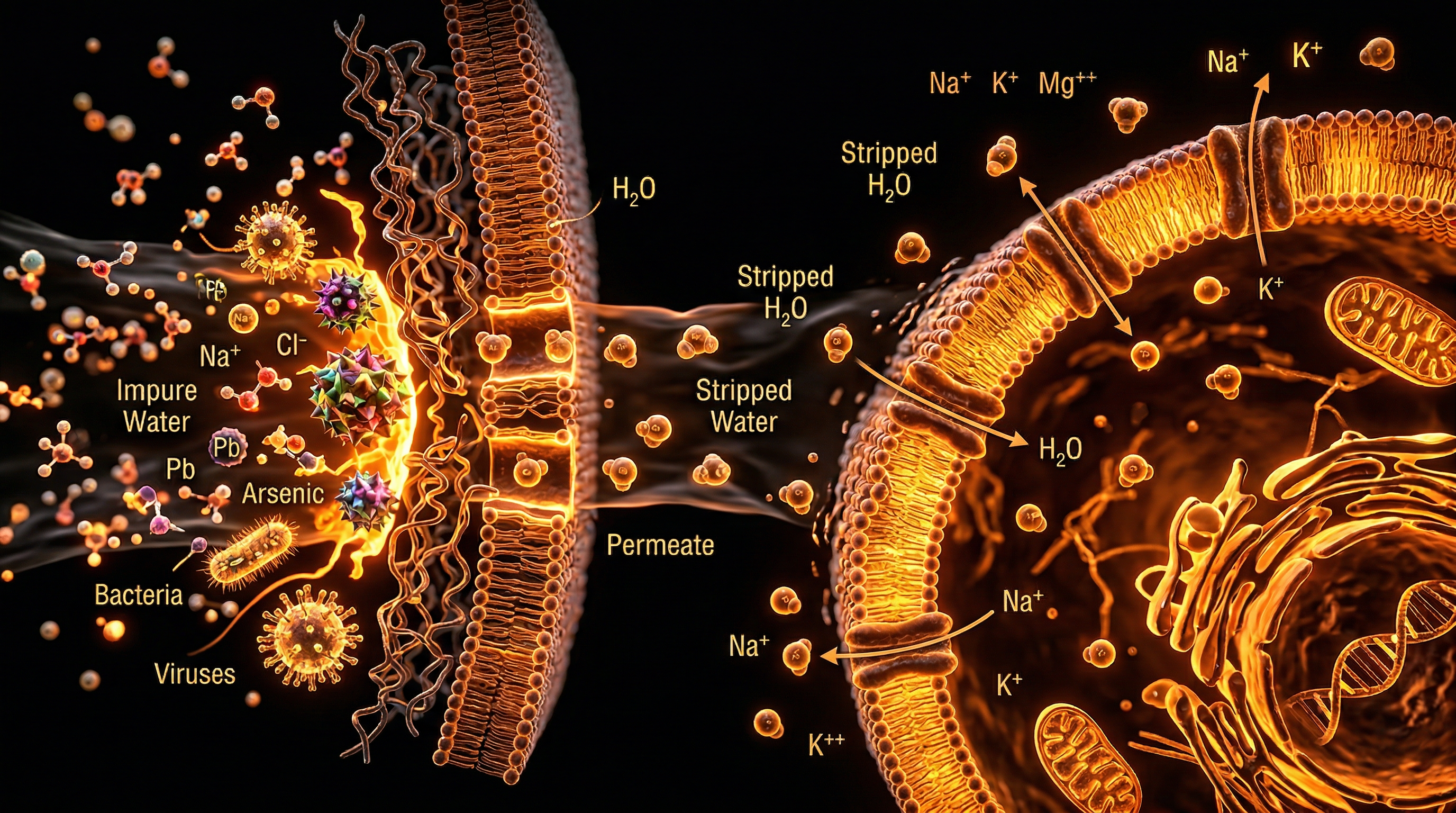
In a Reverse Osmosis system, this process is forced into reverse using high-pressure pumps. Water is pushed through a synthetic, semi-permeable membrane with microscopic pores—typically around 0.0001 microns in size. This pressure overcomes the natural osmotic pressure, forcing water molecules through the membrane while leaving behind larger ions, molecules, and contaminants.
The Membrane Mechanism
The RO membrane acts as a molecular gatekeeper. It is designed to reject anything larger than the water molecule itself. This includes:
- Monovalent and Divalent Ions: Such as Sodium, Calcium, Magnesium, and Chloride.
- Heavy Metals: Lead, Arsenic, Mercury, and Cadmium.
- Organic Chemicals: Pesticides, herbicides (glyphosate), and volatile organic compounds (VOCs).
- Microorganisms: Bacteria, viruses, and cysts.
According to fluid dynamics, the rejection rate of a high-quality RO membrane for inorganic minerals and salts is typically between 95% and 99.8%.
The result is a permeate water that is chemically "pure" but biologically vacant. In its natural state, water exists as a complex solution of dissolved minerals and gases, which determine its pH, conductivity, and Zeta potential. By stripping these components, RO creates a vacuum-like state. This water is technically "hungry"; it is chemically unstable and seeks to re-establish its mineral equilibrium by absorbing whatever it comes into contact with—including the plastic of the storage tank, the copper of the pipes, or the tissues of the body.
Mechanisms at the Cellular Level
The human body is not a static vessel; it is a highly sensitive bio-electromagnetic system. Our cells do not simply "drink" water; they interact with it through specialised channels and electromagnetic fields. When we introduce RO water into this system, several critical cellular mechanisms are disrupted.
Aquaporins and Molecular Geometry
The discovery of Aquaporins by Peter Agre (which earned him the Nobel Prize in Chemistry) revealed that water enters cells through specific protein channels. These channels are incredibly narrow, allowing water molecules to pass through in a single-file "water wire." However, this transport is not merely dependent on the size of the molecule; it is dependent on the dipole moment and the structural orientation of the water clusters.
Natural water tends to form "hexagonal" or structured clusters. RO water, having been forced through a membrane under high pressure, emerges with a chaotic, fragmented molecular structure. This "bulk water" is less "wet" at a cellular level, meaning it requires more metabolic energy (ATP) for the cell to organise the water into a form that can pass through the aquaporin. Consequently, it is possible to be "over-hydrated" on a macro level (frequent urination) while remaining "dehydrated" at a cellular level.
The Leaching Effect and Osmotic Balance
Extracellular fluid must maintain a specific concentration of electrolytes (Sodium, Potassium, Magnesium, Calcium) to ensure proper osmotic pressure. When we consume demineralised RO water, we introduce a fluid with zero TDS (Total Dissolved Solids) into the gut.
Through the laws of diffusion, the body must sacrifice its own internal mineral stores to bring that water into an isotonic state suitable for absorption. This leads to a systemic "leaching" effect. The water pulls electrolytes from the blood and tissues to balance itself, which are then excreted via the kidneys. Over time, this can lead to a state of chronic sub-clinical mineral deficiency, particularly in Magnesium and Calcium, which are critical for mitochondrial function and heart rhythm.
The Exclusion Zone (EZ) and Bio-Photons
Research by Dr Gerald Pollack at the University of Washington has identified a fourth phase of water, known as Exclusion Zone (EZ) water or H₃O₂. This is a gel-like state of water that forms next to hydrophilic surfaces (like our cell membranes). This EZ layer acts as a biological battery, storing charge.
RO water, being devoid of the mineral ions that facilitate the formation of these exclusion zones, has a lower "charge density." It lacks the bio-photonic signature of living water. In essence, RO water is "dead" because it cannot effectively support the electromagnetic environment necessary for protein folding and enzymatic reactions within the cell.
Environmental Threats and Biological Disruptors
The shift towards RO filtration in the UK is not a matter of choice for many; it is a defensive reaction to an increasingly toxic water supply. The modern water grid is a delivery system for a myriad of Biological Disruptors.
PFAS: The "Forever Chemicals"
Per- and polyfluoroalkyl substances (PFAS) are a group of man-made chemicals used in non-stick cookware and firefighting foams. They are structurally nearly indestructible and have been linked to thyroid disease, liver damage, and cancer. In the UK, monitoring of PFAS in tap water is often criticised for being insufficient, with many "safe" limits set far above what independent researchers deem dangerous.
Fluoridation and the Brain
In the UK, large swathes of the population (particularly in the West Midlands and North East) receive artificially fluoridated water. While mainstream dentistry promotes this for tooth decay, the biological reality is that Fluoride is a known neurotoxin and an endocrine disruptor that accumulates in the pineal gland, potentially calcifying it and disrupting circadian rhythms.
Pharmaceuticals and Hormones
Modern sewage treatment plants are not designed to filter out microscopic drug residues. Studies of UK waterways have found significant concentrations of:
- Ethinylestradiol: From birth control pills, leading to the feminisation of aquatic life and potential endocrine disruption in humans.
- Statins and Antidepressants: Found in trace amounts in major city tap water.
- Antibiotics: Contributing to the rise of "superbugs" and disrupting the human gut microbiome.
Research indicates that over 4,000 different pharmaceutical residues have been detected in environmental water samples globally.
RO is one of the few technologies capable of removing these "invisible" threats, making it a necessary evil in a world where our primary water sources have become chemical disposal sites.
The Cascade: From Exposure to Disease
What happens when a population drinks chemically pure but structurally dead water over years or decades? The biological cascade is subtle but devastating.
Electrolyte Imbalance and Cardiovascular Health
The World Health Organization (WHO) published a paper titled "Health Risks from Drinking Demineralized Water," which warned that the consumption of water low in magnesium and calcium is associated with an increased risk of sudden death from cardiovascular disease.
Magnesium is a cofactor for over 300 enzymatic reactions. When RO water leaches magnesium from the vascular system, it leads to:
- Vasoconstriction: Increasing blood pressure.
- Arrhythmia: The heart’s electrical system becomes unstable.
- Muscle Cramps and Spasms: Especially during physical exertion.
Metabolic Acidosis
RO water typically has an acidic pH, often ranging between 5.5 and 6.5. While the body has robust buffering systems (using bicarbonate from the kidneys and minerals from the bones), a constant intake of acidic water puts a chronic strain on these systems. This can lead to low-grade metabolic acidosis, a state that promotes inflammation, decreases bone density (osteoporosis), and provides a fertile environment for cancer cells, which thrive in acidic, low-oxygen conditions.
Cognitive Decline and Heavy Metal Affinity
Because RO water is so aggressive, it has a high affinity for heavy metals. If the water sits in a low-quality plastic tank or passes through old lead piping after filtration, it will aggressively pull those toxins into solution. Furthermore, the lack of "protective" minerals like silica in RO water means that the body is more vulnerable to the neurotoxic effects of Aluminium, which silica normally helps to chelate and excrete.
What the Mainstream Narrative Omits
The mainstream scientific and governmental narrative regarding water is focused almost exclusively on toxicology (the presence of "bad" things) while completely ignoring physiology (the presence of "good" things and the state of the water itself).
The Myth of "Mineral Sufficiency" from Food
A common argument from proponents of "pure" RO water is that "we get all our minerals from food, so it doesn't matter if they are in the water." This is a biological fallacy.
- Bioavailability: Minerals in water are in an ionic form, making them highly bioavailable. They are absorbed directly in the upper GI tract.
- Soil Depletion: Modern industrial farming has depleted the soil of minerals. A carrot today contains significantly less magnesium than a carrot from 1950. We can no longer rely solely on food for our electrolyte requirements.
- The Buffer Effect: Waterborne minerals serve as a pH buffer for the stomach and blood that food cannot replicate in the same temporal window.
The Memory of Water
Mainstream science often dismisses the concept of "water memory," yet researchers like Jacques Benveniste and later Luc Montagnier (who discovered HIV) provided evidence that water can retain the electromagnetic frequency of substances previously dissolved in it.
Even after the physical toxins are removed by the RO membrane, the electromagnetic signature of those toxins—the "stress" in the water's structure—remains. Standard RO systems do nothing to "reset" the water's information. This is why "dead" water feels different in the mouth and body compared to a mountain spring; it lacks the coherent frequency of the Earth's magnetic field.
The UK Context
The UK presents a unique challenge for water quality. Unlike the vast, deep aquifers of some regions, the UK relies heavily on surface water and aging Victorian-era infrastructure.
Hard Water vs. Soft Water Areas
In the South East of England and London, the water is notoriously "hard," containing high levels of calcium carbonate. While this scales up kettles, it is actually more cardioprotective than the "soft" water found in Scotland and the North. However, the hardness comes with high levels of chlorine and agricultural nitrates.
Residents in London often turn to RO to remove the "chemical taste" of Thames Water. Without realising it, they are trading a mineral-rich (albeit contaminated) source for a chemically pure but mineral-depleted source.
The Nitrate Problem
In East Anglia and other agricultural hubs, nitrate levels in groundwater frequently approach or exceed legal limits due to nitrogen-based fertilisers. Nitrates can be converted to nitrites in the body, interfering with the blood's ability to carry oxygen (methemoglobinemia). For residents in these areas, RO is one of the few effective ways to remove nitrates, but it leaves them with the "stripped water" dilemma.
The Rise of Domestic RO
The UK market has seen an explosion in "under-sink" RO systems. Most of these are basic 3-stage or 5-stage units that do not include a remineralisation or restructuring phase. The result is a generation of health-conscious Britons who are unintentionally inducing mineral deficiencies in their pursuit of cleanliness.
Protective Measures and Recovery Protocols
If you use an RO system, or are considering one, it is imperative to move beyond simple filtration. You must become an "architect" of your water. The goal is to take the "blank slate" of RO water and turn it back into biological fuel.
1. Remineralisation: The First Pillar
You must replace the missing ions.
- Trace Mineral Drops: Use a high-quality concentrated mineral complex (derived from inland seas or ancient salt deposits).
- Quinton Marine Plasma: This is the "gold standard" of remineralisation. It is harvested from plankton blooms and contains every element of the periodic table in the exact proportions found in human blood. Adding a vial of Quinton to RO water "wakes it up" biologically.
- Himalayan or Celtic Sea Salt: A pinch of high-quality salt per litre adds sodium, potassium, and magnesium, helping to structure the water and improve its conductivity.
2. Restructuring: The Second Pillar
Water in nature never moves in a straight line or sits in a square tank; it spirals and vortexes.
- Vortexing: Use a magnetic stirrer or a specialised vortexing jug. This movement breaks up large water clusters and increases dissolved oxygen.
- Magnetism: Passing RO water through a strong magnetic field (1,000+ Gauss) helps to realign the hydrogen bonds and can decrease the surface tension, making the water more "absorbable."
- Crystals and Stones: The use of Shungite (a carbon-based mineral from Russia) is particularly effective. It contains "fullerenes"—spherical carbon molecules that act as powerful antioxidants and help to neutralise the "memory" of toxins in the water.
3. Charging: The Third Pillar
Water is a battery that is charged by light.
- Solarisation: Place your water in a blue glass bottle and leave it in the sun for 1–3 hours. The UV and infrared light from the sun help to expand the Exclusion Zone (EZ) within the water, increasing its bio-energetic potential.
- Infrared Exposure: If sun is not available (a common UK problem), using a near-infrared (NIR) light on your water container for a few minutes can achieve a similar effect.
4. Storage Matters
Never store RO water in plastic. Its "aggressive" nature will leach endocrine-disrupting phthalates and BPA/BPS into the water much faster than standard tap water.
- Use Borosilicate glass, high-grade stainless steel, or ceramic dispensers.
Summary: Key Takeaways
The use of Reverse Osmosis is a modern necessity dictated by the degradation of our environment. However, drinking "naked" RO water is a biological error that can lead to systemic depletion.
- The Paradox: RO is the most effective way to remove PFAS, Fluoride, and Pharmaceuticals, but it creates "dead" water that can leach minerals from your body.
- Biological Impact: RO water lacks the molecular structure and ionic charge required for optimal aquaporin transport and cellular EZ formation.
- Health Risks: Chronic consumption of un-remineralised RO water is linked to cardiovascular issues, electrolyte imbalances, and metabolic acidosis.
- The UK Situation: Residents must navigate a choice between contaminated "hard" water and "dead" filtered water.
- The Solution: Filtration is only the first half of the process. For true hydration, RO water must be remineralised (with trace minerals or Quinton), restructured (via vortexing or magnetism), and recharged (via sunlight or infrared).
To drink water is to participate in an ancient biological rite. By applying the principles of structured water science, we can ensure that our quest for purity does not come at the cost of our vitality. We must transform the "stripped" water of the industrial age back into the "living" water of our biological heritage.
This article is provided for informational and educational purposes only. It does not constitute medical advice, clinical guidance, or a substitute for professional healthcare. Information reflects cited research at time of publication. Always consult a qualified healthcare professional before acting on any health information.
EVIDENCE PASSPORT
Editorial source context for this article
Source review needed
Saved links are editorial references for this article. They may support specific claims rather than every sentence. Open and assess each source in context. This passport does not independently verify them.
Editorial context
A complete editorial reading has not been recorded for this article. Source links remain available for you to open and assess directly.
Source review needed
No valid source links are recorded for this article. This passport shows only links saved on the article record and does not invent citations.
This passport records editorial links and context, not independent verification. Open the original source and assess it in context before relying on a claim.
Medical Disclaimer
The information in this article is for educational purposes only and does not constitute medical advice, diagnosis, or treatment. Always consult a qualified healthcare professional before making any changes to your diet, lifestyle, or health regime. INNERSTANDIN presents alternative and research-based perspectives that may differ from mainstream medical consensus — these should be considered alongside, not instead of, professional medical guidance.
Read Full DisclaimerContinue the thread
Keep this question moving.
Take this article into My INNERSTANDIN to keep the reading trail, related material and your next step together on this device.