
The Role of Dopamine in ADHD
Updated May 2026
A look into the neurochemistry of attention and how dopamine levels influence ADHD symptoms.
Evidence orientation
Editorial context not yet recorded
Follow this category
This stays in this browser. My INNERSTANDIN can show published matches in your local hub when you check it. It does not send email, push, or alert notifications.
Local learning review
A private browser aid for revisiting ideas. It is not an alert or a health recommendation.
Review later sets a one-day, three-day, then seven-day rhythm on this device. Choose it only when you want to revisit this article.
Introduction
Attention Deficit Hyperactivity Disorder (ADHD) is one of the most prevalent neurodevelopmental conditions in the United Kingdom, affecting approximately 5% of children and 3-4% of adults. For decades, the condition was frequently misunderstood as a behavioural issue—a failure of discipline or a lack of willpower. However, modern neuroscience has shifted this paradigm entirely, revealing ADHD to be a complex, heritable, and biological condition rooted in the intricate architecture of the brain’s neurotransmitter systems.
At the heart of this biological narrative is dopamine. Often colloquially referred to as the brain’s "pleasure chemical," dopamine’s role in ADHD is far more nuanced. It is the fundamental architect of motivation, executive function, and the regulation of internal and external stimuli. In the UK context, understanding the dopaminergic basis of ADHD is not merely an academic exercise; it is the cornerstone of clinical diagnosis, the development of National Institute for Health and Care Excellence (NICE) guidelines, and the foundation upon which millions of patients manage their daily lives.
This article provides an authoritative exploration of the relationship between dopamine and ADHD, examining the neurobiology of the "dopamine deficiency" hypothesis, the genetic underpinnings of the condition, and how pharmacological interventions seek to rebalance this delicate chemical ecosystem.
Part I: What is Dopamine? More Than a Reward Chemical
To understand ADHD, one must first understand dopamine. Dopamine is a monoamine neurotransmitter—a chemical messenger that transmits signals across the synaptic cleft (the gap between neurons). In the human brain, it is produced primarily in the substantia nigra and the ventral tegmental area (VTA).
While popular media focuses on dopamine’s role in "reward" and "pleasure," neuroscientists view it through the lens of salience and anticipation. Dopamine signals to the brain that a particular stimulus is important, worth noticing, and worth pursuing. It is the "engine" of the brain, driving us toward goals, whether that is seeking food, finishing a work report, or engaging in social interaction.
The Dynamics of Dopamine: Tonic vs. Phasic
To understand the ADHD brain, we must distinguish between two types of dopamine release:
- Tonic Dopamine: This is the steady, "background" level of dopamine present in the synapse. It sets the threshold for how responsive we are to our environment.
- Phasic Dopamine: These are rapid bursts of dopamine released in response to specific stimuli—usually a "reward prediction error" (something better than expected) or a novel event.
In a neurotypical brain, there is a harmonious balance between tonic and phasic levels. In the ADHD brain, this balance is disrupted, leading to a system that is simultaneously "noisy" and "under-responsive."
Part II: The Dopamine Hypothesis of ADHD
The "Dopamine Hypothesis" is the prevailing neurobiological theory of ADHD. It suggests that the symptoms of inattention, hyperactivity, and impulsivity are the result of dysregulated dopamine transmission, particularly in the pathways that govern executive function and reward processing.
1. The "Low Tonic" Problem
Research indicates that individuals with ADHD often have lower levels of tonic (baseline) dopamine. When background dopamine is low, the brain finds it difficult to sustain attention on tasks that are not inherently stimulating (such as administrative work or academic study). The brain feels "bored" at a cellular level. To compensate, the individual may seek out high-stimulation activities—fidgeting, risk-taking, or frequent task-switching—to trigger "phasic" bursts of dopamine to "wake up" the system.
2. The Dopamine Transporter (DAT) Density
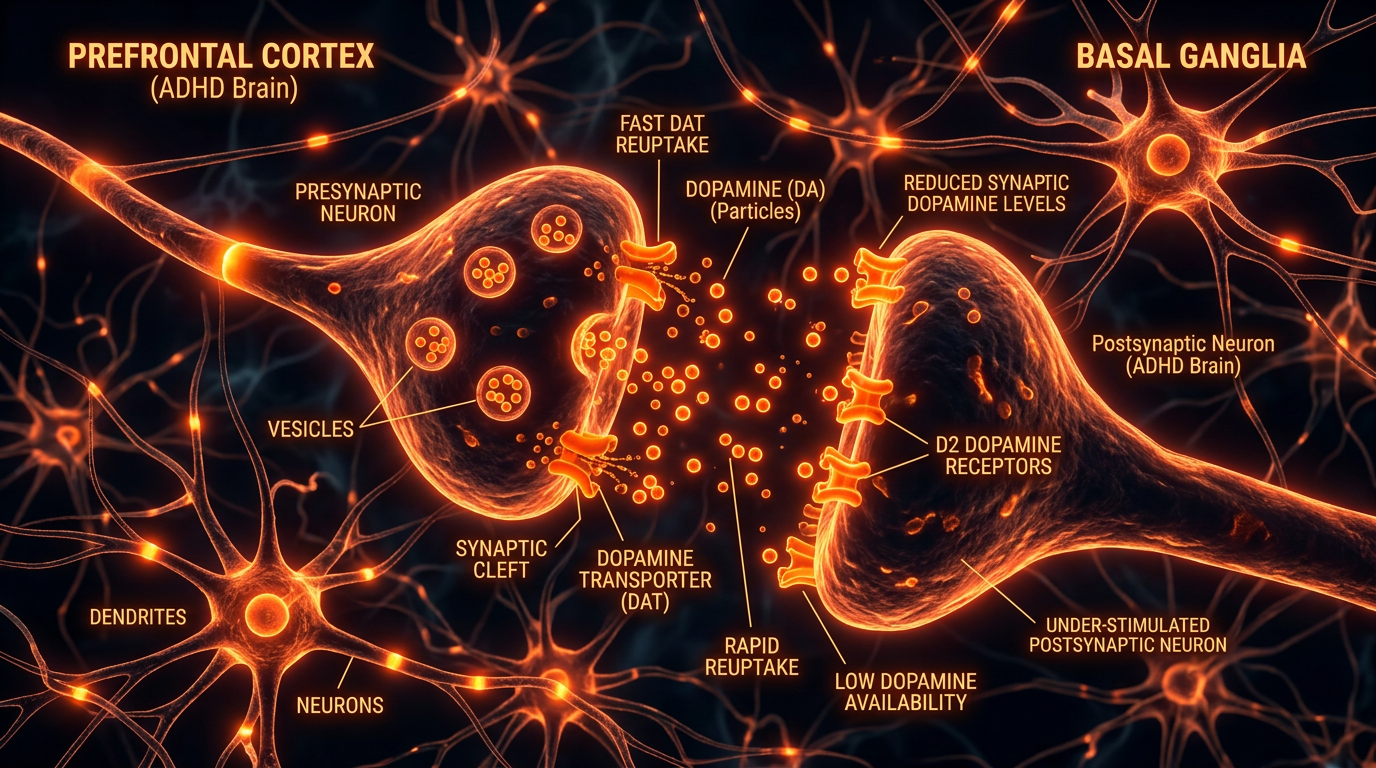
A significant factor in the UK’s understanding of ADHD involves the role of the Dopamine Transporter (DAT). DAT is a protein responsible for "reuptake"—the process of vacuuming up dopamine from the synapse after it has been released.
Studies using Positron Emission Tomography (PET) scans have shown that many people with ADHD have an overabundance of these transporters. Essentially, the "vacuum cleaners" are too efficient, removing dopamine before it has had a chance to bind to the receiving neuron. This results in a "short circuit" of the reward and attention pathways.
3. Receptor Sensitivity
It isn't just about the amount of dopamine; it’s about how the brain receives it. There are five types of dopamine receptors (D1 through D5). Research, particularly into the DRD4 and D2 receptors, suggests that in ADHD, these receptors may be less sensitive or less numerous in key areas of the brain. Even if dopamine is present, the message isn't being received clearly.
Part III: The Neuroanatomical Pathways
Dopamine doesn't act in a vacuum; it travels along specific "highways" in the brain. In ADHD, three primary pathways are of particular interest:
1. The Mesocortical Pathway (The "Executive")
This pathway connects the VTA to the prefrontal cortex (PFC). The PFC is the brain’s "Chief Executive Officer," responsible for planning, decision-making, working memory, and impulse control. In ADHD, insufficient dopamine in this pathway leads to "Executive Dysfunction." This explains why an ADHD individual may know what they need to do but cannot "bridge the gap" to actually doing it. The UK’s Royal College of Psychiatrists often highlights this as a deficit in "self-regulation."
2. The Mesolimbic Pathway (The "Reward Centre")
Often called the "reward pathway," this connects the VTA to the nucleus accumbens. It regulates motivation and the experience of pleasure. In ADHD, this pathway often exhibits "Reward Deficiency Syndrome." Typical rewards (like the satisfaction of finishing a task) don't register as strongly. Consequently, the ADHD brain prioritises immediate, high-intensity rewards over long-term goals—the biological root of impulsivity.
3. The Nigrostriatal Pathway (The "Motor")
This pathway connects the substantia nigra to the striatum and is involved in motor control. Dysregulation here is thought to contribute to the physical hyperactivity and "fidgeting" often seen in the hyperactive-impulsive and combined presentations of ADHD.
Part IV: Executive Function and the "Goldilocks Principle"
The relationship between dopamine and the prefrontal cortex follows what scientists call an "Inverted U-shaped curve," or the Goldilocks Principle.
- Too Little Dopamine: The brain is under-aroused. Focus is scattered, and the individual is easily distracted by any passing thought or external noise.
- Too Much Dopamine: The brain becomes over-aroused, leading to "hyper-focus," anxiety, or cognitive inflexibility.
- The "Just Right" Amount: This is where optimal executive functioning occurs—the ability to focus, plan, and shift attention flexibly.
For the ADHD individual, the brain is chronically stuck on the "Too Little" side of the curve. This is why stimulants, which increase dopamine, actually have a "calming" effect on those with ADHD; they move the brain into the "Just Right" zone, allowing the prefrontal cortex to finally exert control over the rest of the brain.
Part V: The Genetic Landscape
ADHD is one of the most heritable conditions in psychiatry, with heritability estimates around 74-80%. Much of this genetic influence is tied directly to dopamine-regulating genes.
The DRD4 Gene
The DRD4 gene codes for a specific type of dopamine receptor. A specific variation, known as the "7-repeat allele," has been consistently linked to ADHD. This variation makes the receptor less sensitive to dopamine, requiring higher levels of the neurotransmitter to achieve the same effect as a neurotypical person.
The COMT Gene
The Catechol-O-methyltransferase (COMT) gene provides instructions for an enzyme that breaks down dopamine in the prefrontal cortex. Certain variations of this gene result in the enzyme working too quickly, leading to a chronic shortage of dopamine in the area of the brain responsible for focus and logic.
In the UK, research at institutions like King’s College London and Cardiff University continues to explore how these genetic markers can eventually lead to "personalised medicine," where a patient’s genetic profile determines their specific treatment plan.
Part VI: Reward Deficiency and the "Boredom" Crisis
A defining feature of the ADHD experience is the struggle with "monotony." Because of the dysregulated mesolimbic pathway, the ADHD brain perceives boredom not just as a nuisance, but as an almost physical pain.
Delayed Gratification
In neurotypical individuals, the brain can "hold" the image of a future reward (e.g., "If I work hard now, I will get a promotion next year") and release enough dopamine to sustain effort. In ADHD, the brain struggles to value future rewards. If the reward isn't "Now," the dopamine isn't there. This is why many UK adults with ADHD report a history of "starting but never finishing" projects.
Sensation Seeking and Risk
The "Reward Deficiency Syndrome" often drives individuals toward high-dopamine activities. This can include:
- Extreme sports.
- High-pressure careers (A&E doctors, stock traders, emergency services).
- Less healthy coping mechanisms, such as excessive caffeine consumption, nicotine, or substance misuse.
Understanding this as a "dopamine-seeking behaviour" rather than a moral failing is essential for effective therapy and support.
Part VII: Pharmacological Interventions in the UK
The primary treatment for ADHD in the UK, as recommended by NICE, involves pharmacological support designed to modulate dopamine levels.
1. Stimulants (The First Line)
Stimulants are the most common treatments and include Methylphenidate (brand names: Concerta, Ritalin, Equasym) and Lisdexamfetamine (brand name: Elvanse).
- Methylphenidate: This acts primarily as a Dopamine Reuptake Inhibitor (DRI). It blocks the DAT "vacuums," preventing dopamine from being cleared away too quickly. This increases the amount of tonic dopamine available in the synapse.
- Lisdexamfetamine/Dexamfetamine: These are dopamine releasing agents. Not only do they block reuptake, but they also trigger the release of more dopamine from the storage vesicles within the neuron.
In the UK, the "titration" process is used by clinicians to find the exact dose that brings a patient into the "Goldilocks" zone without pushing them into over-arousal.
2. Non-Stimulants
For those who do not tolerate stimulants, medications like Atomoxetine are used. While Atomoxetine primarily targets noradrenaline (norepinephrine), the two systems are deeply intertwined. Increasing noradrenaline in the prefrontal cortex also leads to a secondary increase in dopamine in that specific region, aiding focus without the systemic "surge" of a stimulant.
3. The Role of Noradrenaline
It is important to note that dopamine does not work alone. Noradrenaline is its "sister" neurotransmitter. While dopamine signals importance and reward, noradrenaline signals urgency and arousal. Most ADHD medications target both, as the balance between the two is vital for staying on task.
Part VIII: The Impact of Modern Life on the ADHD Dopamine System
The 21st-century environment—characterised by "infinite scrolls," instant notifications, and short-form video content—acts as a "dopamine trap" for the ADHD brain.
The "Dopamine Loop"
Social media platforms are designed to trigger phasic dopamine bursts. For a brain already starving for dopamine, these platforms are highly addictive. In the UK, concerns are growing regarding how "digital dopamine" might exacerbate ADHD symptoms, leading to a state of "continuous partial attention."
For individuals with ADHD, the challenge is that these digital rewards are "cheap"—they provide the dopamine hit without the constructive outcome, often leaving the individual feeling more depleted and less able to focus on real-world responsibilities.
Part IX: Non-Pharmacological Management of Dopamine
While medication is the most effective way to regulate dopamine, lifestyle factors play a significant role in "dopamine hygiene."
1. Physical Exercise
Exercise is often called "natural Ritalin." Physical activity increases the production of dopamine and Brain-Derived Neurotrophic Factor (BDNF). In the UK, many ADHD coaching programmes emphasise "Green Exercise"—outdoor activity—which has been shown to have a particularly grounding effect on the ADHD nervous system.
2. Protein-Rich Diets
Dopamine is synthesised from the amino acid tyrosine. Consuming protein-rich foods (lean meats, eggs, beans, nuts) provides the raw building blocks for dopamine production. While diet alone cannot "cure" ADHD, a lack of tyrosine can certainly make symptoms harder to manage.
3. Sleep Regulation
There is a reciprocal relationship between dopamine and sleep. Dopamine regulates our circadian rhythm, but sleep deprivation also desensitises dopamine receptors. Many people with ADHD in the UK suffer from "Delayed Sleep Phase Syndrome," where their brain "wakes up" at 10 pm. Managing this cycle is crucial for maintaining dopamine sensitivity during the day.
4. Novelty and "Body Doubling"
Using the brain’s love for novelty can be a strategy. "Body doubling"—working alongside someone else (a common practice in UK ADHD support groups and co-working spaces)—can provide a subtle, steady stream of dopamine through social accountability, making it easier to stay on task.
Part X: Co-morbidities and the Dopaminergic Overlap
Dopamine dysregulation is not unique to ADHD; it overlaps with several other conditions, which is why ADHD rarely "travels alone."
1. ADHD and Addiction
The "Reward Deficiency" mentioned earlier makes individuals with ADHD significantly more prone to substance use disorders. In the UK, research suggests that a substantial percentage of the prison population and individuals in addiction recovery have undiagnosed ADHD. They are often "self-medicating" to raise their dopamine levels to a functional baseline.
2. ADHD and Depression (Dysthymia)
Low dopamine is linked to anhedonia—the inability to feel pleasure. Many ADHD patients are initially misdiagnosed with depression in the UK because they present with a lack of motivation and energy, which is actually a symptom of dopaminergic under-arousal rather than primary clinical depression.
3. Obesity and Binge Eating
Dopamine regulates the reward we get from food. Those with ADHD may engage in impulsive eating or seek out high-sugar/high-fat foods to trigger dopamine releases, leading to higher rates of obesity within the ADHD community.
Part XI:
The UK Context
: NHS Challenges and the Future of Care
The understanding of dopamine's role in ADHD has led to a surge in demand for assessments in the UK. However, this has put significant pressure on the NHS.
The "Right to Choose"
Due to long waiting lists for adult ADHD assessments (sometimes exceeding three to five years in certain trusts), many patients are using "Right to Choose" to access private assessments funded by the NHS. This shift highlights the growing public awareness that ADHD is a medical, chemical condition requiring specialist intervention.
Neurodiversity in the Workplace
The UK’s Equality Act 2010 recognises ADHD as a potential disability. Employers are increasingly aware that "dopamine-friendly" workplaces—those that offer variety, clear feedback, and flexible environments—allow ADHD employees to thrive. When the dopaminergic need for novelty and stimulation is met, individuals with ADHD can become some of the most creative and productive members of a team.
Future Research: Beyond the Stimulant
Current research in the UK is looking into "Neuromodulation"—such as Transcranial Magnetic Stimulation (TMS)—which aims to stimulate the dopaminergic pathways without the use of medication. There is also ongoing study into the "Default Mode Network" (DMN)—the part of the brain that wanders when we aren't focused—and how dopamine helps "shut it off" so we can concentrate.
Conclusion: Reframing the ADHD Brain
The role of dopamine in ADHD is the story of a brain that is fundamentally "wired" differently. It is a brain that struggles with the mundane but often excels in the extraordinary; a brain that is easily distracted by the irrelevant but can achieve "hyper-focus" on the fascinating.
By understanding ADHD through the lens of dopamine, we move away from a culture of blame and toward a culture of management and empowerment. We recognise that the "inattentive" child in a London classroom or the "disorganised" employee in a Manchester office is not failing to try; they are working with a neurochemical system that requires a different set of tools to function optimally.
Whether through medication that regulates reuptake, exercise that boosts production, or environmental changes that provide healthy stimulation, the goal is the same: to balance the delicate dopaminergic scales. In doing so, we don't just "treat" a condition; we unlock the significant potential of the neurodivergent mind.
As we move forward, the UK’s medical and social systems must continue to adapt to this neurobiological reality. ADHD is not a deficit of "will"; it is a challenge of "chemistry." And in that understanding lies the key to helping millions of people lead focused, fulfilling, and dopaminergically balanced lives.
References and Further Reading (UK Context)
- NICE Guidelines [NG87]: Attention deficit hyperactivity disorder: diagnosis and management.
- ADHD UK: A leading charity providing research and support for the UK ADHD community.
- The Royal College of Psychiatrists: Resources on adult and paediatric ADHD neurobiology.
- AADD-UK: The main charity for adults with ADHD in the United Kingdom.
- Volkow, N. D., et al.: "Evaluating Dopamine Reward Pathway in ADHD," Journal of the American Medical Association (JAMA).
- Barkley, R. A.: Executive Functions: What They Are, How They Work, and Why They Evolved. (Widely used by UK practitioners).
This article is provided for informational and educational purposes only. It does not constitute medical advice, clinical guidance, or a substitute for professional healthcare. Information reflects cited research at time of publication. Always consult a qualified healthcare professional before acting on any health information.
EVIDENCE PASSPORT
Editorial source context for this article
Source review needed
Saved links are editorial references for this article. They may support specific claims rather than every sentence. Open and assess each source in context. This passport does not independently verify them.
Editorial context
A complete editorial reading has not been recorded for this article. Source links remain available for you to open and assess directly.
Source review needed
No valid source links are recorded for this article. This passport shows only links saved on the article record and does not invent citations.
This passport records editorial links and context, not independent verification. Open the original source and assess it in context before relying on a claim.
Medical Disclaimer
The information in this article is for educational purposes only and does not constitute medical advice, diagnosis, or treatment. Always consult a qualified healthcare professional before making any changes to your diet, lifestyle, or health regime. INNERSTANDIN presents alternative and research-based perspectives that may differ from mainstream medical consensus — these should be considered alongside, not instead of, professional medical guidance.
Read Full DisclaimerContinue the thread
Keep this question moving.
Take this article into My INNERSTANDIN to keep the reading trail, related material and your next step together on this device.
Explore this in the Body Map
See where this hits your biology. Interactive anatomy, threats, and protective protocols.
Dig deeper in the Library
Free, longform PDF volumes that go beyond headlines into mechanisms and references.