
Short-Chain Fatty Acids: The Epigenetic Power of Fiber
Updated May 2026
When microbes ferment fibre, they produce butyrate, a short-chain fatty acid with epigenetic silencing capabilities. This mechanism is crucial for preventing colorectal cancers in the UK population.
Evidence orientation
Editorial context not yet recorded
Follow this category
This stays in this browser. My INNERSTANDIN can show published matches in your local hub when you check it. It does not send email, push, or alert notifications.
Local learning review
A private browser aid for revisiting ideas. It is not an alert or a health recommendation.
Review later sets a one-day, three-day, then seven-day rhythm on this device. Choose it only when you want to revisit this article.
Overview
In the modern landscape of clinical oncology and gastroenterology, we have long viewed dietary fibre as little more than a "bulking agent"—a biological broom designed to sweep the intestinal tract and ensure regularity. This reductionist perspective, promulgated by decades of simplistic nutritional guidelines, has obscured one of the most profound biochemical alliances in human physiology. We are not merely consumers of fibre; we are biological hosts to a sophisticated microbial refinery that converts indigestible plant polysaccharides into high-potency molecular signals known as Short-Chain Fatty Acids (SCFAs).
The primary SCFAs—acetate, propionate, and butyrate—are not merely metabolic by-products. They are potent epigenetic modulators capable of silencing oncogenes, activating tumour-suppressor genes, and governing the very integrity of the human genome. Specifically, butyrate stands as a sentinel of cellular order, exerting a level of control over the colonic epithelium that modern pharmacology struggles to replicate.
The UK Fibre Gap: Despite government recommendations of 30g per day, the average adult in the United Kingdom consumes only 18g. This chronic deficiency creates a "metabolic vacuum" in the distal colon, depriving the microbiome of the raw materials needed to produce protective SCFAs.
As we face a burgeoning crisis of colorectal cancer (CRC) in the UK—now the second most common cause of cancer death—the necessity of understanding the "epigenetic power of fibre" has never been more urgent. This article explores the hidden mechanics of the microbial-host axis, the silent industrial assault on our internal fermentation vats, and the suppressed reality that our best defence against malignancy lies not in a syringe, but in the complex carbohydrates we have been conditioned to ignore.
The Biology — How It Works
The human genome is surprisingly ill-equipped to break down complex plant matter. We lack the enzymes required to deconstruct cellulose, hemicellulose, pectins, and resistant starches. Instead, we have outsourced this task to the gut microbiota, specifically the anaerobic bacteria residing in the caecum and ascending colon.
The Fermentation Bioreactor
When we consume Microbiota-Accessible Carbohydrates (MACs), they escape digestion in the small intestine and arrive in the large bowel. Here, a specialised guild of bacteria—primarily members of the Bacteroidetes and Firmicutes phyla—engage in anaerobic fermentation.
- Acetate (C2): The most abundant SCFA, produced by a wide range of bacteria. It enters the systemic circulation and reaches the liver and peripheral tissues, where it influences lipid metabolism and appetite regulation.
- Propionate (C3): Primarily metabolised by the liver, it plays a critical role in gluconeogenesis and has been shown to inhibit cholesterol synthesis.
- Butyrate (C4): The most physiologically significant SCFA for colonic health. While it constitutes only about 15-20% of the total SCFA pool, it provides up to 70% of the energy requirements for colonocytes (the cells lining the colon).
The Microbial Labour Force
Key butyrate-producing species include Faecalibacterium prausnitzii, Eubacterium rectale, and Roseburia spp. These microbes are not merely passive residents; they are master chemists. Through the butyryl-CoA:acetate CoA-transferase pathway, they convert the products of primary fermenters into the life-giving butyrate that maintains the mucosal barrier.
Callout: In a healthy gut, SCFA concentrations can reach 100 mmol/L in the lumen, creating an acidic environment (pH 5.5–6.5) that inhibits the growth of pathogenic species like E. coli and Salmonella.
Mechanisms at the Cellular Level
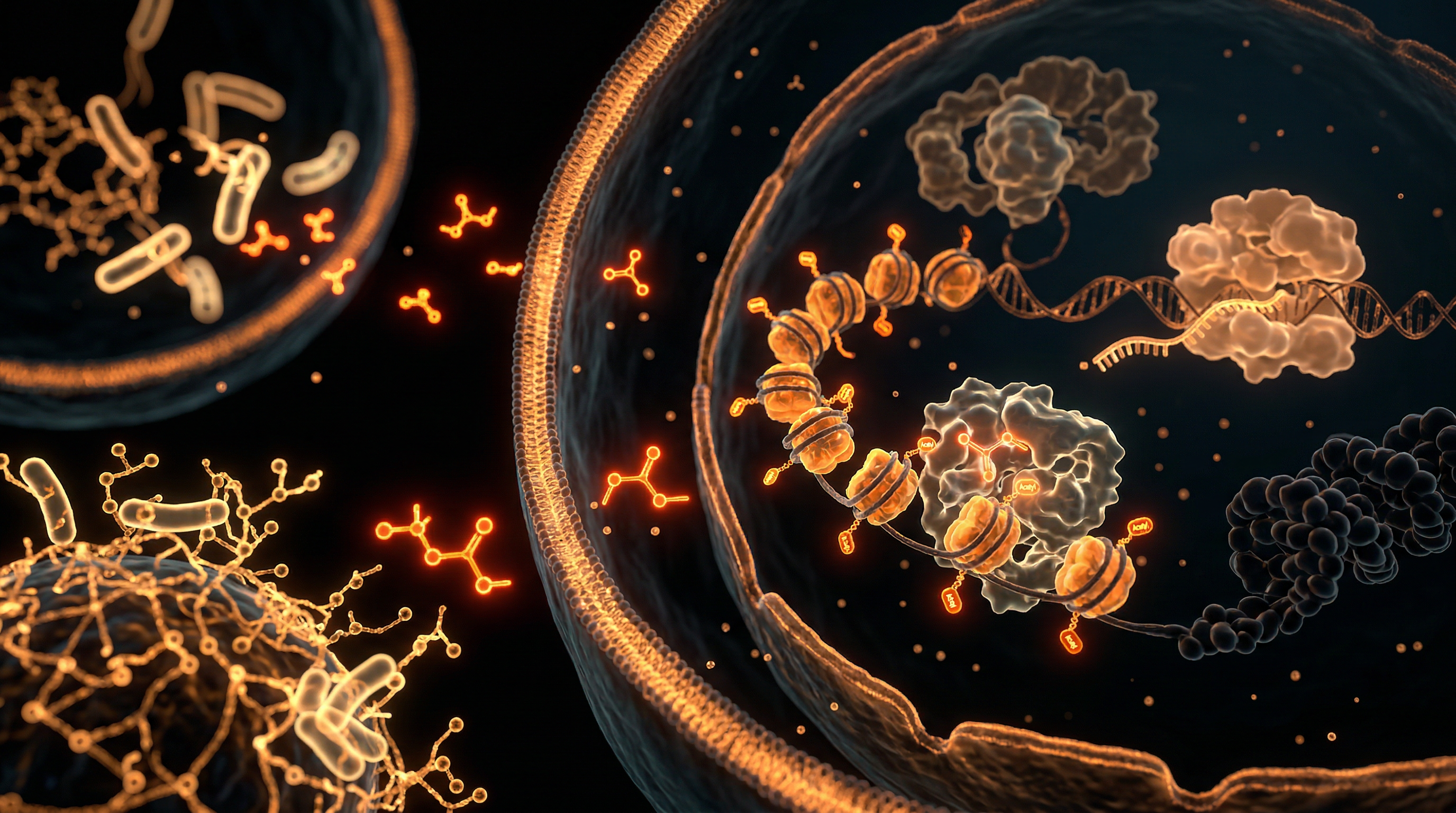
The truly "magic" property of butyrate lies in its ability to cross the cellular membrane and enter the nucleus, where it interacts directly with the folding of our DNA. This is the realm of epigenetics.
HDAC Inhibition: The Master Switch
The primary mechanism by which butyrate prevents cancer is through its role as a Histone Deacetylase (HDAC) Inhibitor. To understand this, we must look at how DNA is packaged. DNA is wrapped around proteins called histones. When histones are "acetylated" (holding an acetyl group), the DNA is loosely packed, allowing "tumour-suppressor genes" to be read and expressed.
Histone Deacetylases (HDACs) are enzymes that remove these acetyl groups, causing the DNA to wrap tightly, effectively silencing those protective genes. In many cancers, HDACs are overactive, shutting down the body’s natural anti-cancer instructions.
- Butyrate acts as a natural, potent HDAC inhibitor.
- By blocking HDACs, butyrate ensures that genes responsible for apoptosis (programmed cell death) and cell cycle arrest remain "switched on."
- This prevents the uncontrolled proliferation of damaged cells that leads to tumours.
The Butyrate Paradox
A fascinating aspect of this mechanism is the "Butyrate Paradox." In healthy colonocytes, butyrate is the preferred fuel source; it is rapidly oxidised in the mitochondria for energy. However, cancerous colonocytes undergo a metabolic shift known as the Warburg Effect, switching to glucose fermentation even in the presence of oxygen.
Because cancer cells do not oxidise butyrate efficiently, the SCFA accumulates in the nucleus. It is only in these malignant cells that butyrate reaches high enough concentrations to inhibit HDACs and trigger apoptosis. In essence, butyrate is a "smart" molecule: it feeds healthy cells and executes cancerous ones.
G-Protein Coupled Receptors (GPCRs)
Beyond the nucleus, SCFAs act as ligands for specific receptors on the cell surface, most notably GPR41, GPR43, and GPR109A.
- GPR43 activation on immune cells (T-regulatory cells) suppresses intestinal inflammation.
- GPR109A activation leads to the production of anti-inflammatory cytokines like IL-10.
By binding to these receptors, SCFAs douse the "fire" of chronic inflammation, which is a known precursor to DNA damage and oncogenesis.
Environmental Threats and Biological Disruptors
The SCFA production line is an exquisite piece of evolutionary machinery, but it is highly vulnerable to the chemical landscape of the 21st century. The modern "environment" is effectively a scorched-earth campaign against butyrate-producing microbes.
The Glyphosate Factor
The herbicide glyphosate, ubiquitous in the UK food chain via imported soy and non-organic grains, acts through the shikimate pathway. While humans do not possess this pathway, our beneficial gut bacteria do. Glyphosate preferentially targets the very microbes responsible for SCFA production, leading to a state of chronic dysbiosis.
Ultra-Processed Emulsifiers
Common food additives such as Carboxymethylcellulose (CMC) and Polysorbate 80, found in everything from "healthy" low-fat yoghurts to industrial bread, act as detergents. They erode the protective mucus layer of the gut. When the mucus layer thins, the proximity of bacteria to the epithelial wall triggers an inflammatory cascade, disrupting the delicate fermentation balance and reducing butyrate availability.
Antibiotic Overuse and "Collateral Damage"
A single course of broad-spectrum antibiotics can decimate populations of Faecalibacterium prausnitzii. In many cases, these butyrate-producing guilds never fully recover, leaving the host in a permanent state of "epigenetic vulnerability." The UK's historical over-reliance on antibiotics for viral infections has left a generation with "thinned" microbiomes.
Critical Statistic: Research indicates that the use of broad-spectrum antibiotics is associated with a 10% increase in the risk of developing colorectal cancer, likely due to the permanent reduction in SCFA-producing capacity.
The Cascade: From Exposure to Disease
The transition from a healthy gut to a malignant state is not an overnight event; it is a decades-long cascade of molecular failures driven by the absence of SCFAs.
- Stage 1: The Fibre Gap. The individual consumes a diet high in refined sugars and low in MACs. The "primary fermenters" starve, and the pH of the colon rises (becomes more alkaline).
- Stage 2: Microbial Shift. Acid-sensitive, butyrate-producing bacteria die off. They are replaced by proteolytic bacteria and "pathobionts" that thrive on protein fermentation, producing toxic metabolites like ammonia, hydrogen sulphide, and phenols.
- Stage 3: Mucosal Erosion. Without butyrate as a fuel source, colonocytes become energy-starved. The "tight junctions" between cells fail, leading to Hyperpermeability (Leaky Gut).
- Stage 4: Epigenetic Silencing. HDAC levels rise in the absence of butyrate. Tumour-suppressor genes (like p53 or p21) are methylated and silenced.
- Stage 5: DNA Damage. Chronic inflammation leads to oxidative stress. Without the "corrective" influence of butyrate-induced apoptosis, cells with DNA mutations survive and replicate.
- Stage 6: Adenoma to Carcinoma. A polyp forms. In a butyrate-deficient environment, this polyp undergoes rapid clonal expansion, eventually breaching the basement membrane and becoming a malignant colorectal cancer.
What the Mainstream Narrative Omits
The mainstream medical establishment in the UK focuses almost exclusively on early detection (screening) and reactive treatment (surgery, chemotherapy). While these have their place, the narrative conveniently ignores the metabolic and epigenetic prevention that SCFAs provide.
The Pharmaceutical Bias
There is no "patent" on fibre. There is no blockbuster profit margin in encouraging the population to consume resistant starch. Consequently, the profound HDAC-inhibiting power of butyrate is rarely discussed in GP surgeries. Instead, the pharmaceutical industry is racing to develop synthetic HDAC-inhibitor drugs—many of which have significant side effects—while a natural, side-effect-free version is produced every time we eat a leek or a cold potato.
The "Protein Obsession"
Current dietary trends, particularly the "carnivore" or high-protein/low-carb movements, often overlook the long-term cost to the colonic environment. When the gut is flooded with protein but no fibre, the bacteria switch from saccharolytic fermentation (producing beneficial SCFAs) to putrefaction (producing carcinogenic metabolites). The mainstream narrative often fails to distinguish between "low-carb" and "low-fibre," a distinction that may be the difference between life and death for the colon.
The Suppression of "Metabolic Flexibility"
The focus is always on the "genetic" risk of cancer. However, epigenetics proves that genes load the gun, but the environment pulls the trigger. By omitting the role of SCFAs in gene expression, the establishment maintains a model of "inevitable disease" managed by life-long medication, rather than a model of "biological empowerment" through microbial symbiosis.
The UK Context
The United Kingdom presents a unique and troubling case study in SCFA deficiency. We have some of the highest rates of Ultra-Processed Food (UPF) consumption in Europe, with over 50% of the average British diet coming from industrialised sources.
The "Great British Gut" Crisis
The British diet is historically "beige." The traditional reliance on refined white flour, processed meats, and sugar-laden "ready meals" has created a national microbiome that is functionally "impoverished."
- Colorectal Cancer Statistics: In the UK, there are roughly 43,000 new cases of CRC every year. It is the second most common cause of cancer death, claiming over 16,000 lives annually.
- The NHS Burden: The cost of treating CRC runs into billions of pounds. Yet, the public health spend on educating citizens about Resistant Starch and Fermentation Biotics is negligible.
The Role of the British Microbiome Project
Studies comparing the British microbiome to indigenous populations in Africa have shown a "diversity collapse." Indigenous populations consuming 50-100g of fibre daily have high levels of butyrate and virtually zero incidence of CRC. This "fibre-disparity" is the primary driver of the UK's cancer epidemic, yet it remains on the periphery of public health policy.
Protective Measures and Recovery Protocols
To harness the epigenetic power of SCFAs and protect against the industrial assault on our biology, we must move beyond simple "fibre" and adopt a targeted Microbiome Restoration Protocol.
1. The "Three Cs" of SCFA Production
To maximise butyrate, the diet must be rich in:
- Cruciferous Vegetables: Broccoli, kale, and cauliflower contain sulforaphane, but they also provide the complex fibres that specific butyrate-producers crave.
- Cultured Foods: Unpasteurised sauerkraut, kimchi, and kefir introduce both the beneficial microbes and the organic acids that lower colonic pH.
- Complex Starches: Specifically Resistant Starch (RS).
2. The Resistant Starch Strategy
Resistant starch is the "gold medal" fuel for butyrate production. It resists digestion in the small intestine and arrives intact in the colon.
- Type 2 RS: Found in green (unripe) bananas and raw potato starch.
- Type 3 RS (Retrograded Starch): Formed when cooked potatoes, rice, or pasta are cooled in the fridge for 24 hours. This process changes the molecular structure, making it "resistant" and significantly boosting SCFA production upon consumption.
3. Elimination of Disruptors
- Switch to Organic: To avoid the glyphosate-induced "microbial cull."
- Avoid "The Emulsifier Eight": Read labels and avoid carboxymethylcellulose, polysorbate 80, carrageenan, lecithin (unless organic), and mono- and diglycerides.
- Chlorine Filtration: The chlorine in UK tap water is designed to kill bacteria. Unfortunately, it does not distinguish between the bacteria in the pipes and the bacteria in your gut. Use a high-quality water filter.
4. Supplementation as a "Bridge"
For those with existing dysbiosis, "tributyrin" supplements (a more bioavailable form of butyrate) can help provide the epigenetic signalling required while the microbial population is being rebuilt through diet.
Recovery Protocol: Start with 5g of additional fibre per week to avoid bloating, aiming for a "Fermentation Target" of 40-50g of varied MACs per day. Diversity is key; aim for 30 different plant species per week.
Summary: Key Takeaways
The relationship between fibre and the human colon is the most significant "epigenetic interface" in the body. We are not passive victims of our genetics; we are the curators of a microbial ecosystem that determines which genes are expressed and which are silenced.
- Fibre is a Pro-drug: It is the precursor to Butyrate, a powerful HDAC inhibitor that prevents cancer at a genetic level.
- The Warburg Advantage: Butyrate selectively targets and kills cancer cells while nourishing healthy ones—a feat no synthetic chemotherapy has mastered.
- The UK Crisis: Our "fibre gap" and UPF consumption are the direct drivers of our colorectal cancer epidemic.
- Metabolic Sovereignty: By focusing on Resistant Starch and avoiding environmental disruptors like glyphosate and emulsifiers, we can re-establish the microbial-host alliance.
The "epigenetic power of fibre" represents a shift from a germ-theory based view of the gut to a terrain-theory based view. If we provide the correct raw materials, our internal "microbial pharmacy" will produce the very molecules required to maintain genomic integrity. The path to overcoming the UK's oncology crisis lies not in the lab, but in the soil, the ferment, and the complex architecture of the plant kingdom. It is time to reclaim our metabolic sovereignty.
This article is provided for informational and educational purposes only. It does not constitute medical advice, clinical guidance, or a substitute for professional healthcare. Information reflects cited research at time of publication. Always consult a qualified healthcare professional before acting on any health information.
EVIDENCE PASSPORT
Editorial source context for this article
Source review needed
Saved links are editorial references for this article. They may support specific claims rather than every sentence. Open and assess each source in context. This passport does not independently verify them.
Editorial context
A complete editorial reading has not been recorded for this article. Source links remain available for you to open and assess directly.
Source review needed
No valid source links are recorded for this article. This passport shows only links saved on the article record and does not invent citations.
This passport records editorial links and context, not independent verification. Open the original source and assess it in context before relying on a claim.
Medical Disclaimer
The information in this article is for educational purposes only and does not constitute medical advice, diagnosis, or treatment. Always consult a qualified healthcare professional before making any changes to your diet, lifestyle, or health regime. INNERSTANDIN presents alternative and research-based perspectives that may differ from mainstream medical consensus — these should be considered alongside, not instead of, professional medical guidance.
Read Full DisclaimerContinue the thread
Keep this question moving.
Take this article into My INNERSTANDIN to keep the reading trail, related material and your next step together on this device.
Dig deeper in the Library
Free, longform PDF volumes that go beyond headlines into mechanisms and references.