
Telomere Attrition: Modern Longevity vs. Ancient Aging
Updated May 2026
While modern medicine extends lifespan, the quality of healthspan is declining due to accelerated telomere shortening. Environmental stressors unique to industrial society are the primary drivers of this cellular decay.
Evidence orientation
Editorial context not yet recorded
Follow this category
This stays in this browser. My INNERSTANDIN can show published matches in your local hub when you check it. It does not send email, push, or alert notifications.
Local learning review
A private browser aid for revisiting ideas. It is not an alert or a health recommendation.
Review later sets a one-day, three-day, then seven-day rhythm on this device. Choose it only when you want to revisit this article.
Overview
In the grand tapestry of human evolution, the last two centuries represent a mere blink of an eye. Yet, in this infinitesimal window, the human species has undergone a radical departure from the environmental conditions that shaped our genome over millions of years. We find ourselves in a biological paradox: modern medicine has successfully extended the human lifespan—the total number of years an individual lives—but it has failed to protect our healthspan, the period of life spent in optimal physiological function. At the heart of this discrepancy lies a fundamental cellular mechanism: Telomere Attrition.
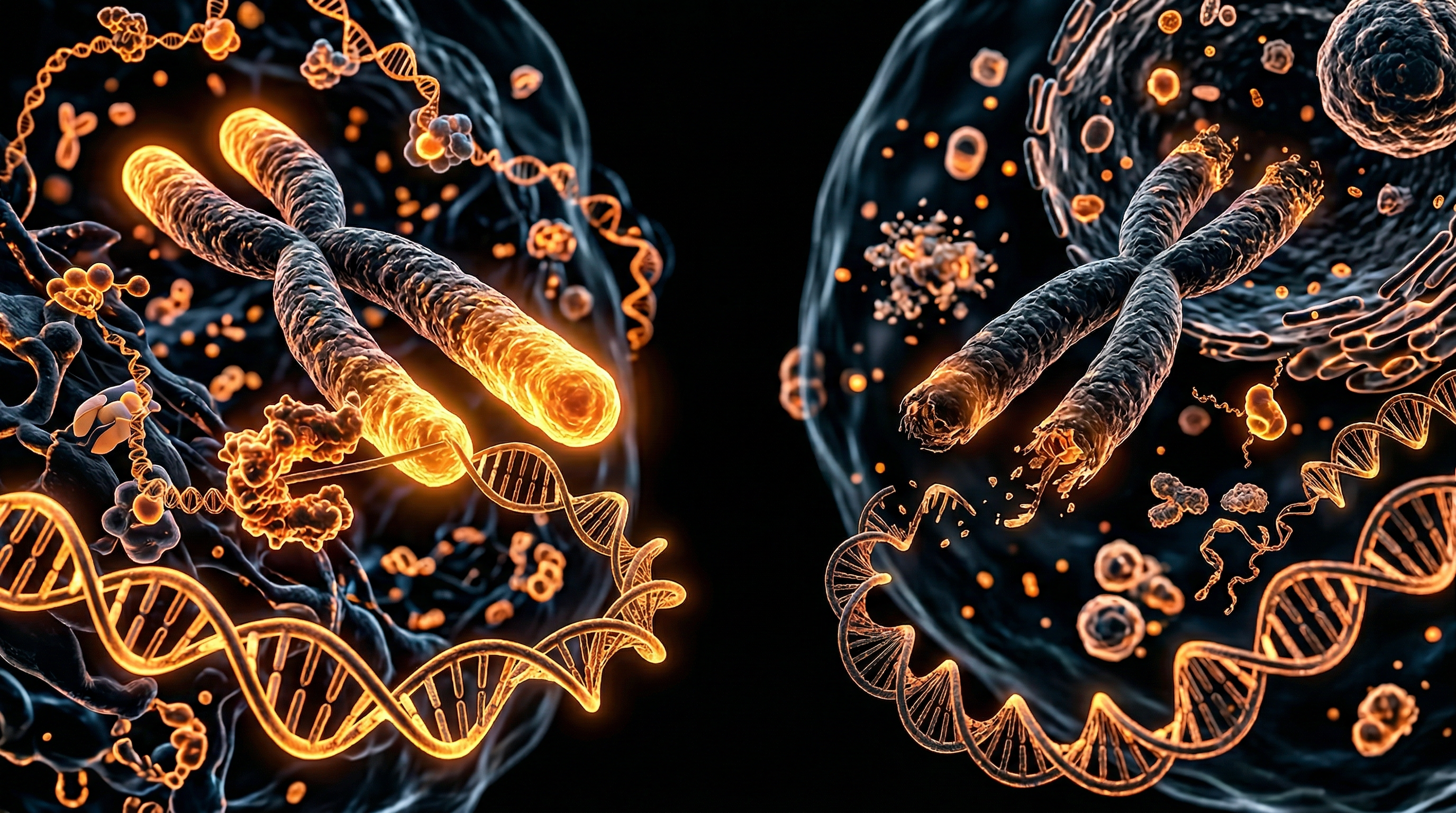
Telomeres are often described as the protective caps at the ends of our chromosomes, analogous to the plastic tips (aglets) on shoelaces that prevent them from fraying. However, this metaphor, while useful, underscores a far more complex reality. Telomeres are the primary "molecular clocks" of the human body. They dictate the proliferative potential of our cells and, by extension, the expiration date of our organs and systems.
While our ancestors frequently succumbed to infectious diseases, trauma, or predation, those who survived into old age often maintained a level of functional vitality that is increasingly rare in the modern West. Today, we are witnessing a phenomenon of "accelerated biological aging," where individuals in their thirties and forties exhibit the telomeric profiles of sixty-year-olds. This article explores the mechanisms of this decay, the industrial disruptors driving it, and the suppressed reality that our modern "comforts" are, in fact, the very catalysts of our cellular demise.
Key Statistic: Research indicates that individuals under chronic psychological stress or poor metabolic health can exhibit telomere lengths equivalent to people 10 to 15 years their senior, effectively "ageing" a decade in a matter of months at the cellular level.
The Biology — How It Works
To understand telomere attrition, one must first understand the fundamental limitation of DNA replication. Every time a human cell divides, it must copy its entire genetic blueprint. However, the enzyme responsible for this—DNA polymerase—is incapable of copying the very tip of the DNA strand. This is known as the "end-replication problem."
The Protective Buffer
Without telomeres, each cell division would result in the loss of essential genetic information, leading to immediate cell death or catastrophic mutation. Telomeres consist of repetitive non-coding DNA sequences (TTAGGG) that act as a sacrificial buffer. When the DNA polymerase fails to reach the end, it is the telomere that is shortened, leaving the vital genes intact.
The Hayflick Limit
In the 1960s, Dr. Leonard Hayflick discovered that human cells have a finite capacity for division. Most human cells can divide approximately 50 to 70 times before the telomeres become critically short. Once this threshold is reached, the cell enters a state of permanent arrest known as senescence.
Telomerase: The Fountain of Youth?
There exists an enzyme called Telomerase (an RNA-dependent DNA polymerase) that has the unique ability to add TTAGGG sequences back onto the ends of chromosomes, effectively "winding back" the molecular clock. In a healthy biological state, telomerase is highly active in embryonic stem cells and certain immune cells. However, in most adult somatic cells, the gene for telomerase is "silenced" or expressed at very low levels. The modern challenge is that our environment is accelerating the loss of telomeres faster than our limited telomerase can repair them.
Mechanisms at the Cellular Level
Telomere attrition is not merely a passive result of cell division; it is an active process driven by the biochemical environment of the cell. Several key mechanisms dictate the speed at which these "caps" erode.
Oxidative Stress and DNA Damage
The most significant driver of accelerated telomere shortening is Oxidative Stress. Telomeres are particularly rich in guanine, a DNA base that is highly susceptible to damage by Reactive Oxygen Species (ROS). When the body is flooded with ROS—due to poor diet, environmental toxins, or chronic inflammation—single-strand breaks occur in the telomeric DNA.
Unlike the rest of the genome, telomeric DNA is notoriously difficult for the cell to repair. Consequently, oxidative damage leads to the "shearing" of telomeres, causing them to shorten far more rapidly than would occur through normal replication alone.
The Role of Glucocorticoids
The "Ancient Aging" model was regulated by acute stress (the fight-or-flight response), which was followed by long periods of recovery. In "Modern Longevity," we exist in a state of chronic, low-grade stress. This results in the persistent elevation of Cortisol. High levels of cortisol have been shown in multiple studies to downregulate the activity of telomerase. By inhibiting the repair enzyme, chronic stress effectively "locks" the cell into a path of rapid decay.
Cellular Senescence and the SASP
When telomeres reach a critically short length, the cell does not always die. Instead, it becomes a Senescent Cell—often termed a "Zombie Cell." These cells remain metabolically active but no longer divide. Crucially, they secrete a cocktail of pro-inflammatory cytokines, growth factors, and proteases known as the Senescence-Associated Secretory Phenotype (SASP).
- SASP spreads inflammation to neighbouring healthy cells.
- It degrades the extracellular matrix.
- It triggers telomere shortening in nearby healthy cells, creating a "bystander effect" of accelerated aging.
Environmental Threats and Biological Disruptors
The disconnect between our ancestral biology and the industrialised world has created a "perfect storm" for telomeric decay. The following factors are not merely lifestyle choices; they are biological disruptors that hijack our cellular machinery.
Ultra-Processed Foods (UPFs) and Glycation
The modern diet is dominated by Ultra-Processed Foods, which are high in refined sugars and industrial seed oils. These foods lead to the formation of Advanced Glycation End-products (AGEs). AGEs cross-link with proteins and DNA, inducing massive oxidative stress.
Observation: A 2020 study published in the American Journal of Clinical Nutrition found that a high intake of UPFs was directly associated with a 50% increased risk of having short telomeres.
Circadian Disruption and Artificial Blue Light
Our ancestors lived by the rhythm of the sun. Modern humans spend 90% of their time indoors under artificial Blue Light, particularly from LEDs and screens. This suppresses the production of Melatonin. While melatonin is famous for sleep, it is also one of the body’s most potent endogenous antioxidants and a protector of telomeres. By disrupting the circadian rhythm, we deprive our cells of the nightly "repair phase" required to maintain telomere length.
Electromagnetic Fields (EMFs) and Non-Ionising Radiation
While controversial in mainstream circles, a growing body of independent research suggests that chronic exposure to high-frequency EMFs (from 5G, Wi-Fi, and mobile devices) can trigger Voltage-Gated Calcium Channel (VGCC) activation. This leads to an influx of calcium into the cell, stimulating the production of peroxinitrites—highly aggressive free radicals that specifically target telomeric sequences.
Chemical Endocrine Disruptors
We are exposed to thousands of synthetic chemicals, including PFAS ("forever chemicals"), phthalates, and bisphenols (BPA/BPS). These substances interfere with hormonal signalling. Since hormones like oestrogen actually stimulate telomerase activity, the disruption of the endocrine system directly impacts the cell's ability to maintain its DNA caps.
The Cascade: From Exposure to Disease
Telomere attrition is the "upstream" cause of the "downstream" diseases we associate with aging. When we view chronic disease through the lens of telomere biology, the picture changes from one of "unfortunate genetics" to one of "cellular exhaustion."
Cardiovascular Decay
The lining of our blood vessels, the Endothelium, relies on constant cell division to remain supple and functional. When endothelial telomeres shorten, the vessels become stiff (atherosclerosis) and lose the ability to produce nitric oxide. This is why telomere length is now considered a more accurate predictor of cardiovascular risk than LDL cholesterol alone.
Neurodegeneration and the Blood-Brain Barrier
In the brain, short telomeres in Microglia (the brain's immune cells) lead to a state of chronic neuroinflammation. This is a primary driver of Alzheimer’s and Parkinson’s. Furthermore, the breakdown of the blood-brain barrier is often the result of telomeric senescence in the vascular cells supporting the brain.
Immunosenescence
The "exhaustion" of the immune system is perhaps the most visible sign of telomere attrition. As T-cells reach their Hayflick limit, they lose the ability to recognise and destroy pathogens or cancerous cells. This explains why both the elderly and the "biologically old" young are more susceptible to severe viral infections and the proliferation of tumours.
- Cancer Paradox: Short telomeres cause genomic instability, which can lead to the mutations that start cancer. However, once a tumour forms, it often "hijacks" the telomerase enzyme to become immortal. This underscores the importance of maintaining telomere length early in life to prevent the initial instability.
What the Mainstream Narrative Omits
The current medical-industrial complex is predicated on the management of symptoms rather than the preservation of biological integrity. There is a profound silence regarding telomere attrition for several reasons.
The Pharmaceutical Bias
Treating a "shortened telomere" is not as profitable as treating the five different diseases that result from it. Statin drugs, hypertensive medications, and diabetic treatments are multi-billion dollar industries. If the public understood that these conditions are largely preventable through ancestral lifestyle interventions that preserve telomere length, the current pharmaceutical model would collapse.
The Myth of Genetic Determinism
The mainstream narrative often suggests that we are victims of our "bad genes." In reality, the field of Epigenetics shows that our environment and behaviour control 80-90% of our aging process. Telomeres are the interface between our environment and our genes. By focusing on "DNA testing" for disease risks, the industry distracts from the fact that we can actively lengthen our biological clocks through environmental mastery.
Ignoring the "Victorian Paradox"
History reveals a startling truth: mid-Victorian Britons (1840-1880) who survived childhood often lived as long as we do today, but without the chronic degenerative diseases. They had higher levels of physical activity, nutrient-dense diets, and no exposure to synthetic chemicals or artificial light. Their "Ancient Aging" involved a slow, natural decline, whereas "Modern Longevity" involves a decades-long period of medicalised morbidity.
The UK Context
In the United Kingdom, the crisis of telomere attrition is particularly acute. Despite the presence of the NHS, healthy life expectancy is stalling, and in some regions, it is actively declining.
The "Sickness Gap"
Recent data from the Office for National Statistics (ONS) highlights a growing "Sickness Gap." While a male in the UK might expect to live to 79, his healthy life expectancy is only around 63. This means the average Briton spends the last 16 years of their life in poor health. This 16-year window is the direct result of "accelerated cellular aging" occurring in the middle years.
Industrial Heritage and Environmental Toxicity
The UK’s history as the cradle of the Industrial Revolution has left a legacy of environmental degradation. From the "forever chemicals" found in UK tap water to the high density of electromagnetic infrastructure in British cities, the average UK resident faces a relentless barrage of telomere-shortening stressors.
The NHS Burden
The NHS is currently overwhelmed by "lifestyle-related" conditions that are, at their core, manifestations of telomere attrition. Type 2 diabetes, which is skyrocketing among young Britons, is a potent accelerator of telomere shortening. The system is designed to provide "acute care" for what is essentially a "chronic cellular collapse."
Fact: UK studies have shown that residents of "deprived" urban areas have telomeres that are significantly shorter than their counterparts in more rural, less "modernised" areas, even when controlling for smoking and diet. This points to the impact of "environmental despair" and pollution on cellular integrity.
Protective Measures and Recovery Protocols
While the modern world is designed to erode our telomeres, we are not helpless. By adopting an "Ancestral Blueprint" modified for the 21st century, we can protect and even potentially extend our telomeric caps.
1. Hormetic Stress (The Good Stress)
Unlike chronic stress, Hormesis is acute, controlled stress that triggers repair mechanisms.
- Sauna Use: Heat shock proteins protect DNA and have been linked to increased longevity.
- Cold Exposure: Increases mitochondrial efficiency and reduces oxidative stress.
- High-Intensity Interval Training (HIIT): Specifically shown to increase telomerase activity more than steady-state cardio.
2. Nutritional Fortification
The goal is to provide the raw materials for DNA repair while minimising inflammation.
- Magnesium: A critical cofactor for all DNA replication and repair enzymes. Most Westerners are deficient.
- Omega-3 Fatty Acids (DHA/EPA): High levels of Omega-3s are strongly correlated with slower telomere attrition.
- Sulforaphane: Found in cruciferous vegetables, it activates the Nrf2 pathway, the body’s master antioxidant defence.
- Avoidance of UPFs: Eliminating seed oils and refined sugars is the single fastest way to reduce the "oxidative shearing" of telomeres.
3. Circadian Management
Protecting the "Repair Window" is essential.
- Morning Sunlight: 10-20 minutes of direct sunlight in the morning sets the circadian clock and boosts serotonin (the precursor to melatonin).
- Blue Light Blocking: Using amber-tinted glasses or "red-light" modes after sunset to preserve melatonin levels.
- Grounding (Earthing): Direct physical contact with the Earth allows for the transfer of free electrons, which act as natural antioxidants to neutralise ROS.
4. Psychological Resilience
Because cortisol is a telomerase inhibitor, managing the "perception" of stress is a biological necessity.
- Meditation and Breathwork: Studies on long-term meditators show significantly higher telomerase activity compared to controls.
- Vagus Nerve Stimulation: Techniques such as humming or cold-water face immersion can shift the body from sympathetic (stress) to parasympathetic (repair) mode.
5. Intermittent Fasting and Autophagy
By restricting the window of eating, we trigger Autophagy—the body's way of "cleaning out" damaged organelles and senescent cells. This prevents the "zombie cells" from accumulating and spreading the SASP to healthy, long-telomere cells.
Summary: Key Takeaways
The path to true longevity lies not in more pharmaceuticals, but in a return to the biological wisdom of our ancestors, supported by modern scientific understanding.
- Telomeres are the Molecular Clock: They define our biological age, which is distinct from our chronological age.
- Modernity is a Telomere Shearing Machine: Industrial food, artificial light, chronic stress, and chemical toxins accelerate the ticking of this clock.
- The "Longevity" Myth: We are living longer but in a state of prolonged cellular decay. We must shift our focus to Healthspan.
- Inflammation is the Enemy: Chronic, low-grade inflammation (inflammaging) is the primary driver of telomere attrition and the subsequent diseases of modern life.
- Empowerment Through Environment: We cannot change our birth date, but we can change the rate at which our cells divide and decay. By optimising our light, food, movement, and stress levels, we reclaim control over our genetic destiny.
The battle for longevity is won at the microscopic level. Every choice we make—the food we consume, the light we expose ourselves to, and the thoughts we dwell upon—either preserves the integrity of our telomeres or shears them away. To choose the "Ancient" way of aging is to choose a life of vitality, where the end is not a decades-long decline, but a graceful and natural conclusion to a life well-lived in accordance with our biological heritage.
This article is provided for informational and educational purposes only. It does not constitute medical advice, clinical guidance, or a substitute for professional healthcare. Information reflects cited research at time of publication. Always consult a qualified healthcare professional before acting on any health information.
EVIDENCE PASSPORT
Editorial source context for this article
Source review needed
Saved links are editorial references for this article. They may support specific claims rather than every sentence. Open and assess each source in context. This passport does not independently verify them.
Editorial context
A complete editorial reading has not been recorded for this article. Source links remain available for you to open and assess directly.
Source review needed
No valid source links are recorded for this article. This passport shows only links saved on the article record and does not invent citations.
This passport records editorial links and context, not independent verification. Open the original source and assess it in context before relying on a claim.
Medical Disclaimer
The information in this article is for educational purposes only and does not constitute medical advice, diagnosis, or treatment. Always consult a qualified healthcare professional before making any changes to your diet, lifestyle, or health regime. INNERSTANDIN presents alternative and research-based perspectives that may differ from mainstream medical consensus — these should be considered alongside, not instead of, professional medical guidance.
Read Full DisclaimerContinue the thread
Keep this question moving.
Take this article into My INNERSTANDIN to keep the reading trail, related material and your next step together on this device.