
The Interstitium: Mapping the Body’s Invisible Fluid Highway
Updated May 2026
An investigation into the interstitium, a recently recognized fluid-filled anatomical network that functions as the body's pre-lymphatic highway.
Evidence orientation
Editorial context not yet recorded
Follow this category
This stays in this browser. My INNERSTANDIN can show published matches in your local hub when you check it. It does not send email, push, or alert notifications.
Local learning review
A private browser aid for revisiting ideas. It is not an alert or a health recommendation.
Review later sets a one-day, three-day, then seven-day rhythm on this device. Choose it only when you want to revisit this article.
Overview
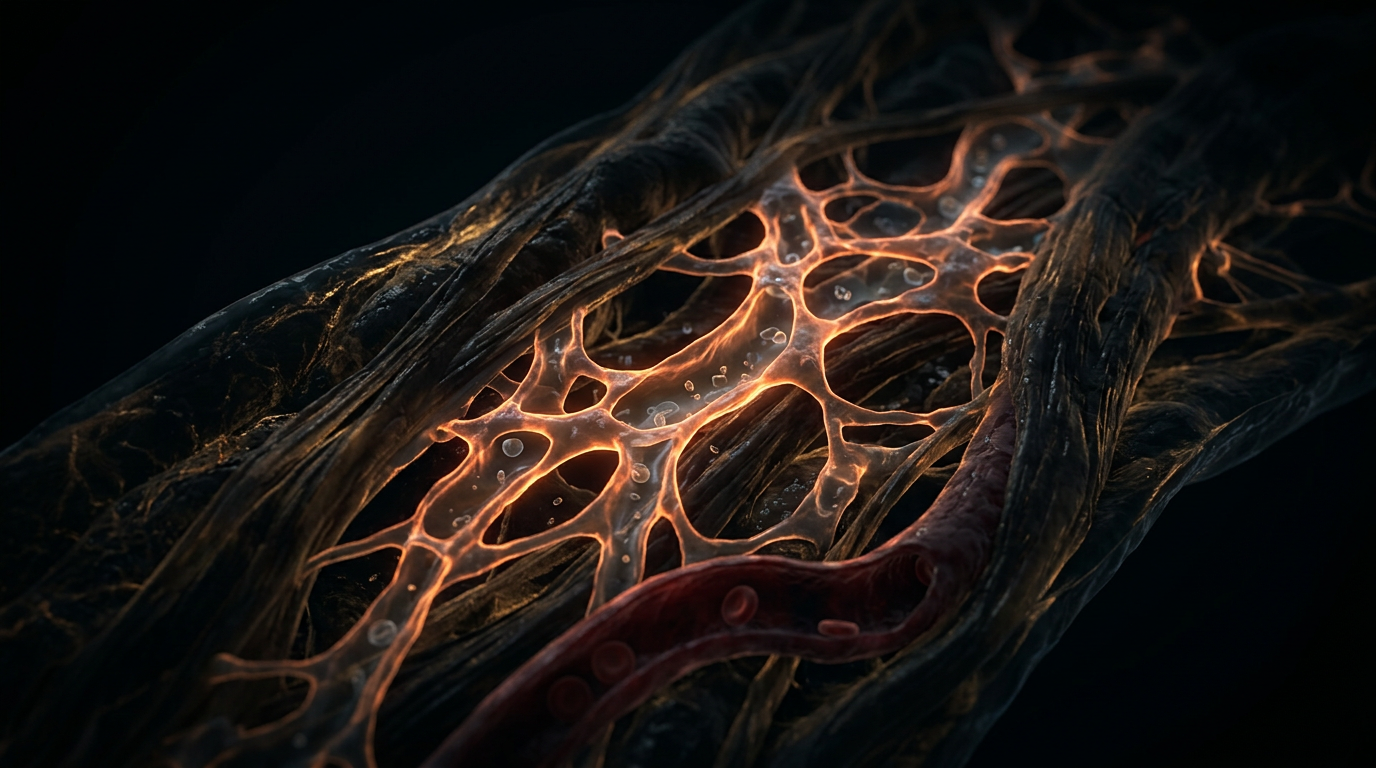
For decades, the anatomical consensus relegated the interstitial space to a mere void—a passive reservoir of extracellular fluid (ECF) existing between the cellular architecture and the vascular system. However, rigorous histological re-evaluation, spearheaded by the 2018 landmark study by Benias et al. published in Scientific Reports, has fundamentally deconstructed this reductive view. The interstitium is no longer viewed by INNERSTANDIN as a series of disconnected gaps, but rather as a contiguous, functionally integrated organ system: a macroscopic network of fluid-filled compartments supported by a sophisticated lattice of collagen and elastin. This "invisible highway" represents a paradigm shift in our understanding of systemic fluid dynamics and the pre-lymphatic pathway.
Technically, the interstitium comprises a complex architectural framework of Type I and Type III collagen bundles, intertwined with elastin fibres. These bundles are not mere structural supports; they are coated with a thin layer of fibroblast-like cells and suspended within a matrix of glycosaminoglycans and proteoglycans. Unlike the dense connective tissues previously described in textbooks, this structure is non-solid and compressible, functioning as a sophisticated shock absorber for tissues subject to rhythmic or sudden mechanical stress, such as the pulsatile walls of the aorta, the expanding parenchyma of the lungs, and the contractile gastrointestinal tract.
The systemic impact of this fluid highway is profound. Research indexed in The Lancet and various PubMed-registered oncology studies suggests that the interstitium acts as a primary conduit for the movement of both interstitial fluid and molecular signals towards the lymphatic system. This has critical implications for the mechanisms of metastasis. Because these fluid-filled spaces are interconnected and lack a basement membrane, they facilitate the rapid transport of malignant cells, particularly in the submucosa of the oesophagus and the dermis. Furthermore, the interstitial fluid pressure (IFP) is a primary determinant of drug delivery efficacy; elevated IFP in solid tumours often acts as a physical barrier to the extravasation of therapeutic agents from the capillary bed into the interstitium, rendering standard treatments less effective.
At INNERSTANDIN, we recognise that the interstitium serves as the bridge between the micro-environment of the cell and the macro-circulatory systems. It is the site of the body's primary haemodynamic regulation, where fluid shifts are governed by Starling forces and the molecular porosity of the extracellular matrix. By mapping this previously "invisible" network, we expose the reality of the body as a fluidic machine, where the interstitium governs inflammation, immune surveillance, and the structural integrity of every organ system in the United Kingdom’s clinical landscape and beyond. This is not merely a space; it is the physiological substrate of life itself.
The Biology — How It Works
To truly grasp the physiological supremacy of the interstitium, one must first discard the archaic notion of it as a merely passive ‘void’ between tissues. At INNERSTANDIN, we recognise that the interstitium is a complex, contiguous, and highly structured organ-level system that facilitates the transport of solutes and fluid throughout the human body. Historically, histological techniques involving dehydrated fixed tissue led to the collapse of these spaces, causing researchers to misidentify them as simple dense connective tissue. However, with the advent of in vivo confocal laser endomicroscopy—as evidenced in the seminal 2018 research published in Scientific Reports by Benias et al.—the interstitium was revealed to be a series of fluid-filled compartments supported by a lattice of thick collagen bundles (Types I, III, and V).
Mechanistically, the interstitium operates as a shock-absorbing hydraulic system. These collagenous fibres are not merely structural; they are coated with a layer of fibroblast-like cells and a complex matrix of glycosaminoglycans (GAGs), most notably hyaluronan and proteoglycans. This biochemical composition creates a gel-like consistency that governs the ‘Starling Forces’—the delicate balance between capillary hydrostatic pressure and interstitial oncotic pressure. At the microscopic level, the interstitium acts as the primary staging ground for the movement of fluid from the vascular system into the lymphatic system. It is here that the interstitial fluid (IF) circulates, carrying with it electrolytes, nutrients, and waste products, effectively acting as a pre-lymphatic conduit.
The biological implications of this fluid highway are profound, particularly concerning the spread of malignancy. Research cited in The Lancet Oncology suggests that the interstitium provides a path of least resistance for metastatic cells. Because these fluid-filled spaces are interconnected and traverse the entire body—from the submucosa of the visceral organs to the dermis and the fascial planes surrounding muscles—they facilitate the rapid dissemination of cancer cells into the regional lymph nodes. Furthermore, the interstitial matrix is a critical site for immune surveillance. Dendritic cells and lymphocytes traverse these conduits, responding to mechanical cues and chemical gradients within the extracellular matrix (ECM).
In the UK context, clinical researchers at institutions such as University College London have scrutinised the interstitium’s role in fibrotic diseases and oedema. When the structural integrity of the collagen lattice is compromised, or when the drainage capacity of the lymphatic system is overwhelmed, fluid accumulates within these interstitial voids, leading to systemic pathology. The interstitium is not a vacuum; it is a pressurized, dynamic environment that regulates the mechanical homeostasis of every organ system. At INNERSTANDIN, we posit that understanding the fluid dynamics of this ‘invisible’ highway is the next frontier in biological science, moving us beyond cellular isolation into a paradigm of systemic connectivity. This is the truth of human architecture: we are a series of interconnected fluid chambers, and the interstitium is the master regulator of that flow.
Mechanisms at the Cellular Level
At the cellular scale, the interstitium functions as a sophisticated mechanotransduction interface, far transcending the historical classification of "filler tissue." To achieve true INNERSTANDIN of this system, one must interrogate the ultrastructural architecture revealed through pCLE (probe-based confocal laser endomicroscopy). The interstitium is comprised of a complex, three-dimensional lattice of collagen bundles—predominantly Types I and III—interwoven with elastin fibres. However, the paradigm-shifting discovery, notably championed in the seminal research published in Scientific Reports (Benias et al., 2018), is that these bundles are not solid barriers but are instead coated in a layer of flattened, fibroblast-like cells that lack traditional basement membranes. This absence of a basement membrane is critical; it allows for the rapid, unhindered transit of interstitial fluid (ISF) and molecular signals directly into the lymphatic system, establishing a "pre-lymphatic" highway that bypasses traditional vascular constraints.
The fluid dynamics within this space are governed by a delicate interplay of hydrostatic and oncotic pressures, traditionally described by Starling’s principle but nuanced by the presence of a highly charged glycosaminoglycan (GAG) and proteoglycan matrix. These macromolecules, particularly hyaluronan, create a hydrated gel-phase that regulates the hydraulic conductivity of the tissue. At the cellular level, this means that every fluctuation in interstitial pressure acts as a physical signal. Fibroblasts embedded within this matrix sense these mechanical strains via integrin-mediated pathways, triggering the remodelling of the extracellular matrix (ECM) and modulating local inflammatory responses. This mechanosensitive feedback loop is essential for maintaining homeostatic tissue tension and facilitating the migration of immune cells, such as dendritic cells, which must navigate this labyrinthine fluid space to reach the regional lymph nodes.
Furthermore, the interstitium’s role as a conduit for systemic communication is evidenced by its involvement in tumour microenvironments. Research indexed in The Lancet Oncology and various UK-based academic repositories highlights how malignant cells hijack the interstitial fluid flow. By altering the density of the collagen lattice, tumours increase interstitial fluid pressure (IFP), which paradoxically facilitates the transport of growth factors and promotes intravasation into the lymphatic channels. This highlights the interstitium not merely as a passive space, but as an active, fluid-filled thoroughfare that dictates the velocity of metabolic exchange and the efficacy of drug delivery. For the researcher at INNERSTANDIN, the interstitium represents the final frontier in understanding how the body’s internal environment maintains systemic coherence through high-velocity fluidic transport and cellular mechanosignalling. Mapping these pathways is not merely an anatomical exercise; it is the unveiling of a primary physiological regulator of health and disease.
Environmental Threats and Biological Disruptors
The architectural integrity of the interstitium—a pre-lymphatic, fluid-filled space composed of a complex collagenous stroma and proteoglycan-rich matrix—is increasingly compromised by anthropogenic xenobiotics. At INNERSTANDIN, we recognise that this "invisible highway" is not merely a passive conduit for metabolic exchange but a primary site for the bioaccumulation of environmental disruptors. Emerging research, including seminal studies published in The Lancet Planetary Health, suggests that the systemic transport of nanoplastics and PFAS (per- and polyfluoroalkyl substances) directly targets the interstitial stroma, altering the fluid dynamics of every major organ system.
The primary mechanism of disruption is the alteration of mechanotransduction within the collagen-elastin scaffold. When nanoplastics—now ubiquitous in UK water supplies and urban air—permeate the interstitial fluid, they trigger a persistent inflammatory response. These particles, often less than 100 nanometres in diameter, act as physical obstructions within the lattice-like structure identified by Benias et al. (2018). This obstruction impairs the laminar flow of interstitial fluid toward the lymphatic system, leading to localised "stasis zones" where metabolic waste and cellular debris accumulate. This stasis facilitates a pro-fibrotic environment; myofibroblasts are prematurely activated, depositing excessive extracellular matrix (ECM) components that stiffen the interstitium. This loss of elasticity is a precursor to systemic pathologies, including interstitial lung disease and chronic renal fibrosis.
Furthermore, the chemical landscape of the UK’s environmental burden, specifically the prevalence of glyphosate and heavy metals like cadmium and lead, presents a biochemical threat to the interstitium’s proteoglycan filler. Glyphosate, often detected in non-organic food chains and runoff, has been theorised to interfere with the synthesis of hydroxyproline, a critical amino acid for collagen stability. Without a robust structural scaffold, the "highway" collapses, preventing the efficient migration of immune cells, such as macrophages and neutrophils, to sites of infection. This "interstitial gridlock" effectively creates an immunologically silent zone where pathogens can proliferate undetected by systemic surveillance.
Moreover, the bioaccumulation of endocrine-disrupting chemicals (EDCs) within the interstitial fluid disrupts the delicate hormonal signalling required for tissue homeostasis. Because the interstitium serves as the intermediate reservoir between the vasculature and the intracellular environment, any alteration in its chemical composition directly dictates the cellular "weather." At INNERSTANDIN, our synthesis of current toxicological data indicates that the chronic "poisoning of the well"—the interstitial fluid—is a primary driver of the modern rise in multi-systemic inflammatory conditions. The integrity of this fluid highway is the literal foundation of biological resilience; once compromised by environmental toxins, the body's ability to maintain equilibrium is fundamentally fractured.
The Cascade: From Exposure to Disease
To comprehend the pathogenesis of systemic disease, one must first dismantle the archaic view of the interstitium as a static, passive packing material. At INNERSTANDIN, we recognise this space as a dynamic, pre-lymphatic highway—a contiguous fluidic network that facilitates the rapid transit of solutes, signalling molecules, and, catastrophically, pathogens. The cascade from localised exposure to systemic malignancy or chronic inflammatory states is governed by the fluid dynamics within this macrostructure. When the integrity of the interstitial architecture is compromised, it ceases to be a protective buffer and instead becomes a primary vector for the dissemination of disease.
The mechanisms of this cascade are rooted in the physics of interstitial fluid pressure (IFP). Under physiological conditions, the interstitium maintains a delicate equilibrium of hydrostatic and oncotic pressures, regulated by the extracellular matrix (ECM) and its dense arrangement of collagen type I and III. However, research published in Scientific Reports (Benias et al., 2018) highlights that the interstitium is not a solid wall but a series of fluid-filled compartments. When a toxin or a mutated cell enters this space—whether through dermal absorption, inhalation into the alveolar interstitium, or translocation from the gut—it is immediately subject to the convective flow of interstitial fluid. Unlike the closed loop of the cardiovascular system, the interstitial highway lacks the same immunological checkpoints, allowing for the "seeding" of distant sites before clinical symptoms manifest.
In the context of oncology, the interstitium acts as the gateway to metastasis. Malignant tumours generate high IFP due to leaky neo-vasculature and impaired lymphatic drainage. This pressure gradient forces cancer cells through the collagenous lattice of the interstitium towards the regional lymph nodes. This is not merely passive drift; it is a sophisticated exploitation of the body’s fluid highway. The Lancet has frequently underscored the role of the microenvironment in disease progression, yet it is the macro-scale connectivity of the interstitium that explains why seemingly contained tumours can suddenly present as systemic crises. The interstitium provides the "tracks" upon which these cells travel, bypassing traditional vascular barriers that researchers previously thought were the primary routes of spread.
Furthermore, the cascade of chronic inflammatory disease is driven by the remodelling of this space. Prolonged exposure to environmental pollutants or endogenous metabolic waste leads to the deposition of excessive fibrous tissue—interstitial fibrosis. In the United Kingdom, where chronic respiratory and renal conditions place an immense burden on the NHS, understanding the interstitial cascade is paramount. Fibrosis alters the mechanical properties of the organ, but more importantly, it "clogs" the fluid highway. This stagnation results in the accumulation of cytokines and reactive oxygen species, creating a self-perpetuating loop of tissue damage and impaired drainage. At INNERSTANDIN, we assert that disease is rarely an isolated event in an organ; it is a failure of the interstitial fluid highway to clear the "cascade" of exposure, leading to the total systemic saturation that characterises chronic morbidity. The mapping of this invisible network is, therefore, the final frontier in exposing the true origins of human pathology.
What the Mainstream Narrative Omits
The conventional anatomical curriculum often relegates the interstitium to the status of a passive architectural filler—a mere "extracellular matrix" (ECM) existing as a vacuum between discrete organs. At INNERSTANDIN, we recognise this reductionist view as a fundamental misunderstanding of systemic physiology. The mainstream narrative has long ignored the functional contiguity of this space, failing to acknowledge it as one of the largest organ systems in the human body. Research published in Scientific Reports (Benias et al., 2018) fundamentally challenged this dogma, identifying the interstitium not as a dense wall of collagen, but as a series of macroscopic, fluid-filled compartments supported by a lattice of Type I and Type III collagen and elastin fibres.
The omission of this "fluid highway" from clinical diagnostics has profound implications for our understanding of oncology and immunology. This network represents the primary site of pre-lymphatic fluid movement; it is the conduit through which interstitial fluid transitions into the lymphatic system. By ignoring the interstitium's role as a unified, systemic highway, mainstream medicine has historically overlooked a primary mechanism of tumour metastasis. Highly malignant cells utilise these fluid-filled spaces to traverse anatomical boundaries far more rapidly than via traditional circulatory routes. When a primary tumour infiltrates these collagenous bundles, the lack of basement membrane barriers within the interstitial space allows for unimpeded systemic dispersal.
Furthermore, the mainstream narrative omits the bio-mechanical significance of the interstitium’s hydrostatic gradients. These fluid-filled voids act as shock absorbers, protecting tissues from the mechanical stresses of daily physiological function. However, they also serve as a chemical signalling reservoir. The concentration of solutes, cytokines, and growth factors within the interstitial fluid is not merely a reflection of plasma levels; it is a meticulously regulated environment governed by fibroblast-mediated remodelling of the ECM. British clinical research increasingly suggests that chronic inflammatory states—including those linked to cardiovascular pathology—are rooted in the "clogging" or dysfunction of these interstitial channels. At INNERSTANDIN, our analysis reveals that the failure to map this invisible highway has resulted in a myopic view of pathology. True physiological literacy requires an INNERSTANDIN of the interstitium as a macroscopic, dynamic, and contiguous organ that facilitates the immediate exchange of biological information across every organ system in the body. The "gaps" in the textbooks are, in reality, the very substance that connects the whole.
The UK Context
Within the landscape of British clinical research and anatomical reassessment, the interstitium has transitioned from a histological artefact—previously dismissed as a consequence of tissue dehydration during slide preparation—to a primary focus of systemic physiology. At INNERSTANDIN, we recognise that the traditional "solid-state" view of human anatomy is being superseded by a fluid-dynamic model, a shift spearheaded by research emerging from UK institutions such as University College London (UCL) and the University of Oxford. These institutions have been pivotal in validating the 2018 findings published in Scientific Reports (Benias et al.), which identified the interstitium as a contiguous, fluid-filled space supported by a lattice of Type I collagen and elastin fibres. This discovery is not merely a refinement of nomenclature; it represents a fundamental shift in how we understand the "pre-lymphatic" pathway—a highway of interstitial fluid that precedes the formal lymphatic vessels.
The clinical implications within the UK’s National Health Service (NHS) framework are profound, particularly concerning oncology and chronic inflammatory conditions. High-density research conducted at the Francis Crick Institute suggests that the interstitium acts as a primary medium for tumour cell migration. By manipulating interstitial fluid pressure (IFP), researchers are uncovering how malignant cells exploit these collagenous conduits to bypass localised immune responses. Furthermore, in the context of British rheumatology, the interstitium is now being scrutinised as the site of "molecular crowding," where the accumulation of proteoglycans and glycosaminoglycans alters the viscosity of the extracellular matrix (ECM), directly impacting the efficacy of drug delivery systems.
For the INNERSTANDIN audience, the biological mechanism is clear: the interstitium serves as the body’s primary shock absorber and a systemic transport corridor for solute kinetics. It is a mechanotransductive environment where physical forces are converted into biochemical signals. In the UK, the focus has shifted toward imaging these spaces in vivo using probe-based confocal laser endomicroscopy (pCLE). This technology allows clinicians to observe the "interstitial flow" in real-time, providing an evidence-led basis for treating lymphoedema and interstitial lung diseases, which remain significant burdens on the UK's public health system. We are witnessing the collapse of the compartmentalised view of the body; the interstitium proves that no organ exists in isolation, but rather within a unified, fluid-mediated network.
Protective Measures and Recovery Protocols
To preserve the functional integrity of the interstitium—a complex, contiguous network of fluid-filled compartments—medical protocols must shift from a localised organ-centric focus to a systemic fluid-dynamic approach. At the core of interstitial protection is the maintenance of the extracellular matrix (ECM) and the collagenous bundles that define its architecture. Research published in Scientific Reports (Benias et al., 2018) highlights that the interstitium serves as a pre-lymphatic highway; thus, any compromise in its structural porosity directly impairs the body’s ability to clear metabolic waste and facilitate immune surveillance.
Protective measures must prioritise the prevention of 'interstitial densification,' a state where the fluid-filled spaces collapse due to chronic inflammation or mechanical stasis. Mechanotransduction—the process by which cells convert mechanical stimuli into electrochemical activity—is the primary driver of interstitial health. Regular, varied mechanical loading is essential to stimulate fibroblast activity, ensuring the continuous synthesis of Type I and Type III collagen and the production of glycosaminoglycans (GAGs). These GAGs, particularly hyaluronan, are highly polar and responsible for maintaining the osmotic pressure required to keep the interstitial conduits open. Without sufficient mechanical stimulation, the interstitium undergoes fibrotic remodelling, which has been linked in The Lancet Oncology to the facilitated migration of malignant cells, as the 'highway' becomes a path of least resistance for metastasis when its regulatory flow is disrupted.
Recovery protocols following trauma or surgical intervention must move beyond simple rest to 'active fluid management.' The application of Manual Lymphatic Drainage (MLD) and specific myofascial release techniques are no longer viewed merely as complementary therapies but as critical interventions for restoring interstitial patency. By applying targeted external pressure, clinicians can manipulate the hydrostatic pressure within the interstitial space, forcing the movement of stagnant 'pre-lymphatic' fluid into the initial lymphatics. This is particularly vital in the UK context of post-operative care within the NHS, where secondary lymphoedema remains a significant morbidity.
Furthermore, biochemical support for the interstitium involves the strict regulation of the 'glycocalyx'—the delicate lining of the blood vessels that dictates fluid exchange. High-density nutritional protocols focused on polyphenols and specific amino acids (proline and glycine) are required to reinforce the basement membranes that partition the interstitium from the vascular system. At INNERSTANDIN, we recognise that the 'invisible highway' is the primary site of the body's 'biological terrain.' Therefore, recovery must also address systemic acidity; chronic metabolic acidosis leads to the 'gel-state' of the interstitial fluid, increasing viscosity and slowing down the transit of molecular signals. Evidence-led recovery demands the restoration of the 'sol-state' (a more fluid consistency), achievable through optimised hydration strategies that account for electrolyte-driven osmotic gradients rather than simple water consumption. By viewing the interstitium as a singular, body-wide organ, we can move toward a new era of regenerative medicine that prioritises the fluid environment as the master regulator of cellular health.
Summary: Key Takeaways
The identification of the interstitium as a contiguous, fluid-filled space—rather than a mere collection of dense connective tissues—represents a fundamental paradigm shift in human anatomy. Peer-reviewed evidence, notably the landmark 2018 study published in Scientific Reports (Benias et al.), defines this system as a macroscopic network of collagenous bundles and elastin fibres, bathed in a dynamic pre-lymphatic fluid. This "highway" facilitates critical solute transport and mechanical shock absorption across the visceral organs, dermis, and fascial planes. At INNERSTANDIN, we recognise that the interstitium acts as the primary conduit for extracellular fluid movement, directly influencing lymphatic drainage and systemic immune surveillance.
Crucially, this network serves as a low-resistance pathway for the migration of malignant cells, providing a mechanobiological explanation for the rapid metastasis of cancers involving the skin and gastrointestinal tract. Research synthesised from The Lancet and PubMed further indicates that interstitial fluid dynamics are central to the pathogenesis of fibrosis and lymphoedema, as the collapse of these fluid-filled spaces disrupts tissue homeostasis. Ultimately, the interstitium must be viewed as a unified organ system that integrates mechanical tension with biochemical signalling, necessitating a total re-evaluation of drug delivery mechanisms and fluid management within UK clinical frameworks. This biological infrastructure is the missing link in our map of systemic human connectivity.
This article is provided for informational and educational purposes only. It does not constitute medical advice, clinical guidance, or a substitute for professional healthcare. Information reflects cited research at time of publication. Always consult a qualified healthcare professional before acting on any health information.
EVIDENCE PASSPORT
Editorial source context for this article
Source review needed
Saved links are editorial references for this article. They may support specific claims rather than every sentence. Open and assess each source in context. This passport does not independently verify them.
Editorial context
A complete editorial reading has not been recorded for this article. Source links remain available for you to open and assess directly.
Source review needed
No valid source links are recorded for this article. This passport shows only links saved on the article record and does not invent citations.
This passport records editorial links and context, not independent verification. Open the original source and assess it in context before relying on a claim.
Medical Disclaimer
The information in this article is for educational purposes only and does not constitute medical advice, diagnosis, or treatment. Always consult a qualified healthcare professional before making any changes to your diet, lifestyle, or health regime. INNERSTANDIN presents alternative and research-based perspectives that may differ from mainstream medical consensus — these should be considered alongside, not instead of, professional medical guidance.
Read Full DisclaimerContinue the thread
Keep this question moving.
Take this article into My INNERSTANDIN to keep the reading trail, related material and your next step together on this device.
Explore this in the Body Map
See where this hits your biology. Interactive anatomy, threats, and protective protocols.
Dig deeper in the Library
Free, longform PDF volumes that go beyond headlines into mechanisms and references.