
The Hidden Ocean: The Interstitium and the Physiology of Fluid Dynamics
Published May 2026
A deep dive into the newly recognized interstitial organ and its role in nutrient transport, waste removal, and systemic immunity.
Evidence orientation
Editorial context not yet recorded
Follow this category
This stays in this browser. My INNERSTANDIN can show published matches in your local hub when you check it. It does not send email, push, or alert notifications.
Local learning review
A private browser aid for revisiting ideas. It is not an alert or a health recommendation.
Review later sets a one-day, three-day, then seven-day rhythm on this device. Choose it only when you want to revisit this article.
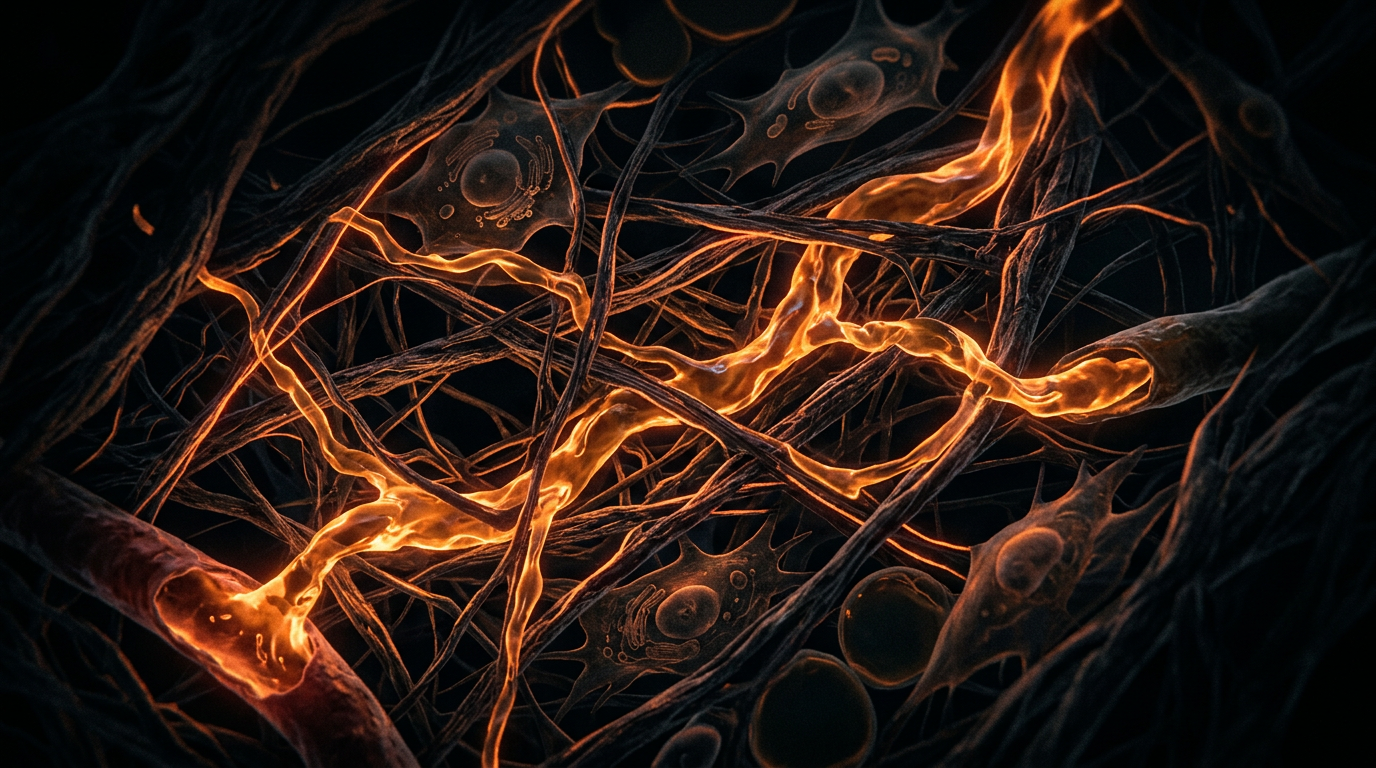
The Hidden Ocean: The Interstitium and the Physiology of Fluid Dynamics. In 2018, researchers identified a 'new organ' that had been hiding in plain sight: the interstitium. This vast network of fluid-filled spaces in the connective tissue was previously dismissed as mere 'packing material.' However, an evidence-based investigation reveals that the interstitium is a critical communication highway and the primary site of the body's immune surveillance. Section 1: Redefining the Organ of Connectivity. The interstitium is a series of spaces supported by a lattice of strong (collagen) and flexible (elastin) connective tissue proteins.
It contains a significant portion of the body’s total fluid, acting as a buffer between the circulatory system and the cells. This 'third space' is where the actual business of nutrient delivery and waste removal occurs. When the collagen structure of the interstitium becomes cross-linked or 'fibrotic' due to chronic inflammation, the flow of interstitial fluid is compromised. This leads to what we might call 'biological stagnation,' where cells are essentially bathing in their own metabolic waste. Section 2: Lymphatic Stasis and Sub-Clinical Oedema.
While the lymphatic system is often discussed in isolation, it is inextricably linked to the interstitium. The lymphatics are the drainage pipes for the interstitial ocean. Mainstream medicine only tends to recognize lymphatic issues when they manifest as overt lymphedema. However, many chronic health issues are driven by 'sub-clinical oedema'—a subtle buildup of fluid and toxins in the interstitium that impairs cellular signaling and creates a pro-inflammatory environment. This stasis is often the result of poor fascial health and a lack of varied movement, as the interstitium relies on mechanical pressure to move fluid.
Section 3: Cultivating Fluidity. To support the interstitium, we must move beyond the 'muscle and bone' model of exercise. Fascial health is paramount. Practices that involve multi-planar movement, myofascial release, and adequate hydration with electrolytes are essential. Furthermore, the role of 'structured water' or the Exclusion Zone (EZ) phase of water, as described by Dr.
Gerald Pollack, plays a vital role in how fluid moves through these microscopic channels. By viewing the body as a fluid system rather than a collection of solid parts, we can better address systemic issues like chronic fatigue and autoimmune sensitivity.
This article is provided for informational and educational purposes only. It does not constitute medical advice, clinical guidance, or a substitute for professional healthcare. Information reflects cited research at time of publication. Always consult a qualified healthcare professional before acting on any health information.
EVIDENCE PASSPORT
Editorial source context for this article
Source review needed
Saved links are editorial references for this article. They may support specific claims rather than every sentence. Open and assess each source in context. This passport does not independently verify them.
Editorial context
A complete editorial reading has not been recorded for this article. Source links remain available for you to open and assess directly.
Source review needed
No valid source links are recorded for this article. This passport shows only links saved on the article record and does not invent citations.
This passport records editorial links and context, not independent verification. Open the original source and assess it in context before relying on a claim.
Medical Disclaimer
The information in this article is for educational purposes only and does not constitute medical advice, diagnosis, or treatment. Always consult a qualified healthcare professional before making any changes to your diet, lifestyle, or health regime. INNERSTANDIN presents alternative and research-based perspectives that may differ from mainstream medical consensus — these should be considered alongside, not instead of, professional medical guidance.
Read Full DisclaimerContinue the thread
Keep this question moving.
Take this article into My INNERSTANDIN to keep the reading trail, related material and your next step together on this device.
Explore this in the Body Map
See where this hits your biology. Interactive anatomy, threats, and protective protocols.
Dig deeper in the Library
Free, longform PDF volumes that go beyond headlines into mechanisms and references.