
Understanding Glyphosate Residues in the Modern Food Supply
Updated May 2026
An in-depth exploration of how glyphosate enters the food chain, current regulatory limits, and the potential long-term health implications for consumers.
Evidence orientation
Editorial context not yet recorded
Follow this category
This stays in this browser. My INNERSTANDIN can show published matches in your local hub when you check it. It does not send email, push, or alert notifications.
Local learning review
A private browser aid for revisiting ideas. It is not an alert or a health recommendation.
Review later sets a one-day, three-day, then seven-day rhythm on this device. Choose it only when you want to revisit this article.
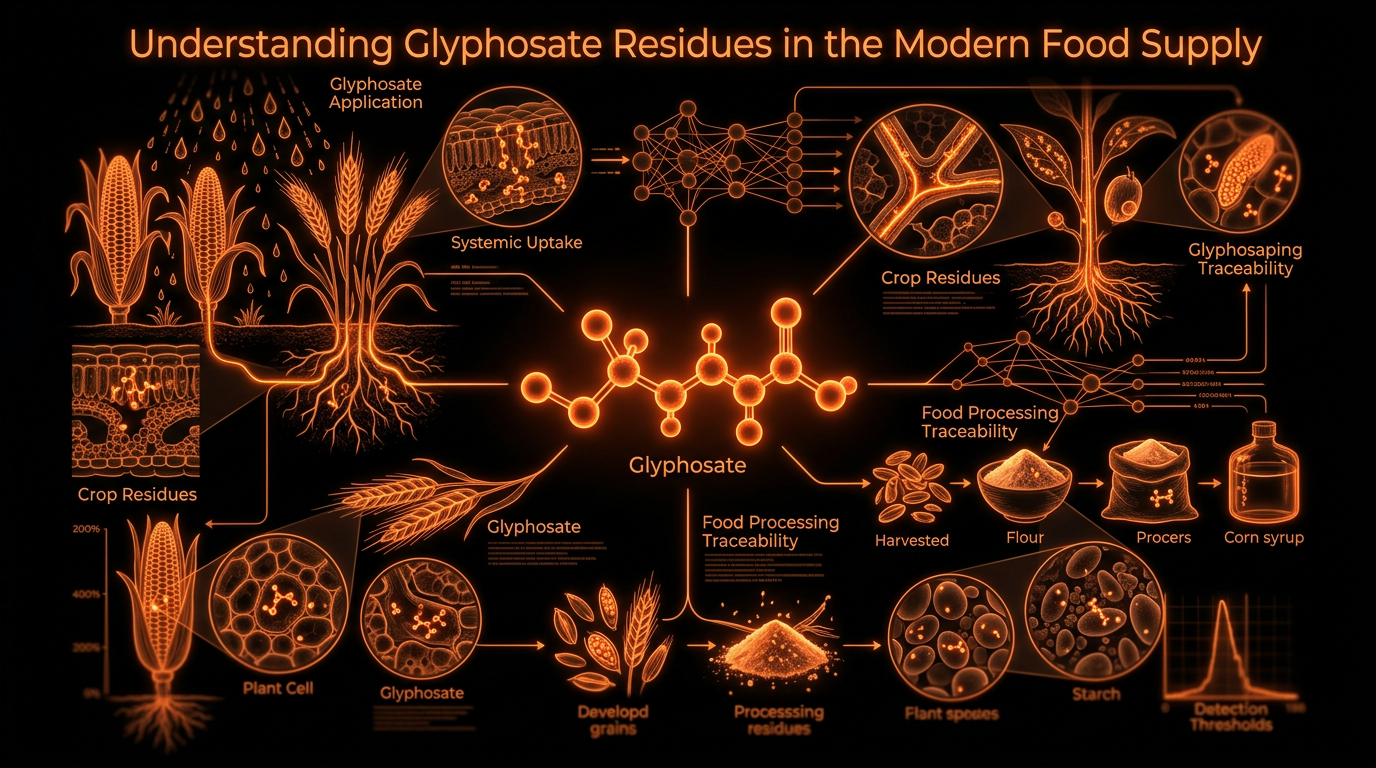
In the contemporary landscape of industrial agriculture, few chemicals have ignited as much controversy, litigation, and scientific scrutiny as N-(phosphonomethyl)glycine—known globally as glyphosate. Originally patented by Stauffer Chemical in 1964 as a chelating agent to descale industrial pipes, and later repurposed by Monsanto in 1974 as a broad-spectrum herbicide, glyphosate has moved from a peripheral agricultural tool to the most heavily used chemical in the history of human civilisation.
To achieve a true 'innerstanding' of this substance, one must look beyond the marketing narratives of "safety" and "efficiency." We must examine the molecular mechanics of how this synthetic compound interacts with the soil, the microbiome, and the very architecture of human physiology. This report serves as a high-authority interrogation of glyphosate’s ubiquity, its biological impact, and the necessary protocols for systemic recovery.
The Illusion of Safety: The Shikimate Pathway Fallacy
The foundational argument for glyphosate’s safety—propounded by regulatory bodies and agrochemical giants alike—is that it targets an enzyme found only in plants and bacteria, not in humans. This enzyme, 5-enolpyruvylshikimate-3-phosphate synthase (EPSPS), is a crucial component of the Shikimate Pathway. This metabolic route is responsible for the synthesis of essential aromatic amino acids: phenylalanine, tyrosine, and tryptophan.
The industry logic was simple: humans do not possess the shikimate pathway; therefore, glyphosate is as "safe as salt." However, this narrative purposefully ignores the most critical component of human health: the microbiome.
- Microbial Disruption: The trillions of bacteria residing in the human gut do possess the shikimate pathway. Glyphosate acts as a potent antibiotic, selectively eliminating beneficial bacteria (like Lactobacillus and Bifidobacterium) while allowing pathogenic strains (like Clostridia and Salmonella) to thrive, as they are often glyphosate-resistant.
- Neurotransmitter Depletion: Because the shikimate pathway in our gut flora produces the precursors for serotonin, dopamine, and melatonin, glyphosate exposure is directly linked to the modern epidemic of anxiety, depression, and sleep disorders.
- The Trojan Horse: Glyphosate is a structural analogue of the amino acid glycine. Emerging evidence suggests that the body may mistakenly incorporate glyphosate into protein synthesis in place of glycine, leading to misfolded proteins and systemic biological "glitches" that manifest as autoimmune conditions and neurodegenerative diseases.
The Modern Saturation: Beyond Weed Control
The presence of glyphosate in our food supply is no longer limited to the "GMO" soy and corn crops common in North America. In the United Kingdom and Europe, a more insidious practice has led to the saturation of the conventional food chain: Pre-harvest Desiccation.
Several weeks before harvest, farmers often spray non-GMO crops—such as wheat, oats, barley, and oilseed rape—with glyphosate. This kills the plant, forcing it to drop its moisture and "dry down" uniformly, which eases the harvesting process. Because the chemical is applied so close to the point of consumption, the residues do not have time to degrade.
"Data from the UK’s Pesticide Residues in Food (PRiF) committee consistently identifies glyphosate residues in over 60% of conventional wholemeal bread samples tested. While these levels are often cited as being within 'Maximum Residue Limits' (MRLs), these safety thresholds fail to account for the cumulative, 'cocktail effect' of daily low-dose exposure over decades."
Environmental Persistence and the Water Table
Glyphosate is not a "stationary" chemical. Its high solubility in water means it moves through the environment with alarming fluidity.
- Soil Degradation: Glyphosate binds to soil minerals, rendering them unavailable to the plants. This results in "empty" food—produce that looks correct but lacks the mineral density (manganese, magnesium, zinc) required for human enzyme function.
- Hydrological Contamination: It is now a common constituent of rainwater and groundwater. Even if one consumes a strictly organic diet, the environmental "drift" ensures that total avoidance is nearly impossible in a modern industrialised nation.
Biological Mechanisms of Harm: The Molecular Sabotage
To understand the internal damage caused by glyphosate, we must look at three primary mechanisms: chelation, endocrine disruption, and the compromise of the intestinal barrier.
1. Mineral Chelation
Glyphosate was originally a descaler for a reason; it is a powerful chelator. In the human body, it binds to divalent cations—specifically Manganese (Mn). Manganese is a critical co-factor for the enzyme glutamine synthetase (which detoxifies ammonia in the brain) and superoxide dismutase (the body’s primary antioxidant defence). By stripping these minerals, glyphosate induces a state of chronic oxidative stress and "brain fog."
2. Cytochrome P450 (CYP) Inhibition
The CYP enzyme family is responsible for detoxifying xenobiotics (foreign chemicals) and metabolising vitamin D and cholesterol. Glyphosate inhibits these enzymes, effectively "handcuffing" the liver's ability to detoxify other environmental toxins, such as heavy metals or plasticisers. This creates a synergistic toxicity, where glyphosate makes every other poison in our environment more damaging.
3. "Leaky Gut" and Zonulin
Glyphosate has been shown to disrupt Tight Junctions in the intestinal lining. It triggers the release of Zonulin, a protein that modulates the permeability of these junctions. When tight junctions open inappropriately, undigested food particles and lipopolysaccharides (LPS) enter the bloodstream, triggering systemic inflammation and the "leaky gut" syndrome that underpins most modern chronic illnesses.
The UK Context: Regulatory Gaps and Public Health
While the European Union has debated the renewal of glyphosate’s licence with increasing intensity, the UK’s post-Brexit regulatory landscape remains permissive.
"According to the Soil Association, nearly 2.4 million hectares of British farmland are treated with glyphosate annually. This represents a 400% increase in use over the last 30 years, despite the World Health Organization’s International Agency for Research on Cancer (IARC) classifying glyphosate as a 'probable human carcinogen' in 2015."
The focus on "acute toxicity" (whether a single dose will kill you) is a scientific distraction. The true threat lies in chronic, sub-lethal toxicity—the slow erosion of metabolic integrity over twenty to thirty years.
Environmental Disruptors: The Adjuvant Problem
It is a common misconception that "Roundup" is just glyphosate. In reality, commercial herbicides contain surfactants and adjuvants, such as polyethoxylated tallow amine (POEA).
- These "inert" ingredients are designed to break down the waxy surface of a leaf so the glyphosate can penetrate the plant.
- In the human body, these surfactants perform the same role on our cellular membranes, making our cells up to 1,000 times more permeable to the toxin than glyphosate alone.
- Research indicates that the full commercial formulations are significantly more cytotoxic and endocrine-disrupting than the isolated active ingredient used in regulatory safety trials.
Recovery Protocols: Restoring Biological Sovereignty
If we accept that glyphosate is a near-ubiquitous presence in the modern world, the question shifts from "how do we avoid it?" to "how do we mitigate and recover?" Achieving "innerstanding" requires a proactive approach to detoxification and nutritional fortification.
1. The Organic Mandate
The most effective way to reduce glyphosate burden is to switch to certified organic or biodynamic produce. Studies have shown that switching to an organic diet for just one week can reduce urinary glyphosate levels by over 70%.
- Focus particularly on "High-Risk" foods: Wheat, oats, soy, corn, and sugar beets.
- Look for the "Glyphosate Residue Free" seal, which is becoming a gold standard in transparent labelling.
2. Glycine Competition
Since glyphosate acts as a glycine analogue, supplementing with high-quality collagen peptides or pure L-Glycine can help "crowd out" the toxin. By saturating the system with pure glycine, the body is less likely to mistakenly incorporate glyphosate into its structural proteins.
3. Humic and Fulvic Acids
Derived from ancient soil deposits, humic and fulvic substances are nature’s most potent chelators.
- They have a high affinity for glyphosate and can help "mop up" residues within the intestinal tract before they are absorbed.
- They also provide the trace minerals that glyphosate typically strips from the body, helping to restore enzymatic balance.
4. Microbiome Restoration
To repair the damage done to the gut flora, a multi-pronged approach is necessary:
- Probiotics: Focus on Bifidobacterium and Lactobacillus strains which are most susceptible to glyphosate.
- Spore-Based Organisms: Soil-based organisms (SBOs) like Bacillus coagulans are hardier and can help re-establish a healthy microbial terrain.
- Prebiotic Fibre: Feed the survivors with inulin, chicory root, and Jerusalem artichoke.
5. Sulphur and Glutathione Support
Because glyphosate interferes with the sulphate pathway, supporting the body’s "Master Antioxidant"—Glutathione—is essential.
- NAC (N-Acetyl Cysteine): A precursor to glutathione.
- Sulphur-rich foods: Garlic, onions, and cruciferous vegetables (broccoli, kale).
- Epsom Salt Baths: Transdermal magnesium sulphate bypasses the digestive tract to provide immediate sulphate support.
The Path to Innerstanding
The presence of glyphosate in our food supply is a symptom of a deeper disconnection from the natural order. We have prioritised yield over nutrition, and convenience over vitality. This chemical is not merely a "weed killer"; it is a systemic disruptor that operates at the intersection of soil health, microbial ecology, and human genetics.
To protect ourselves and future generations, we must transition from passive consumers to informed stewards of our own biology. This involves demanding rigorous testing, supporting regenerative farming practices, and implementing personal protocols that reinforce our resilience against an increasingly toxic world.
Truth-exposing research is the first step toward sovereignty. By recognising the mechanisms by which glyphosate operates, we strip it of its "invisible" power. Knowledge, when integrated into action, is the ultimate antidote.
Summary of Key Actions:
- Prioritise: Organic sourdough or ancient grains (einkorn/spelt) over conventional bread.
- Filter: High-quality water filtration (Reverse Osmosis or Berkey with PF-2 filters) to remove glyphosate drift.
- Supplement: Fulvic acid, Glycine, and Manganese (only after testing levels).
- Advocate: Support local, small-scale farmers who eschew the chemical-intensive model of agriculture.
The health of the soil and the health of the human are one and the same. To heal one, we must heal the other.
This article is provided for informational and educational purposes only. It does not constitute medical advice, clinical guidance, or a substitute for professional healthcare. Information reflects cited research at time of publication. Always consult a qualified healthcare professional before acting on any health information.
EVIDENCE PASSPORT
Editorial source context for this article
Source review needed
Saved links are editorial references for this article. They may support specific claims rather than every sentence. Open and assess each source in context. This passport does not independently verify them.
Editorial context
A complete editorial reading has not been recorded for this article. Source links remain available for you to open and assess directly.
Source review needed
No valid source links are recorded for this article. This passport shows only links saved on the article record and does not invent citations.
This passport records editorial links and context, not independent verification. Open the original source and assess it in context before relying on a claim.
Medical Disclaimer
The information in this article is for educational purposes only and does not constitute medical advice, diagnosis, or treatment. Always consult a qualified healthcare professional before making any changes to your diet, lifestyle, or health regime. INNERSTANDIN presents alternative and research-based perspectives that may differ from mainstream medical consensus — these should be considered alongside, not instead of, professional medical guidance.
Read Full DisclaimerContinue the thread
Keep this question moving.
Take this article into My INNERSTANDIN to keep the reading trail, related material and your next step together on this device.
Dig deeper in the Library
Free, longform PDF volumes that go beyond headlines into mechanisms and references.