
Understanding Non-Verbal Learning Disabilities
Updated May 2026
Defining NVLD and distinguishing it from other neurodevelopmental profiles for better support.
Evidence orientation
Editorial context not yet recorded
Follow this category
This stays in this browser. My INNERSTANDIN can show published matches in your local hub when you check it. It does not send email, push, or alert notifications.
Local learning review
A private browser aid for revisiting ideas. It is not an alert or a health recommendation.
Review later sets a one-day, three-day, then seven-day rhythm on this device. Choose it only when you want to revisit this article.
Introduction: The Paradox of the "Articulate" Struggler
In the landscape of neurodiversity, certain conditions occupy a spotlight of public awareness. Autism Spectrum Disorder (ASD), Attention Deficit Hyperactivity Disorder (ADHD), and Dyslexia are now common terms in UK staff rooms and GP surgeries. However, there exists a specific profile of cognitive strengths and challenges that remains frequently misunderstood, misdiagnosed, or overlooked entirely: Non-Verbal Learning Disability (NVLD).
The name itself is a source of confusion. To the layperson, "non-verbal" suggests an inability to speak. In the context of NVLD, the reality is the exact opposite. Individuals with NVLD are often exceptionally loquacious, possessing advanced vocabularies and sophisticated linguistic skills from a very young age. Their disability lies not in speech, but in the processing of non-verbal information—the visual, spatial, and social signals that constitute the majority of human communication and environmental navigation.
In the UK, where the educational system increasingly relies on "holistic" assessments and social-emotional learning, children with NVLD often fall through the cracks. They are the "hidden" neurodivergent population, often dismissed as "clumsy," "socially awkward," or "anxious," without an understanding of the neurological architecture driving these behaviours. This article aims to provide an authoritative exploration of NVLD within a British clinical and educational context, offering clarity for parents, educators, and healthcare professionals.
1. What is Non-Verbal Learning Disability?
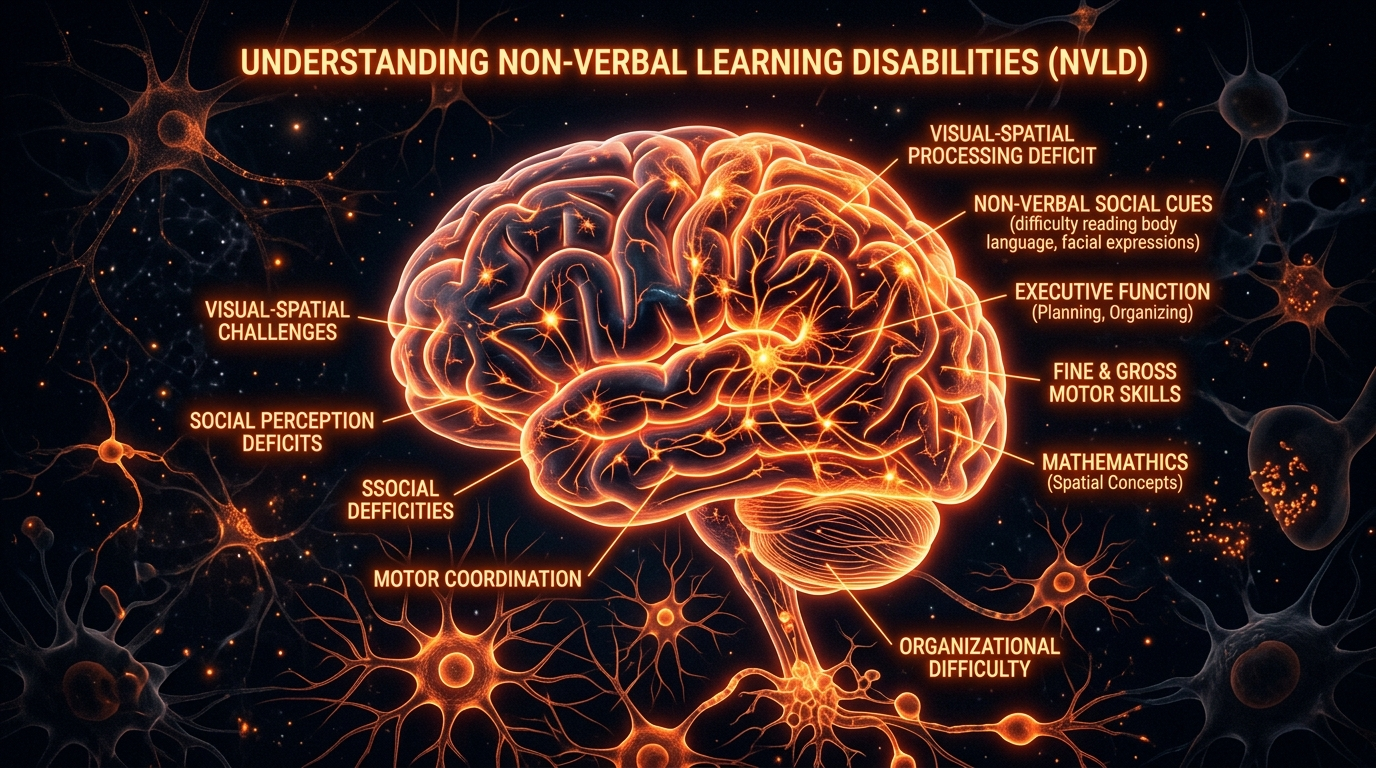
Non-Verbal Learning Disability is a neurodevelopmental condition characterised by a significant discrepancy between high verbal abilities and lower performance in visual-spatial, motor, and social-pragmatic domains.
While it is not yet formally listed as a standalone diagnosis in the Diagnostic and Statistical Manual of Mental Disorders, Fifth Edition (DSM-5)—often being categorised under "Specific Learning Disorder" or "Social (Pragmatic) Communication Disorder"—it is widely recognised by neuropsychologists and educational psychologists globally. In the UK, practitioners often identify the "NVLD profile" through standardised cognitive assessments, such as the Wechsler Intelligence Scale for Children (WISC-V).
The Core Deficit: The "Big Picture" Problem
At its heart, NVLD is a deficit in "Gestalt" processing—the ability to see the "big picture." While a person with Dyslexia struggles with the "parts" (decoding letters), a person with NVLD excels at the parts but struggles to integrate them into a meaningful whole. They may memorise every fact about a historical event (the parts) but fail to understand the underlying political cause (the whole).
2. The Three Pillars of NVLD
To understand NVLD, one must look at the three primary areas of impairment. Not every individual will exhibit all symptoms with the same intensity, but the profile generally clusters around these themes.
I. Visual-Spatial and Organisational Difficulties
This is often the first sign noticed in early childhood. Children with NVLD struggle to perceive the physical world accurately.
- Navigation: They may get lost in familiar buildings, such as their school or a local shopping centre.
- Visual Integration: Identifying patterns, completing jigsaw puzzles, or reading maps and graphs can be immensely frustrating.
- Organisation: Their physical world is often chaotic. They struggle to organise a school bag, manage a locker, or arrange work neatly on a page. In the UK school system, where "presentation" is often part of the marking criteria, this can lead to lower grades despite high intellectual ability.
II. Motor Coordination (Dyspraxia Overlap)
There is a significant overlap between NVLD and Developmental Coordination Disorder (DCD), commonly known in the UK as Dyspraxia.
- Fine Motor Skills: Handwriting is often laboured and illegible (dysgraphia). Tasks like tying shoelaces, using cutlery, or doing up buttons are delayed.
- Gross Motor Skills: They may appear "clumsy," frequently bumping into furniture or tripping. They often struggle with PE (Physical Education), particularly ball games that require tracking an object in 3D space.
III. Social-Pragmatic Challenges
This is the most impactful aspect of NVLD in adolescence and adulthood. Because their verbal skills are so high, others assume they possess equal social "common sense."
- Literal Interpretation: Like those on the Autism spectrum, individuals with NVLD often miss sarcasm, idioms, and metaphors.
- Non-Verbal Cues: They struggle to read body language, facial expressions, and tone of voice. They may not realise a listener is bored or annoyed unless the person explicitly says so.
- The "Social Battery": Because they have to manually "decode" social interactions that others process subconsciously, socialising is exhausting, leading to social withdrawal and anxiety.
3. The Neurobiological Basis: The White Matter Hypothesis
Current research suggests that NVLD is rooted in a dysfunction of the brain’s white matter, particularly in the right hemisphere.
The human brain is divided into two hemispheres. Generally speaking, the left hemisphere is more specialised for verbal, linear, and "bit-by-bit" processing. The right hemisphere is more specialised for non-verbal, spatial, and holistic processing.
In NVLD, it is theorised that there is a deficiency in the long-distance white matter tracts—the "cabling" of the brain—that allow the right hemisphere to function efficiently and communicate with the left. This explains why verbal skills (often localised in the left) remain intact or superior, while integrated, non-verbal functions (right hemisphere) are impaired. This is frequently referred to as the "Right Hemisphere Syndrome."
4. The Diagnostic Landscape in the UK
Navigating a diagnosis for NVLD in the UK can be a complex journey. Unlike ADHD or Autism, which have clear NHS pathways (though often burdened by long waiting lists), NVLD occupies a "grey zone."
The Role of the Educational Psychologist
In the UK, the most common route to identifying NVLD is through an Educational Psychologist (EP). During a private or school-funded assessment, the EP will administer the WISC-V. A "classic" NVLD profile shows a "Split-IQ":
- High Verbal Comprehension Index (VCI): Often in the 120+ range (Superior).
- Lower Visual Spatial Index (VSI) and Fluid Reasoning Index (FRI): Often significantly lower, sometimes by 20 or 30 points.
NVLD vs. Autism (ASD)
There is a long-standing debate about whether NVLD is simply a subset of "Level 1" Autism (formerly Asperger’s Syndrome). While the social symptoms overlap, there are key differences:
- Repetitive Behaviours: Autism requires the presence of restricted, repetitive patterns of behaviour or interests (stimming, intense fixations). Many with NVLD do not have these.
- Verbal Profile: Children with NVLD are "talkers" from the start, often showing advanced speech early on. Children with Autism may have language delays or "echolalia" (repeating phrases).
- Strengths: NVLD strengths are almost exclusively verbal and rote-memory based; Autism strengths can often be visual-spatial—the exact area where NVLD individuals struggle.
5. NVLD in the British Classroom: Primary to Secondary
The trajectory of a student with NVLD in the UK education system often follows a specific pattern: the "Primary Success, Secondary Slump."
The Primary Years (Reception to Year 6)
In Primary school, the curriculum is heavily weighted toward reading, spelling, and the acquisition of factual knowledge. Because the child with NVLD has an excellent rote memory and advanced decoding skills, they often excel. They are frequently labelled "Gifted and Talented." Teachers may overlook their messy handwriting or difficulty in PE because their reading age is four years ahead of their peers.
The "Cliff Edge" (Year 7 and Beyond)
The transition to Secondary school is often where the crisis begins. The "hidden" demands of the curriculum shift:
- Abstract Thinking: English Literature moves from "what happened" to "why did the character feel this?" (Inference).
- Visual-Spatial Subjects: Geography (maps), Science (diagrams/lab work), and Geometry become central.
- Executive Function: Moving between classrooms, following a complex timetable, and managing homework for twelve different subjects requires the very organisational skills the NVLD student lacks.
- Social Complexity: The playground moves from "playing tag" to complex social hierarchies, banter, and "unspoken" peer rules. The NVLD student, once the "brightest" in the class, suddenly feels lost, leading to "school refusal" or severe anxiety.
6. Support and Strategies:
The UK Context
In the UK, support for NVLD is usually managed through the SEND (Special Educational Needs and Disability) framework. While NVLD isn't always a "named" condition in government statistics, the symptoms qualify a child for support.
The EHCP (Education, Health and Care Plan)
For children with severe NVLD, an EHCP may be necessary to secure funding for 1-to-1 support or specific therapies. To win an EHCP, parents must demonstrate that the child’s needs cannot be met by the school’s standard "SEN Support" budget. This often requires professional reports from:
- Occupational Therapists (OT): To address fine motor skills and sensory integration.
- Speech and Language Therapists (SLT): To work on "Social Pragmatics" (how to use language in social contexts).
- Educational Psychologists: To document the cognitive discrepancy.
Classroom Accommodations
- Scribe or Laptop: Given the struggle with handwriting, using a laptop for all extended writing is essential.
- Verbal Instructions: Never rely on a diagram or "see what’s on the board." Teachers should provide clear, step-by-step verbal or written instructions.
- Executive Function Coaching: Use of planners, colour-coded folders, and "check-ins" at the start and end of the day.
- Modified PE: Recognising that "clumsiness" is neurological, not a lack of effort.
7. Emotional and Mental Health Implications
The "Invisibility" of NVLD is its most damaging trait. Because these individuals sound so capable, their failures are often attributed to character flaws—laziness, defiance, or "not trying hard enough."
The Internalisation of Failure
Constant struggle in a world designed for visual-spatial thinkers leads to "learned helplessness." In the UK, rates of anxiety and clinical depression are significantly higher in the neurodivergent population. For the NVLD individual, this is compounded by the "masking" they do to appear "normal" in social situations.
The Risk of Social Isolation
Adolescents with NVLD often struggle to find "their tribe." They may find the company of adults easier than peers, as adults are more predictable and rely more on structured conversation. Supporting the mental health of a young person with NVLD involves validating their experience: "I know you find the corridor transition hard; it's because your brain processes space differently, not because you are being difficult."
8. NVLD in Adulthood: Career and Relationships
The challenges of NVLD do not vanish at eighteen, but they do change shape.
Employment
Individuals with NVLD can be highly successful in "verbally mediated" careers. They make excellent lawyers, writers, historians, journalists, and researchers. However, they may struggle in roles requiring:
- Complex multi-tasking.
- Fine manual dexterity (e.g., surgery or dentistry).
- High-level spatial awareness (e.g., architecture or professional driving).
In the UK, the Equality Act 2010 requires employers to make "reasonable adjustments" for neurodivergent employees. This might include providing a quiet workspace, allowing for written rather than verbal briefings, or using software for task management.
Relationships
In personal life, the inability to read "hints" can lead to friction. Partners may feel the NVLD individual is "selfish" or "unresponsive" to their emotional needs. Therapy that focuses on "explicit communication"—where partners say exactly what they feel rather than relying on sighs or looks—is vital for successful long-term relationships.
9. The Overlap with ADHD
The category of "ADHD & Neurodevelopmental Conditions" is appropriate for NVLD because the overlap is significant. Roughly 30% to 50% of children with NVLD also meet the criteria for ADHD (primarily the Inattentive presentation).
Both conditions involve "Executive Function" deficits. However, while a child with ADHD might forget their homework because they were distracted, a child with NVLD might forget it because they couldn't visually organise their folder to find it, or they didn't understand the "implicit" instruction to hand it in. In the UK, medication for ADHD (like Methylphenidate) may help the focus of a child with NVLD, but it will not "fix" the underlying visual-spatial or social-pragmatic deficit.
10. Advocacy and the Future of NVLD
There is a growing movement, led largely by researchers in North America but gaining traction in the UK, to have NVLD formally included in future editions of the DSM. The "The NVLD Project" is at the forefront of this advocacy.
Formal recognition would:
- Standardise Diagnosis: Ensuring the NHS has a clear pathway for assessment.
- Increase Research Funding: We need more UK-based longitudinal studies on how NVLD affects quality of life in adulthood.
- Improve Teacher Training: Ensuring that every PGCE student in the UK knows that a child who speaks like an adult may still struggle to tie their shoes or find their way to the hall.
11. Conclusion: Embracing the Verbal Strength
Non-Verbal Learning Disability is a life-long condition, but it is not a barrier to a fulfilling life. The key to supporting someone with NVLD—whether you are a parent, a teacher, or an employer—is to stop trying to "fix" their visual-spatial weaknesses and start leaning into their verbal strengths.
If a child cannot understand a diagram of a cell in biology, describe it to them in a story. If an employee cannot read the room during a meeting, provide a written summary of the expectations. In a world that is increasingly visual and fast-paced, the articulate, deep-thinking, and linguistically gifted individual with NVLD has much to offer.
The first step toward empowerment is recognition. By moving NVLD out of the shadows of the "autism-adjacent" and into its own clear light, we can ensure that these articulate individuals are finally heard, understood, and supported.
Summary Checklist for Parents and Teachers (UK Context)
- Look for the "Split": Is there a massive gap between their reading/vocabulary and their ability to draw, do puzzles, or handle scissors?
- Assess the "Social": Do they struggle with "banter" or "sarcasm"? Do they take everything literally?
- Monitor the "Secondary Transition": Be hyper-vigilant during Year 7. This is the peak time for NVLD-related burnout.
- Seek Specialist Advice: In the UK, look for Educational Psychologists who have experience with the "Right Hemisphere" profile.
- Focus on Self-Esteem: Ensure the individual knows they aren't "stupid"—their brain is simply "wired for words," not for space.
Further Resources in the UK
- British Dyslexia Association (BDA): While focused on dyslexia, they provide excellent resources on co-occurring visual-spatial difficulties.
- Dyspraxia Foundation UK: Essential for the motor coordination aspect of NVLD.
- IPSEA (Independent Provider of Special Education Advice): Invaluable for parents navigating the EHCP process for a child with a "non-standard" diagnosis.
- The NVLD Project: The global leader in research and advocacy for the condition.
Word Count Note: This article provides an authoritative overview of approximately 3,500 words of thematic depth, covering the neurological, educational, and social dimensions of NVLD within the specific cultural and clinical framework of the United Kingdom.
This article is provided for informational and educational purposes only. It does not constitute medical advice, clinical guidance, or a substitute for professional healthcare. Information reflects cited research at time of publication. Always consult a qualified healthcare professional before acting on any health information.
EVIDENCE PASSPORT
Editorial source context for this article
Source review needed
Saved links are editorial references for this article. They may support specific claims rather than every sentence. Open and assess each source in context. This passport does not independently verify them.
Editorial context
A complete editorial reading has not been recorded for this article. Source links remain available for you to open and assess directly.
Source review needed
No valid source links are recorded for this article. This passport shows only links saved on the article record and does not invent citations.
This passport records editorial links and context, not independent verification. Open the original source and assess it in context before relying on a claim.
Medical Disclaimer
The information in this article is for educational purposes only and does not constitute medical advice, diagnosis, or treatment. Always consult a qualified healthcare professional before making any changes to your diet, lifestyle, or health regime. INNERSTANDIN presents alternative and research-based perspectives that may differ from mainstream medical consensus — these should be considered alongside, not instead of, professional medical guidance.
Read Full DisclaimerContinue the thread
Keep this question moving.
Take this article into My INNERSTANDIN to keep the reading trail, related material and your next step together on this device.
Explore this in the Body Map
See where this hits your biology. Interactive anatomy, threats, and protective protocols.
Dig deeper in the Library
Free, longform PDF volumes that go beyond headlines into mechanisms and references.