
Vagus Nerve: The Master Regulator of Healing
Updated May 2026
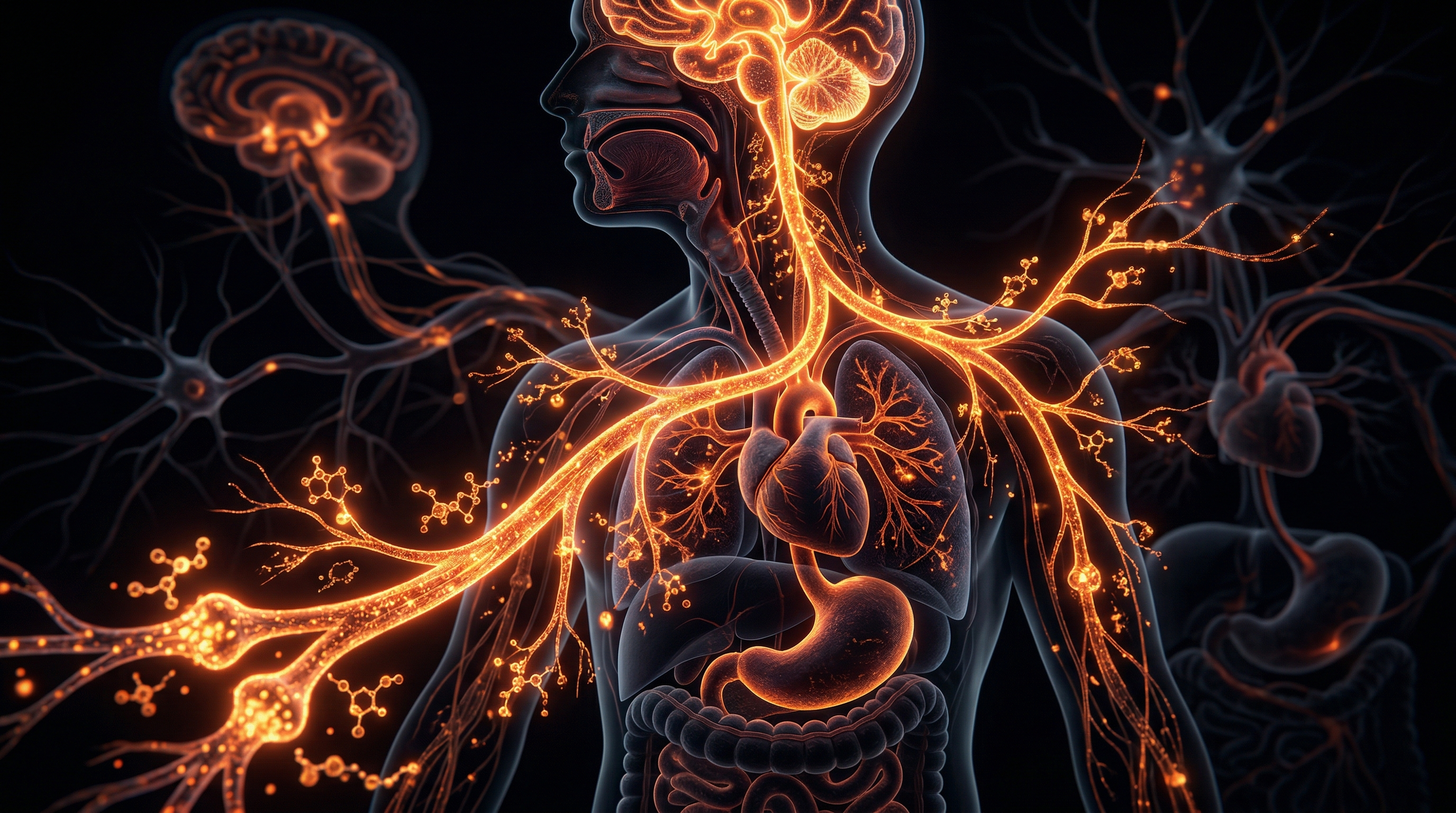
The vagus nerve — the tenth cranial nerve and the longest nerve in the autonomic nervous system — extends from the brainstem through the neck, chest, and abdomen, innervating the heart, lungs, oesophagus, stomach, liver, gallbladder, spleen, pancreas, and the entire length of the intestines, carrying both efferent signals from the brain to peripheral organs and, critically, 80% afferent signals from the organs back to the brain. As the primary conduit of the parasympathetic nervous system, vagal tone — the level of ongoing vagal activity measurable through heart rate variability (HRV) — determines the body's capacity to maintain anti-inflammatory homeostasis via the 'inflammatory reflex', regulate intestinal motility and gut microbiome composition, manage the stress response through HPA axis modulation, and facilitate the restorative 'rest and digest' physiology that enables tissue repair. Chronic vagal dysfunction — driven by psychological trauma, chronic inflammation, gut dysbiosis, toxic exposure, and sedentary behaviour — is now identified as a common denominator across conditions including autoimmune disease, inflammatory bowel disease, treatment-resistant depression, PTSD, and ME/CFS, making vagal rehabilitation through evidence-based practices a critical and underutilised therapeutic frontier.
Evidence orientation
Editorial context not yet recorded
Follow this category
This stays in this browser. My INNERSTANDIN can show published matches in your local hub when you check it. It does not send email, push, or alert notifications.
Local learning review
A private browser aid for revisiting ideas. It is not an alert or a health recommendation.
Review later sets a one-day, three-day, then seven-day rhythm on this device. Choose it only when you want to revisit this article.
Overview
In the hierarchy of human physiology, we have been conditioned to view the brain as the undisputed monarch and the peripheral organs as its subservient subjects. However, modern biological research is exposing a far more complex and democratic reality. At the centre of this systemic communication is the vagus nerve—the tenth cranial nerve and the longest, most intricate component of the autonomic nervous system. Often referred to as the "wandering nerve" (derived from the Latin vagus), it serves as the primary superhighway between the brainstem and the visceral organs, governing the fundamental transition between survival-based stress and restorative healing.
For decades, the vagus nerve was relegated to the sidelines of medical education, viewed primarily as a regulator of heart rate and digestion. We now recognise it as the Master Regulator of Healing. It is the physical manifestation of the mind-body connection, a bidirectional conduit that does not merely transmit commands from the brain to the body, but, more crucially, provides a constant stream of "intelligence reports" from the body back to the brain. In fact, approximately 80% of vagal fibres are afferent, meaning they carry sensory information from the heart, lungs, and gut upward to the medulla oblongata.
This article aims to strip away the reductionist layers of mainstream medicine to reveal the vagus nerve as the key to resolving chronic inflammatory cascades. We are currently witnessing an epidemic of "vagal withdrawal"—a state where the body loses its ability to engage the parasympathetic "rest and digest" response, leaving the individual trapped in a perpetual state of sympathetic dominance. Whether we are discussing autoimmune conditions, refractory depression, or the burgeoning crisis of ME/CFS (Myalgic Encephalomyelitis/Chronic Fatigue Syndrome), the common denominator is almost invariably a breakdown in vagal tone. To understand the vagus nerve is to understand the very blueprint of human resilience and biological recovery.
Over 80% of the fibres within the vagus nerve are sensory (afferent), meaning your brain is listening to your organs four times more often than it is speaking to them.
##
##
The Biology — How It Works
The vagus nerve is not a single cord, but a bilateral pair of nerve bundles that originate in the medulla oblongata of the brainstem. From this ancient control centre, the nerve exits the skull through the jugular foramen and descends through the neck, passing through the carotid sheath alongside the internal carotid artery and the internal jugular vein. This anatomical positioning is critical; it places the vagus nerve in a position to monitor the chemical composition of the blood and the mechanical pressure of the cardiovascular system via the baroreceptors and chemoreceptors.
The Anatomy of the Wandering Nerve
As the vagus nerve descends, it branches out with extraordinary complexity. It innervates the pharynx and larynx, controlling the muscles of speech and swallowing—a biological link between our voice and our internal state. Continuing downward, it forms the pulmonary plexus to regulate bronchial constriction and the cardiac plexus to modulate the rhythm of the heart. Below the diaphragm, the vagus nerve enters the abdominal cavity, where it becomes the primary architect of the "second brain" or the enteric nervous system (ENS).
The nerve’s reach is comprehensive. It penetrates the:
- Heart: It releases acetylcholine to slow the firing rate of the sinoatrial node, thereby lowering heart rate and increasing Heart Rate Variability (HRV).
- Lungs: It manages the depth and frequency of respiration.
- Liver and Gallbladder: It stimulates bile production and regulates glucose metabolism and insulin sensitivity.
- Spleen: It acts as a remote control for the immune system, triggering the anti-inflammatory reflex.
- Gut: It manages peristalsis (the wave-like contractions that move food), gastric acid secretion, and the integrity of the mucosal barrier.
The Afferent Surveillance System
The true power of the vagus nerve lies in its sensory capacity. Through the nodose ganglion, the vagus nerve "tastes" the chemical environment of the gut. It detects the presence of bacterial metabolites (such as short-chain fatty acids), inflammatory cytokines (like TNF-alpha), and even the specific hormones released during digestion (such as cholecystokinin). This information is fed into the Nucleus Tractus Solitarius (NTS) in the brain, which then coordinates a systemic response. If the vagus detects a pathogen in the gut, it signals the brain to initiate a fever or an immune response before the pathogen even enters the bloodstream.
The Polyvagal Perspective
To fully grasp vagal biology, we must move beyond the simple "on/off" switch model of the autonomic nervous system. Stephen Porges’ Polyvagal Theory identifies three distinct evolutionary stages of the nervous system:
- The Dorsal Vagal Complex (The Primitive Brake): An unmyelinated pathway that mediates "freeze" responses or metabolic shutdown during extreme threat.
- The Sympathetic-Adrenal System (The Accelerator): The "fight or flight" mechanism.
- The Ventral Vagal Complex (The Smart Brake): A uniquely mammalian, myelinated pathway that supports social engagement, calm, and physiological repair. This is the "Master Regulator" we seek to optimise.
Heart Rate Variability (HRV) is the gold-standard metric for vagal tone. A low HRV is not just a sign of stress; it is a clinical predictor of all-cause mortality and systemic inflammatory failure.
##
##
Mechanisms at the Cellular Level
To understand how a nerve can heal a damaged organ, we must look at the biochemistry of the Cholinergic Anti-inflammatory Pathway (CAP). This is the cellular mechanism by which the vagus nerve directly halts the production of toxic inflammatory molecules.
The Cholinergic Anti-inflammatory Pathway
When the vagus nerve is stimulated, it releases the neurotransmitter acetylcholine (ACh). While ACh is well-known for its role in muscle contraction, its role in the immune system is revolutionary. In the spleen and other lymphoid tissues, ACh binds to specific receptors on the surface of macrophages—the "sentinel" cells of the immune system. These receptors are known as α7 nicotinic acetylcholine receptors (α7nAChR).
Once ACh binds to the α7nAChR, it triggers an intracellular signalling cascade that inhibits the activity of Nuclear Factor-kappa B (NF-κB). NF-κB is the "master switch" for inflammation; when activated, it enters the cell nucleus and turns on the genes responsible for producing pro-inflammatory cytokines such as Tumour Necrosis Factor-alpha (TNF-α), Interleukin-1 beta (IL-1β), and Interleukin-6 (IL-6).
By suppressing NF-κB, the vagus nerve effectively "mutes" the cytokine storm. This is not merely a theoretical model; it is a hardwired biological reflex. Damage to the vagus nerve or low vagal tone means this reflex is broken, allowing inflammation to run rampant and unchecked throughout the body.
HPA Axis Modulation
The vagus nerve also serves as the primary counterbalance to the Hypothalamic-Pituitary-Adrenal (HPA) axis. While the HPA axis floods the body with cortisol and adrenaline during stress, the vagus nerve provides the "negative feedback" required to shut this response down once the threat has passed. Chronic vagal dysfunction leads to cortisol resistance, where the body’s cells no longer respond to the anti-inflammatory effects of cortisol, leading to the paradoxical state of high stress hormones alongside high systemic inflammation.
The Gut-Brain Barrier and Zonulin
In the intestines, the vagus nerve regulates the "tight junctions" between epithelial cells. Low vagal activity is associated with an increase in Zonulin, a protein that modulates intestinal permeability. When Zonulin levels rise, the gut becomes "leaky," allowing undigested food particles, lipopolysaccharides (LPS) from bacterial cell walls, and environmental toxins to enter the systemic circulation. The vagus nerve’s role in maintaining the mucosal barrier is therefore the first line of defence against the systemic "autoimmune" attacks that characterise modern chronic illness.
##
##
Environmental Threats and Biological Disruptors
The modern world is an inherently anti-vagal environment. Our biology, evolved over millennia in a state of relative silence and natural rhythms, is now being assaulted by a cocktail of disruptors that specifically target vagal integrity.
Chemical Insults: Glyphosate and Heavy Metals
Perhaps the most insidious threat to vagal function is glyphosate, the active ingredient in many agricultural herbicides used extensively in the UK and worldwide. Glyphosate is a potent chelator and an analogue of the amino acid glycine. It disrupts the gut microbiome by inhibiting the shikimate pathway in beneficial bacteria, leading to a state of dysbiosis.
The vagus nerve is directly impacted by this:
- Dysbiosis leads to the production of neurotoxic metabolites that travel up the vagus nerve to the brain.
- Glyphosate can impair the transport of essential minerals (like manganese and zinc) required for the synthesis of acetylcholine.
Furthermore, heavy metals such as mercury (from dental amalgams and certain seafood) and aluminium (from various industrial sources) have a high affinity for nervous tissue. These metals can accumulate in the nodose ganglion, the sensory hub of the vagus nerve, causing "short circuits" in the afferent signalling system.
The EMF Environment
We are now submerged in an invisible sea of Electromagnetic Fields (EMFs) from Wi-Fi, 5G infrastructure, and mobile devices. Emerging research suggests that exogenous EMFs can interfere with the Voltage-Gated Calcium Channels (VGCCs) in our cells. Because the vagus nerve relies on precise electrical signalling and calcium signalling to release neurotransmitters, chronic exposure to high-intensity EMFs can "jam" vagal communication, leading to a persistent state of sympathetic arousal and lowered HRV.
The Trauma Imprint
Biological disruption is not solely chemical or electrical; it is also psychological. The vagus nerve is the "record keeper" of our emotional history. Developmental trauma or chronic "micro-stressors" (the constant pings of a smartphone, the pressure of a 24-hour work culture) keep the ventral vagal system offline. Over time, the nerve can undergo neuroplastic degradation, where the pathways for calm and repair literally wither from disuse, while the sympathetic "fight or flight" pathways become hypertrophied.
According to the British Society for Ecological Medicine, environmental toxins and "sick building syndrome" are major contributors to vagal dysregulation, yet they remain largely ignored in primary care settings.
##
##
The Cascade: From Exposure to Disease
When the vagus nerve fails, the result is not a single symptom but a systemic collapse known as Dysautonomia. This cascade typically follows a predictable pathological trajectory.
Stage 1: The Loss of Resilience
The first sign is a drop in HRV and a loss of "vagal flexibility." The individual may find it harder to recover from minor stressors, experiencing prolonged periods of irritability or anxiety. Sleep becomes less restorative, as the vagus fails to transition the body into the deep parasympathetic states required for glymphatic drainage (the brain’s waste-removal system).
Stage 2: Systemic Inflammation and Gut Issues
As the "inflammatory reflex" weakens, levels of CRP (C-Reactive Protein) and inflammatory cytokines begin to rise. Concurrently, the lack of vagal stimulation to the gut leads to SIBO (Small Intestinal Bacterial Overgrowth). Without the "Migrating Motor Complex"—the vagally-mediated "cleansing wave" that sweeps the small intestine—bacteria from the colon migrate upward, leading to bloating, malabsorption, and further systemic toxicity.
Stage 3: The Chronic Disease State
Eventually, the combination of high inflammation and mitochondrial dysfunction (driven by chronic sympathetic "alarm" signals) manifests as a diagnosed condition. These include:
- Inflammatory Bowel Disease (IBD): Crohn’s and Ulcerative Colitis are now being treated in clinical trials via vagus nerve stimulation (VNS) with remarkable success.
- Treatment-Resistant Depression: When the brain is bathed in inflammatory cytokines (neuroinflammation), the production of serotonin and dopamine is diverted toward the kynurenine pathway, creating "sickness behaviour" that we label as depression.
- Post-Viral Syndromes and ME/CFS: There is compelling evidence that viruses (such as Epstein-Barr or SARS-CoV-2) can infect the vagus nerve directly (Vagus Nerve Infection Hypothesis), causing a persistent "alarm" state that results in the profound exhaustion and "brain fog" characteristic of these conditions.
##
##
What the Mainstream Narrative Omits
The current medical model is built on the "one drug, one target" philosophy. If you have acid reflux, you are given a Proton Pump Inhibitor (PPI). If you have depression, an SSRI. If you have inflammation, a steroid. This approach is fundamentally flawed because it ignores the Master Regulator that governs all these systems simultaneously.
The Pharmaceutical Blind Spot
Mainstream medicine rarely measures HRV or assesses vagal tone during a standard GP consultation. Why? Because you cannot patent the vagus nerve. Many common pharmaceuticals actually suppress vagal activity. For example, some anti-cholinergic drugs (used for everything from allergies to overactive bladder) directly block the very receptors the vagus nerve uses to heal the body.
The Suppression of Bioelectronic Medicine
We are on the cusp of a revolution in Bioelectronic Medicine—the use of electrical impulses rather than chemicals to treat disease. While the NHS has begun to explore VNS for epilepsy and certain cases of depression, the broader application of this technology for autoimmune and metabolic diseases is being slowed by a regulatory framework that prioritises pharmaceutical interventions. The "suppressed truth" is that many "incurable" conditions are simply states of vagal hibernation that can be reversed through targeted stimulation and environmental detoxification.
The Role of the "Social Nervous System"
Mainstream narratives also omit the vital role of human connection in biology. The ventral vagus is part of the Social Engagement System. Loneliness and social isolation are not just "sad"; they are biologically toxic. They signal to the vagus that the "herd" is gone, and the body must remain in a state of high-alert survival mode, which shuts down the repair pathways.
##
##
The UK Context
The UK presents a unique set of challenges for vagal health. From the "postcode lottery" of the NHS to the specific environmental pressures of a densely populated, post-industrial nation, the British public is at significant risk of vagal dysfunction.
The NHS Crisis and Chronic Disease
The NHS is currently designed for acute care—fixing broken bones and treating infections. It is ill-equipped to handle the complex, multi-systemic nature of vagal-mediated chronic illness. Patients with ME/CFS or Fibromyalgia often spend years being passed between specialists (gastroenterologists, neurologists, psychiatrists) without anyone ever looking at the autonomic nervous system as a whole.
Environmental Regulatory Failures
In the UK, the Environment Agency and the Food Standards Agency (FSA) have faced criticism for their stance on glyphosate and water quality. British rivers and tap water often contain "cocktails" of endocrine disruptors and pharmaceutical residues (like oestrogen and antidepressants) that the current filtration systems are not designed to remove. These contaminants act as chronic stressors on the vagus nerve.
The "Stiff Upper Lip" Myth
Cultural factors in the UK also play a role. The traditional "stiff upper lip" mentality—the suppression of emotion and the "carry on" attitude—is a recipe for vagal withdrawal. Suppressing emotional expression requires a massive amount of sympathetic effort, which inhibits the ventral vagal "calm" response, leading to a higher prevalence of stress-related disorders.
Recent data indicates that over 15 million people in England are living with a chronic condition—a number that is skyrocketing as vagal-disrupting environmental factors increase.
##
##
Protective Measures and Recovery Protocols
Healing the vagus nerve is not about a single "hack"; it is about a total biological recalibration. To restore the Master Regulator, we must remove the disruptors and provide the specific inputs the nerve requires to regain its tone.
1. Resonant Frequency Breathing
The fastest way to influence the vagus nerve is through the breath. By slowing the breathing rate to approximately 5.5 to 6 breaths per minute (the "resonant frequency"), we synchronise the heart rate with the respiratory cycle. This creates "coherence," sending a powerful signal of safety to the brainstem.
- Protocol: Inhale for 5.5 seconds, exhale for 5.5 seconds. Do this for 10 minutes, twice daily.
2. Cold Thermogenesis
The vagus nerve is highly sensitive to temperature. Brief exposure to cold—specifically on the face, neck, and chest—triggers the "mammalian dive reflex," which causes an immediate spike in vagal activity and a lowering of the heart rate.
- Protocol: End your morning shower with 30-60 seconds of cold water, ensuring it hits the back of the neck and the chest area.
3. Vagal Toning via Sound
The vagus nerve innervates the vocal cords and the muscles of the inner ear. Gargling, humming, and singing (especially low-frequency chanting like "OM") physically vibrate the nerve, stimulating the ventral vagal complex.
- Protocol: Gargle vigorously with water every morning and evening until your eyes water slightly—this ensures you have reached the intensity required to trigger the vagal reflex.
4. Nutritional Support for Acetylcholine
To produce the "healing neurotransmitter" acetylcholine, the body needs raw materials.
- Choline: Found in egg yolks, liver, and cruciferous vegetables.
- Acetyl-L-Carnitine: A critical co-factor in the synthesis of ACh.
- Omega-3 Fatty Acids (DHA/EPA): These increase the sensitivity of the vagal receptors and improve the fluidity of the nerve membranes.
5. Tracking and Monitoring (HRV)
You cannot manage what you do not measure. Using wearable technology (like Oura, Whoop, or Apple Watch) to track Heart Rate Variability (HRV) allows you to see in real-time how your lifestyle choices (alcohol, late-night meals, overtraining) are impacting your vagal tone.
6. Environmental Detoxification
- Filter Your Water: Use high-quality filters (reverse osmosis or carbon block) to remove fluoride, chlorine, and heavy metals.
- Eat Organic: Minimise glyphosate exposure by choosing organic produce, especially for "dirty dozen" crops.
- EMF Hygiene: Turn off Wi-Fi at night and keep mobile phones away from the body to reduce the "electrical noise" interfering with vagal signalling.
##
##
Summary: Key Takeaways
The vagus nerve is the biological bridge between our environment and our internal state. It is the architect of repair, the sentinel of the immune system, and the primary conduit for the "rest and digest" physiology that is essential for life.
- The Vagus is Sensory: 80% of its work is listening to the body’s internal environment.
- The Inflammatory Reflex: Vagal tone is the only way to "switch off" the production of toxic cytokines via the α7 nicotinic acetylcholine receptor.
- The Modern Assault: Our vagus nerve is being systematically degraded by environmental toxins like glyphosate, EMFs, and chronic psychological trauma.
- HRV is the Vital Sign: Measuring Heart Rate Variability is the most accurate way to assess your body’s capacity to heal.
- Vagal Rehabilitation is Possible: Through breathwork, cold exposure, sound therapy, and environmental detoxification, the vagus nerve can be "retrained" to lead the body back to health.
In the pursuit of true health, we must stop looking at organs in isolation and start focusing on the master regulator that connects them all. The vagus nerve is not just a part of the nervous system; it is the interface of our survival and our ability to thrive. By understanding and honouring this ancient "wandering nerve," we reclaim the power to heal ourselves from the inside out.
This article is provided for informational and educational purposes only. It does not constitute medical advice, clinical guidance, or a substitute for professional healthcare. Information reflects cited research at time of publication. Always consult a qualified healthcare professional before acting on any health information.
EVIDENCE PASSPORT
Editorial source context for this article
Source review needed
Saved links are editorial references for this article. They may support specific claims rather than every sentence. Open and assess each source in context. This passport does not independently verify them.
Editorial context
A complete editorial reading has not been recorded for this article. Source links remain available for you to open and assess directly.
Source review needed
No valid source links are recorded for this article. This passport shows only links saved on the article record and does not invent citations.
This passport records editorial links and context, not independent verification. Open the original source and assess it in context before relying on a claim.
Medical Disclaimer
The information in this article is for educational purposes only and does not constitute medical advice, diagnosis, or treatment. Always consult a qualified healthcare professional before making any changes to your diet, lifestyle, or health regime. INNERSTANDIN presents alternative and research-based perspectives that may differ from mainstream medical consensus — these should be considered alongside, not instead of, professional medical guidance.
Read Full DisclaimerContinue the thread
Keep this question moving.
Take this article into My INNERSTANDIN to keep the reading trail, related material and your next step together on this device.
Explore this in the Body Map
See where this hits your biology. Interactive anatomy, threats, and protective protocols.
Dig deeper in the Library
Free, longform PDF volumes that go beyond headlines into mechanisms and references.