
VOL. 03
Cardiovascular Physiology
Cardiac Cycle, Blood Pressure & Vascular Control
The mechanics and regulation of the cardiovascular system — cardiac excitation-contraction coupling, the cardiac cycle in precise detail, blood pressure regulation and baroreceptor reflexes, vascular tone and endothelial function, microcirculatory exchange, and the integrated cardiovascular response to exercise and stress.
CONTENTS
— WHAT'S INSIDE THIS VOLUME
Cardiac Excitation-Contraction Coupling
The Cardiac Cycle
Cardiac Output & Its Regulation
Blood Pressure & Baroreceptor Reflexes
Vascular Tone & Endothelial Function
Microcirculation & Capillary Exchange
The Coronary & Pulmonary Circulations
Cardiovascular Response to Exercise
FULL VOLUME CONTENT
INTRODUCTION
Cardiovascular Physiology
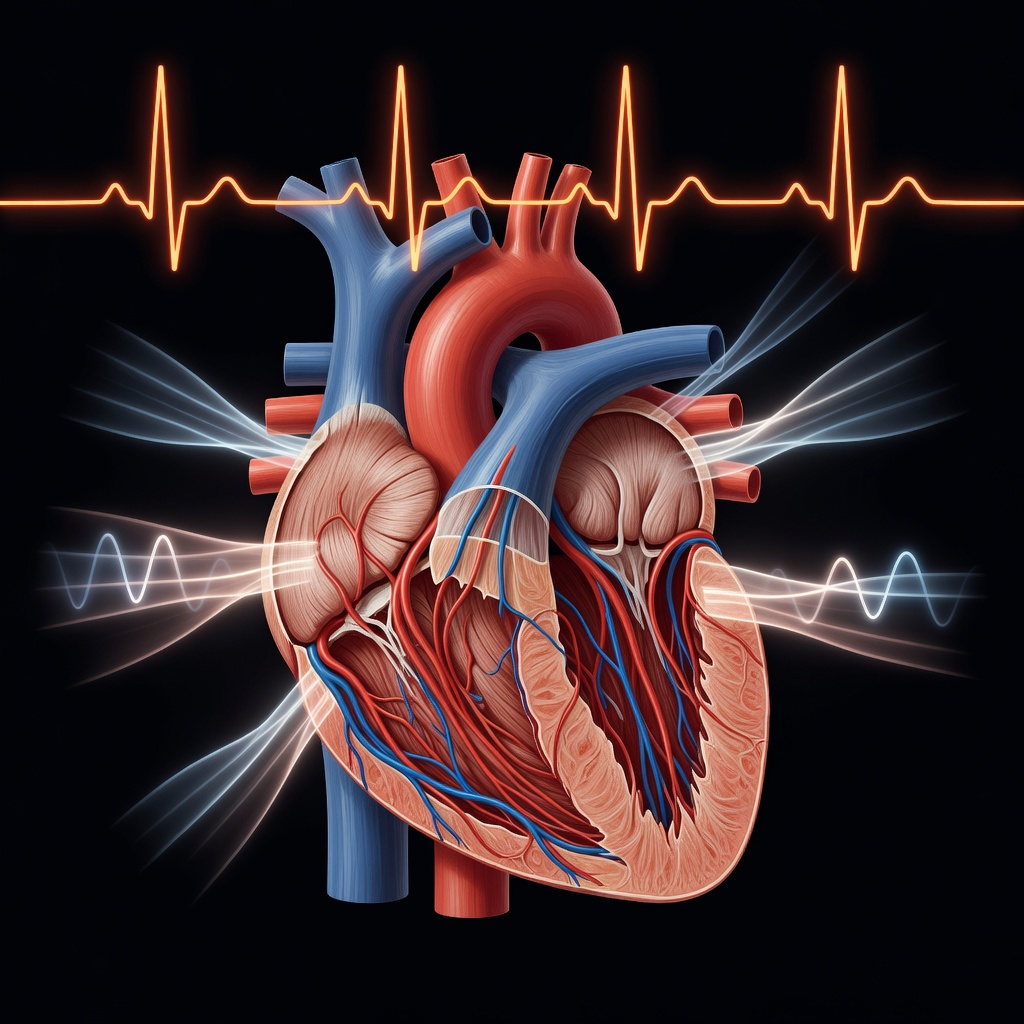
You are currently housing a transport network so vast it could wrap around the planet twice. Right now, as you read this, sixty thousand miles of tubing are snaking through your frame. That is enough to circle the Earth twice over, all tucked neatly inside your skin. Most of us go through our entire lives treating our heart like a simple pump and our blood like a passive liquid, but the reality is far more gripping.
Your cardiovascular system is a high-pressure, self-regulating, ultra-intelligent distribution grid. It never sleeps. It never takes a lunch break. If it stops for even a few minutes, the lights go out forever.
You are a miracle of plumbing and physics combined. Think about the sheer relentless power of your heart. It beats roughly one hundred thousand times every single day. By the time you reach eighty, it will have pulsed three billion times without a single second of downtime.
No man-made machine can match that endurance. Your heart isn't just a muscle; it is a master conductor. It creates its own electricity to trigger every squeeze. We call this the cardiac cycle.
It is a two-stroke masterpiece consisting of systole—the high-pressure clench that flings blood into your arteries—and diastole—the brief, vital moment where the heart relaxes to refill. If your heart didn't have this rhythm, your blood wouldn't flow; it would just vibrate. Every time that clench happens, it sends a shockwave through your body. When you feel your pulse at your wrist, you aren't feeling the blood itself arriving.
You are feeling a pressure wave travelling at ten metres per second, the physical echo of your heart's power. Your blood vessels aren't just dumb pipes either. They are smart. They are alive.
They constantly adjust their diameter to decide where your blood goes. When you are sprinting for a bus, your vessels dilate—they widen their opening—to flood your leg muscles with oxygen. When you are cold, they constrict—tightening like a drawstring—to keep your heat tucked deep inside your core. This is vascular resistance, the invisible hand that dictates your blood pressure.
You are walking around with a fluid pressure system so finely tuned that it can detect a change in position before you have even finished standing up from your chair. Your body uses baroreceptors—tiny pressure sensors in your neck and chest—to tell your brain exactly how hard to push. It is a constant, silent conversation happening beneath your notice. We didn't always understand this.
For over a thousand years, the world followed the ideas of a Roman physician named Galen. He thought blood was created in your liver from the food you ate and then simply got 'consumed' by your organs like fuel in a fire. He believed it moved in a slow ebb and flow, like the tide on a beach. People thought the heart was a furnace for vital spirits.
It wasn't until 1628 that an English doctor named William Harvey proved everyone wrong. He realised that the blood has to circulate in a loop. He calculated that the heart pumps so much blood in an hour that you would need to eat several times your body weight in food every day just to replace it if it were being 'consumed' as Galen suggested. He showed us that your blood is on a continuous voyage that repeats every minute of your life.
In the chapters ahead, we are going to dive into the mechanics of this voyage. We will look at the myocardium—the specialised muscle of your heart wall—and how it coordinates its billions of cells to twitch in perfect unison. We will explore the endothelium, the one-cell-thick lining of your vessels that is so smooth it makes ice feel like sandpaper. You will see how your kidneys and brain act like a thermostat for your blood pressure, constantly tweaking the settings to keep the system from bursting or stalling.
You will learn about the stroke volume—the exact amount of blood shoved out with every single pump—and how your body regulates it with the precision of a Swiss watch. You aren't just a person with a pulse. You are a masterpiece of fluid dynamics. It is time you understood how the engine actually runs.
DOWNLOAD THIS VOLUME
This volume is compiled from peer-reviewed physiology literature into a precision longform PDF. Generate once — it's then saved permanently in the INNERSTANDING library for instant re-download by all users.
PDF format · No wait time · Standardized Print Resolution