
VOL. 05
Renal & Fluid Physiology
Filtration, Reabsorption, Acid-Base & Fluid Homeostasis
The kidney as a master regulator of body chemistry — glomerular filtration dynamics, tubular reabsorption and secretion mechanisms, countercurrent multiplication in the loop of Henle, renin-angiotensin-aldosterone system, ADH and water homeostasis, renal acid-base regulation, and the physiology of fluid compartments.
CONTENTS
— WHAT'S INSIDE THIS VOLUME
Glomerular Filtration Dynamics
Proximal Tubule Reabsorption
The Loop of Henle & Countercurrent System
Distal Tubule & Collecting Duct Regulation
Renin-Angiotensin-Aldosterone System
ADH & Water Homeostasis
Renal Acid-Base Regulation
Fluid Compartments & Osmolality
FULL VOLUME CONTENT
INTRODUCTION
Renal & Fluid Physiology
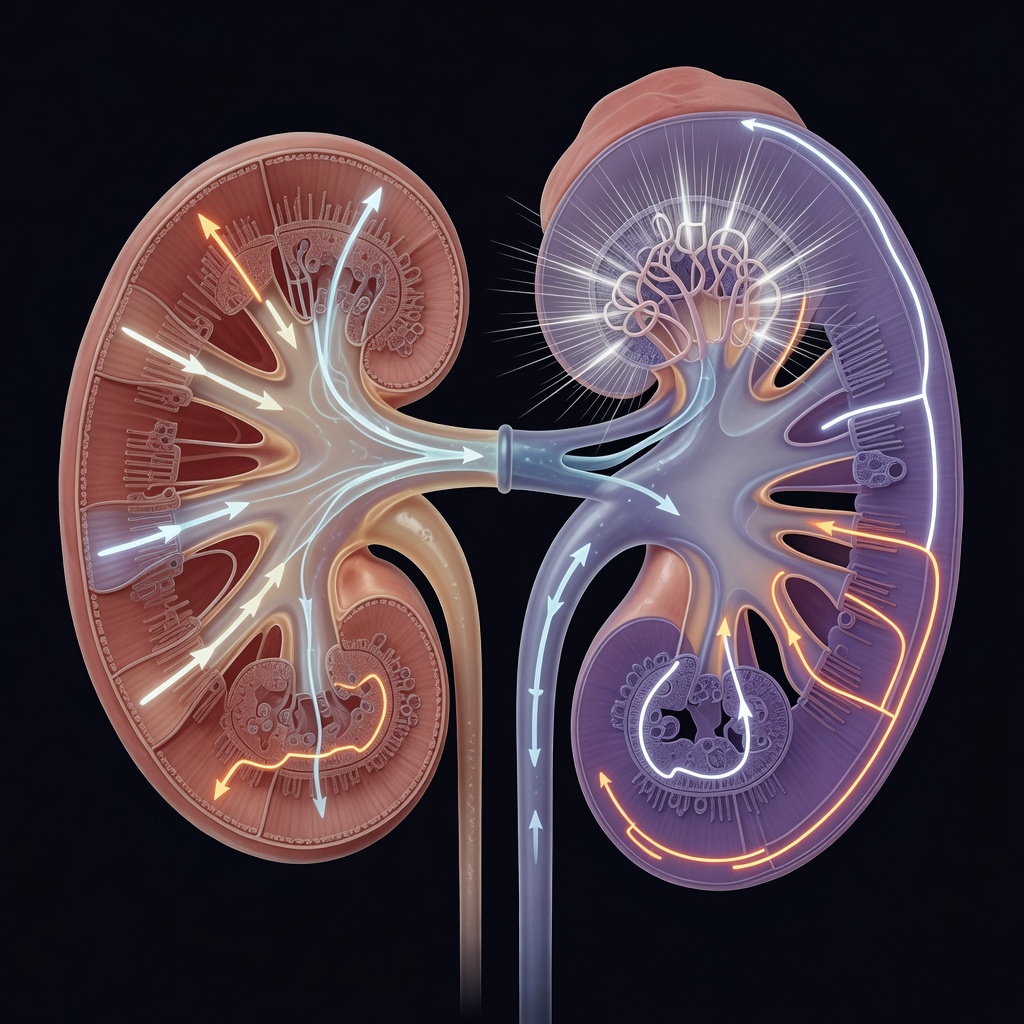
Right now, as you read this sentence, your entire blood supply is rushing through a pair of fist-sized organs at a terrifying speed. Your heart is throwing a full quarter of its total output straight at your kidneys. That is a massive amount of resources for two organs that most people think are just there to make urine. But your kidneys aren't just a waste-disposal system.
They are the master chemists of your entire existence. Imagine standing in front of a standard household bathtub. Now imagine filling that tub to the brim with fluid. That is 180 litres.
That is the exact volume of liquid your two kidneys filter every single day. If they were just simple strainers, you would dehydrate and die within minutes. Instead, they are the world's most obsessed hoarders. They filter that entire volume and then claw back 99 percent of it, centimetre by centimetre, through a labyrinth of microscopic pipes.
They are the ultimate quality control department, deciding exactly which molecules deserve to stay in your blood and which are destined for the exit. This isn't just about plumbing; it is about survival at the most granular level. Your kidneys control your blood pressure, your bone density, and the very pH of your soul. They are the architects of your internal sea.
Most of the time, you don't even feel them working, but they are performing a high-stakes balancing act that would make a NASA engineer sweat. We used to be completely oblivious to this. For centuries, the smartest minds in medicine thought the kidneys were just passive sieves. The ancient Greeks believed they were just a secondary trap for 'serous humours.'
It took until the 1660s for Marcello Malpighi to point a primitive microscope at a slice of kidney and see the 'glomeruli' — those tiny, coiled knots of capillaries where the blood is actually processed. He called them 'microscopic glands,' but he still didn't really know what they were doing. It wasn't until 1842 that a British surgeon named William Bowman finally mapped out the structure of the 'capsule' that catches the filtered fluid. But even then, we were missing the most important part: the 'tubules.'
These are the miles of winding conveyor belts where your body performs its most miraculous trick — reabsorption. This is the process of sniffing through the trash to find the gold. Your kidneys throw almost everything out of the blood into a temporary holding area, and then they use 'active transport' — which is basically biological machinery using energy to push molecules uphill against their will — to snatch back the sodium, the glucose, and the water you need to stay alive. In the chapters ahead, we are going to dive into the 'Nephron.'
This is the functional unit of the kidney, and you have about a million of them in each side. You will see how they use 'hydrostatic pressure' — simple physical force — to shove fluid through a molecular mesh. You will discover the 'Loop of Henle,' a hairpin turn in your plumbing that creates a massive salt gradient to trick water into moving where we want it to go. We will look at 'Acid-Base Homeostasis,' the internal thermostat that keeps your blood from becoming too acidic or too alkaline.
This is managed through 'ion channels,' which are essentially tiny, voltage-gated trapdoors that allow specific charged particles to skip across cell membranes. You will learn how your body manages 'Osmolarity' — the thickness or saltiness of your blood. It is a system of 'feedback loops' where the brain and the kidneys are in a constant, silent conversation, using hormones as radio signals to tell the pipes when to tighten and when to relax. Every second of your life, your kidneys are adjusting the dial.
They are making sure that the environment your cells live in stays exactly the same, even if you drink a gallon of water or eat a bag of salty chips. This is the miracle of 'Homeostasis' — the Greek word for 'staying the same.' It is the most vital, complex, and under-appreciated dance in the human body. Welcome to the machine.
DOWNLOAD THIS VOLUME
This volume is compiled from peer-reviewed physiology literature into a precision longform PDF. Generate once — it's then saved permanently in the INNERSTANDING library for instant re-download by all users.
PDF format · No wait time · Standardized Print Resolution