
VOL. 04
Respiratory Physiology
Ventilation, Gas Exchange & Respiratory Control
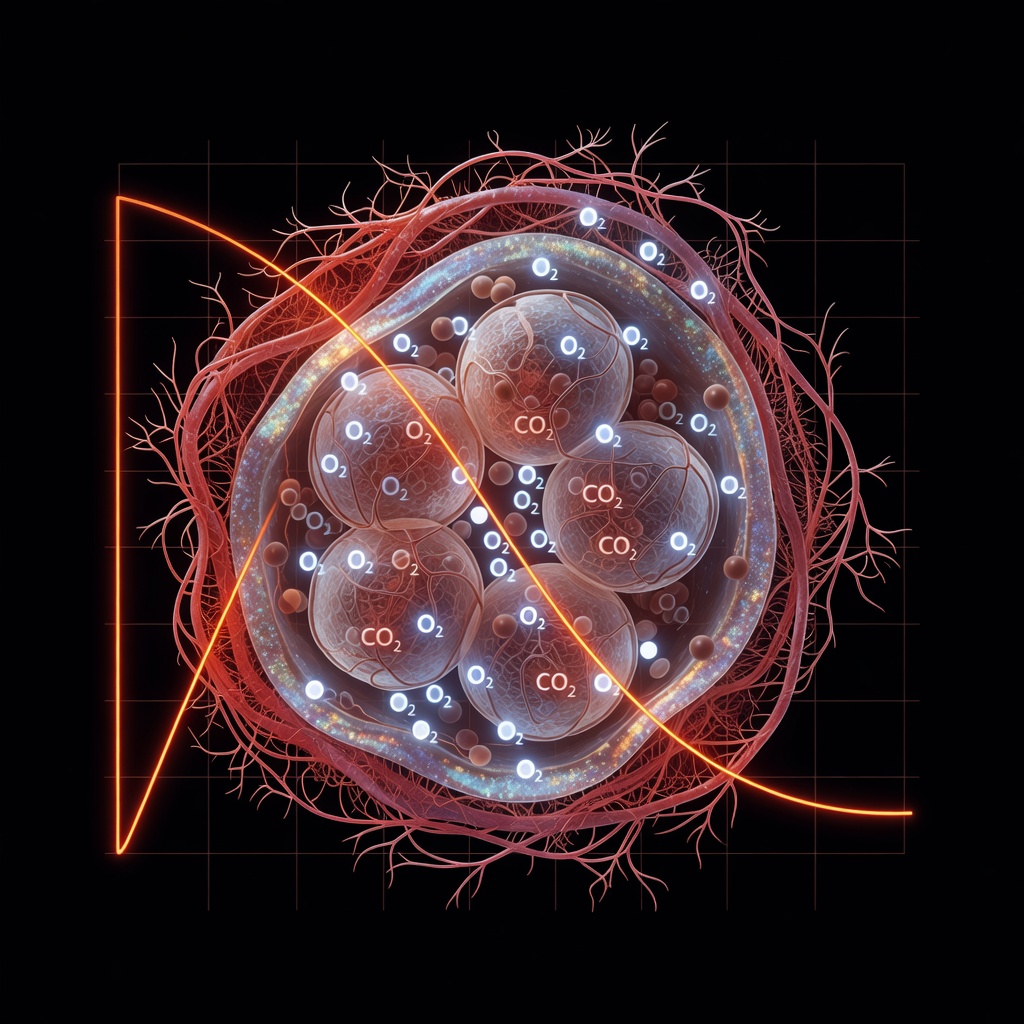
The mechanics of breathing and the precision chemistry of gas exchange — lung compliance and surfactant, ventilation-perfusion matching, the oxygen-haemoglobin dissociation curve, CO2 transport and acid-base buffering, respiratory control centres, chemoreceptor reflexes, and the physiological demands of altitude and exercise.
CONTENTS
— WHAT'S INSIDE THIS VOLUME
Lung Mechanics & Compliance
Surfactant & Surface Tension
Ventilation-Perfusion Matching
Oxygen Transport & Haemoglobin
Carbon Dioxide Transport & Buffering
Respiratory Control Centres
Chemoreceptor Reflexes
Respiratory Physiology at Altitude & Exercise
FULL VOLUME CONTENT
INTRODUCTION
Respiratory Physiology
You take your first breath the moment you hit the light, and your last one just before you leave. In between, you will inhale and exhale roughly seven hundred million times. Right now, as you read these words, you are performing a feat of engineering so precise it makes a Formula 1 engine look like a toy. You don't think about it.
You don't have to. But the reality of what is happening inside your chest is far more explosive than 'air in, air out'. You are a gas-powered machine. Every single one of the thirty-seven trillion cells in your body is a tiny furnace, and those furnaces require a constant, unwavering supply of oxygen to keep the lights on.
At the same time, they are churning out carbon dioxide—a toxic waste product that would turn your blood into acid if it stayed there for more than a few minutes. Your respiratory system is the high-speed logistics network that manages this trade. It is a masterpiece of surface area. If you could somehow reach inside your ribcage and iron out the three hundred million tiny air sacs—the alveoli—that make up your lungs, you would be standing on a surface the size of a professional tennis court.
All of that is packed into a space no bigger than a couple of loaves of bread. This massive landscape is separated from your blood by a membrane so incredibly thin that a single red blood cell has to squeeze through in single file to pick up its cargo. We are talking about a barrier only two cells thick. This is the blood-gas barrier, the most critical border crossing in your entire body.
For most of human history, we were utterly clueless about this. The ancient Greeks, brilliant as they were, thought your lungs were simply a cooling system for the heart. They believed you breathed in 'pneuma'—a vital spirit—to keep your internal fire from melting you. It took until the late 1700s for us to finally see the truth.
Joseph Priestley and Antoine Lavoisier discovered that breathing is actually a form of slow-motion combustion. They realised that we consume oxygen and produce carbon dioxide just like a candle flame, only we do it without the smoke and heat. It was a revolution in understanding that turned the body from a mystical vessel into a chemical powerhouse. In the chapters ahead, we are going to pull back the curtain on how this powerhouse actually runs.
We will start with the bellows—the pressure gradients. You don't 'pull' air in; you create a vacuum. Your diaphragm, that powerful dome of muscle sitting beneath your heart, contracts and drops down, making the space in your chest larger. Because nature hates a vacuum, the atmosphere outside simply shoves its way into your lungs to fill the gap.
That is ventilation. Then, we will look at the dance of diffusion. This is the physics of movement. It is the process where molecules move from where they are crowded to where they have more room.
Oxygen doesn't need to be pumped into your blood; it simply falls into it because the concentration in your lungs is higher. It is elegant, passive, and incredibly fast. Finally, we will meet the master conductor: your respiratory control centre. Tucked away in your brain stem, this is your body’s most sensitive thermostat.
It doesn't actually care how much oxygen you have. Instead, it is obsessed with carbon dioxide. It monitors the acidity of your blood with the precision of a laboratory sensor. If your CO2 levels rise by even a fraction, this control centre sends a lightning-bolt signal to your muscles to pick up the pace.
You don't even have to notice. You might be sprinting for a bus or sleeping soundly in the middle of the night, but this loop never sleeps. It is a perfect, self-regulating feedback system that keeps your internal chemistry in a state of exquisite balance. This is not just anatomy.
This is the story of how you stay alive, second by second, in a world that is constantly trying to balance its gases through you. Welcome to the engine room.
DOWNLOAD THIS VOLUME
This volume is compiled from peer-reviewed physiology literature into a precision longform PDF. Generate once — it's then saved permanently in the INNERSTANDING library for instant re-download by all users.
PDF format · No wait time · Standardized Print Resolution