
VOL. 07
Gastrointestinal Physiology
Digestion, Absorption, Motility & the Gut-Brain Axis
How food becomes fuel — the cephalic, gastric, and intestinal phases of digestion, exocrine pancreatic enzyme secretion, bile chemistry and fat emulsification, intestinal absorption of every macronutrient and micronutrient, gut motility patterns, the enteric nervous system, and the gut-brain axis as a bidirectional communication superhighway.
CONTENTS
— WHAT'S INSIDE THIS VOLUME
Cephalic & Gastric Phase Physiology
Gastric Acid Secretion
Exocrine Pancreas & Enzyme Secretion
Bile Physiology & Fat Digestion
Carbohydrate & Protein Absorption
Vitamin & Mineral Absorption
Gut Motility & the Enteric Nervous System
The Gut-Brain Axis
FULL VOLUME CONTENT
INTRODUCTION
Gastrointestinal Physiology
Imagine you are a doughnut. It sounds ridiculous, but topologically speaking, you are a fleshy ring. From your mouth to your exit, there is a continuous, nine-metre tunnel of space that technically exists outside your body. Right now, as you sit there, you are performing a feat of biological alchemy that would make a medieval chemist weep.
You are taking chunks of the external world—a sandwich, an apple, a cup of tea—and dismantling them into molecular dust so you can rebuild yourself from the atoms up. This isn't just a plumbing system. It is a highly intelligent, self-aware processing plant that decides what gets to become part of 'you' and what gets sent to the incinerator. You have likely been told your stomach is just a bag of acid.
It is so much more. It is a rhythmic, pulsing engine that coordinates with a nervous system so complex we call it your 'second brain'. We are talking about a hundred million neurons—nerve cells that transmit electrical signals—wrapped around your gut, making executive decisions without ever asking your head for permission. Most people go their whole lives thinking their brain is the boss, but your gut is a sovereign state with its own laws and its own logic.
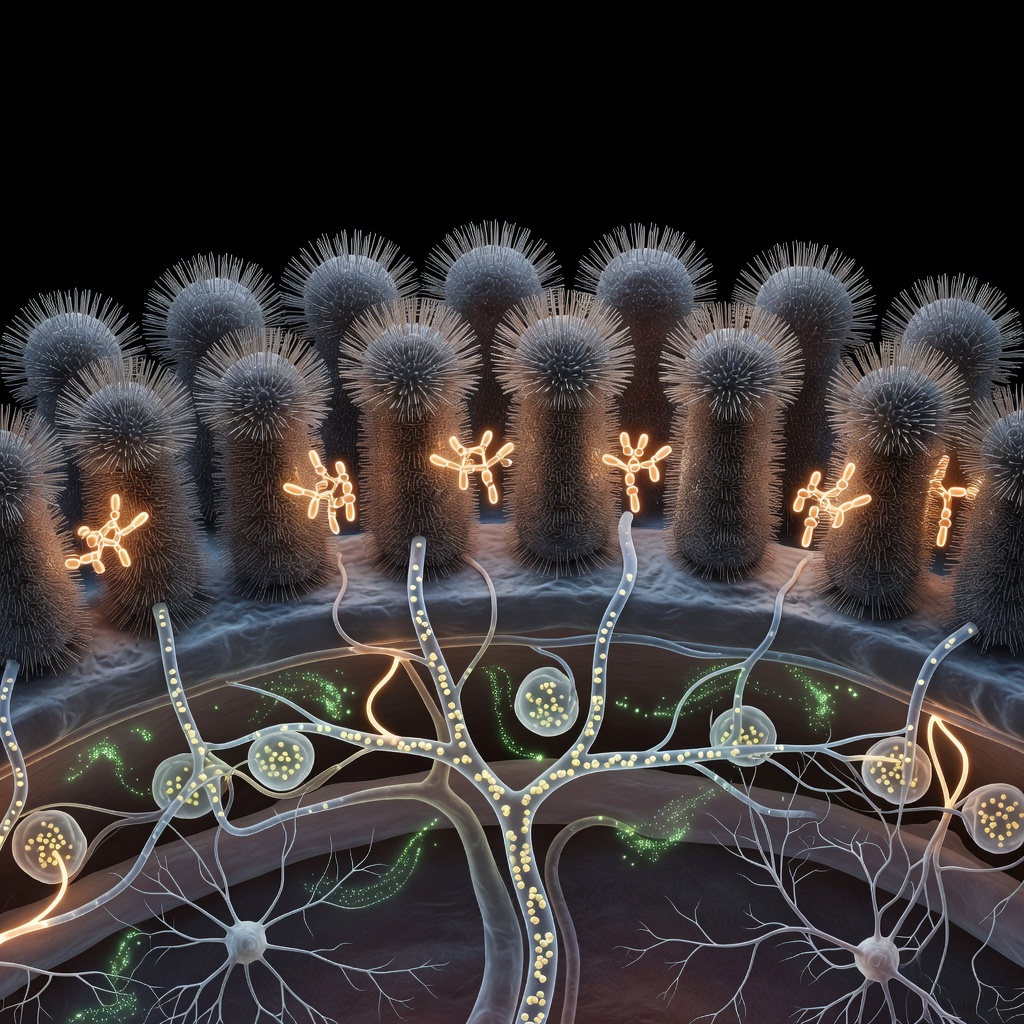
Consider the scale of the operation happening beneath your ribs right now. If you were to iron out the lining of your small intestine, it would not be a flat, simple strip. It is folded and pleated into microscopic, finger-like projections called villi. These increase your internal surface area to roughly the size of a doubles tennis court.
Every single millimetre of that massive surface is a high-stakes border crossing. Your gut has to be porous enough to let tiny nutrients through, but tough enough to keep out trillions of bacteria and toxins. It is a masterpiece of engineering. Your body manages this through a precision dance of motility—the muscular movements that push food along—and secretion, where your glands pump out cocktails of enzymes.
Think of enzymes as tiny, biological scissors. They are specialised proteins designed to snip long chains of carbohydrates and proteins into pieces small enough to slip into your bloodstream. While you read this, billions of these scissors are snipping away at your last meal with sub-microscopic precision. For centuries, we were completely clueless about how this actually worked.
Ancient thinkers believed digestion was a form of 'cooking'—that your stomach was a literal internal oven. They thought food just rotted or fermented inside you. It was not until the 1820s that we got a grizzly, front-row seat to the truth. An army surgeon named William Beaumont treated a man with a gunshot wound that never fully healed, leaving a 'window' into his stomach.
For years, Beaumont dangled bits of food on a string through this hole to see what happened. He discovered that digestion was not just mechanical grinding; it was chemical. It was active. It was alive.
Since then, we have realised that your gut does not just react to what you eat. It predicts. Before a single crumb touches your tongue, your brain signals your stomach to start producing acid. It is called the cephalic phase—the 'head phase' of digestion.
Your body is already preparing the assembly line for the work ahead because it knows exactly what is coming. In the chapters ahead, we are going to pull back the curtain on this entire operation. We will look at how your gut communicates with your head via the vagus nerve—the thick biological superhighway that carries more information from your belly to your brain than the other way around. We will explore the 'pacemaker' cells that create the electrical rhythm for your gut’s movements, ensuring everything flows in one direction.
You will learn how your pancreas acts like a smart-dosing factory, releasing exactly the right amount of bicarbonate—a natural antacid—to ensure your stomach acid does not burn a hole through your next section of tubing. It is a world of pressure sensors, chemical detectors, and microscopic pumps. It is the most intimate interaction you have with the world around you. Every time you eat, you are engaging in a complex negotiation with the environment, deciding what to keep and what to reject.
You are literally turning the world into your own flesh and blood. It is time you understood how the machine actually runs.
DOWNLOAD THIS VOLUME
This volume is compiled from peer-reviewed physiology literature into a precision longform PDF. Generate once — it's then saved permanently in the INNERSTANDING library for instant re-download by all users.
PDF format · No wait time · Standardized Print Resolution