
VOL. 08
Immune Physiology
Innate Immunity, Adaptive Response & Immune Regulation
The body's multi-layered defence architecture — pattern recognition and innate immune activation, the complement cascade, phagocytosis and the inflammatory response, T lymphocyte activation and clonal expansion, B cell differentiation and antibody classes, MHC presentation, immunological memory, regulatory T cells, and immune tolerance mechanisms.
CONTENTS
— WHAT'S INSIDE THIS VOLUME
Innate Immunity & Pattern Recognition
The Complement Cascade
Phagocytosis & The Inflammatory Response
Antigen Presentation & MHC Molecules
T Lymphocyte Activation & Differentiation
B Cells, Antibodies & Humoral Immunity
Immunological Memory
Immune Regulation & Tolerance
FULL VOLUME CONTENT
INTRODUCTION
Immune Physiology
You think you’re sitting still right now. You aren’t. Inside your veins and tucked into your tissues, a trillion-strong army is on the move. It’s the most sophisticated security system in the known universe, and it’s running on autopilot.
Most people think of their immune system like a shield, something static that just waits for trouble. That’s wrong. It’s more like a living, breathing intelligence. It’s a sensory organ that feels the world at a molecular level.
Right now, your body is making two million new white blood cells every single second. Just to keep the peace. You have more immune cells in your gut than there are people on the planet. Think about that for a moment.
This isn’t just a background process. It’s a miracle of biological engineering. Most people spend their lives completely unaware of the constant, silent vigilance happening beneath their skin. In the chapters ahead, we’re going to pull back the curtain on how this machinery actually ticks.
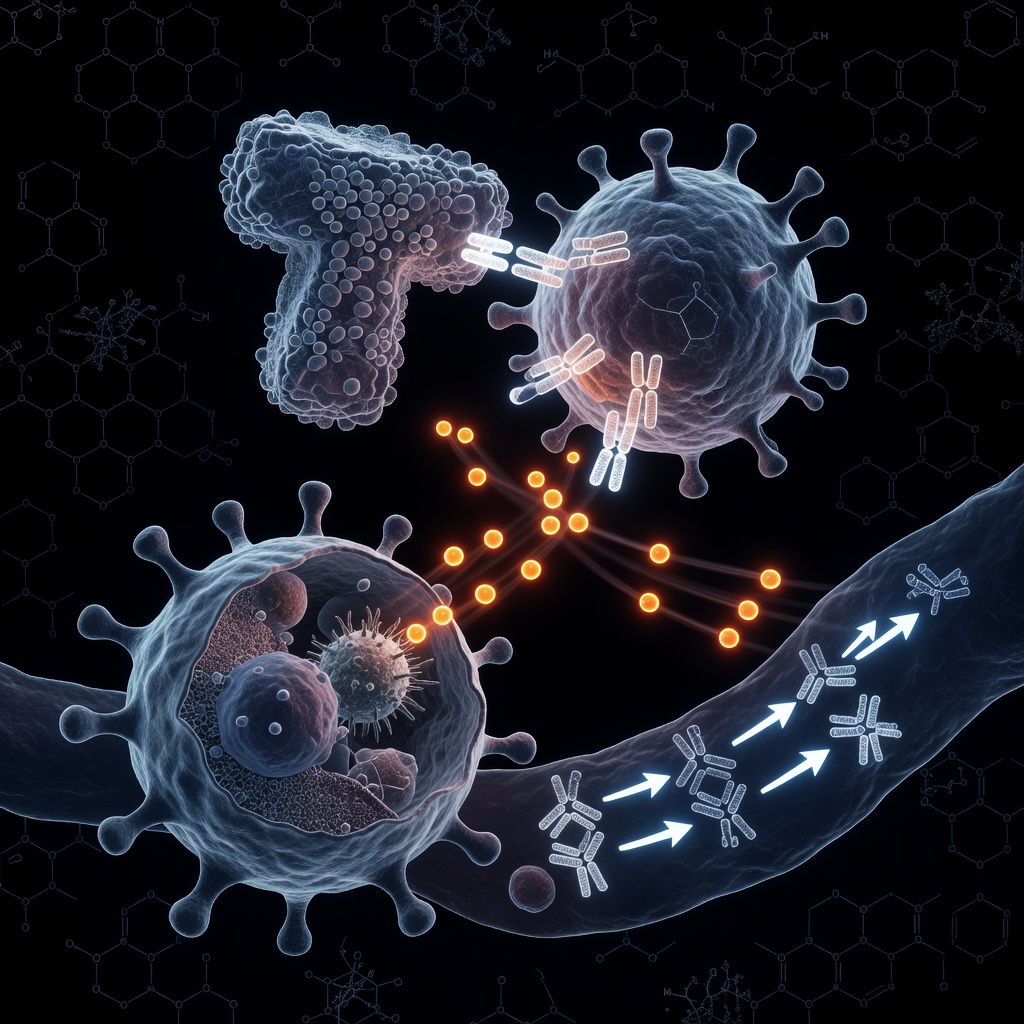
We’ll look at your innate system first. These are the first responders, the bouncers at the door. They don’t need an introduction; they just see something that doesn’t belong and they eat it. We call this phagocytosis—literally 'cell eating'.
It’s brutal, fast, and incredibly effective. These cells carry pattern recognition receptors—think of them as biological scanners that look for the universal signatures of invaders. They don't need to know exactly who the intruder is; they just need to know they aren't 'you'. It’s an immediate, scorched-earth response that happens in minutes.
Along with these eaters, you have the complement system. Imagine a set of nine chemical proteins that circulate in your blood like inactive landmines. When they hit a target, they assemble into a literal spear that punches holes in the intruder. It’s pure, mechanical destruction.
But the real magic happens when your adaptive system kicks in. This is your body’s elite special forces, the precision snipers. They don't just fight; they learn. They create a library of memories so they can recognise a threat they haven’t seen in twenty years.
They use receptors—tiny, uniquely shaped protein locks on their surface—to identify specific antigens, which are the unique chemical ID cards carried by every substance in nature. It’s like having a custom-made key for every single lock in the world. Your body creates billions of these variations through a process of genetic shuffling, a massive lottery of protection, ensuring that no matter what you encounter, you have a cell ready to meet it. This is why you rarely get the same cold twice.
Your cells remember the face of the enemy and they keep the blueprint for the weapon that defeated it. It’s hard to fathom the scale of this coordination. Every second, your cells send out cytokines—chemical text messages—to alert their neighbours. It’s a constant, roaring conversation.
When a cell finds trouble, it releases these signals to create a chemical trail. Other cells follow this trail like bloodhounds, a process called chemotaxis. Imagine a city where every single citizen is a highly trained sensor, constantly reporting back to central command. That is your lymphatic system.
It's a secondary plumbing network that filters your fluids, checking for anything out of place. It’s where your cells go to 'school' to learn what a threat looks like. We’ll explore how your T-cells and B-cells, your highly specialised defenders, undergo a rigorous selection process in the thymus and bone marrow. Most of them don't even graduate.
They have to prove they can recognise an enemy without accidentally attacking your own tissues. It’s the ultimate quality control. We haven't known about any of this for very long. For most of human history, we were totally in the dark.
In the late 19th century, the scientific world split down the middle. One camp, led by the Russian zoologist Elie Metchnikoff, watched starfish larvae under a microscope and saw mobile cells surrounding and eating foreign thorns. He thought the cells did all the work. Another camp, led by the German chemist Paul Ehrlich, believed it was all down to 'magic bullets' or antibodies—proteins in the blood—that neutralised threats.
They were both right, but it took nearly a century to see the whole picture. We didn't even understand the 'Major Histocompatibility Complex'—the cellular passport system that identifies your cells as your own—until the 1950s. We are living in the first century where we actually understand the blueprint of our own protection. Power needs control, and your immune system is incredibly powerful, capable of dissolving bone and liquefying tissue if left unchecked.
You have regulatory cells that act like seasoned diplomats, calming the troops down once the job is done. This is a feedback loop—a system where the output of a process controls its future activity. It’s the thermostat of your survival. Without it, your own defenders would tear the house down in their enthusiasm.
It’s a delicate balance of signals and countersignals, a symphony played out in your lymph nodes and spleen. You’re about to discover that your body isn't just a machine; it’s a masterpiece of tactical brilliance. Every time you breathe, every time you eat, and every time you graze your knee, this invisible world leaps into action. It’s time you met the army that has been keeping you alive since the second you were born.
DOWNLOAD THIS VOLUME
This volume is compiled from peer-reviewed physiology literature into a precision longform PDF. Generate once — it's then saved permanently in the INNERSTANDING library for instant re-download by all users.
PDF format · No wait time · Standardized Print Resolution