
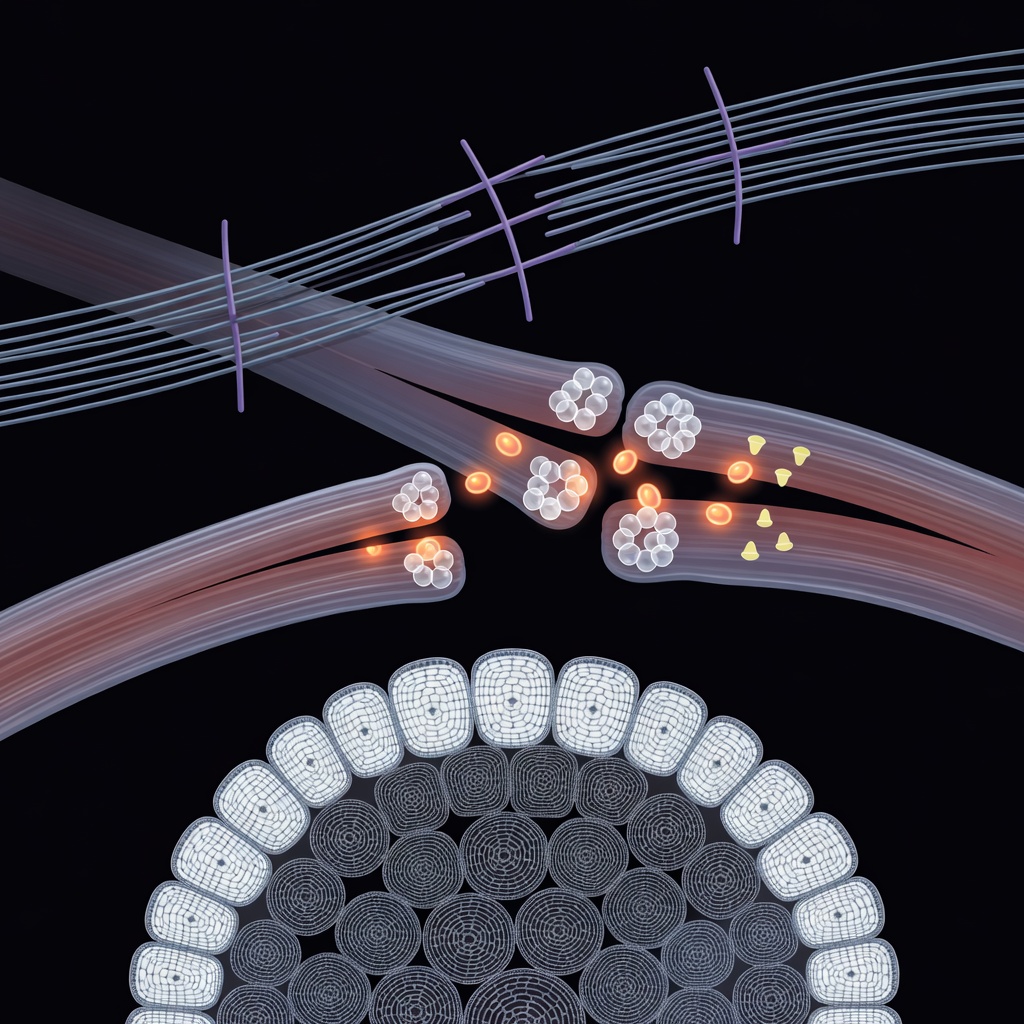
VOL. 09
Musculoskeletal Physiology
Muscle Contraction, Motor Control & Bone Metabolism
The physiology of movement — excitation-contraction coupling in skeletal and cardiac muscle, the sliding filament mechanism in molecular detail, motor unit recruitment and force gradation, muscle metabolism and fatigue, the physiology of different fibre types, proprioception and the stretch reflex, and the hormonal and mechanical regulation of bone remodelling.
CONTENTS
— WHAT'S INSIDE THIS VOLUME
Excitation-Contraction Coupling
The Sliding Filament Mechanism
Motor Unit Recruitment & Force Gradation
Muscle Metabolism & Energy Systems
Muscle Fibre Types & Adaptability
Muscle Fatigue & Recovery
Proprioception & Reflex Physiology
Bone Remodelling Physiology
FULL VOLUME CONTENT
INTRODUCTION
Musculoskeletal Physiology
Right now, you think you’re being still. You aren't. Even as you read these words, your body is a riot of high-speed engineering. Inside your forearms, trillions of microscopic protein motors are clambering over each other like tiny climbers on a rope.
This is happening at a scale so small you can’t see it, and at a speed that makes a Formula 1 engine look sluggish. Your musculoskeletal system is often dismissed as the 'chassis' of your body, the simple frame and the meat that moves it. That’s a lie. You are inhabiting a biological masterpiece that defies everything we know about man-made machines.
Think about your bones. You probably imagine them as dry, inert props—white sticks of calcium that hold you up. In reality, your skeleton is more like a frenetic, 24-hour construction site. Right now, specialised cells called osteoclasts—the demolition crew—are dissolving tiny patches of your bone, while osteoblasts—the builders—are laying down fresh new mineral.
You get a brand-new skeleton roughly every ten years. You are literally being rebuilt from the inside out while you sleep. You are a living work in progress. Then there’s the movement itself.
Every single twitch of your finger is the result of a precise electrical storm. Your brain sends a signal called an action potential—essentially a tiny bolt of biological electricity—down a nerve fibre. When that spark reaches your muscle, it doesn’t just 'pull' a lever. It triggers a chemical cascade, releasing a flood of calcium that acts as a master key.
This key unlocks the binding sites on your muscle proteins, allowing them to grab hold and slide. This is the Sliding Filament Theory, the core mechanism of how you move, and it was only discovered in 1954. Before that, even the smartest scientists on Earth were guessing. For centuries, people like the ancient physician Galen believed your muscles moved because they were pumped full of 'animal spirits' through hollow nerves, like a balloon inflating.
It took nearly two thousand years to realise that you aren’t a pneumatic machine, but an electrical one. In the chapters ahead, we’re going to pull back the curtain on this incredible process. You’ll discover how your brain manages the 'size principle'—a clever piece of neural logic that ensures you don’t use the same explosive force to pick up a feather as you do to lift a heavy kettle. You’ll see how your muscles are organised into motor units—teams of muscle fibres all controlled by a single nerve leader.
We’ll dive into the world of bone metabolism, where your body treats your skeleton like a high-stakes mineral bank, constantly depositing and withdrawing calcium to keep your heart and nerves firing correctly. Consider the sheer precision required for you to even hold your phone or a cup of tea. Your nervous system is performing calculations that would baffle a supercomputer. It’s measuring 'proprioception'—your body’s innate sense of where its limbs are in space—through tiny sensors buried deep in your tendons.
These sensors, called Golgi tendon organs, act like high-tech strain gauges, making sure you don't pull your own muscles off the bone when you're straining. And the energy! To make any of this happen, your cells are burning ATP—adenosine triphosphate, or the universal currency of biological energy. You produce and consume your own body weight in ATP every single day just to keep the lights on.
If you stopped making it, you’d be frozen solid in seconds. This guide is your backstage pass to that internal theatre. We’re moving past the 'bicep curls' and 'calcium for strong bones' clichés. Instead, we’re looking at the cross-bridge cycle—the rhythmic grabbing and releasing of proteins that creates every movement you've ever made.
We’ll explore the 'all-or-nothing' principle, which dictates that a muscle fibre doesn’t just half-heartedly contract; it either fires with everything it’s got or it stays silent. It’s your brain that mixes and matches these fires to create the fluid grace of a dancer or the brute force of a powerlifter. You’ll see that your bones are actually a sophisticated endocrine organ—an organ that sends chemical messages through your blood—affecting everything from your brain health to how you handle sugar. For a long time, we thought bones were just the silent partners of the body.
We now know they are active, loud, and vital to your survival. By the time you finish this, you’ll never look at a skeleton in a biology classroom the same way again. You’ll see it for what it is: a dynamic, self-repairing, electrical scaffolding that is currently keeping you alive and upright against the crushing force of gravity. You aren't just 'using' your muscles and bones.
You are a living, breathing symphony of tension, electrical signals, and constant architectural renewal. Welcome to the truth about how you actually move.
DOWNLOAD THIS VOLUME
This volume is compiled from peer-reviewed physiology literature into a precision longform PDF. Generate once — it's then saved permanently in the INNERSTANDING library for instant re-download by all users.
PDF format · No wait time · Standardized Print Resolution