
Bradykinin: Understanding the Vascular Inflammatory Cascade
Updated May 2026
Bradykinin is a peptide that promotes inflammation and dilates blood vessels. Excessive levels are linked to the 'bradykinin storm' observed in severe respiratory infections and vascular distress.
Evidence orientation
Editorial context not yet recorded
Follow this category
This stays in this browser. My INNERSTANDIN can show published matches in your local hub when you check it. It does not send email, push, or alert notifications.
Local learning review
A private browser aid for revisiting ideas. It is not an alert or a health recommendation.
Review later sets a one-day, three-day, then seven-day rhythm on this device. Choose it only when you want to revisit this article.
Overview
In the intricate theatre of human physiology, few molecules play a more paradoxical role than bradykinin. A nonapeptide (a peptide containing nine amino acids), bradykinin is the primary effector of the Kallikrein-Kinin System (KKS), a complex hormonal pathway that mirrors the more famous Renin-Angiotensin System (RAS). While the medical establishment has long focused on the latter in its pursuit of managing hypertension and cardiovascular health, the KKS—and bradykinin in particular—has remained a shadow player, often ignored until it manifests in catastrophic systemic failure.
Bradykinin is, fundamentally, a potent vasodilator and a mediator of inflammation. Under homeostatic conditions, it is the body’s "pressure release valve." It lowers blood pressure by relaxing vascular smooth muscle and promoting the release of nitric oxide (NO) and prostacyclin. However, when the regulatory mechanisms that degrade this peptide are compromised, or when its production is hyper-stimulated, bradykinin transforms from a guardian of vascular tone into a primary driver of pathological destruction.
Recent global health crises have brought the term "bradykinin storm" into the peripheral vision of the public, yet its true implications remain largely obscured. Unlike a cytokine storm, which involves an overactive immune response by white blood cells, a bradykinin storm represents a breakdown of the vascular barrier itself. It leads to profound vascular permeability, where the "tight junctions" between endothelial cells dissolve, allowing fluid to leak into the surrounding tissues.
As a senior biological researcher for INNERSTANDING, it is my objective to peel back the layers of this peptide. We will explore how bradykinin, when left unchecked, acts as the invisible architect behind pulmonary oedema, chronic pain, and the vascular distress that characterises modern environmental and biological threats. This article serves as a definitive guide to understanding the vascular inflammatory cascade, exposing the truths that the mainstream narrative has consistently failed to address.
Fact: Bradykinin is estimated to be ten times more potent as a vasodilator than histamine, making its regulation critical for preventing rapid-onset tissue swelling and hypotensive shock.
The Biology — How It Works
To understand bradykinin, one must first grasp the Kallikrein-Kinin System (KKS). This system exists in a state of dynamic equilibrium with the Renin-Angiotensin System (RAS). While the RAS is primarily concerned with vasoconstriction (narrowing of blood vessels) and sodium retention via Angiotensin II, the KKS promotes vasodilation (widening of blood vessels) and the excretion of sodium.
The Biosynthesis Pathway
The production of bradykinin is initiated by the activation of Factor XII (Hageman factor), a protein involved in the blood coagulation cascade. This activation triggers a chain reaction:
- Prekallikrein is converted into the enzyme plasma kallikrein.
- Kallikrein then cleaves a high-molecular-weight precursor known as High-Molecular-Weight Kininogen (HMWK).
- The result of this cleavage is the release of the nine-amino-acid peptide: Bradykinin.
In certain tissues, a separate enzyme, tissue kallikrein, acts on Low-Molecular-Weight Kininogen (LMWK) to produce a similar peptide called kallidin (Lys-bradykinin), which is subsequently converted into bradykinin by aminopeptidases.
The Degradation Trap
The most critical aspect of bradykinin biology is not how it is made, but how it is destroyed. Bradykinin has an extremely short half-life—typically less than 30 seconds. It is broken down by several enzymes, the most prominent being Angiotensin-Converting Enzyme (ACE).
Wait—ACE? Yes, the same enzyme responsible for creating the vasoconstrictor Angiotensin II is also responsible for destroying the vasodilator bradykinin. This is the "dual-edged sword" of the ACE protein. When ACE is functioning correctly, it maintains a perfect balance. However, when ACE is inhibited—either by pharmaceutical drugs (ACE inhibitors) or by viral interference with the ACE2 receptor—bradykinin levels begin to climb exponentially.
The Receptor Duality
Bradykinin exerts its effects through two primary receptors:
- B2 Receptor: This receptor is constitutive, meaning it is always present on the surface of healthy cells. It mediates the standard, beneficial effects of bradykinin, such as blood pressure regulation and smooth muscle relaxation.
- B1 Receptor: This receptor is inducible. In a healthy state, it is barely detectable. However, in response to tissue injury, chronic inflammation, or high levels of cytokines (like IL-1 and TNF-alpha), the B1 receptor is synthesized in mass quantities. The B1 receptor responds to a metabolite of bradykinin called des-Arg9-bradykinin.
Statistic: Over 90% of bradykinin’s physiological degradation in the lungs is performed by ACE. If ACE activity drops by just 50%, the resulting accumulation of bradykinin can trigger immediate vascular leakage.
Mechanisms at the Cellular Level
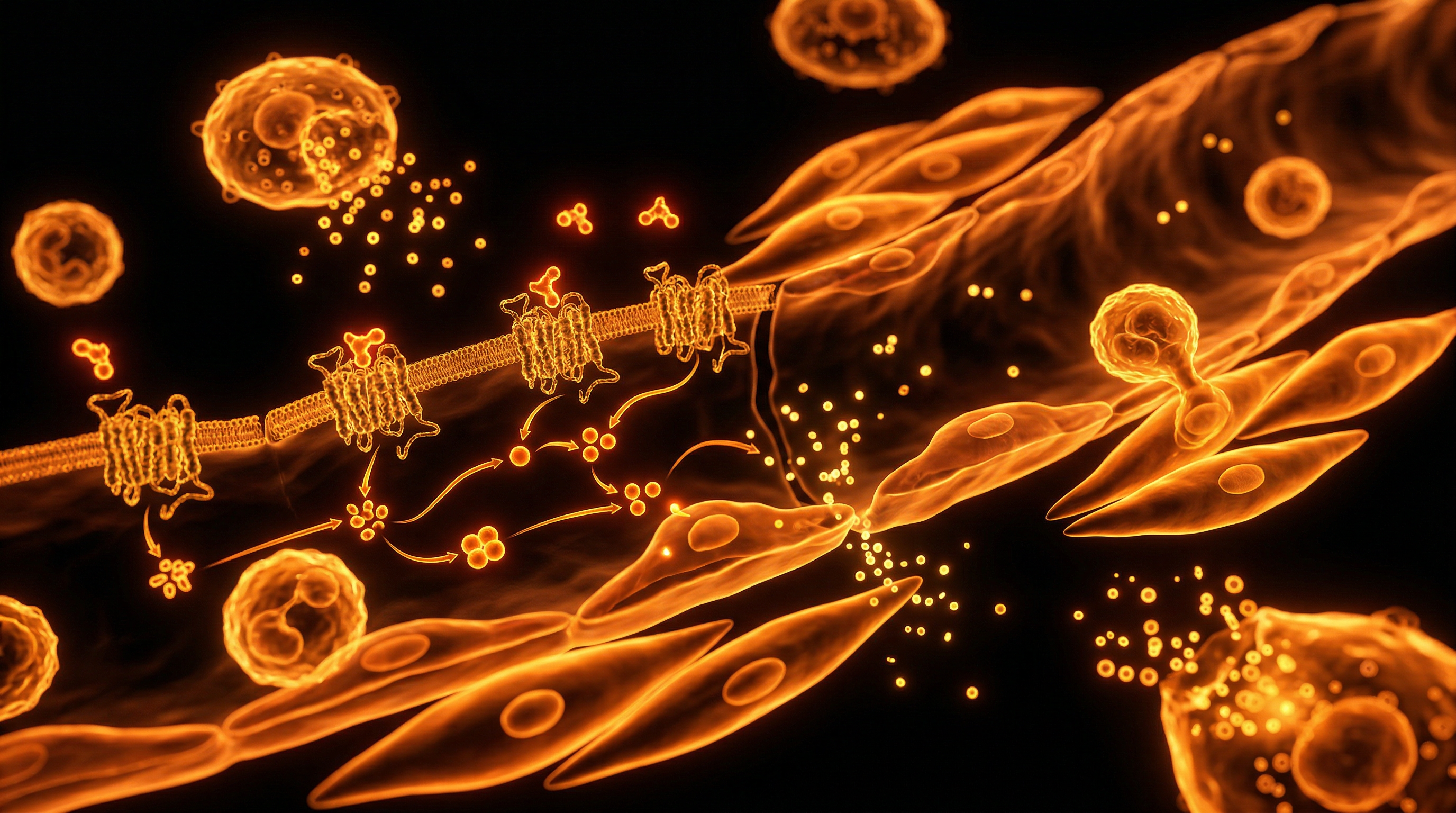
Once bradykinin binds to its receptors (specifically the B2 and B1 receptors) on the endothelial cells that line our blood vessels, it initiates a cascade of intracellular events that fundamentally alter the integrity of the vascular wall.
Nitric Oxide and Prostaglandins
The binding of bradykinin triggers the activation of phospholipase A2 and the subsequent release of arachidonic acid. This leads to the production of prostacyclin (PGI2). Simultaneously, the enzyme endothelial nitric oxide synthase (eNOS) is activated, producing a surge of Nitric Oxide (NO).
While NO is necessary for cardiovascular health, an excessive surge causes extreme vasodilation, leading to a sudden drop in blood pressure (hypotension). This is why bradykinin is a central player in the pathology of anaphylaxis and septic shock.
The "Leaky Pipe" Phenomenon
Perhaps the most devastating cellular effect of bradykinin is its impact on vascular permeability. Endothelial cells are held together by "tight junctions" and "adherens junctions." Bradykinin induces the phosphorylation of proteins like VE-cadherin, which causes these junctions to pull apart.
Imagine a garden hose with tiny pinpricks. Normally, water stays inside. Under the influence of a bradykinin surge, those pinpricks become gaping holes. Plasma, proteins, and fluids leak out of the blood vessels and into the interstitial space (the area between cells). In the lungs, this results in pulmonary oedema, where the air sacs (alveoli) fill with fluid, effectively drowning the patient from the inside.
The Hyaluronic Acid Connection
Recent research has uncovered a sinister synergy between bradykinin and hyaluronic acid (HA). Bradykinin stimulates the overproduction of HA in the lungs. HA is a substance that can absorb up to 1,000 times its weight in water. When bradykinin causes fluid to leak into the lungs, and that fluid meets a surplus of HA, it creates a thick, viscous hydrogel. This gel is nearly impossible to cough up and renders mechanical ventilation ineffective because the oxygen cannot penetrate the jelly-like substance to reach the bloodstream.
Pain Sensitisation
Bradykinin is also a potent algogen (pain-producing substance). It lowers the threshold of nociceptors (pain-sensing neurons), making them hyper-sensitive to both thermal and mechanical stimuli. This is why inflammation is almost always accompanied by pain; bradykinin is literally "screaming" at the nervous system that the tissue is under duress.
Environmental Threats and Biological Disruptors
In the modern era, our Kallikrein-Kinin System is under constant assault from various environmental and biological factors. These disruptors shift the balance toward a state of chronic "hyper-bradykininism."
The Role of Synthetic Pathogens and Spike Proteins
The most pressing disruptor identified in recent years is the interaction between the SARS-CoV-2 spike protein and the ACE2 receptor. The mainstream narrative focused on the virus as a respiratory pathogen, but from a biochemical perspective, it is a vascular disruptor.
The virus binds to ACE2, causing the receptor to be internalised or "downregulated." Because ACE2 is responsible for breaking down the B1-receptor ligand (des-Arg9-bradykinin), its loss leads to a massive accumulation of kinins. This creates a "perfect storm":
- Reduced ACE2 leads to more bradykinin.
- More bradykinin induces more B1 receptors.
- B1 receptors increase vascular leakage.
- The result is the catastrophic Bradykinin Storm.
Environmental Pollutants and Toxins
Certain industrial pollutants and heavy metals (such as cadmium and lead) have been shown to interfere with the enzymes that degrade bradykinin. Furthermore, exposure to certain mycotoxins (toxins produced by moulds) can trigger the activation of the contact system (Factor XII), initiating the KKS cascade prematurely.
EMF and Calcium Signalling
Emerging research (though often suppressed) suggests that exposure to high-frequency Electromagnetic Fields (EMF) can modulate Voltage-Gated Calcium Channels (VGCCs). Since bradykinin signalling is heavily dependent on intracellular calcium surges, environmental EMF may act as a silent potentiator, making the vascular system more "reactive" to bradykinin-mediated inflammatory triggers.
Pharmaceutical "Side Effects"
The most common medical cause of elevated bradykinin is the use of ACE inhibitors (e.g., Ramipril, Enalapril, Lisinopril). While these drugs are effective at lowering blood pressure, a well-known side effect is a persistent, dry, "hacking" cough. This cough is caused by the accumulation of bradykinin in the lungs. In rare cases, this can progress to angioedema—a life-threatening swelling of the face, tongue, and airway.
The Cascade: From Exposure to Disease
How does a microscopic peptide surge translate into systemic disease? The bradykinin cascade follows a predictable, yet devastating, progression.
Phase 1: The Initial Trigger
Exposure occurs—be it a viral infection, a toxin, or a drug reaction. This trigger inhibits the breakdown enzymes (ACE/ACE2) or over-activates the precursor proteins (Factor XII/Kallikrein).
Phase 2: Localized Oedema
Bradykinin levels rise in specific tissues. In the lungs, this leads to the "ground glass opacities" seen on CT scans. This isn't necessarily viral pneumonia; it is often localised angioedema of the lung tissue. The patient begins to feel shortness of breath as the blood-gas barrier thickens with fluid.
Phase 3: The Systemic Surge
As the inflammation spreads, the body begins producing B1 receptors systemically. This is where the "cascade" becomes a "storm." The vascular leakage is no longer confined to one organ.
- Brain: Bradykinin can break down the Blood-Brain Barrier (BBB), leading to "brain fog," cognitive impairment, and neurological inflammation.
- Heart: Excessive vasodilation leads to hypotension, forcing the heart to work harder, potentially leading to myocarditis or arrhythmias.
- Gut: Increased permeability in the intestines (leaky gut) allows endotoxins to enter the bloodstream, further fueling the inflammatory cycle.
Phase 4: The Hydrogel Formation
As mentioned previously, the synergy between bradykinin and hyaluronic acid creates a physical barrier to oxygen. At this stage, the patient is in severe respiratory distress. Standard treatments for "cytokine storms" (like certain steroids) may help, but if the bradykinin-hyaluronic acid gel is not addressed, the prognosis remains grim.
Callout: The "dry cough" associated with both ACE inhibitors and certain viral infections is a diagnostic hallmark of bradykinin accumulation in the pulmonary tissue.
What the Mainstream Narrative Omits
As a researcher for INNERSTANDING, I must address the glaring omissions in the established medical discourse regarding bradykinin. Why was the "Bradykinin Hypothesis" relegated to the footnotes of medical journals while "Cytokine Storms" dominated the headlines?
The Pharmaceutical Conflict
Many of the drugs that could potentially block a bradykinin storm are off-patent, inexpensive, or used for niche conditions. For example, Icatibant is a potent B2 receptor antagonist used for Hereditary Angioedema. However, it is extremely expensive and was not widely trialled for general respiratory distress.
Conversely, the focus remained on high-cost, patented biologics that target specific cytokines like IL-6. While these drugs have their place, they do nothing to stop the vascular leakage caused by the KKS. Acknowledging bradykinin as the primary driver would have shifted the focus toward re-balancing the RAS/KKS systems—an approach that favours metabolic health and basic biochemistry over high-tech "silver bullets."
The Mismanagement of Ventilation
During the early stages of the 2020-2022 health crisis, the rapid move to mechanical ventilation was, in many cases, a fatal error. If a patient's lungs are filled with bradykinin-induced hydrogel, "pumping" air into them under high pressure can cause barotrauma (pressure injury), further increasing inflammation and Factor XII activation, which—crucially—creates more bradykinin. The mainstream narrative rarely admits that the treatment protocol itself may have exacerbated the bradykinin cascade.
The ACE2 Paradox
The medical establishment focuses on ACE2 as the "doorway" for the virus. They omit the fact that ACE2 is primarily a protective enzyme. Its job is to destroy the inflammatory peptides produced by the RAS and KKS. By focusing only on the "doorway" aspect, the narrative ignored the "protective depletion" aspect. We weren't just suffering from a virus; we were suffering from an acute, induced deficiency of the body's most important anti-inflammatory regulator.
The UK Context
In the United Kingdom, the bradykinin issue is particularly acute due to demographic factors and specific NHS prescribing habits.
The ACE Inhibitor Capital
The UK has some of the highest rates of cardiovascular disease in Europe. Consequently, ACE inhibitors are among the most commonly prescribed medications in the country. Millions of Britons are walking around with a pharmacologically suppressed ability to break down bradykinin.
When a "novel trigger" (whether environmental or biological) enters such a population, the baseline risk of a bradykinin storm is significantly higher. The NHS "Standard of Care" did not sufficiently account for the fact that patients on ACE inhibitors were essentially "pre-loaded" for vascular collapse when faced with an ACE2-depleting pathogen.
The Vitamin D Deficiency Factor
The UK’s northern latitude and lack of sunlight lead to widespread Vitamin D deficiency. Vitamin D is a known modulator of the Renin-Angiotensin System; it helps maintain the levels of ACE2. The chronic Vitamin D deficiency in the British population likely played a massive, though understated, role in the severity of the vascular cascades observed in the UK over the last three years.
Research and Silence
British scientists at institutions like the University of Oxford were among the first to model the "Bradykinin Hypothesis" using supercomputers. Yet, these findings were rarely translated into front-line NHS protocols. The focus remained on vaccines and "anti-virals" rather than the physiological stabilisation of the vascular wall.
Protective Measures and Recovery Protocols
Understanding the bradykinin cascade allows us to develop targeted strategies for protection and recovery. These protocols focus on stabilising the vascular endothelium and restoring the balance between the RAS and KKS.
1. ACE2 Support and Upregulation
Since the loss of ACE2 is the primary trigger for the storm, supporting this enzyme is paramount.
- Vitamin D3: Essential for the regulation of the RAS. High-dose D3 (with K2) is a foundational requirement.
- Resveratrol: A polyphenol that has been shown in studies to upregulate ACE2 expression, providing more "decoy" targets and more degradation capacity for kinins.
- Nicotiana-related compounds: Emerging research suggests certain alkaloids may interact with nicotinic acetylcholine receptors, which are linked to the inflammatory reflex that modulates bradykinin production.
2. Natural Kininase Activators and ACE Mimics
If the body’s ACE is tied up or depleted, we can use natural compounds to help dampen the cascade.
- Magnesium: Magnesium is a natural calcium channel blocker. By limiting calcium influx, it reduces the "excitability" of the B2 and B1 receptors.
- Quercetin and Zinc: This combination acts as a potent anti-inflammatory and helps stabilise mast cells. Mast cells, when activated, release heparin and tryptase, which can further activate the kallikrein system.
- Vitamin C: High doses of Vitamin C are crucial for maintaining the "tight junctions" of the vascular wall, physically preventing the leakage that bradykinin induces.
3. Managing Hyaluronic Acid
To prevent the "drowning" effect of the hydrogel:
- Bromelain: An enzyme derived from pineapple that can help break down fibrin and potentially interfere with the viscous secretions in the lungs.
- N-Acetyl Cysteine (NAC): A precursor to glutathione that also acts as a mucolytic, thinning the fluids in the respiratory tract.
4. Avoiding Triggers
- Review Medications: Those concerned about the bradykinin cascade should consult with a healthcare professional about the necessity of ACE inhibitors, especially if they suffer from a chronic "dry cough." ARBs (Angiotensin Receptor Blockers) are often suggested as an alternative that does not affect bradykinin levels.
- Environmental Filtering: Using high-quality HEPA filters to reduce the load of mycotoxins and pollutants that can trigger Factor XII.
Summary: Key Takeaways
The bradykinin cascade is a fundamental mechanism of human pathology that has been overlooked in favour of more "profitable" inflammatory models.
- Bradykinin is a vascular peptide that regulates blood pressure and inflammation, but in excess, it causes "leaky" blood vessels.
- The "Bradykinin Storm" is a more accurate description of severe vascular distress than the "Cytokine Storm" in many respiratory and systemic conditions.
- ACE and ACE2 are the primary regulators. When these enzymes are inhibited by drugs, viruses, or toxins, bradykinin levels explode.
- The Synergy with Hyaluronic Acid creates a deadly hydrogel in the lungs, making traditional ventilation difficult or even counter-productive.
- Mainstream medicine has largely ignored this pathway, focusing instead on high-cost interventions that do not address the underlying vascular breakdown.
- Protective measures include Vitamin D, Magnesium, Resveratrol, and the careful management of ACE-inhibiting medications.
As we move forward into an era of increasing environmental and biological complexity, understanding the Kallikrein-Kinin System is not just a matter of academic interest—it is a matter of survival. By maintaining the integrity of our vascular "pipes" and ensuring our biochemical "drainage" systems are functioning, we can protect ourselves from the storms that modern life and modern medicine often leave us vulnerable to.
The truth about bradykinin is a testament to the complexity of our biology—and a reminder that when we disrupt the delicate balances of nature, the consequences are felt in every cell and every vessel of our being.
Author: Senior Biological Researcher, INNERSTANDING Date: May 2024 Subject: Peptide Science / Vascular Pathology
This article is provided for informational and educational purposes only. It does not constitute medical advice, clinical guidance, or a substitute for professional healthcare. Information reflects cited research at time of publication. Always consult a qualified healthcare professional before acting on any health information.
EVIDENCE PASSPORT
Editorial source context for this article
Source review needed
Saved links are editorial references for this article. They may support specific claims rather than every sentence. Open and assess each source in context. This passport does not independently verify them.
Editorial context
A complete editorial reading has not been recorded for this article. Source links remain available for you to open and assess directly.
Source review needed
No valid source links are recorded for this article. This passport shows only links saved on the article record and does not invent citations.
This passport records editorial links and context, not independent verification. Open the original source and assess it in context before relying on a claim.
Medical Disclaimer
The information in this article is for educational purposes only and does not constitute medical advice, diagnosis, or treatment. Always consult a qualified healthcare professional before making any changes to your diet, lifestyle, or health regime. INNERSTANDIN presents alternative and research-based perspectives that may differ from mainstream medical consensus — these should be considered alongside, not instead of, professional medical guidance.
Read Full DisclaimerContinue the thread
Keep this question moving.
Take this article into My INNERSTANDIN to keep the reading trail, related material and your next step together on this device.
Explore this in the Body Map
See where this hits your biology. Interactive anatomy, threats, and protective protocols.
Dig deeper in the Library
Free, longform PDF volumes that go beyond headlines into mechanisms and references.