
The Chemistry of Non-Toxic Cleaning Alternatives
Updated May 2026
Exploring the effectiveness of vinegar, baking soda, and citric acid as safer substitutes for harsh industrial household chemicals.
Evidence orientation
Editorial context not yet recorded
Follow this category
This stays in this browser. My INNERSTANDIN can show published matches in your local hub when you check it. It does not send email, push, or alert notifications.
Local learning review
A private browser aid for revisiting ideas. It is not an alert or a health recommendation.
Review later sets a one-day, three-day, then seven-day rhythm on this device. Choose it only when you want to revisit this article.
The modern domestic environment is, paradoxically, one of the most chemically concentrated habitats on Earth. Whilst the public has been conditioned to associate the sharp, artificial scent of "pine" or "lemon" with hygiene and safety, the molecular reality is far more sinister. Under the guise of sanitation, the contemporary household has become a laboratory for slow-release toxicosis.
To truly understand the necessity of non-toxic alternatives, one must first deconstruct the chemical architecture of conventional cleaners and the biological havoc they wreak upon the human organism and the biosphere.
The Illusion of Sterility: The Price of Synthetic Surfactants
For decades, the petrochemical industry has dominated the domestic sphere, replacing traditional soap-based cleaning with complex synthetic formulations. These products are designed for industrial efficiency, not biological compatibility.
The VOC Phenomenon and Respiratory Toxicity
Volatile Organic Compounds (VOCs) are the invisible vanguard of domestic pollution. These carbon-based chemicals evaporate at room temperature, entering the lungs and systemic circulation with ease.
- Formaldehyde: Often used as a preservative or a byproduct of surfactant degradation, it is a known Class 1 carcinogen.
- 1,2-Dichloroethane: Found in many heavy-duty degreasers, linked to central nervous system depression.
- Phthalates: Used to anchor synthetic fragrances, these are potent endocrine disruptors that interfere with androgen signalling.
According to data from the Royal College of Paediatrics and Child Health, indoor air pollution in the UK—much of it derived from household cleaning products—is linked to the deaths of approximately 40,000 people annually, contributing to a rise in childhood asthma and allergic sensitisation.
Biological Mechanisms: How Cleaners Breach the Human Fortress
The human body possesses sophisticated barriers—the skin, the lungs, and the gut—designed to filter environmental insults. However, the chemical profiles of modern detergents are specifically engineered to bypass these defences.
Dermal Penetration and the Phospholipid Bilayer
Conventional cleaners often contain "penetration enhancers" like glycol ethers. These molecules are amphiphilic, meaning they are soluble in both water and fats. This allows them to dissolve the protective lipid barrier of the human skin, facilitating the transdermal transport of other more toxic additives directly into the bloodstream.
Endocrine Disruption: The Molecular Mimicry
Perhaps the most insidious mechanism is that of endocrine disruption. Chemicals such as Alkylphenol Ethoxylates (APEs), found in many laundry detergents and "all-purpose" cleaners, are molecular mimics.
At a cellular level, these compounds possess a structure similar enough to oestrogen that they can bind to oestrogen receptors (ERα and ERβ). This "false key in the lock" scenario triggers hormonal cascades at inappropriate times, linked in clinical literature to reduced sperm counts in males and early-onset puberty in females.
The Microbiome Extinction
The obsession with "99.9% antibacterial" efficacy has led to a domestic scorched-earth policy. Quaternary Ammonium Compounds ("Quats"), such as Benzalkonium chloride, do not discriminate between pathogenic bacteria and the commensal microbes essential for human immune modulation. Over-exposure to these agents promotes the "Hygiene Hypothesis" in reverse—by obliterating our microbial allies, we prime the immune system for autoimmune dysfunction and chronic inflammation.
Environmental Disruptors: The Hydro-Cycle Contamination
The chemical journey does not end at the drain. The UK’s Victorian-era sewage systems and even modern treatment plants are often incapable of neutralising the complex synthetic polymers found in commercial cleaners.
- Eutrophication: Phosphate-heavy detergents lead to algal blooms in British waterways, depleting oxygen and suffocating aquatic life.
- Bioaccumulation: Chemicals like Triclosan (now restricted but still present in various formulations) accumulate in the fatty tissues of fish, eventually returning to the human food chain.
- Microplastics: Many "scrubbing" agents contain polymer micro-beads that bypass filtration, entering the marine ecosystem and adsorbing persistent organic pollutants (POPs).
The Environment Agency (UK) has consistently reported that "forever chemicals" and synthetic surfactants from domestic runoff are primary contributors to the failure of English rivers to meet "good" chemical status under Water Framework Directive standards.
The Chemistry of the Alternative: Reclaiming the Molecule
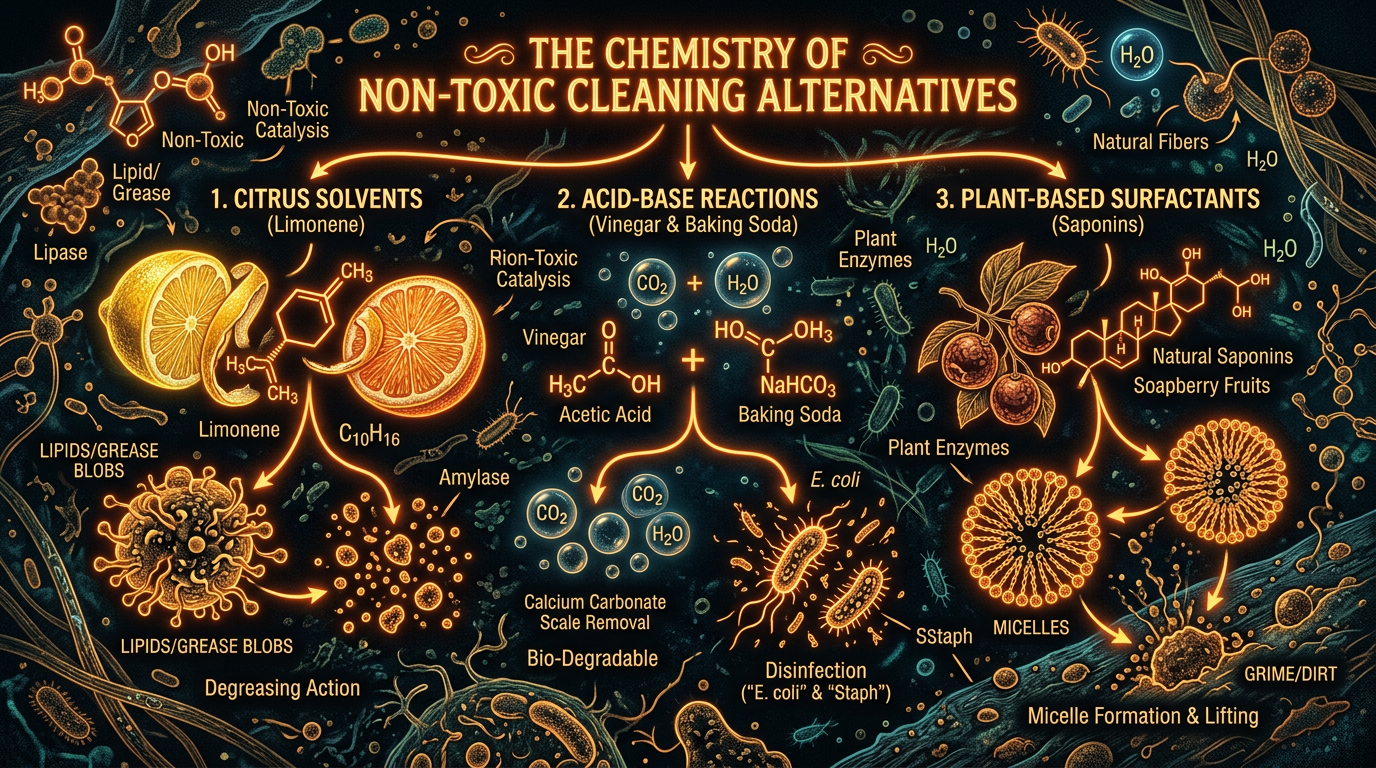
Transitioning to non-toxic cleaning is not a regression to "primitive" methods; it is an advancement toward biomimetic chemistry. By utilising simple, high-purity compounds, we can achieve sanitation through specific pH manipulation and enzymatic action rather than blunt-force toxicity.
1. Acetic Acid (White Vinegar)
The efficacy of vinegar lies in its acidity (typically 5% acetic acid).
- Mechanism: Acetic acid crosses the cell membranes of bacteria and denatures their proteins and fats. It is particularly effective against Salmonella and E. coli.
- The Descaling Power: It reacts with calcium carbonate (limescale) to produce carbon dioxide, water, and calcium acetate—a water-soluble salt that is easily rinsed away.
2. Sodium Bicarbonate (Bicarbonate of Soda)
As a mild alkali, sodium bicarbonate is the perfect counter-balance to acetic acid.
- Mechanism: It acts as a mechanical abrasive that is softer than most surfaces (preventing micro-scratches where bacteria hide). Chemically, it serves as a "buffer," neutralising acidic odour molecules (like those from sour milk or sweat) rather than masking them with synthetic fragrance.
3. Citric Acid
Derived from citrus fruits or via fermentation, citric acid is a powerful chelating agent.
- Mechanism: Chelation is the process by which a molecule "grabs" a metal ion. Citric acid binds to magnesium and calcium ions in hard water, preventing them from interfering with soap molecules, thus acting as a natural water softener and potent disinfectant.
4. Saponified Oils (Castile Soap)
Traditional soap, made through the saponification of vegetable oils with potassium hydroxide, remains the gold standard for surfactant safety.
- Mechanism: Soap molecules have a polar head and a non-polar tail. They surround grease and viral envelopes (like the lipid coating of the influenza virus), forming "micelles" that are then washed away with water. Unlike synthetic detergents, pure soap is readily biodegradable and non-toxic to aquatic life.
5. Essential Oils: The Terpene Defence
Plants have spent millions of years evolving chemical defences against microbes. Essential oils like Melaleuca alternifolia (Tea Tree) and Thymus vulgaris (Thyme) contain high concentrations of terpenes and phenols.
- Mechanism: Thymol, found in thyme oil, disrupts the cell wall of pathogens. Research indicates that certain essential oil blends are as effective as bleach at neutralising mould spores without the respiratory risk of chlorine gas.
The Recovery Protocol: Detoxifying the Domestic Sanctuary
To transition from a chemically saturated home to a biologically compatible one, a structured recovery protocol is required. This is not merely about changing products; it is about "off-gassing" the legacy of industrial cleaners.
Phase I: The Purge
Identify and remove products containing:
- Fragrance/Parfum: The industry term for an undisclosed cocktail of up to 3000 chemicals.
- 2-Butoxyethanol: A common ingredient in glass cleaners that can cause sore throats and severe liver/kidney damage.
- Chlorine Bleach (Sodium Hypochlorite): A potent lung irritant that can form chloroform gas when mixed with other organic matter.
Phase II: Structural Remediation
Once the sources of VOCs are removed, the home must be purged of lingering residues.
- High-Rate Ventilation: Open windows at opposite ends of the dwelling to create a "cross-draught" for at least two hours daily.
- Phytoremediation: Introduce plants such as Sansevieria (Snake Plant) and Chlorophytum comosum (Spider Plant). NASA studies have confirmed these species' ability to metabolise airborne formaldehyde and benzene.
- HEPA Filtration: Use air purifiers with activated carbon filters to adsorb legacy VOCs embedded in carpets and upholstery.
Phase III: The Non-Toxic Toolkit
Construct a universal cleaning kit based on molecular simplicity:
- All-Purpose Spray: 50% distilled water, 50% white vinegar, 20 drops of Lemon essential oil.
- Heavy Degreaser: A paste of bicarbonate of soda and liquid Castile soap.
- Glass Cleaner: 70% water, 20% Isopropyl alcohol (99%), 10% vinegar.
- Sanitiser: High-strength (3%) Hydrogen Peroxide (H₂O₂). It breaks down into nothing but water and oxygen, yet is lethal to almost all known pathogens.
Truth-Exposing: The Regulatory Failure
One must ask: if these alternatives are so effective and safe, why does the industrial complex continue to promote toxic synthetics? The answer lies in the "Economy of Scale" and "Regulatory Capture."
The UK’s REACH (Registration, Evaluation, Authorisation and Restriction of Chemicals) framework is often lagging years behind the latest independent toxicological data. Many chemicals are "grandfathered" in—assumed safe until proven otherwise by a body of evidence that often takes decades to accumulate. Furthermore, the cleaning industry is largely self-regulated regarding "fragrance," allowing manufacturers to hide toxic ingredients under trade secret laws.
The "green" brands found in supermarkets are often guilty of "greenwashing." Many use "biodegradable" surfactants that are still toxic to aquatic life or include synthetic fragrances that are just as disruptive as their budget counterparts.
Conclusion: Reclaiming Domestic Sovereignty
The chemistry of the home is a direct extension of the chemistry of the body. By rejecting the petroleum-based paradigm of "cleaning through toxicity," we reclaim our domestic sovereignty.
True cleanliness is not the absence of all life; it is the absence of biological interference. By utilising the inherent properties of acetic acid, sodium bicarbonate, and plant-derived terpenes, we create an environment that supports human health rather than undermining it. The transition to non-toxic alternatives is an essential act of biological defiance—a necessary step for anyone seeking true INNERSTANDING of their place within the living ecosystem.
Technical Glossary for the Informed Practitioner
- Amphiphilic: A molecule possessing both hydrophilic (water-loving) and lipophilic (fat-loving) properties.
- Chelation: The formation of multiple bonds between a ligand and a central metal ion.
- Endocrine Disruptor: A substance that interferes with the synthesis, secretion, transport, binding, action, or elimination of natural hormones.
- Micelle: An aggregate of surfactant molecules dispersed in a liquid colloid.
- Saponification: The hydrolysis of an ester under basic conditions to form an alcohol and the salt of a carboxylic acid (soap).
This article is provided for informational and educational purposes only. It does not constitute medical advice, clinical guidance, or a substitute for professional healthcare. Information reflects cited research at time of publication. Always consult a qualified healthcare professional before acting on any health information.
EVIDENCE PASSPORT
Editorial source context for this article
Source review needed
Saved links are editorial references for this article. They may support specific claims rather than every sentence. Open and assess each source in context. This passport does not independently verify them.
Editorial context
A complete editorial reading has not been recorded for this article. Source links remain available for you to open and assess directly.
Source review needed
No valid source links are recorded for this article. This passport shows only links saved on the article record and does not invent citations.
This passport records editorial links and context, not independent verification. Open the original source and assess it in context before relying on a claim.
Medical Disclaimer
The information in this article is for educational purposes only and does not constitute medical advice, diagnosis, or treatment. Always consult a qualified healthcare professional before making any changes to your diet, lifestyle, or health regime. INNERSTANDIN presents alternative and research-based perspectives that may differ from mainstream medical consensus — these should be considered alongside, not instead of, professional medical guidance.
Read Full DisclaimerContinue the thread
Keep this question moving.
Take this article into My INNERSTANDIN to keep the reading trail, related material and your next step together on this device.
Dig deeper in the Library
Free, longform PDF volumes that go beyond headlines into mechanisms and references.