
Developmental Coordination Disorder
Updated May 2026
Understanding Dyspraxia and its impact on motor skills, coordination, and daily functioning.
Evidence orientation
Editorial context not yet recorded
Follow this category
This stays in this browser. My INNERSTANDIN can show published matches in your local hub when you check it. It does not send email, push, or alert notifications.
Local learning review
A private browser aid for revisiting ideas. It is not an alert or a health recommendation.
Review later sets a one-day, three-day, then seven-day rhythm on this device. Choose it only when you want to revisit this article.
Introduction
Developmental Coordination Disorder (DCD), historically and still commonly referred to in the UK as 'Dyspraxia', is a chronic neurodevelopmental condition that affects physical coordination. It is a lifelong challenge that begins in childhood, impacting an individual’s ability to plan and execute smooth, coordinated movements.
In the landscape of neurodiversity—alongside ADHD, Autism Spectrum Disorder (ASD), and Dyslexia—DCD remains one of the most prevalent yet frequently misunderstood conditions. Estimates suggest it affects approximately 5% to 6% of school-aged children, with roughly 2% being severely affected. Despite its prevalence, it is often dismissed as mere "clumsiness," a label that fails to capture the profound impact the disorder has on academic achievement, social integration, and emotional well-being.
In a UK context, where the National Health Service (NHS) and the educational Special Educational Needs (SEN) framework play pivotal roles, understanding DCD is essential for parents, educators, healthcare professionals, and employers. This article provides a comprehensive exploration of DCD, from its biological roots to its practical management across the lifespan.
What is Developmental Coordination Disorder?
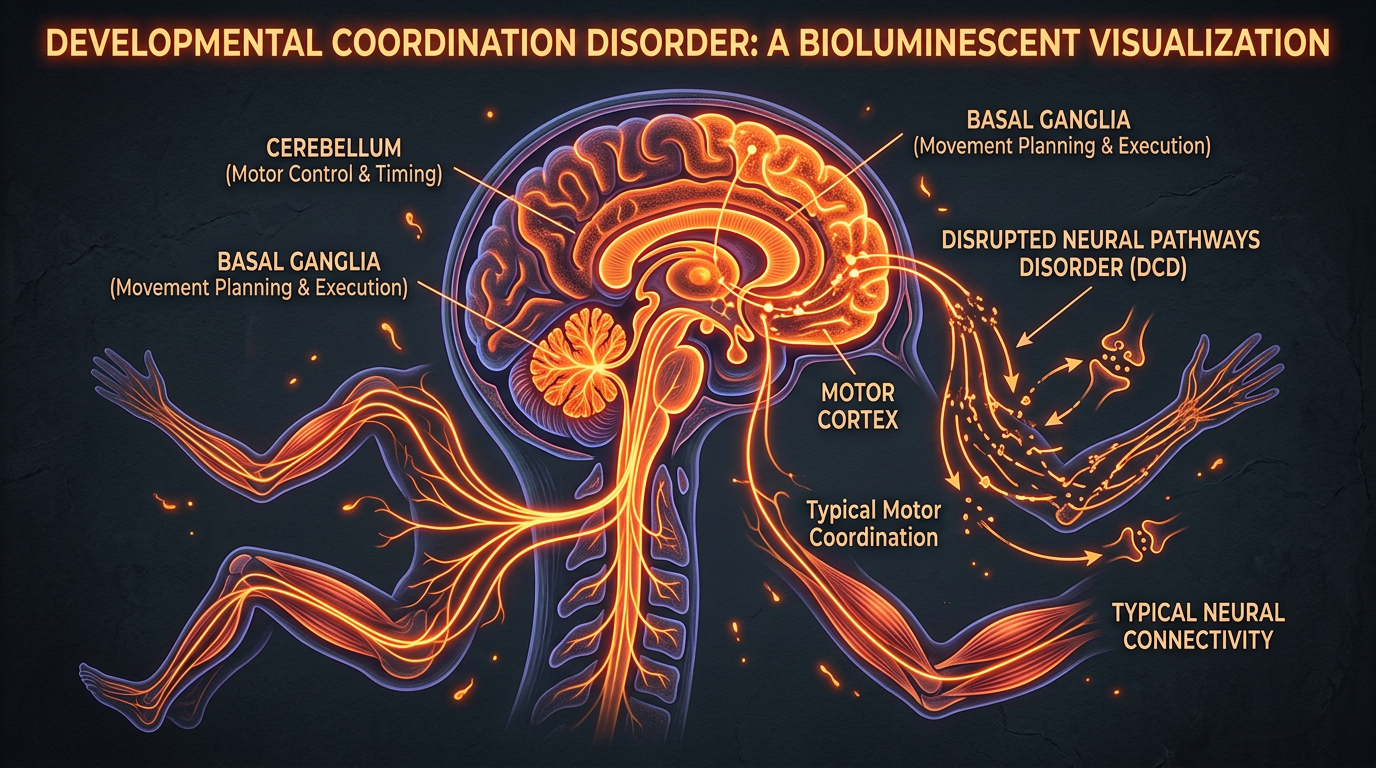
DCD is categorised as a motor disorder within the broader group of neurodevelopmental conditions. It is not a matter of muscle weakness or a lack of intelligence; rather, it is a "wiring" issue in the brain.
The Mechanism of Movement
Typical movement involves a complex relay between the brain and the muscles. This includes:
- Ideation: Thinking of what to do.
- Motor Planning: Organising how the body will move to achieve the goal.
- Execution: Performing the movement.
For individuals with DCD, the breakdown typically occurs in the motor planning phase. The brain struggles to transmit messages to the muscles in a synchronised manner. This results in movements that appear jerky, hesitant, or inaccurate.
DCD vs. Dyspraxia: A Note on Terminology
In the UK, "Dyspraxia" is the term most familiar to the public and many support organisations (such as the Dyspraxia Foundation). However, "Developmental Coordination Disorder" is the formal clinical diagnosis used by the NHS and defined in the Diagnostic and Statistical Manual of Mental Disorders (DSM-5) and the International Classification of Diseases (ICD-11). While some clinicians use the terms interchangeably, DCD is the preferred international medical term.
Signs and Symptoms Across the Lifespan
DCD does not look the same in every person, nor does it look the same at every age. Its manifestations evolve as the individual faces different developmental demands.
Early Years (0–5 Years)
In infants and toddlers, DCD may manifest as delays in reaching motor milestones. Parents might notice:
- Delayed Milestones: Late to sit up, crawl, or walk.
- Feeding Difficulties: Difficulty sucking or swallowing, or messy eating beyond the expected age.
- Play Challenges: Difficulty with "constructional" toys like Lego, or struggling to ride a tricycle.
- Proprioception Issues: Frequently bumping into furniture or falling over "nothing."
Primary School Years (5–11 Years)
This is often when the condition becomes most apparent as children are compared to their peers in a structured environment.
- Handwriting (Graphomotor Skills): This is often the primary concern in school. Handwriting is slow, laborious, and often illegible.
- Self-Care: Difficulty with buttons, zips, shoelaces, and using cutlery.
- Physical Education (PE): Difficulty catching or throwing balls, hopping, skipping, or keeping balance.
- Spatial Awareness: "The Clumsy Child" syndrome—knocking over drinks, tripping on stairs, or invading others’ personal space unintentionally.
Secondary School and Adolescence (11–18 Years)
As the workload increases and social dynamics become more complex, the challenges shift:
- Organisation: Difficulty managing a timetable, bringing the right books to lessons, or meeting deadlines (Executive Functioning).
- Fatigue: The mental and physical effort required to move and stay upright can lead to extreme exhaustion by the end of the school day.
- Social Isolation: Avoidance of team sports can lead to social withdrawal or being bullied.
- Low Self-Esteem: A growing awareness that they find "easy" tasks difficult compared to peers.
Adulthood
DCD is a lifelong condition. Adults with DCD may face:
- Daily Living: Difficulty with complex tasks like driving (especially manual cars), DIY, or cooking (chopping and timing).
- Workplace Challenges: Typing speed, filing, and time management.
- Mental Health: Higher rates of anxiety and depression, often stemming from a lifetime of feeling "inadequate" or misunderstood.
The Neurodevelopmental Overlap: ADHD and Comorbidity
DCD rarely exists in a vacuum. It is part of the "neurodevelopmental rainbow." Research indicates that a significant percentage of people with DCD meet the criteria for at least one other condition.
DCD and ADHD
There is a high rate of co-occurrence between DCD and Attention Deficit Hyperactivity Disorder (ADHD), estimated to be as high as 50%. When these conditions coexist, the challenges are compounded. The impulsivity and inattention of ADHD, combined with the motor planning difficulties of DCD, can make tasks like crossing a busy road or participating in sports particularly hazardous.
Other Overlapping Conditions
- Autism Spectrum Disorder (ASD): Many autistic individuals experience motor coordination challenges.
- Dyslexia: There is a significant overlap in the difficulty with processing information and sequential tasks.
- Specific Language Impairment (SLI): Difficulties with the motor aspects of speech (Verbal Dyspraxia) or the organisation of language.
In the UK, the "Overlap" model is increasingly used by clinicians to ensure that a child diagnosed with one condition is screened for others, ensuring a holistic support plan.
Diagnosis in the UK Context
Securing a diagnosis of DCD in the UK can sometimes be a complex "postcode lottery." However, the pathway generally involves the NHS and adheres to the DSM-5 criteria.
The Diagnostic Criteria (DSM-5)
To be diagnosed with DCD, an individual must meet four criteria:
- Motor Impairment: Learning and execution of coordinated motor skills are substantially below what is expected given the individual’s age and opportunity for skill learning.
- Impact on Daily Living: The motor deficit significantly interferes with activities of daily living (e.g., self-care) and academic/vocational productivity.
- Early Onset: Symptoms begin in the early developmental period.
- Exclusion of Other Causes: The motor deficits are not better explained by intellectual disability, visual impairment, or neurological conditions affecting movement (like Cerebral Palsy).
The UK Pathway
The process usually begins with a GP or a school’s Special Educational Needs Coordinator (SENCo).
- Paediatrician: To rule out other neurological conditions.
- Occupational Therapist (OT): The "gold standard" for DCD assessment. They assess fine motor skills, gross motor skills, and visual-perception skills.
- Physiotherapist: Often involved if gross motor skills and core strength are the primary concerns.
For adults, the pathway is more difficult, as NHS adult neurodevelopmental services are often focused on ADHD and Autism. Many adults seek private assessments through chartered occupational therapists.
The Impact on Daily Life and Mental Health
The physical symptoms of DCD are only the tip of the iceberg. The "hidden" symptoms—emotional and psychological—often have the longest-lasting impact.
Executive Functioning
Many people with DCD struggle with executive functions: planning, organising, and sequencing. This makes "simple" tasks like following a recipe or packing a school bag a monumental cognitive challenge. In the UK, this is often described as "brain fog" or "mental clutter."
Sensory Processing
DCD often coincides with Sensory Processing Disorder (SPD). Individuals may be over-sensitive or under-sensitive to light, noise, touch, or their own body position (proprioception). A noisy UK classroom or a crowded London Underground carriage can be overwhelming, leading to sensory overload.
The Psychological Toll
Because DCD is an "invisible" disability, those affected are often accused of being "lazy," "clumsy," or "not trying hard enough." Chronic failure in PE or messy handwriting leads to:
- Learned Helplessness: The belief that no matter how hard they try, they will fail.
- Social Anxiety: Fear of being judged for their physical awkwardness.
- Secondary Mental Health Issues: Increased risk of clinical anxiety and depression in adolescence and adulthood.
Management and Support Strategies
There is no "cure" for DCD, but with the right support, individuals can develop highly effective compensatory strategies.
Occupational Therapy (OT)
The focus has shifted from "remediating" the impairment to "task-oriented" interventions.
- CO-OP Approach (Cognitive Orientation to daily Occupational Performance): A popular UK intervention where the therapist helps the individual "discover" their own solutions to motor problems using a "Goal-Plan-Do-Check" framework.
- Adaptive Equipment: Using weighted pens, ergonomic keyboards, or "slip-on" shoes to bypass the motor challenge.
Physical Activity
While people with DCD may struggle with team sports like football or netball, physical activity is crucial for muscle tone and mental health.
- Recommended Activities: Swimming (where the water supports the body), martial arts (for sequencing and discipline), and cycling (with support if needed).
- The "Daily Mile": Many UK primary schools implement this; for a child with DCD, this should be focused on participation rather than speed.
Classroom Adjustments (The SEN Framework)
Under the UK’s Special Educational Needs and Disability (SEND) Code of Practice, schools have a duty to make "reasonable adjustments."
- Assistive Technology: Using a laptop for long-form writing.
- Extra Time: 25% extra time in SATs, GCSEs, and A-Levels to account for slow processing and motor speed.
- Handouts: Providing printed copies of notes so the student doesn't have to copy from the board.
DCD in the UK Educational System: SEN and EHCPs
In England, support for DCD falls under the Graduated Approach: Assess, Plan, Do, Review.
SEN Support
Most children with DCD will have their needs met through "SEN Support." This involves school-based interventions like small group work or interventions from an external OT.
Education, Health and Care Plans (EHCP)
For children with severe DCD, particularly when co-occurring with ADHD or Autism, an EHCP may be necessary. This is a legal document that stipulates the specific support a child must receive, often including funding for 1-to-1 assistance or specialised equipment. Securing an EHCP for "pure" DCD can be challenging in the UK, as it is often perceived as a "low-impact" condition, requiring parents to provide robust evidence of the impact on the child's learning.
DCD in Adulthood and the Workplace
Entering the workforce presents a new set of challenges for the dyspraxic adult. However, the Equality Act 2010 provides protection against discrimination and mandates that employers make reasonable adjustments.
Workplace Adjustments
- Software: Speech-to-text software (like Dragon) or mind-mapping tools (like Inspiration).
- Environment: A quiet workspace to reduce sensory distractions.
- Workflow: Instructions given in writing rather than verbally, and flexible deadlines.
- Access to Work: A UK government scheme that can provide grants for specialised equipment or workplace coaching for neurodivergent employees.
Driving
Learning to drive is often a major milestone that takes longer for those with DCD. In the UK, many find that learning in an automatic car removes the complex motor sequencing of the clutch and gear stick, allowing them to focus on spatial awareness and road safety.
The Strengths-Based Perspective: Neurodiversity
While the medical definition of DCD focuses on deficits, the neurodiversity movement highlights the unique strengths associated with the dyspraxic brain. Many people with DCD are:
- Creative Problem Solvers: Because they have had to find "workarounds" for physical tasks their whole lives, they are often highly innovative.
- Highly Empathetic: Their own struggles often lead to a deep understanding of others' difficulties.
- Resilient: The sheer persistence required to navigate a world not designed for them builds immense grit.
- Big-Picture Thinkers: Many dyspraxic individuals excel at holistic, strategic thinking rather than getting bogged down in minute, linear details.
Prominent figures like Daniel Radcliffe and Florence Welch have spoken openly about their experiences with dyspraxia, helping to shift the narrative from "disability" to "difference."
Supporting Someone with DCD: Practical Tips for Families
- Be Patient: Understand that a task that takes you 5 seconds might take them 50 seconds and 5 times the energy.
- Break it Down: Give instructions one step at a time. Instead of "Get ready for school," try "Put on your socks," then "Put on your trousers."
- Focus on Effort, Not Result: Praise the process of trying to tie a lace, even if the knot is messy.
- Advocate: In the UK, you are your child's best advocate. Learn the SEN Code of Practice and don't be afraid to challenge the school or the Local Authority if support is lacking.
Conclusion
Developmental Coordination Disorder is far more than a physical inconvenience. It is a fundamental difference in how an individual interacts with the world. In the UK, while awareness is growing, there is still a significant journey ahead in ensuring that every child and adult with DCD receives the timely diagnosis and support they deserve.
By moving away from the "clumsy" stereotype and embracing a neurodevelopmental understanding, we can support those with DCD to overcome their challenges and harness their considerable strengths. Whether it is through an EHCP in primary school, extra time in university exams, or "Access to Work" support in an office, the goal remains the same: to create an environment where coordination is not a barrier to potential.
Essential UK Resources
- The Dyspraxia Foundation: The UK’s leading charity for DCD, providing resources, helplines, and local support groups.
- Movement Matters: A UK coalition that provides evidence-based policy and clinical guidelines for DCD.
- The NHS Website: For the formal clinical pathway and health advice.
- IPSEA (Independent Provider of Special Education Advice): Invaluable for navigating the legalities of SEN support and EHCPs in England.
Summary Table: DCD at a Glance
| Feature | Description | | :--- | :--- | | Core Issue | Difficulty with motor planning, coordination, and sequencing. | | Prevalence | 5-6% of children; 3:1 male-to-female ratio (though girls are often under-diagnosed). | | UK Clinical Term | Developmental Coordination Disorder (DCD). | | Common Term | Dyspraxia. | | Comorbidities | ADHD, Autism, Dyslexia, Anxiety. | | Key UK Law | Equality Act 2010 (Protects adults in work); SEND Code of Practice (Protects children). | | Main Intervention | Occupational Therapy, task-based strategies, and assistive technology. |
Word Count Note: This comprehensive guide provides an authoritative overview of DCD within the UK context. For those seeking further depth, engaging with the Dyspraxia Foundation’s annual conferences and the latest research from UK universities (such as Goldsmiths or Oxford Brookes) is highly recommended.
This article is provided for informational and educational purposes only. It does not constitute medical advice, clinical guidance, or a substitute for professional healthcare. Information reflects cited research at time of publication. Always consult a qualified healthcare professional before acting on any health information.
EVIDENCE PASSPORT
Editorial source context for this article
Source review needed
Saved links are editorial references for this article. They may support specific claims rather than every sentence. Open and assess each source in context. This passport does not independently verify them.
Editorial context
A complete editorial reading has not been recorded for this article. Source links remain available for you to open and assess directly.
Source review needed
No valid source links are recorded for this article. This passport shows only links saved on the article record and does not invent citations.
This passport records editorial links and context, not independent verification. Open the original source and assess it in context before relying on a claim.
Medical Disclaimer
The information in this article is for educational purposes only and does not constitute medical advice, diagnosis, or treatment. Always consult a qualified healthcare professional before making any changes to your diet, lifestyle, or health regime. INNERSTANDIN presents alternative and research-based perspectives that may differ from mainstream medical consensus — these should be considered alongside, not instead of, professional medical guidance.
Read Full DisclaimerContinue the thread
Keep this question moving.
Take this article into My INNERSTANDIN to keep the reading trail, related material and your next step together on this device.
Explore this in the Body Map
See where this hits your biology. Interactive anatomy, threats, and protective protocols.
Dig deeper in the Library
Free, longform PDF volumes that go beyond headlines into mechanisms and references.