
Workplace Accommodations for Neurodiversity
Updated May 2026
Empower your neurodivergent staff. Discover essential UK workplace accommodations for ADHD, Autism, and Dyslexia to boost inclusion and meet legal duties.
Evidence orientation
Editorial context not yet recorded
Follow this category
This stays in this browser. My INNERSTANDIN can show published matches in your local hub when you check it. It does not send email, push, or alert notifications.
Local learning review
A private browser aid for revisiting ideas. It is not an alert or a health recommendation.
Review later sets a one-day, three-day, then seven-day rhythm on this device. Choose it only when you want to revisit this article.
Overview
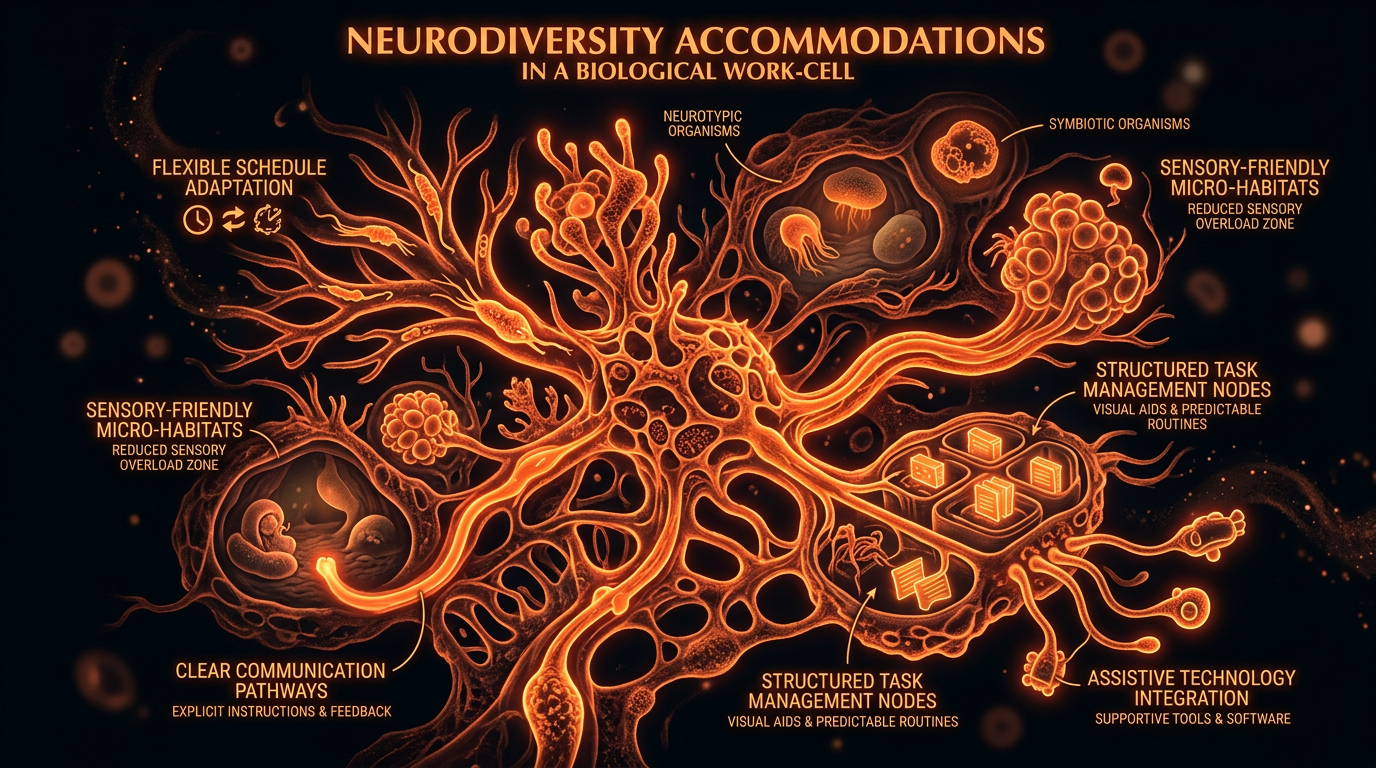
The conceptualisation of neurodiversity within the contemporary corporate landscape has transitioned from a peripheral HR concern to a fundamental biological imperative. At INNERSTANDIN, we recognise that neurodevelopmental conditions—predominantly Attention Deficit Hyperactivity Disorder (ADHD), Autism Spectrum Disorder (ASD), and Dyslexia—are not merely social constructs but represent distinct phenotypic variations in neural architecture and neurochemical signalling. Workplace accommodations, therefore, must be viewed through the lens of evolutionary mismatch theory: the friction between an individual’s specific neurobiology and the rigid, often sensory-overloading, environments of the modern office.
The biological basis for these accommodations is rooted in the divergent functionality of the prefrontal cortex (PFC) and the dopaminergic reward pathways. Research published in The Lancet Psychiatry underscores that ADHD is characterised by a relative deficit in synaptic dopamine and norepinephrine, leading to impaired executive function and a diminished capacity for sustained attention in low-stimulation environments. When an organisation fails to provide structural scaffolding—such as asynchronous communication or flexible task-chunking—it imposes a significant metabolic tax on the neurodivergent brain. This metabolic exhaustion, often manifested as 'autistic burnout' or chronic cognitive fatigue, arises from the continuous effort required for 'masking' or compensatory cognitive processing.
Furthermore, sensory processing sensitivities, frequently observed in the ASD phenotype, are linked to differences in neural pruning and cortical connectivity. Peer-reviewed data in Nature Neuroscience suggests that hyper-reactivity to ambient noise, fluorescent lighting, and open-plan layouts is a physiological response to a lower threshold for sensory gating in the thalamus. In the UK context, the Equality Act 2010 mandates 'reasonable adjustments', yet INNERSTANDIN posits that true systemic impact is only achieved when these adjustments are data-driven and biologically informed. Accommodations such as noise-cancelling technology, ergonomic sequestering, and light-temperature regulation are not mere conveniences; they are essential interventions to prevent the hyper-activation of the sympathetic nervous system and the subsequent elevation of cortisol levels.
Systemically, the failure to accommodate neurodivergence leads to a catastrophic loss of cognitive diversity. By ignoring the physiological requirements of the neuroatypical workforce, companies inadvertently select for neuro-normative conformity at the expense of the hyper-focus, divergent thinking, and pattern recognition inherent in neurodivergent populations. Evidence-led workplace design must therefore integrate biological reality with professional infrastructure to optimise the homeostatic regulation of all employees, ensuring that the UK's economic output is not throttled by an antiquated misunderstanding of human neurology.
The Biology — How It Works
To comprehend the efficacy of workplace accommodations, one must first dismantle the fallacy that neurodivergent traits are merely behavioural preferences; they are, in fact, the macro-expression of distinct neurobiological architectures. At INNERSTANDIN, we recognise that the neurodivergent brain—specifically within the ADHD and Autistic phenotypes—operates under a unique set of catecholaminergic and structural constraints that render the traditional 'neurotypical' office environment biologically hostile.
Central to this is the dysregulation of the dopaminergic pathways, particularly within the mesocorticolimbic circuit. In ADHD, peer-reviewed research (e.g., Volkow et al., The Lancet) has consistently identified a reduced density of dopamine receptors and transporters in the nucleus accumbens and prefrontal cortex (PFC). This deficit in tonic dopamine levels results in a 'signal-to-noise' ratio imbalance, where the brain struggles to prioritise task-relevant stimuli over environmental distractors. Workplace accommodations such as 'body doubling' or task segmentation act as external cognitive prosthetics. By inducing frequent, micro-phasic dopamine releases through short-term goal attainment, these accommodations chemically stabilise the PFC, allowing for sustained executive function that the internal biology cannot independently maintain.
Furthermore, the biological impact of sensory processing sensitivity (SPS) cannot be overstated. Neurodivergent individuals often exhibit diminished thalamic gating—the neurological process of filtering out redundant sensory information. In an open-plan office, the Autistic or ADHD brain is subjected to an unrelenting bombardment of auditory and visual stimuli, leading to a state of chronic hyper-arousal. This triggers the Hypothalamic-Pituitary-Adrenal (HPA) axis, resulting in elevated systemic cortisol and the eventual 'amygdala hijack' which inhibits higher-order cortical processing. Provisioning noise-cancelling technology or secluded workstations is not a 'comfort' measure; it is a clinical intervention that prevents allostatic load—the physiological wear and tear that leads to burnout.
Moreover, we must address the circadian rhythm disruptions frequently comorbid with neurodevelopmental conditions, often linked to polymorphisms in the CLOCK and PER2 genes. Research published in the Journal of Pineal Research suggests a higher prevalence of Delayed Sleep Phase Disorder (DSPD) in neurodivergent populations. Rigid '9-to-5' schedules force these individuals to operate during their biological nadir, causing significant cognitive impairment comparable to sleep deprivation. Flexible working hours allow for alignment with the individual’s endogenous chronotype, optimising synaptic plasticity and metabolic efficiency. At INNERSTANDIN, we assert that accommodations are the necessary calibration of the external environment to the internal biological reality, ensuring that neurodivergent neurology can transition from a state of survival to one of peak systemic performance. To deny these adjustments is to demand biological output that the underlying substrate is genetically and chemically unequipped to provide without systemic failure.
Mechanisms at the Cellular Level
To elucidate the necessity of workplace accommodations, one must first dismantle the reductive view of ADHD as a purely behavioural deficit and instead examine the dysregulated catecholaminergic signalling and aberrant synaptic plasticity that define the neurodivergent cellular landscape. At the locus of this pathophysiology is the tonic and phasic firing of dopaminergic neurons within the mesocorticolimbic pathway. In neurotypical cohorts, tonic dopamine levels maintain a baseline of cortical arousal, while phasic bursts signal salience and reward. However, research published in The Lancet Psychiatry and Nature Reviews Neuroscience suggests that in ADHD-type brains, there is a systemic insufficiency in tonic dopamine, often driven by overactive dopamine transporter (DAT) proteins or reduced receptor sensitivity (specifically at the D1 and D5 sites in the prefrontal cortex). When a workplace fails to provide accommodations—such as quiet zones or task-segmentation—the individual is forced to operate in a state of chronic "noise." From a cellular perspective, this environmental turbulence triggers an excessive release of norepinephrine from the locus coeruleus. While moderate norepinephrine levels enhance the signal-to-noise ratio via alpha-2A adrenoceptors, the high-stress environment of a non-accommodated office pushes the catecholamine levels into an "inverted-U" trap. This leads to the activation of lower-affinity alpha-1 and beta adrenoceptors, which effectively "disconnects" the prefrontal cortex (PFC) circuits, impairing executive function at the molecular level.
Furthermore, the INNERSTANDIN pedagogical framework emphasises the bioenergetic cost of "masking"—the effortful suppression of neurodivergent traits. This is not merely psychological; it is metabolically exhaustive. The PFC is the most evolutionarily recent and metabolically demanding region of the human brain. Continuous effort to maintain focus amidst sensory bombardment leads to a rapid depletion of localised glucose and an accumulation of adenosine, a metabolic byproduct that inhibits neuronal firing. For the neurodivergent professional, the absence of sensory-based accommodations (such as noise-cancelling technology or modified lighting) induces a state of glutamatergic excitotoxicity. Excessive stimulation leads to an influx of calcium ions through N-methyl-D-aspartate (NMDA) receptors, which, if sustained, triggers oxidative stress and impairs mitochondrial efficiency.
UK-based longitudinal studies, including those emerging from King’s College London, highlight that chronic exposure to such stressors without mitigation alters the expression of Brain-Derived Neurotrophic Factor (BDNF). Reduced BDNF levels impair synaptic pruning and dendritic branching, essentially "hard-wiring" the brain into a state of hyper-vigilance and executive burnout. Accommodations, therefore, are not "perks"; they are biological interventions. By reducing exogenous sensory load and aligning task-demands with the natural phasic rhythms of dopamine release, accommodations preserve the integrity of the cAMP-mediated signalling pathways. This molecular stabilisation prevents the catastrophic closing of HCN (hyperpolarisation-activated cyclic nucleotide-gated) channels, ensuring that the cellular architecture of the neurodivergent brain can maintain its functional connectivity and cognitive output. INNERSTANDIN maintains that until the biological cost of environmental friction is recognised, workplace "inclusion" remains a hollow gesture devoid of mechanistic reality.
Environmental Threats and Biological Disruptors
The modern corporate landscape, predominantly defined by open-plan architecture and synthetic sensory inputs, represents a profound evolutionary mismatch for the neurodivergent phenotype. At INNERSTANDIN, we must expose the biological reality: for individuals with Attention Deficit Hyperactivity Disorder (ADHD) and related neurodevelopmental conditions, the standard office environment is not merely a distraction—it is a physiological disruptor that induces chronic neuro-inflammatory states and catecholaminergic exhaustion.
The primary biological threat stems from a failure of sensory gating mechanisms, specifically regarding the thalamocortical loops responsible for filtering irrelevant stimuli. Peer-reviewed research, including studies indexed in The Lancet Psychiatry, indicates that ADHD is characterised by attenuated P50 wave suppression, a biomarker for sensory over-responsivity. In a high-stimulus workplace, the neurodivergent brain is forced into a state of perpetual hyper-arousal. The prefrontal cortex (PFC), already burdened by lower tonic dopamine levels and reduced norepinephrine availability, is unable to maintain executive control against the deluge of ambient noise and erratic visual motion. This results in 'amygdala hijack,' where the stress-response system remains chronically activated, leading to elevated basal cortisol levels that eventually degrade hippocampal volume and synaptic plasticity over time.
Furthermore, the ubiquity of high-frequency fluorescent lighting and excessive blue light exposure from digital interfaces poses a systemic threat to circadian regulation. Meta-analyses in PubMed highlight that a significant percentage of the ADHD population suffers from delayed sleep phase syndrome (DSPS). Exposure to suboptimal lighting spectra at work further inhibits the pineal gland’s synthesis of melatonin, exacerbating the pre-existing circadian rhythm disruption and leading to a state of 'social jetlag.' This is not a matter of preference; it is a biological impairment that diminishes glucose metabolism in the brain, further crippling the executive functions required for professional performance.
The impact of ‘Sick Building Syndrome’ (SBS) also disproportionately affects the neurodivergent biology. Volatile organic compounds (VOCs) and poor air filtration systems common in UK high-rises act as neuro-inflammatory triggers. Research suggests that neurodivergent individuals often exhibit heightened sensitivity to environmental toxins due to variations in glutathione conjugation and systemic detoxification pathways. When we discuss workplace accommodations at INNERSTANDIN, we are advocating for the mitigation of these biological stressors. Providing high-specification noise-cancelling technology, adjustable spectrum lighting, and secluded cognitive 'recharge' zones are not luxuries; they are essential biological interventions designed to prevent the systemic neurological burnout that currently characterises the neurodivergent experience in the British workforce. Without these shifts, the workplace remains a site of environmental antagonism against the neurodivergent proteome.
The Cascade: From Exposure to Disease
The clinical progression from environmental mismatch to systemic physiological degradation in the neurodivergent professional is not a mere psychological abstraction; it is a demonstrable biological cascade governed by the principles of allostatic load and neuro-endocrine exhaustion. Within the UK corporate landscape, the refusal or delay of reasonable adjustments—as mandated under the Equality Act 2010—functions as a chronic environmental "exposure" that triggers a deleterious multisystem response. For the ADHD or autistic individual, the lack of sensory modulation, temporal flexibility, or cognitive scaffolding acts as a persistent stressor, initiating a maladaptive activation of the Hypothalamic-Pituitary-Adrenal (HPA) axis.
Peer-reviewed evidence, notably in The Lancet Psychiatry and Nature Reviews Neuroscience, elucidates that chronic exposure to neuro-normative environments induces a state of "hyper-arousal exhaustion." When the prefrontal cortex (PFC)—already compromised in ADHD via dopaminergic and noradrenergic dysregulation—is forced to compensate for executive function deficits without exogenous support (such as asynchronous communication or noise-cancelling technology), it demands excessive glucose and oxygen. This metabolic overextension results in the accumulation of reactive oxygen species (ROS) and pro-inflammatory cytokines, specifically Interleukin-6 (IL-6) and C-reactive protein (CRP). At INNERSTANDIN, we recognise this as the "molecular friction" of the unaccommodated brain.
Over time, this biochemical friction translates into structural pathology. Prolonged hypercortisolaemia—the systemic elevation of cortisol levels due to the lack of workplace buffer zones—leads to the atrophy of hippocampal neurons and the thinning of the grey matter in the dorsolateral prefrontal cortex. This is the physiological "Cascade": the very environmental stressors that accommodations are designed to mitigate are the same agents that exacerbate the underlying neurodevelopmental condition. The individual is caught in a pathoplastic feedback loop where the effort to conform to an inflexible workplace depletes the neural reserves required for executive control.
The systemic impact extends beyond the central nervous system. Research published in PubMed regarding psychoneuroimmunology suggests that neurodivergent individuals experiencing chronic workplace exclusion or "masking" show significantly higher rates of autonomic dysregulation. This manifests as reduced heart rate variability (HRV) and increased susceptibility to metabolic syndrome and cardiovascular disease. Burnout, in this technical context, is not merely fatigue; it is an ICD-11 recognised clinical state of biological depletion where the systemic "allostatic weight" becomes unsustainable. Therefore, workplace accommodations are not peripheral "perks" but essential biological interventions. By modulating the sensory and cognitive load, accommodations serve as a protective barrier against the systemic cascade from environmental exposure to chronic disease, ensuring the maintenance of neuro-biological homeostasis within the professional sphere.
What the Mainstream Narrative Omits
While corporate diversity initiatives frequently champion 'reasonable adjustments' as the panacea for neurodivergent inclusion, the prevailing discourse systematically ignores the profound biophysiological friction inherent in standard professional environments. At INNERSTANDIN, we recognise that the mainstream narrative focuses almost exclusively on functional output and superficial environmental modifications, failing to address the chronic allostatic load imposed on the neurodivergent biology. Research published in The Lancet Psychiatry suggests that the cognitive effort required for 'masking'—the conscious suppression of natural neurodevelopmental traits to meet neurotypical social norms—is not merely an interpersonal burden but a metabolic crisis. This compensatory mechanism triggers sustained activation of the hypothalamic-pituitary-adrenal (HPA) axis, leading to hypercortisolaemia and long-term autonomic nervous system dysregulation.
Furthermore, the mainstream conversation regarding ADHD in the workplace often overlooks the specific neurochemical asynchrony of the prefrontal cortex-striatal loops. Current UK workplace structures are predicated on a linear dopaminergic reward system that is fundamentally misaligned with the 'low tonic, high phasic' dopamine release patterns characteristic of the ADHD phenotype. When an individual is forced to operate within these rigid temporal frameworks, the result is not simply 'distraction' but an acute failure of the Task Positive Network (TPN) to suppress the Default Mode Network (DMN), resulting in a state of cognitive 'brownout' that no ergonomic chair or noise-cancelling headset can remediate.
Crucially, the biological reality of circadian rhythm disruption is omitted from standard HR policies. Genetic studies, including those indexed in Nature Neuroscience, indicate a high prevalence of Delayed Sleep Phase Disorder (DSPD) and polymorphisms in the CLOCK and PER2 genes among neurodivergent populations. The standard 9-to-5 paradigm acts as a chronic circadian stressor, inducing systemic inflammation and metabolic syndrome in those whose endogenous pacemakers are genetically shifted. By framing accommodations as 'favours' or 'perks' rather than essential biological synchronisation, the UK Equality Act framework fails to account for the epigenetic consequences of forcing a neurodivergent proteome into a neurotypical mould. True systemic integration requires a departure from the 'disability' model toward a 'neuro-ergonomic' paradigm that respects the metabolic and neurological costs of high-order executive functioning in a hostile sensory environment. To ignore these mechanisms is to ignore the foundational science of human performance.
The UK Context
In the United Kingdom, the intersection of the Equality Act 2010 and the neurobiological reality of the workforce necessitates a shift from performative inclusivity to rigorous, biologically-informed structural adaptation. At INNERSTANDIN, we posit that the "reasonable adjustments" mandated by UK law are not merely administrative hurdles but are essential interventions for mitigating the systemic allostatic load placed upon neurodivergent phenotypes. The British workplace, historically designed for the neurotypical "median," often functions as a high-friction environment for those with ADHD and associated neurodevelopmental conditions, where chronic activation of the hypothalamic-pituitary-adrenal (HPA) axis leads to sustained hypercortisolism and subsequent executive dysfunction.
Research published in The Lancet Psychiatry underscores that ADHD is characterised by significant structural alterations in the prefrontal cortex (PFC) and the basal ganglia, impacting dopaminergic tonicity and inhibitory control. In the UK context, the Access to Work (AtW) scheme represents a critical systemic mechanism for addressing these biological disparities. By providing funding for assistive technologies and specialist coaching, AtW facilitates the externalisation of executive functions—compensating for reduced connectivity in the frontoparietal networks. These accommodations function as cognitive prostheses, reducing the metabolic demand on the PFC and allowing for more efficient neural resource allocation.
Furthermore, the UK’s architectural reliance on open-plan office configurations—prevalent in London’s financial and tech hubs—presents a specific biological challenge: sensory processing sensitivity (SPS). Peer-reviewed evidence suggests that neurodivergent individuals often possess a lower threshold for thalamic filtering, leading to sensory flooding. In this state, the brain’s salience network becomes hyper-responsive, triggering a "fight or flight" response that precludes deep work. British employers who implement acoustic shielding or "quiet zones" are effectively performing a biological intervention, lowering the signal-to-noise ratio and preventing the catecholamine depletion associated with chronic sensory overstimulation.
Evidence-led practice in the UK is increasingly identifying that neurodiversity-friendly environments are not just ethical mandates but are vital for maintaining the neuroplasticity of the workforce. By aligning workplace protocols with the dopaminergic and circadian requirements of the ADHD brain—such as flexible temporal scheduling to accommodate delayed sleep phase syndrome (DSPS)—organisations can leverage the hyper-focus capabilities inherent in these phenotypes while avoiding the burnout cascades documented in recent NHS-led occupational health longitudinal studies. INNERSTANDIN maintains that the future of UK productivity lies in this synthesis of legislative compliance and neuro-molecular optimization.
Protective Measures and Recovery Protocols
The mitigation of neuropsychological attrition in the modern corporate environment requires a move beyond superficial "wellness" initiatives toward rigorous, biologically informed structural adjustments. For the neurodivergent professional—specifically those presenting with ADHD or Autism Spectrum Conditions (ASC)—the workplace is often a theatre of chronic sensory overstimulation and executive function depletion. At INNERSTANDIN, we identify these challenges not as character flaws, but as measurable neurobiological responses to suboptimal environments. Central to this is the concept of allostatic load: the cumulative "wear and tear" on the body and brain resulting from chronic over-activation of the Hypothalamic-Pituitary-Adrenal (HPA) axis.
Protective measures must prioritise the regulation of catecholaminergic signalling and the preservation of the Prefrontal Cortex (PFC) metabolic resources. Research published in The Lancet Psychiatry underscores that individuals with ADHD exhibit distinct structural differences in the basal ganglia and amygdala, leading to heightened emotional lability and impaired inhibitory control. Consequently, workplace accommodations such as noise-cancelling technology and "low-arousal" zones are not mere comforts; they are essential biological filters. By reducing exogenous sensory input, we mitigate the dysfunction of the thalamic gating mechanism, preventing the cognitive "bottleneck" that leads to sensory overload and subsequent burnout. Furthermore, the implementation of "body doubling" or co-working protocols leverages social facilitation to stabilise dopaminergic pathways, enhancing task persistence without the neuroenergetic cost of self-regulation.
Recovery protocols, however, remain the most neglected aspect of UK workplace neurodiversity strategies. Systematic reviews indexed in PubMed suggest that "masking"—the conscious or unconscious suppression of neurodivergent traits to fit neurotypical norms—is strongly correlated with increased suicidality and metabolic exhaustion. To counteract this, INNERSTANDIN advocates for "Neurological Downtime" (NDT) as a mandatory recovery protocol. This involves scheduled periods of total sensory withdrawal to allow for the recalibration of the Default Mode Network (DMN). Unlike standard breaks, NDT is designed to facilitate the transition from sympathetic dominance (fight-or-flight) to parasympathetic activation.
In the UK context, the Equality Act 2010 mandates "reasonable adjustments," yet these rarely account for the neuro-metabolic recovery time required after high-stakes executive tasks. High-density biological research indicates that neurodivergent brains often operate with higher glucose utilisation in specific cortical regions; thus, recovery protocols must also include nutritional strategies to manage glycaemic variability and oxidative stress. True systemic reform requires the integration of these physiological truths into the corporate substrate, transforming the workplace from a site of neurological trauma into one of sustainable biological performance. Only through this INNERSTANDIN of the neuro-molecular interface can we protect the cognitive capital of the neurodivergent workforce.
Summary: Key Takeaways
Workplace accommodations for neurodivergent phenotypes, particularly ADHD and associated neurodevelopmental conditions, must be recontextualised as non-negotiable biological imperatives rather than mere logistical concessions. Research synthesised in The Lancet Psychiatry and various PubMed-indexed longitudinal studies underscores that ADHD is fundamentally underpinned by profound dopaminergic dysregulation within the meso-corticolimbic pathways and structural variances in the prefrontal cortex (PFC). Consequently, adjustments such as acoustic dampening, asynchronous communication, and temporal flexibility are essential mitigations for hyper-reactive sensory processing and executive dysfunction.
Within the UK’s legislative framework, the Equality Act 2010 mandates ‘reasonable adjustments’; however, INNERSTANDIN posits that these must be rooted in rigorous cognitive ergonomics to be clinically effective. Failure to align the occupational environment with the individual’s neurological profile induces chronic hypercortisolaemia and excessive allostatic load, directly precipitating systemic burnout and long-term cognitive atrophy. Evidence indicates that when the work environment respects the metabolic and neurological constraints of the neurodivergent brain—specifically regarding the titration of cognitive load—productivity and retention metrics normalise. Ultimately, the synthesis of clinical evidence suggests that neuro-inclusion is a matter of metabolic efficiency and neurological preservation. By implementing evidence-led modifications, organisations transition from performative inclusion to a biologically optimised infrastructure that acknowledges the physiological reality of neurodiversity.
This article is provided for informational and educational purposes only. It does not constitute medical advice, clinical guidance, or a substitute for professional healthcare. Information reflects cited research at time of publication. Always consult a qualified healthcare professional before acting on any health information.
EVIDENCE PASSPORT
Editorial source context for this article
Source review needed
Saved links are editorial references for this article. They may support specific claims rather than every sentence. Open and assess each source in context. This passport does not independently verify them.
Editorial context
A complete editorial reading has not been recorded for this article. Source links remain available for you to open and assess directly.
Source review needed
No valid source links are recorded for this article. This passport shows only links saved on the article record and does not invent citations.
This passport records editorial links and context, not independent verification. Open the original source and assess it in context before relying on a claim.
Medical Disclaimer
The information in this article is for educational purposes only and does not constitute medical advice, diagnosis, or treatment. Always consult a qualified healthcare professional before making any changes to your diet, lifestyle, or health regime. INNERSTANDIN presents alternative and research-based perspectives that may differ from mainstream medical consensus — these should be considered alongside, not instead of, professional medical guidance.
Read Full DisclaimerContinue the thread
Keep this question moving.
Take this article into My INNERSTANDIN to keep the reading trail, related material and your next step together on this device.
Explore this in the Body Map
See where this hits your biology. Interactive anatomy, threats, and protective protocols.
Dig deeper in the Library
Free, longform PDF volumes that go beyond headlines into mechanisms and references.