
The Digital Therapist: Natural Language Processing in Mental Healthcare
Updated May 2026
Examining the ethical and clinical implications of using NLP-based chatbots and emotion-recognition AI to provide 24/7 mental health support.
Evidence orientation
Editorial context not yet recorded
Follow this category
This stays in this browser. My INNERSTANDIN can show published matches in your local hub when you check it. It does not send email, push, or alert notifications.
Local learning review
A private browser aid for revisiting ideas. It is not an alert or a health recommendation.
Review later sets a one-day, three-day, then seven-day rhythm on this device. Choose it only when you want to revisit this article.
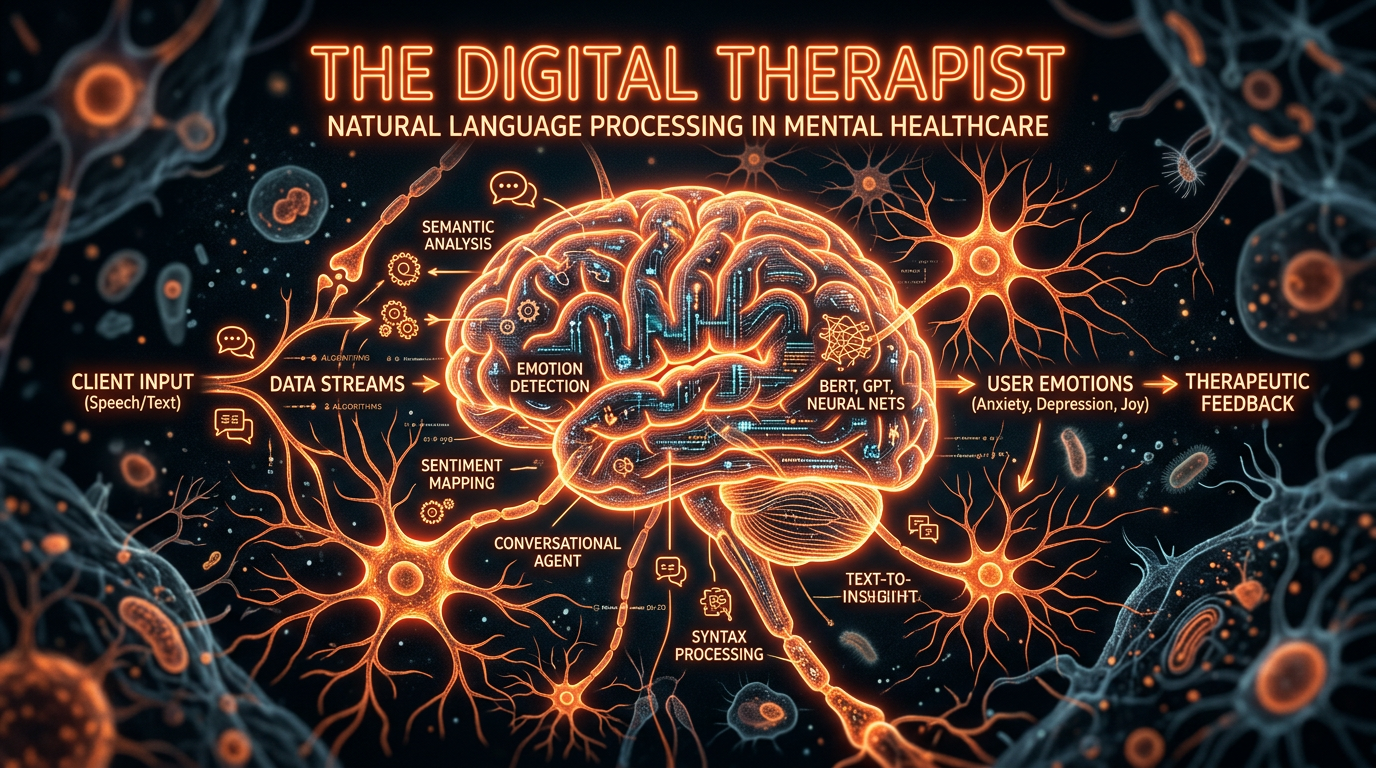
The Digital Therapist: Natural Language Processing in Mental Healthcare
The traditional sanctity of the therapist’s consulting room—a space defined by the scent of old books, the ticking of a clock, and the profound, silent exchange of human empathy—is undergoing a radical, silicon-led transformation. As the United Kingdom faces an unprecedented mental health crisis, with demand for services far outstripping the capacity of the National Health Service (NHS), a new protagonist has entered the clinical theatre: Natural Language Processing (NLP).
NLP, a subfield of Artificial Intelligence (AI) concerned with the interaction between computers and human language, is no longer a futuristic concept. It is currently being deployed to screen for depression, monitor suicidal ideation, and deliver Cognitive Behavioural Therapy (CBT) via smartphone interfaces. However, as we integrate these ‘digital therapists’ into our biological lives, we must scrutinise the mechanisms at play. This is not merely a technological shift; it is a fundamental alteration of the human psychological landscape.
The Biological Mechanisms: How Language Rewires the Brain
To understand the efficacy of NLP in a clinical setting, one must first understand the biological relationship between language and neurobiology. Human speech and writing are not merely methods of communication; they are the externalised manifestations of internal neural states.
Affective Labelling and Amygdala Regulation
Research in functional Magnetic Resonance Imaging (fMRI) has long demonstrated that the act of putting feelings into words—a process known as 'affective labelling'—can dampen the response of the amygdala, the brain's emotional alarm system. When an individual interacts with an NLP-driven platform, the machine prompts this labelling process. By translating nebulous distress into structured syntax, the user engages the ventrolateral prefrontal cortex (vlPFC), which in turn inhibits the amygdala.
The Digital Phenotype
NLP allows for the mapping of what researchers call the 'digital phenotype.' Every word chosen, the latency between sentences, and the frequency of first-person singular pronouns (e.g., "I", "me", "my") serve as biomarkers for specific neurological conditions.
- Depression: Often characterised by a ‘linguistic constriction’—increased use of absolute words (e.g., "always", "never") and ruminative self-focus.
- Hypomania: Indicated by 'pressured speech' patterns, detectable even in text through rapid-fire input and tangential shifts in topic.
- Cognitive Decline: Subtle changes in syntactic complexity and word-finding pauses can be detected by NLP algorithms years before clinical symptoms of dementia manifest.
According to the Mental Health Foundation, approximately 1 in 6 people in the UK experience a common mental health problem (such as anxiety or depression) in any given week. The economic cost of mental ill-health to the UK economy is estimated at £118 billion annually.
Environmental Disruptors: The Silicon Double-Edged Sword
We find ourselves in a paradoxical era. The very environment that necessitates the rise of digital therapists is often the primary disruptor of our mental equilibrium. The 'always-on' digital culture of the United Kingdom has created a pervasive state of sympathetic nervous system activation.
The Dopaminergic Fragmentation
Modern digital environments are designed for 'intermittent reinforcement,' a psychological tactic that disrupts the brain’s dopamine pathways. The constant influx of notifications and the 'infinite scroll' create a fragmented attention span, which NLP tools are now ironically being used to mend. This 'technostress' leads to chronic cortisol elevation, which has been shown to atrophy the hippocampus—the region of the brain responsible for memory and emotional regulation.
Circadian Dysregulation
The blue light emitted by the devices hosting these digital therapists inhibits the production of melatonin. For a population already struggling with insomnia—a primary driver of psychiatric morbidity—the medium of delivery may, in some cases, exacerbate the underlying biological disruption. The 'truth' that must be exposed is that while NLP offers a solution to the scalability of care, it operates within the same digital ecosystem that contributes to our collective neuro-biological fragility.
- Isolation in Connectivity: Despite being ‘connected’, the loss of ‘paralinguistic cues’ (body language, pheromones, and micro-expressions) in digital interactions can lead to a sense of ‘biological loneliness.’
- Algorithmic Bias: NLP models trained on non-representative datasets may fail to understand regional UK dialects or the socio-linguistic nuances of minority communities, leading to 'diagnostic exclusion.'
The NLP Engine: Decoding the Therapeutic Algorithm
How does a machine actually ‘understand’ a patient? The process is a sophisticated multi-layered analysis that mirrors, yet fundamentally differs from, human intuition.
Sentiment Analysis and Beyond
Early iterations of NLP relied on simple sentiment analysis—categorising words as 'positive' or 'negative.' Modern clinical NLP uses 'Transformer' models (like BERT or GPT-4) that understand context and nuance.
- Tokenization: Breaking speech into units (tokens).
- Semantic Mapping: Placing these tokens in a multi-dimensional mathematical space where words with similar meanings are clustered together.
- Sentiment Trajectory: Monitoring how a patient’s mood shifts over the course of a session or a month, providing a high-resolution longitudinal view that a human therapist, meeting once a week, might miss.
Vocal Biomarkers: The Sound of the Soul
Beyond text, NLP is now being applied to the prosody of speech. In the UK, several health-tech start-ups are using vocal biomarkers to screen for depression. They analyse:
- Fundamental Frequency (F0): The pitch of the voice.
- Jitter and Shimmer: Micro-fluctuations in frequency and amplitude that correlate with muscular tension in the larynx, often seen in high-anxiety states.
- Spectral Slope: A measure of the 'brightness' of the voice, which often 'flattens' in patients with clinical depression.
The Truth Exposed: The Risks of De-humanised Care
While the efficiency of NLP is undeniable, we must confront the 'black box' problem. In a clinical setting, accountability is paramount. If a human therapist misses a suicidal cue, there is a legal and ethical framework for recourse. If an algorithm fails, the responsibility becomes diffused.
The Crisis of Meaning
A machine can simulate empathy, but it cannot feel it. The 'therapeutic alliance'—the bond between therapist and patient—is the single greatest predictor of positive outcomes in mental healthcare. NLP platforms provide 'simulated presence.' There is a risk that by relying on these tools, the UK's healthcare system may inadvertently move toward a 'tiering' of care: human-led therapy for those who can afford it, and algorithmic scripts for those who cannot.
Data from the NHS indicates that as of late 2023, over 1.2 million people were on the waiting list for community-based mental health services. In some regions, the wait for psychological therapies exceeds 18 weeks, pushing patients toward unregulated AI alternatives.
Data Sovereignty and Privacy
The 'truth' regarding digital therapy is that the user is often the product. The intimate linguistic data shared with a digital therapist is some of the most sensitive information a human can generate. The risk of de-identification being reversed, or of this data being used by third parties for insurance premium adjustments, remains a significant concern despite the UK's GDPR protections.
The Recovery Protocol: Integrating Silicon and Soul
The goal is not to reject NLP, but to utilise it within a 'Human-in-the-Loop' (HITL) framework. We must move toward a model of 'Augmented Intelligence' rather than Artificial Intelligence.
1. The Hybrid Triage System
NLP should be used as a sophisticated triage tool. By analysing the urgency of language in initial referrals, the NHS can prioritise those in immediate crisis, ensuring that human intervention is directed where it is most critically needed.
2. Digital Sovereignty Protocols
Patients must have absolute ownership of their linguistic data. Recovery protocols should include:
- Localised Processing: Running NLP models locally on the user's device rather than in the cloud to ensure privacy.
- Data Deletion Rights: Transparent 'kill-switches' for all therapeutic transcripts.
3. Restoring the Biological Baseline
To counter the environmental disruptors mentioned earlier, digital therapy must be paired with 'biophilic' interventions.
- Digital Fasting: Incorporating periods of non-screen time into the therapeutic programme.
- Circadian Alignment: Encouraging the use of NLP tools during daylight hours to mitigate sleep disruption.
- Somatic Integration: Using NLP to prompt physical activities (e.g., breathwork, walking) that ground the user in their biological body.
Conclusion: The Synthesis of Science and Spirit
The digital therapist is not a replacement for the human soul, but a powerful new mirror in which we can view our internal states. Natural Language Processing offers the possibility of democratising mental healthcare, providing support to millions who currently suffer in silence.
However, we must remain vigilant. The 'truth' of our mental health is not found in a mathematical vector or a sentiment score; it is found in the lived experience of the individual. As we advance this technology in the UK and beyond, our priority must be to ensure that the machine serves the biological needs of the human, and not the other way around. The future of mental healthcare lies in a sophisticated synthesis: the analytical precision of the algorithm, tempered by the profound, irreducible mystery of human empathy.
In the pursuit of INNERSTANDING, we must remember that while a computer can parse the word 'pain', only a human can truly know what it means to feel it.
This article is provided for informational and educational purposes only. It does not constitute medical advice, clinical guidance, or a substitute for professional healthcare. Information reflects cited research at time of publication. Always consult a qualified healthcare professional before acting on any health information.
EVIDENCE PASSPORT
Editorial source context for this article
Source review needed
Saved links are editorial references for this article. They may support specific claims rather than every sentence. Open and assess each source in context. This passport does not independently verify them.
Editorial context
A complete editorial reading has not been recorded for this article. Source links remain available for you to open and assess directly.
Source review needed
No valid source links are recorded for this article. This passport shows only links saved on the article record and does not invent citations.
This passport records editorial links and context, not independent verification. Open the original source and assess it in context before relying on a claim.
Medical Disclaimer
The information in this article is for educational purposes only and does not constitute medical advice, diagnosis, or treatment. Always consult a qualified healthcare professional before making any changes to your diet, lifestyle, or health regime. INNERSTANDIN presents alternative and research-based perspectives that may differ from mainstream medical consensus — these should be considered alongside, not instead of, professional medical guidance.
Read Full DisclaimerContinue the thread
Keep this question moving.
Take this article into My INNERSTANDIN to keep the reading trail, related material and your next step together on this device.