
Docosahexaenoic Acid (DHA): Why Algal Sources Fail the Brain’s Kinetic Demand
Updated May 2026
Compares the absorption rates of EPA and DHA from oily fish versus plant-based precursors. It explains why the conversion of ALA is insufficient for neurological health.
Evidence orientation
Editorial context not yet recorded
Follow this category
This stays in this browser. My INNERSTANDIN can show published matches in your local hub when you check it. It does not send email, push, or alert notifications.
Local learning review
A private browser aid for revisiting ideas. It is not an alert or a health recommendation.
Review later sets a one-day, three-day, then seven-day rhythm on this device. Choose it only when you want to revisit this article.
Overview
In the contemporary landscape of nutritional science, a dangerous egalitarianism has taken root. The prevailing narrative suggests that as long as one consumes "Omega-3s," the source—whether it be a stalk of flax, a capsule of fermented algae, or a piece of wild-caught salmon—is secondary to the total intake. This is not merely a scientific oversight; it is a fundamental misunderstanding of human lipid biochemistry and evolutionary biology.
Docosahexaenoic acid (DHA) is a 22-carbon fatty acid with six double bonds. It is the most unsaturated fatty acid commonly found in mammalian tissues and is the primary structural component of the human cerebral cortex, skin, and retina. For the human brain to function, it requires a constant, high-kinetic flux of preformed DHA. While the mainstream media and plant-based proponents champion alpha-linolenic acid (ALA) from seeds or supplemental algal oils as "equivalent" alternatives, the biological reality tells a different story.
This article explores the "Kinetic Demand" of the brain—a threshold of absorption and integration that plant-based precursors and synthetic algal extracts consistently fail to meet. We will examine the metabolic bottlenecks of ALA conversion, the superiority of animal-based phospholipid carriers, and why the "nose-to-tail" consumption of marine and terrestrial animal fats remains the only viable strategy for long-term neurological integrity.
Fact: DHA makes up over 90% of the omega-3 fatty acids in the brain and up to 25% of its total fat content. Despite this, the human body’s ability to synthesise DHA from plant precursors is estimated to be less than 0.5% in most adult males.
The Biology — How It Works
To understand why algal and plant sources fail, one must first understand the journey of a lipid from the gut to the grey matter. The human brain is an energetically expensive organ, but it is also a "lipid-expensive" organ.
The Evolutionary Imperative: The Shore-Based Diet
The rapid expansion of the hominid brain, often referred to as "encephalisation," is tightly correlated with the transition to a shore-based diet. Archaeological evidence suggests that early modern humans thrived in coastal environments where they had access to "brain-specific" nutrients: iodine, selenium, zinc, and preformed DHA. Unlike our herbivorous ancestors, the human metabolic pathway for de novo synthesis of DHA has become largely vestigial because our environment provided it in abundance through fish, shellfish, and the brains of scavenged animals.
The Problem of Alpha-Linolenic Acid (ALA)
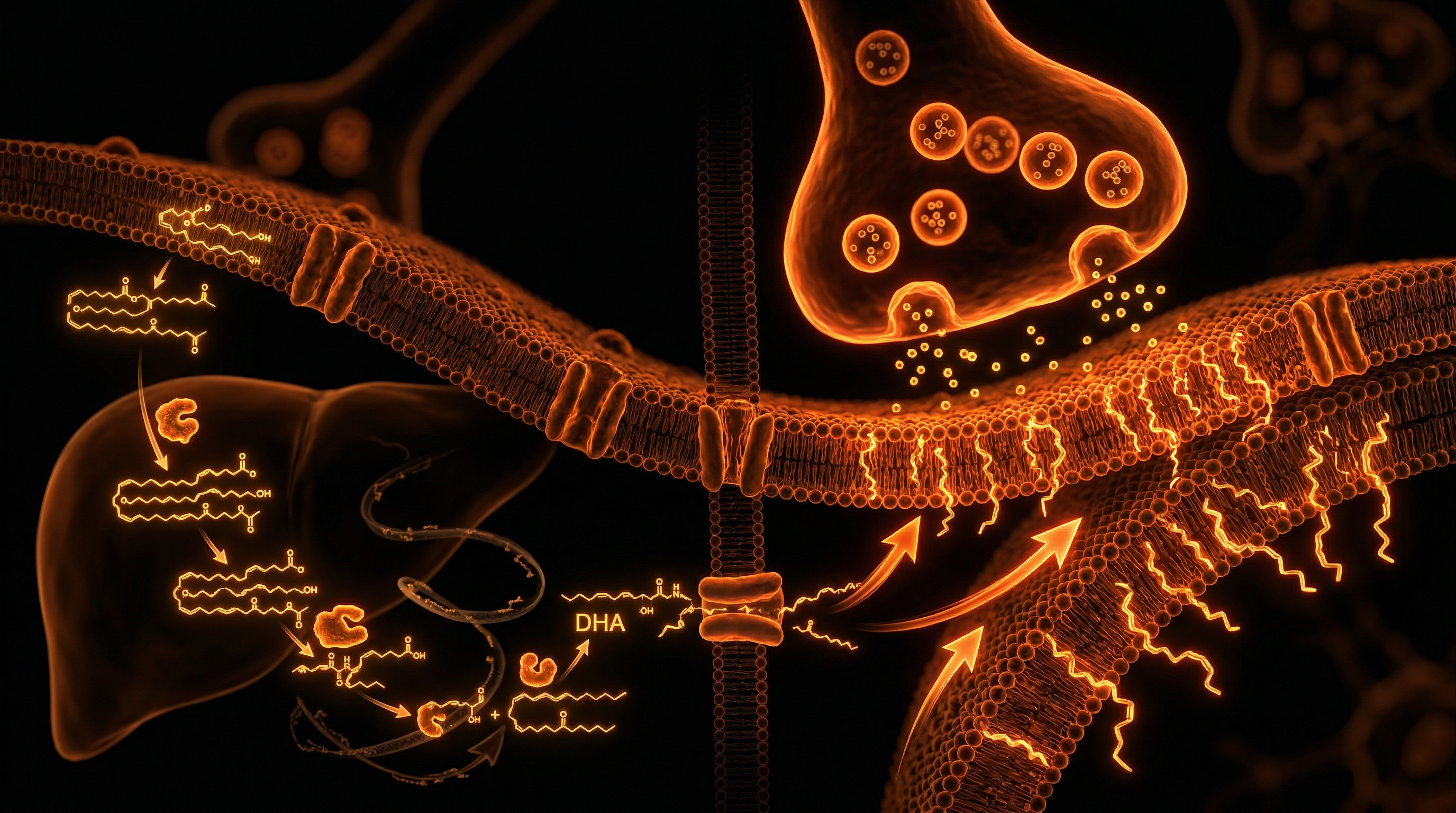
Mainstream nutrition often conflates ALA (found in flax, chia, and walnuts) with DHA. In the liver, ALA must undergo a series of desaturation and elongation steps to become EPA (Eicosapentaenoic acid) and finally DHA.
The enzymes responsible for this—Delta-5 and Delta-6 desaturase—are the limiting factors. In modern humans, these enzymes are often compromised by:
- High intakes of linoleic acid (Omega-6 from seed oils).
- Insufficient levels of co-factors (Zinc, B6, Magnesium).
- Genetic polymorphisms in the FADS1 and FADS2 gene clusters.
The "Algal" Myth
Algal oil is often marketed as the "source" where fish get their DHA. While technically true, this ignores the biological processing that occurs within the fish. When a human consumes algal oil, they are consuming DHA primarily in the form of triglycerides or ethyl esters. These forms lack the specific molecular chaperones—namely phospholipids—that facilitate rapid transport across the blood-brain barrier.
Mechanisms at the Cellular Level
The brain does not simply "soak up" DHA like a sponge. It requires a sophisticated transport mechanism to move fatty acids from the blood into the neural tissue.
The Mfsd2a Transporter
The primary gateway for DHA into the brain is a transporter called Mfsd2a (Major Facilitator Superfamily Domain Containing 2A). This transporter does not recognise free fatty acids or DHA in triglyceride form. It specifically requires DHA to be bound to Lysophosphatidylcholine (LPC).
- Animal Sources: Oily fish, fish roe, and organ meats (like brain and liver) provide DHA already integrated into phospholipid structures or easily converted into LPC-DHA during digestion.
- Algal/Plant Sources: These provide DHA in "naked" or triglyceride forms, which have a significantly lower affinity for the Mfsd2a transporter.
Key Statistic: Research indicates that DHA in the phospholipid form (specifically phosphatidylcholine) is absorbed and integrated into the brain and retina up to 10 times more efficiently than standard fish oil or algal oil supplements.
Membrane Fluidity and Signal Transduction
Once inside the neuron, DHA is incorporated into the cell membrane. Because of its six double bonds, the molecule is highly flexible, providing the "fluidity" required for rapid signal transduction. When DHA levels are low, the brain substitutes other fatty acids (like DPA or Omega-6 DPA), which are less flexible. This results in:
- Slower neurotransmitter release.
- Reduced synaptic plasticity (decreased ability to learn).
- Impaired function of ion channels and membrane-bound enzymes.
The Mitochondrial Connection
DHA is also vital for the mitochondrial membranes within neurons. The brain consumes 20% of the body's energy. Without DHA-rich membranes, the mitochondria become "leaky," producing excess reactive oxygen species (ROS) and leading to neuroinflammation.
Environmental Threats and Biological Disruptors
The modern world is hostile to DHA status. Even if one consumes adequate amounts, several factors can "decouple" DHA from its biological functions.
The Seed Oil Competition
The most significant disruptor is the astronomical rise in Linoleic Acid (LA) consumption via industrial seed oils (soybean, corn, rapeseed). LA competes for the same Delta-6 desaturase enzymes needed to convert plant-based ALA into DHA. When the diet is flooded with Omega-6, the conversion of plant Omega-3s drops by another 40–50%.
Lipid Peroxidation
Because DHA has six double bonds, it is highly susceptible to oxidative stress. If a person is in a state of chronic inflammation or has high levels of circulating "free iron" from a poor diet, the DHA in their tissues can oxidise, turning from a structural master-molecule into a toxic byproduct known as 4-HNE.
Glyphosate and Gut Dysbiosis
The "Brain-Gut Axis" plays a role in DHA metabolism. Emerging research suggests that glyphosate (the active ingredient in many herbicides) may interfere with the cytochrome P450 enzymes involved in fatty acid metabolism, further crippling the body’s ability to process non-animal sources of Omega-3.
The Cascade: From Exposure to Disease
What happens when the "Kinetic Demand" for DHA is not met? The results are not immediate; they are a slow, cascading failure of the nervous system.
Developmental Deficits
DHA is non-negotiable for foetal brain development. In the third trimester, the mother "shunts" her own DHA stores to the foetus. Mothers on vegan or low-DHA diets often suffer from post-natal depression as their own brains are literally "mined" for the limited DHA available. The resulting children often show lower scores in:
- Visual acuity.
- Hand-eye coordination.
- Attention span and executive function.
The Rise of "Type 3 Diabetes"
Alzheimer’s disease is increasingly referred to as "Type 3 Diabetes." A hallmark of the Alzheimer's brain is a profound depletion of DHA in the frontal cortex and hippocampus. Without the protective effect of DHA, the brain cannot clear beta-amyloid plaques effectively.
Psychiatric Disorders
There is a direct correlation between the DHA content of red blood cells (the Omega-3 Index) and the prevalence of major depressive disorder, bipolar disorder, and schizophrenia. The "kinetic failure" of algal sources means that even if blood levels look "acceptable" on a standard test, the brain may still be starving for the phospholipid-bound DHA it requires for emotional regulation.
What the Mainstream Narrative Omits
The promotion of algal oil as an "ethical" and "identical" replacement for animal-sourced DHA is a triumph of marketing over physiology.
The Bioavailability Gap
Studies comparing krill oil (phospholipid-bound) to algal oil (triglyceride-bound) consistently show that while algal oil can raise blood levels of DHA, it fails to achieve the same tissue saturation levels in the brain and heart. The mainstream narrative focuses on "blood levels," but blood is merely the delivery truck; the "house" (the brain) remains empty.
The "Synergy" of Animal Foods
When you consume Salmon Roe or Mackerel, you are not just getting DHA. You are getting:
- Astaxanthin: A potent antioxidant that protects the DHA from oxidising.
- Vitamins A and D: Critical for the nuclear receptors that tell cells what to do with DHA.
- Cholesterol: Essential for the myelin sheath that works alongside DHA.
- Iodine: Synergistic with DHA for neurodevelopment.
Algal oil is a processed, isolated extract. It lacks the biological matrix required for the human body to recognise and utilise the lipid effectively.
The Ethics of Human Health
The narrative that plant-based sources are more "sustainable" ignores the environmental cost of mono-crop industrial farming and the "human cost" of a neurologically compromised population. A society deficient in DHA is a society that is easier to manipulate, less capable of complex reasoning, and more prone to chronic illness.
The UK Context
The United Kingdom presents a unique case study in DHA deficiency. Despite being an island nation with a rich maritime history, the modern British diet is tragically devoid of high-quality animal fats.
The "Oily Fish" Failure
The NHS recommends at least two portions of fish a week, including one portion of oily fish. However, recent data suggests that over 70% of the UK population fails to meet this minimum. Furthermore, the "oily fish" available in supermarkets is often farmed Atlantic salmon, which contains significantly less DHA and higher levels of Omega-6 than its wild counterparts due to the soy-based pellets they are fed.
The "Green" Transition in Schools
There is a growing movement within UK councils to reduce meat and dairy in school lunches. For children in critical developmental windows, replacing nutrient-dense animal fats with "plant-based" alternatives (often fortified with synthetic, low-bioavailability algal DHA) is a recipe for a generational decline in cognitive health.
Warning: The UK’s reliance on ultra-processed "vegan meats" (often based on pea protein and rapeseed oil) creates a metabolic environment that actively inhibits the conversion of what little Omega-3 is present.
Protective Measures and Recovery Protocols
For those seeking to optimise neurological health and recover from "The Algal Trap," a return to evolutionary norms is required.
1. Prioritise Phospholipid Sources
The gold standard for DHA is Salmon Roe (Ikura). It contains DHA in the lysophosphatidylcholine (LPC) form, which bypasses the usual metabolic hurdles and heads straight for the brain.
- Action: Consume 1–2 tablespoons of wild salmon roe or high-quality fish roe weekly.
2. Embrace Nose-to-Tail Eating
While fish is the famous source, the brains of ruminants (lamb, beef) are exceptionally high in preformed DHA and specialized lipids like sphingomyelin.
- Action: If sourcing permits, integrate organ meats into the diet or use high-quality, desiccated glandular supplements from grass-fed sources.
3. Eliminate the Competition
To allow your body’s internal "desaturase" machinery to work (even if it is inefficient), you must remove the burden of excess Omega-6.
- Action: Eliminate all seed oils (sunflower, corn, rapeseed, soybean). Replace them with stable animal fats (tallow, lard, suet, butter) or fruit oils (olive, avocado, coconut).
4. Optimize Co-factors
The pathway from ALA (if you do consume plants) to DHA requires specific micronutrients.
- Action: Ensure adequate intake of Zinc (oysters, red meat), Magnesium (dark chocolate, mineral water), and B6 (liver, poultry).
5. Check Your "Omega-3 Index"
Do not guess—test. A standard lipid panel is useless for assessing brain health.
- Action: Request an "Omega-3 Index" test. Your goal should be a score above 8%, and ideally closer to 12% for optimal cognitive protection.
Summary: Key Takeaways
The human brain is an apex organ that requires apex nutrition. The attempt to bypass millions of years of evolutionary biology by substituting animal-sourced DHA with plant precursors or synthetic algal oils is a failing experiment.
- Kinetic Demand: The brain requires DHA in a specific molecular form (LPC-phospholipid) to cross the blood-brain barrier efficiently.
- The Conversion Myth: ALA from plants is not a "source" of DHA; it is a precursor that the human body converts at a rate near zero in the presence of modern seed oils.
- Algal Oil Insufficiency: While useful as a "emergency" supplement for those who refuse to eat animal products, algal oil lacks the bioavailability and synergistic co-factors found in whole animal foods.
- Nose-to-Tail Necessity: For true neurological resilience, one must look to the ancient "Shore-Based Diet"—wild-caught oily fish, shellfish, roe, and organ meats.
In the pursuit of "Innerstanding," we must recognise that our biology is not an ideological playground. It is a rigorous, demanding system that requires the structural integrity that only preformed, animal-based DHA can provide. To deny the brain its kinetic demand is to deny the very essence of what makes us human.
This article is provided for informational and educational purposes only. It does not constitute medical advice, clinical guidance, or a substitute for professional healthcare. Information reflects cited research at time of publication. Always consult a qualified healthcare professional before acting on any health information.
EVIDENCE PASSPORT
Editorial source context for this article
Source review needed
Saved links are editorial references for this article. They may support specific claims rather than every sentence. Open and assess each source in context. This passport does not independently verify them.
Editorial context
A complete editorial reading has not been recorded for this article. Source links remain available for you to open and assess directly.
Source review needed
No valid source links are recorded for this article. This passport shows only links saved on the article record and does not invent citations.
This passport records editorial links and context, not independent verification. Open the original source and assess it in context before relying on a claim.
Medical Disclaimer
The information in this article is for educational purposes only and does not constitute medical advice, diagnosis, or treatment. Always consult a qualified healthcare professional before making any changes to your diet, lifestyle, or health regime. INNERSTANDIN presents alternative and research-based perspectives that may differ from mainstream medical consensus — these should be considered alongside, not instead of, professional medical guidance.
Read Full DisclaimerContinue the thread
Keep this question moving.
Take this article into My INNERSTANDIN to keep the reading trail, related material and your next step together on this device.
Explore this in the Body Map
See where this hits your biology. Interactive anatomy, threats, and protective protocols.
Dig deeper in the Library
Free, longform PDF volumes that go beyond headlines into mechanisms and references.