
The Genetics of Neurodevelopmental Disorders
Updated May 2026
Exploring how heredity and specific genetic markers contribute to the development of conditions like ADHD and ASD.
Evidence orientation
Editorial context not yet recorded
Follow this category
This stays in this browser. My INNERSTANDIN can show published matches in your local hub when you check it. It does not send email, push, or alert notifications.
Local learning review
A private browser aid for revisiting ideas. It is not an alert or a health recommendation.
Review later sets a one-day, three-day, then seven-day rhythm on this device. Choose it only when you want to revisit this article.
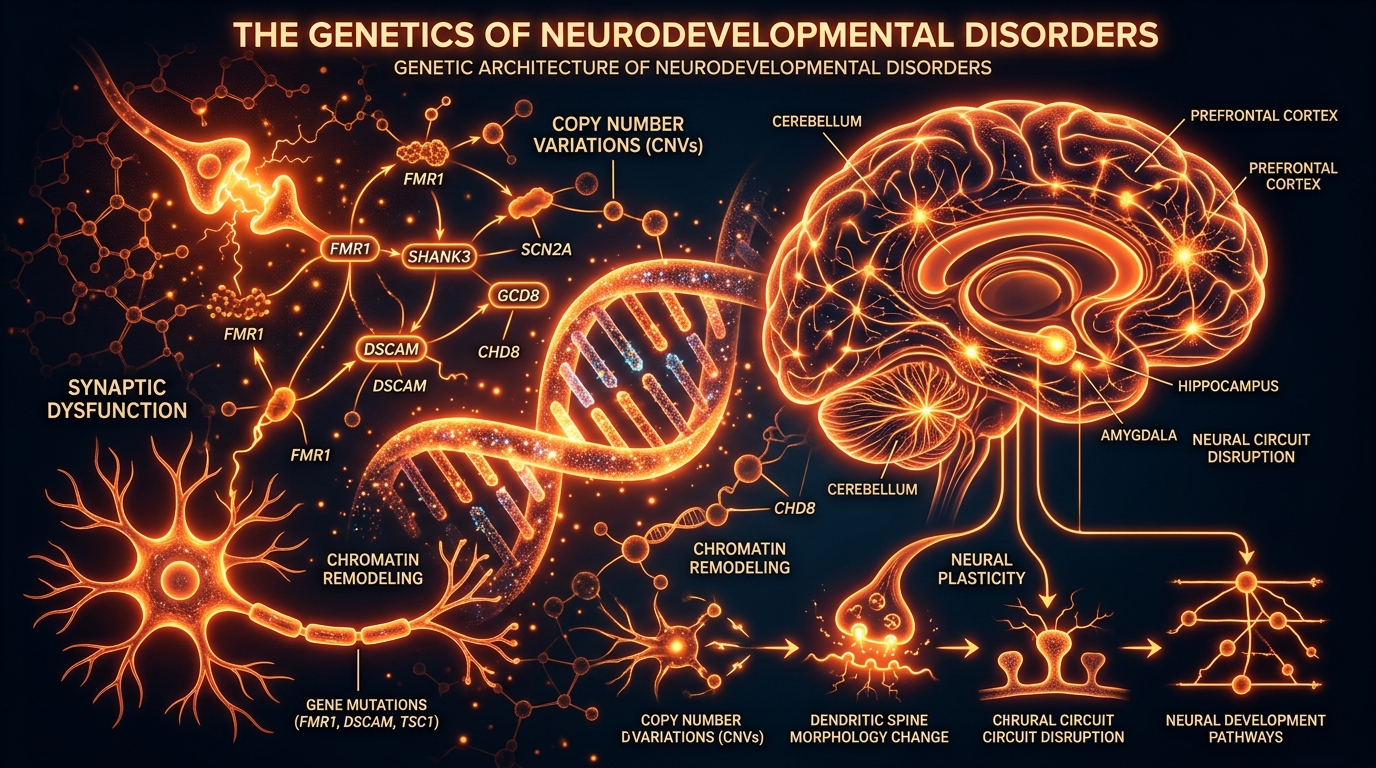
Introduction
Neurodevelopmental disorders (NDDs) represent a diverse group of conditions characterised by impairments in the growth and development of the brain or central nervous system. These conditions, which include Attention Deficit Hyperactivity Disorder (ADHD), Autism Spectrum Disorder (ASD), Intellectual Disability (ID), and communication disorders, typically manifest early in development—often before a child enters primary school.
For decades, the debate surrounding the origins of these conditions was framed within the rigid dichotomy of 'nature versus nurture'. However, the genomic revolution of the 21st century has rendered this distinction obsolete. We now understand that NDDs are the product of a highly sophisticated interplay between genetic susceptibility and environmental factors. In the United Kingdom, pioneering initiatives such as the 100,000 Genomes Project and the work of the Psychiatric Genomics Consortium (PGC) have placed British science at the forefront of this field.
This article provides an authoritative exploration of the genetic landscape of neurodevelopmental disorders, examining the mechanisms of inheritance, the specific genetic architecture of ADHD and ASD, the concept of pleiotropy, and the clinical implications for the NHS and beyond.
1. The Genetic Foundations: Key Concepts
To understand the genetics of NDDs, one must first navigate the hierarchy of genetic variation. The human genome is not a static blueprint but a dynamic landscape where various types of 'errors' or variations can influence neurobiology.
Polygenic vs. Monogenic Architecture
Most neurodevelopmental conditions are polygenic. This means they are not caused by a single mutation in one gene, but rather by the cumulative effect of hundreds or thousands of common genetic variants, each exerting a tiny influence. Conversely, monogenic disorders (like Fragile X Syndrome or Rett Syndrome) are caused by a single, high-impact mutation.
Common Variants (SNPs)
Single Nucleotide Polymorphisms (SNPs) are the most common type of genetic variation. They involve a change in a single 'letter' of the DNA code. Individually, a SNP has a negligible effect on whether someone develops ADHD or ASD. However, when thousands of risk-associated SNPs are aggregated, they form a Polygenic Risk Score (PRS), which can indicate a person’s relative liability toward a specific trait.
Rare Variants and CNVs
Copy Number Variants (CNVs) are larger structural changes where sections of the genome are either deleted or duplicated. While SNPs are common across the population, certain CNVs are rare but carry significantly higher risks. For example, a deletion at the 22q11.2 chromosome location is a known high-risk factor for schizophrenia, ADHD, and developmental delay.
De Novo Mutations
A significant breakthrough in NDD research has been the identification of de novo mutations—genetic alterations that are not inherited from either parent but occur spontaneously in the germline (sperm or egg) or during early embryonic development. These are particularly prevalent in severe cases of ASD and Intellectual Disability.
2. Attention Deficit Hyperactivity Disorder (ADHD)
ADHD is one of the most common neurodevelopmental disorders in the UK, affecting approximately 3–5% of children and 2% of adults. It is characterised by persistent patterns of inattention, hyperactivity, and impulsivity.
Heritability Estimates
Twin studies conducted in the UK and Scandinavia have consistently shown that ADHD has a heritability of approximately 74% to 80%. This places ADHD among the most heritable psychiatric conditions, comparable to height or schizophrenia.
The Polygenic Nature of ADHD
The first large-scale Genome-Wide Association Study (GWAS) for ADHD, published in Nature Genetics (Demontis et al., 2019), identified several significant genetic loci. Many of these genes are involved in neurodevelopmental processes, such as:
- FOXP2: Involved in synapse formation and neural mechanisms related to speech and language.
- SORCS3: Specifically expressed in the brain and involved in glutamate neurotransmission.
- DUSP6: Linked to dopamine signalling pathways.
Importantly, the genetic risk for ADHD exists on a continuum. There is no 'biological cliff' where a person suddenly has the 'ADHD genome'; rather, the clinical diagnosis represents the extreme end of a distribution of traits present in the general population.
3. Autism Spectrum Disorder (ASD)
Autism is defined by challenges with social communication, restricted interests, and repetitive behaviours. Its genetic architecture is arguably the most complex of all NDDs.
The "High-Impact" Rare Variants
Unlike ADHD, where common variants play a dominant role, ASD is frequently associated with rare, high-impact mutations. Research has identified over 100 'high-confidence' autism genes. Many of these genes, such as SHANK3, NLGN3, and NRXN1, are responsible for the 'synaptic scaffold'—the molecular bridge that allows neurons to communicate.
Syndromic vs. Non-Syndromic Autism
- Syndromic ASD: The autism occurs as part of a larger genetic syndrome (e.g., Tuberous Sclerosis or Angelman Syndrome).
- Non-Syndromic ASD: The autism appears in isolation, often driven by a combination of common polygenic risk and de novo mutations.
The Female Protective Model
An enduring mystery in ASD is the 4:1 male-to-female prevalence ratio. Genetic studies suggest a 'Female Protective Effect', where females require a higher 'genetic hit' (more mutations or a higher polygenic load) to reach the diagnostic threshold for autism than males do.
4. The Concept of Genetic Pleiotropy: The "P-Factor"
One of the most significant findings in modern genetics is that NDDs do not live in 'silos'. There is a massive genetic overlap between ADHD, ASD, Dyslexia, and even adult psychiatric conditions like Bipolar Disorder.
This phenomenon is known as pleiotropy—where the same genetic variants influence multiple seemingly different traits. In the UK, the Cross-Disorder Group of the Psychiatric Genomics Consortium found that ADHD and ASD share significant genetic correlations. This explains why a child with autism is frequently also diagnosed with ADHD, or why a parent with a history of depression might have a child with an NDD.
Researchers have proposed a 'p-factor' (general psychopathology factor), suggesting that a common set of neurodevelopmental genes increases general brain vulnerability, while more specific 'modifier' genes determine whether that vulnerability manifests as ADHD, ASD, or another condition.
5. Epigenetics: The Bridge Between Environment and DNA
While genes provide the template, epigenetics determines how those genes are expressed. Epigenetic mechanisms, such as DNA methylation, act like 'dimmer switches' for gene activity.
In the UK context, longitudinal studies like the Adon-Bristol Study of Parents and Children (ALSPAC) have investigated how prenatal environments—such as maternal stress, smoking during pregnancy, or exposure to air pollution—can alter the epigenetic marking of genes involved in brain development. These environmental factors do not change the DNA sequence itself, but they can 'lock' certain genes in an 'on' or 'off' position, potentially increasing the risk of NDDs in genetically vulnerable individuals.
6. The UK Clinical Landscape: From Research to the NHS
The United Kingdom is uniquely positioned in the world of genomics due to the centralised nature of the National Health Service (NHS) and its integration with academic research.
The NHS Genomic Medicine Service
Launched in 2018, the NHS Genomic Medicine Service (GMS) was the first of its kind to integrate whole-genome sequencing (WGS) into routine clinical care. For children with unexplained developmental delays or intellectual disabilities, WGS is now a first-line diagnostic tool. This has significantly increased 'diagnostic yield'—the percentage of patients who receive a definitive genetic explanation for their condition.
NICE Guidelines and Screening
The National Institute for Health and Care Excellence (NICE) provides the framework for diagnosing NDDs. While genetic testing is not currently routine for straightforward ADHD diagnoses, it is increasingly recommended for ASD and ID where there are 'dysmorphic features' or a family history of genetic syndromes.
Ethical Considerations
The UK’s Nuffield Council on Bioethics has raised important questions regarding the use of genetic information. As our ability to predict NDD risk from birth (or even prenatally) improves, society must grapple with the implications of 'genetic labelling' and the potential for discrimination in education or insurance.
7. Pharmacogenomics: Personalising Treatment
One of the most promising applications of NDD genetics is pharmacogenomics—using a patient's genetic profile to predict their response to medication.
In the treatment of ADHD, for example, there is significant variability in how patients respond to methylphenidate (Ritalin) or lisdexamfetamine (Elvanse). Some patients experience profound benefits, while others suffer from severe side effects like anxiety or insomnia. Variations in genes like COMT (which regulates dopamine levels in the prefrontal cortex) and CYP2D6 (which metabolises many drugs) are currently being studied to help UK clinicians move away from the 'trial and error' approach to prescribing.
8. Neurodiversity and the Genetic Perspective
The discovery that much of the genetic risk for NDDs is spread throughout the general population supports the Neurodiversity Movement. This perspective argues that ADHD and ASD are not 'broken' states but are part of the natural variation in the human genome.
Genetic research suggests that many 'risk' genes for ADHD may have provided evolutionary advantages in ancestral hunter-gatherer societies—where traits like hyper-vigilance, rapid task-switching, and physical impulsivity were essential for survival. By framing these conditions as 'evolutionary legacies' rather than merely 'defects', genetics provides a powerful tool for reducing stigma and promoting inclusion within British schools and workplaces.
9. Future Directions: The Next Decade of Research
The field is moving beyond identifying what the genes are to understanding how they work.
Functional Genomics
The next frontier is functional genomics—using techniques like CRISPR-Cas9 gene editing in laboratory models to see exactly how an ADHD-associated mutation changes the way a neuron fires.
Stem Cell Modelling
UK researchers are increasingly using 'induced Pluripotent Stem Cells' (iPSCs). By taking a skin or blood sample from a patient with ASD and 'reprogramming' it into a brain cell in a petri dish, scientists can study the patient’s own neurobiology in real-time, allowing for bespoke drug testing.
Polygenic Risk Scores (PRS) in the Clinic
While not yet ready for widespread clinical use, PRS may eventually help identify infants at high risk for developmental challenges, allowing for 'early intervention' (such as speech and language therapy) years before symptoms would typically warrant a diagnosis.
10. Conclusion
The genetics of neurodevelopmental disorders is a field characterized by staggering complexity and profound hope. We have moved from a rudimentary understanding of 'heredity' to a sophisticated map of the molecular pathways that build the human mind.
For the UK, the challenge lies in translating these monumental scientific discoveries into compassionate, effective clinical care. Understanding the genetic architecture of ADHD and ASD does not diminish the lived experience of these conditions; rather, it validates it. It provides a biological language for the challenges families face and paves the way for a future where support is not a 'one-size-fits-all' model, but is instead as unique as the individual’s own genetic code.
As we continue to decode the "p-factor" and the intricacies of the synaptic scaffold, the goal remains clear: to improve the quality of life for neurodivergent individuals by fostering a society that understands, supports, and values the diverse ways in which the human brain can be wired.
References & Further Reading (Contextual for UK Practitioners)
- Demontis, D., et al. (2019). Discovery of the first genome-wide significant risk loci for attention deficit/hyperactivity disorder. Nature Genetics.
- Grove, J., et al. (2019). Identification of common genetic risk variants for autism spectrum disorder. Nature Genetics.
- Genomics England. The 100,000 Genomes Project Strategy and Results.
- NICE (2018). Attention deficit hyperactivity disorder: diagnosis and management [NG87].
- Thapar, A., & Rutter, M. (2021). Rutter's Child and Adolescent Psychiatry. Wiley-Blackwell. (A core UK text for NDDs).
- The Psychiatric Genomics Consortium (PGC). Annual Reports on Cross-Disorder Analysis.
- UK Biobank. Genetic data resources for neurodevelopmental traits.
Author’s Note: This article is intended for informational purposes and reflects the current state of genomic research as of 2024. Clinical decisions should always be made in consultation with a qualified medical professional or genetic counsellor within the NHS framework.
This article is provided for informational and educational purposes only. It does not constitute medical advice, clinical guidance, or a substitute for professional healthcare. Information reflects cited research at time of publication. Always consult a qualified healthcare professional before acting on any health information.
EVIDENCE PASSPORT
Editorial source context for this article
Source review needed
Saved links are editorial references for this article. They may support specific claims rather than every sentence. Open and assess each source in context. This passport does not independently verify them.
Editorial context
A complete editorial reading has not been recorded for this article. Source links remain available for you to open and assess directly.
Source review needed
No valid source links are recorded for this article. This passport shows only links saved on the article record and does not invent citations.
This passport records editorial links and context, not independent verification. Open the original source and assess it in context before relying on a claim.
Medical Disclaimer
The information in this article is for educational purposes only and does not constitute medical advice, diagnosis, or treatment. Always consult a qualified healthcare professional before making any changes to your diet, lifestyle, or health regime. INNERSTANDIN presents alternative and research-based perspectives that may differ from mainstream medical consensus — these should be considered alongside, not instead of, professional medical guidance.
Read Full DisclaimerContinue the thread
Keep this question moving.
Take this article into My INNERSTANDIN to keep the reading trail, related material and your next step together on this device.
Explore this in the Body Map
See where this hits your biology. Interactive anatomy, threats, and protective protocols.
Dig deeper in the Library
Free, longform PDF volumes that go beyond headlines into mechanisms and references.