
Glaucoma: The Silent Thief and the Role of Ocular Mitochondrial Dysfunction
Updated May 2026
Beyond intraocular pressure, we examine how mitochondrial failure in retinal ganglion cells drives optic nerve damage. This research focuses on metabolic interventions to preserve vision in glaucoma patients through cellular energy support.
Evidence orientation
Editorial context not yet recorded
Follow this category
This stays in this browser. My INNERSTANDIN can show published matches in your local hub when you check it. It does not send email, push, or alert notifications.
Local learning review
A private browser aid for revisiting ideas. It is not an alert or a health recommendation.
Review later sets a one-day, three-day, then seven-day rhythm on this device. Choose it only when you want to revisit this article.
Overview
In the realm of ophthalmology, glaucoma has long been termed 'The Silent Thief of Sight'. It is a condition traditionally defined by a rise in intraocular pressure (IOP) that leads to the progressive destruction of the optic nerve. However, this definition is not only antiquated; it is dangerously incomplete. At INNERSTANDING, our research indicates that focusing solely on fluid pressure is akin to treating a house fire by looking at the water pressure in the pipes, while ignoring the fact that the electrical wiring—the cellular energy system—is already melting.
Glaucoma is the leading cause of irreversible blindness worldwide. In the United Kingdom alone, it is estimated that over 700,000 people live with the condition, and perhaps half of them are unaware of it. The mainstream medical narrative has remained hyper-fixated on the mechanical aspect of the disease: the drainage of aqueous humour. Yet, a significant portion of patients continue to lose their vision even when their eye pressure is surgically or pharmacologically 'controlled'.
The missing link, and the focus of this investigation, is Ocular Mitochondrial Dysfunction. The retinal ganglion cells (RGCs), which form the optic nerve, are among the most metabolically demanding cells in the human body. They are the 'high-performance engines' of the nervous system. When the mitochondria—the cellular power plants—within these cells fail, the cells enter a state of bioenergetic crisis. This article exposes the biological reality behind glaucoma, moving beyond the 'pressure' myth to examine how metabolic failure, oxidative stress, and mitochondrial decay are the true drivers of visual decline.
Callout Fact 1: Up to 50% of glaucoma patients suffer from 'Normal Tension Glaucoma' (NTG), where optic nerve damage occurs despite intraocular pressure remaining within the 'normal' range. This proves that pressure is not the primary cause of the disease, but rather a secondary stressor on an already failing metabolic system.
The Biology — How It Works
To understand glaucoma, one must first understand the architecture of the eye and its connection to the brain. The retina is not merely a piece of 'eye tissue'; it is an extension of the central nervous system. It is, quite literally, brain tissue that has migrated forward during embryonic development to interface with the world.
The Retinal Ganglion Cells (RGCs)
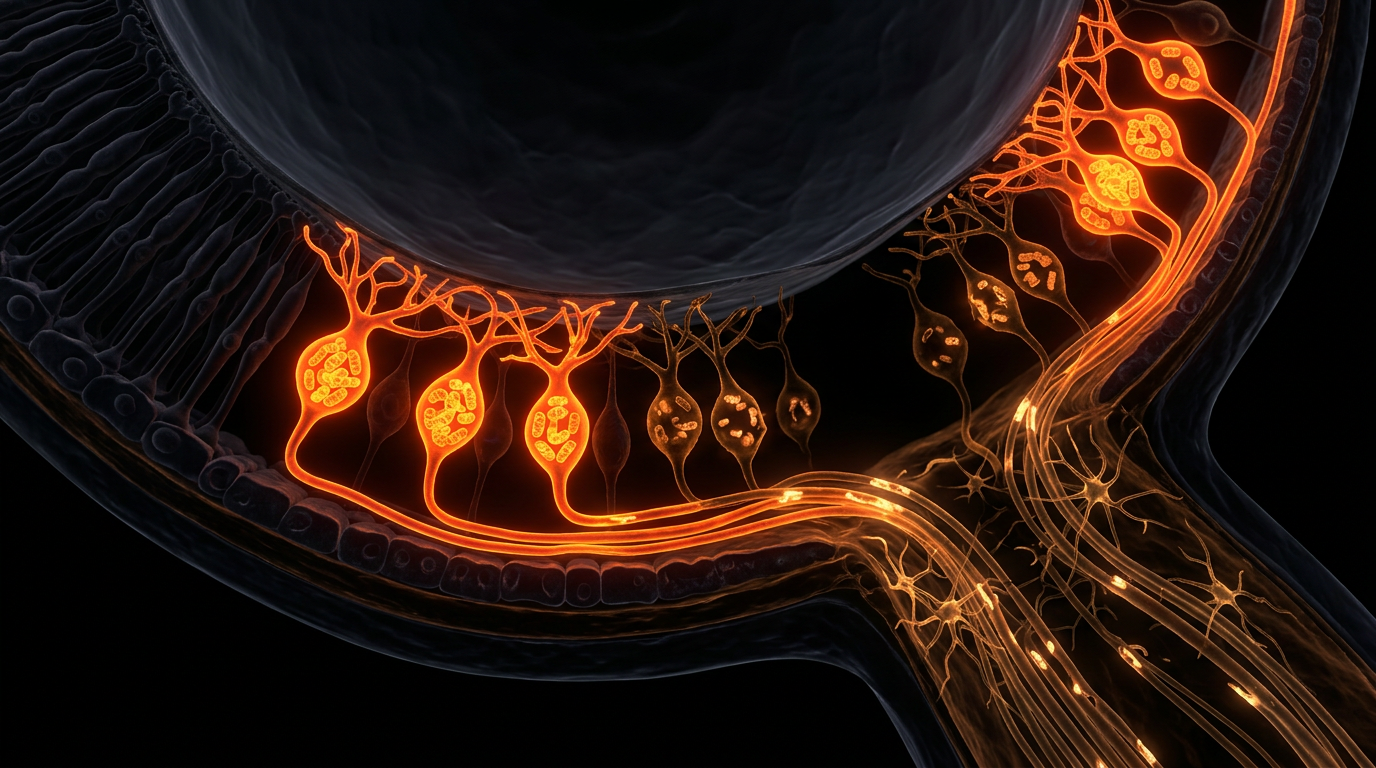
The primary victims of glaucoma are the Retinal Ganglion Cells (RGCs). These are specialised neurons that receive visual information from photoreceptors and transmit it via their long axons to the brain’s visual cortex. These axons cluster together to form the optic nerve.
The biological 'design' of the RGC is both a marvel and a vulnerability. These cells are extremely long; while the cell body sits in the retina, the axon must travel all the way to the lateral geniculate nucleus in the brain. For a cell of its size, this is the equivalent of a human standing in London with their 'arm' reaching all the way to Edinburgh. Maintaining the integrity of this long-distance connection requires an immense, constant supply of Adenosine Triphosphate (ATP)—the universal currency of cellular energy.
The Energy Bottleneck: The Lamina Cribrosa
As these axons exit the eye to form the optic nerve, they pass through a sieve-like structure called the lamina cribrosa. This is the mechanical 'weak point' of the eye. In the mainstream view, high pressure 'squashes' the nerves here. In the mitochondrial view, this area is a metabolic bottleneck.
The axons in this region are unmyelinated (lacking the fatty insulation that speeds up electrical signals). Because they lack myelin, they require significantly more energy to transmit signals and maintain ion gradients. Consequently, this specific section of the optic nerve has the highest density of mitochondria in the entire visual system. If mitochondrial function dips by even a small percentage, the energy required to push signals through this bottleneck fails, leading to axonal 'choking' and eventually, cell death.
Mechanisms at the Cellular Level
At the heart of the glaucomatous process is a failure of bioenergetics. Within the RGCs, mitochondria are responsible for more than just energy; they regulate calcium levels, manage the cell’s 'self-destruct' signals (apoptosis), and produce heat.
The Bioenergetic Crisis and ATP Depletion
Mitochondria produce ATP through a process called oxidative phosphorylation. This involves a series of protein complexes (Complex I through V) embedded in the mitochondrial membrane. In glaucoma patients, research consistently shows a systemic decline in the efficiency of Complex I.
When Complex I fails, two catastrophic events occur:
- ATP production plummets: The RGCs no longer have the energy to maintain their electrical charge or transport essential proteins along the axon.
- ROS Leakage: The 'exhaust' of the energy production process—Reactive Oxygen Species (ROS)—begins to leak into the cell, damaging DNA, proteins, and the mitochondria themselves.
Mitochondrial Dynamics: Fission and Fusion
Healthy mitochondria are not static; they are a dynamic network. They undergo fusion (merging to share resources) and fission (splitting to remove damaged parts). This process is regulated by proteins like OPA1 and DRP1.
In the glaucomatous eye, the balance is heavily tilted toward fission. The mitochondrial network becomes fragmented. These small, dysfunctional mitochondria cannot produce enough energy to support the RGC’s survival. Furthermore, the process of mitophagy—the 'rubbish collection' system that removes dead mitochondria—becomes sluggish. The cell becomes cluttered with biological 'trash', triggering an inflammatory response that leads to programmed cell death.
The Role of NAD+ (Nicotinamide Adenine Dinucleotide)
One of the most significant breakthroughs in ocular science is the discovery of the role of NAD+. This coenzyme is essential for mitochondrial function. As we age, our levels of NAD+ naturally decline, which correlates perfectly with the increased risk of glaucoma in the elderly. Without sufficient NAD+, the mitochondria cannot convert nutrients into energy, leaving the optic nerve vulnerable to even 'normal' levels of eye pressure.
Callout Fact 2: The retinal ganglion cells contain the highest concentration of mitochondria of any cell type in the body. This makes the eye a 'canary in the coal mine' for systemic mitochondrial decay and metabolic dysfunction.
Environmental Threats and Biological Disruptors
The modern world is fundamentally 'anti-mitochondrial'. We have created an environment that systematically degrades the very organelles we rely on for vision.
Artificial Blue Light and Circadian Mismatch
The human eye evolved under the full spectrum of sunlight, which includes a balance of blue, green, yellow, and near-infrared (NIR) light. Today, we spend 90% of our time indoors under LED and fluorescent lighting, which is heavily skewed toward the high-energy blue spectrum, with almost zero NIR.
Blue light in isolation, especially after sunset, is a potent mitochondrial disruptor. It penetrates the retina and generates high levels of oxidative stress within the RGCs. Conversely, NIR light—which is abundant in sunlight—actually stimulates the mitochondria to produce more ATP and reduce inflammation. By living in a 'blue light bubble', we are starving our eyes of the 'nutritional' light they need while overstimulating them with toxic wavelengths.
The Toxicity of the Modern Diet
Mitochondria are the primary sensors of our metabolic health. The prevalence of ultra-processed foods, specifically refined seed oils (high in linoleic acid) and excessive fructose, has a direct impact on the ocular mitochondria.
- Seed Oils: These incorporate into the mitochondrial membranes (specifically the cardiolipin), making them highly susceptible to oxidation and 'leaking'.
- Fructose: High levels of fructose metabolism in the liver lead to systemic uric acid spikes, which signal the mitochondria to enter a 'low energy' storage mode, reducing ATP output in the brain and eyes.
Pharmaceutical Interferences
Many common medications prescribed in the UK have 'hidden' mitochondrial toxicity. Statins, prescribed to millions for cholesterol, inhibit the production of Coenzyme Q10 (CoQ10), a vital component of the mitochondrial electron transport chain. Without CoQ10, the RGCs are left functionally 'weakened' and more susceptible to glaucomatous damage.
Callout Fact 3: Chronic exposure to artificial 'flicker' from LED screens (at frequencies invisible to the naked eye) can induce stress in the retina, forcing mitochondria to work harder to maintain cellular stability, eventually leading to 'burnout'.
The Cascade: From Exposure to Disease
The journey from healthy vision to a glaucoma diagnosis is not a sudden event, but a decades-long 'cascade' of mitochondrial failure.
- Stage 1: Mitochondrial Insufficiency. Due to poor diet, lack of sunlight, and environmental toxins, the NAD+ levels in the retina begin to drop. The RGCs start to struggle, but vision remains 'normal' because the brain compensates for the missing data.
- Stage 2: The Bioenergetic Threshold. The mitochondria can no longer maintain the ion gradients required for electrical signalling. The axons at the lamina cribrosa begin to show signs of 'axonal transport failure'. Essential nutrients can no longer move from the retina to the brain.
- Stage 3: Glial Activation and Neuroinflammation. As mitochondria fail, they release 'danger signals' (mtDNA) into the extracellular space. This activates astrocytes and microglia—the eye’s immune cells. Initially meant to help, these cells become chronically inflamed, secreting neurotoxic cytokines (like TNF-alpha) that further damage the RGCs.
- Stage 4: Programmed Cell Death (Apoptosis). The 'command centre' of the cell determines that it can no longer function. Rather than risking a messy death that might damage neighbours (necrosis), it triggers a controlled 'suicide' (apoptosis). This is the 'Silent Thief' in action—cells vanish one by one.
- Stage 5: Visual Field Loss. Only after roughly 40% to 50% of the RGCs have died does the patient notice a 'shadow' or 'blur' in their peripheral vision. By this point, the damage is traditionally considered irreversible.
What the Mainstream Narrative Omits
The mainstream ophthalmic community is largely captive to a 'Pressure-Centric' dogma. This is not because of malice, but because of institutional inertia and the pharmaceutical business model.
The Failure of the 'Drop' Culture
The primary treatment for glaucoma in the UK is the prescription of prostaglandin analogues (eye drops) to lower IOP. While effective at lowering pressure, these drops do nothing to address the underlying neurodegeneration. Many of these drops contain preservatives like Benzalkonium Chloride (BAK), which have been shown to be toxic to the ocular surface and can actually induce further oxidative stress in the eye.
The Nicotinamide (B3) Suppression
There is overwhelming evidence—including a landmark 2017 study published in Science and subsequent human clinical trials—that Nicotinamide (a form of Vitamin B3) can prevent and even reverse RGC dysfunction by boosting NAD+ levels. Despite this being a safe, cheap, and effective intervention, it is rarely mentioned in the standard NHS glaucoma clinic. Why? Because a nutrient cannot be patented and marketed with the same profit margins as a novel pharmaceutical.
The Gut-Eye Axis
Mainstream medicine rarely looks further than the eyeball. However, emerging research into the gut-eye axis suggests that gut dysbiosis and 'leaky gut' lead to systemic lipopolysaccharides (LPS) entering the bloodstream. These endotoxins can cross the blood-retinal barrier, causing the very mitochondrial inflammation that drives glaucoma. By ignoring the gut, the mainstream approach ignores a primary source of the fire.
Callout Fact 4: Clinical trials have shown that high-dose Nicotinamide (Vitamin B3) can improve visual function in glaucoma patients within weeks, yet it remains absent from standard 'Best Practice' guidelines in most Western nations.
The UK Context
In the United Kingdom, the approach to glaucoma is currently at a breaking point. The NHS is facing a massive backlog in ophthalmology appointments, leading to thousands of patients experiencing 'avoidable' sight loss while on waiting lists.
The 'Standard of Care' Crisis
The UK’s National Institute for Health and Care Excellence (NICE) guidelines focus heavily on a 'step-ladder' of pressure management: drops, then laser (SLT), then surgery. While these are necessary for many, they represent a reactive, rather than proactive, philosophy. The 'Wait and See' approach—monitoring a patient until their vision gets worse before changing treatment—is a failure of biological logic. We should be 'Supporting and Protecting' from the moment of diagnosis.
British Lifestyle and Light Deficiency
The UK’s geographical location and climate contribute significantly to the mitochondrial 'perfect storm'. With low levels of year-round UVB (Vitamin D) and a culture that is increasingly indoor-centric, the average Briton is chronically 'light starved'. Our RGCs are evolved for the red-heavy light of sunrise and sunset; instead, they are bathed in the 'biological midnight' of 4000K LED streetlights and smartphone screens.
Furthermore, the 'British Diet'—high in ultra-processed grains and low in the organ meats and fatty fish that provide essential mitochondrial precursors like CoQ10 and DHA—leaves the population's eyes metabolically 'brittle'.
Protective Measures and Recovery Protocols
At INNERSTANDING, we believe that vision preservation must be a multimodal metabolic strategy. We do not suggest ignoring medical advice or stopping eye drops, but rather 'supercharging' the system so the cells can survive the pressure.
1. NAD+ Restoration (The Bioenergetic Shield)
The single most important intervention for mitochondrial health in the eye is restoring NAD+ levels.
- Protocol: Supplementation with Nicotinamide (Vitamin B3). Clinical doses used in trials typically range from 1.5g to 3.0g per day (under supervision). This provides the RGCs with the raw materials needed to repair DNA and maintain ATP production.
2. Photobiomodulation (Red Light Therapy)
If blue light is the poison, red and near-infrared (NIR) light are the antidote.
- Protocol: Exposure to 670nm deep red light for 3–5 minutes in the morning. Research from University College London (UCL) has shown that this specific wavelength can 'recharge' the mitochondria in the retina, improving colour vision and contrast sensitivity in older adults.
3. Metabolic Flexibility and Ketosis
Mitochondria are more efficient when burning ketones than when burning glucose. Ketones produce fewer ROS per unit of ATP.
- Protocol: Implementing Time-Restricted Feeding (TRF), such as a 16:8 window. This induces mild autophagy and allows the eye to clear out 'mitochondrial debris'. A low-glycemic diet reduces the 'insulin spikes' that lead to ocular inflammation.
4. Targeted Mitochondrial Antioxidants
Standard Vitamin C and E are not enough; we need molecules that can enter the mitochondrial membrane.
- Coenzyme Q10 (Ubiquinol): Essential for the electron transport chain.
- Astaxanthin: A potent carotenoid that crosses the blood-retinal barrier and 'quenches' singlet oxygen in the RGCs.
- Magnesium Acetyl Taurate: This specific form of magnesium has a high affinity for the eyes and brain, helping to prevent 'excitotoxicity' (over-firing of neurons which drains ATP).
5. Circadian Hygiene
Protecting the RGCs from the modern 'light environment'.
- Protocol: Wearing high-quality blue-blocking glasses after sunset. Ensuring total darkness in the bedroom to allow for endogenous melatonin production. Melatonin is not just a sleep hormone; it is the most powerful mitochondrial antioxidant produced by the body.
Callout Fact 5: A study by researchers at UCL found that just three minutes of exposure to deep red light (670nm) once a week could significantly improve vision that had declined due to age-related mitochondrial failure.
Summary: Key Takeaways
The 'Silent Thief' is not a mystery of fluid dynamics; it is a disease of energy starvation. To truly combat glaucoma and preserve vision for a lifetime, we must shift our perspective from the 'Mechanical Eye' to the 'Metabolic Eye'.
- Pressure is a Symptom, Not the Cause: High IOP is a stressor, but the failure to withstand that stress is caused by mitochondrial dysfunction in the retinal ganglion cells.
- The RGC as a High-Performance Engine: These cells require more energy than almost any other cell in the body. When ATP fails, the optic nerve dies.
- NAD+ is Non-Negotiable: Restoring NAD+ through Nicotinamide is the most scientifically backed method for neuroprotecting the eye against glaucomatous damage.
- Environment Matters: Our 'light diet' is as important as our food diet. Reducing blue light and increasing near-infrared exposure is vital for ocular longevity.
- The UK Paradigm Shift: We must move away from the 'Drops and Wait' model towards a proactive protocol of cellular energy support.
Glaucoma does not have to be an inevitable slide into darkness. By understanding the bioenergetic requirements of the optic nerve and feeding the mitochondrial fires, we can protect the 'extension of the brain' that allows us to see the world. The power to preserve sight lies not just in the hands of the surgeon, but in the biological choices we make every day to support our cellular health.
"INNERSTANDING: Empowering Vision through Biological Truth."
This article is provided for informational and educational purposes only. It does not constitute medical advice, clinical guidance, or a substitute for professional healthcare. Information reflects cited research at time of publication. Always consult a qualified healthcare professional before acting on any health information.
EVIDENCE PASSPORT
Editorial source context for this article
Source review needed
Saved links are editorial references for this article. They may support specific claims rather than every sentence. Open and assess each source in context. This passport does not independently verify them.
Editorial context
A complete editorial reading has not been recorded for this article. Source links remain available for you to open and assess directly.
Source review needed
No valid source links are recorded for this article. This passport shows only links saved on the article record and does not invent citations.
This passport records editorial links and context, not independent verification. Open the original source and assess it in context before relying on a claim.
Medical Disclaimer
The information in this article is for educational purposes only and does not constitute medical advice, diagnosis, or treatment. Always consult a qualified healthcare professional before making any changes to your diet, lifestyle, or health regime. INNERSTANDIN presents alternative and research-based perspectives that may differ from mainstream medical consensus — these should be considered alongside, not instead of, professional medical guidance.
Read Full DisclaimerContinue the thread
Keep this question moving.
Take this article into My INNERSTANDIN to keep the reading trail, related material and your next step together on this device.
Explore this in the Body Map
See where this hits your biology. Interactive anatomy, threats, and protective protocols.
Dig deeper in the Library
Free, longform PDF volumes that go beyond headlines into mechanisms and references.