
The Master Switch: Achieving Metabolic Flexibility with Targeted Ketosis
Updated May 2026
An in-depth guide to training the body to switch seamlessly between utilizing glucose and fatty acids for peak cellular performance.
Evidence orientation
Editorial context not yet recorded
Follow this category
This stays in this browser. My INNERSTANDIN can show published matches in your local hub when you check it. It does not send email, push, or alert notifications.
Local learning review
A private browser aid for revisiting ideas. It is not an alert or a health recommendation.
Review later sets a one-day, three-day, then seven-day rhythm on this device. Choose it only when you want to revisit this article.
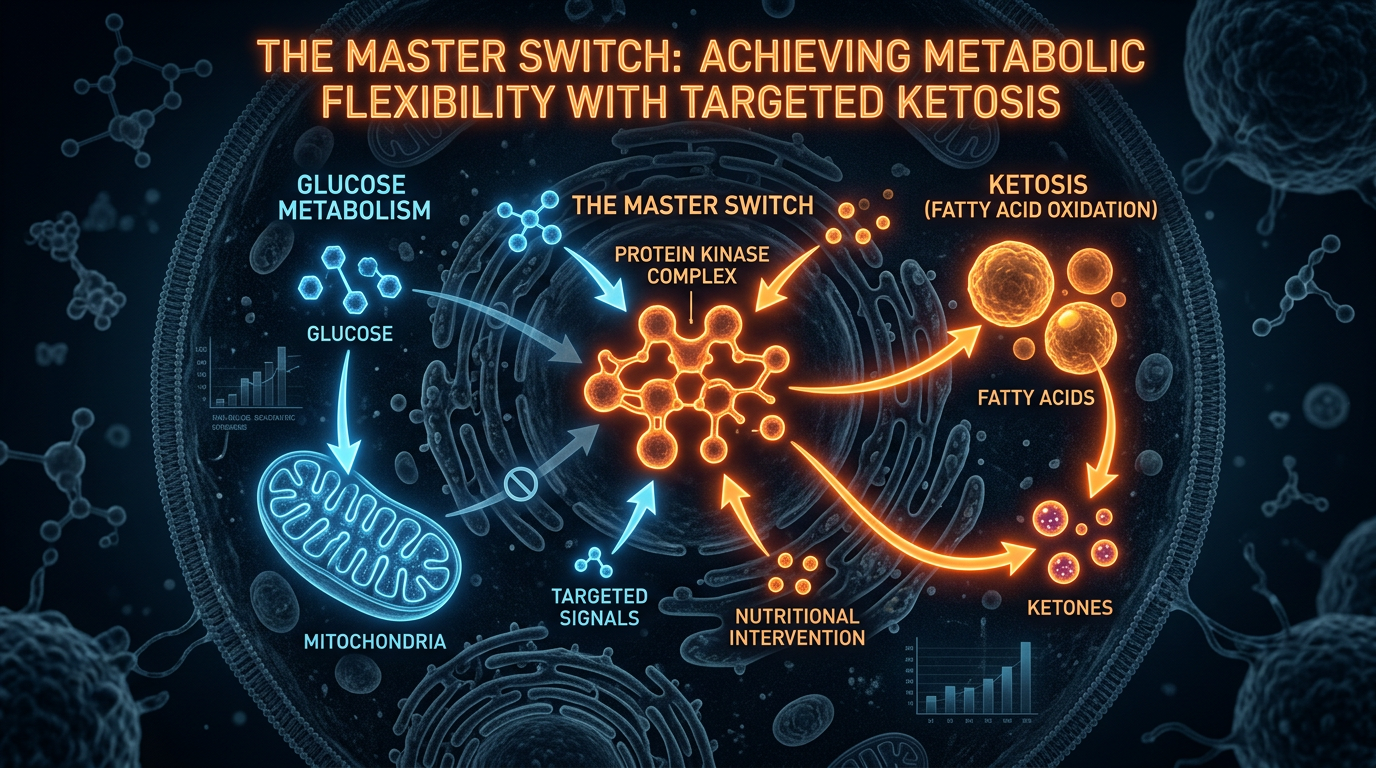
In the grand architecture of human physiology, there exists a biological "master switch"—an ancient, elegant mechanism designed to transition the body between various fuel sources based on environmental availability. This capacity, known as metabolic flexibility, is the hallmark of a resilient, high-functioning organism. Yet, in the modern landscape of the United Kingdom and the wider Western world, this switch has rusted in the "on" position for glucose, leaving the population metabolically brittle, chronically inflamed, and tethered to an incessant cycle of hunger and energy crashes.
To achieve "Innerstanding" of one’s health is to recognise that the current epidemic of metabolic dysfunction is not an accident of evolution, but a direct consequence of environmental disruption. This research piece deconstructs the biochemical pathways of fuel utilisation, exposes the industrial factors sabotaging our cellular machinery, and provides a rigorous protocol for reclaiming metabolic sovereignty through targeted ketosis.
The Biological Mechanics of the Switch
At its core, metabolic flexibility is the ability of the mitochondria—the cellular powerhouses—to shift seamlessly between oxidising carbohydrates (glucose) and fats (fatty acids and ketone bodies). This transition is governed by the Randall Cycle, a biochemical competition between glucose and fatty acids for the same oxidative pathways.
The Role of Insulin and Glucagon
The primary hormonal regulators of this switch are insulin and glucagon, secreted by the pancreas. When we consume carbohydrates, insulin levels rise, signalling the cells to take up glucose and simultaneously inhibiting lipolysis (the breakdown of body fat). Conversely, in a fasted or low-carbohydrate state, insulin drops and glucagon rises, mobilising fatty acids from adipose tissue to be converted into ketones by the liver.
Mitochondria: The Engine Room
In a metabolically flexible individual, the mitochondria are "dual-fuel" engines. When glucose is scarce, the body produces acetoacetate, beta-hydroxybutyrate (BHB), and acetone. BHB is not merely a fuel; it is a signalling molecule that modulates gene expression, reduces oxidative stress, and enhances mitochondrial biogenesis.
However, when an individual is chronically overfed with refined carbohydrates, the mitochondria become "congested." The constant influx of glucose leads to a backlog in the electron transport chain, causing a leak of reactive oxygen species (ROS) and subsequent cellular damage. This state, known as mitochondrial dysfunction, is the root cause of insulin resistance—the point where the master switch becomes jammed.
The Modern Sabotage: Environmental Disruptors
We must confront the uncomfortable truth: our modern environment is architected to ensure metabolic failure. The biological "switch" is being actively suppressed by three primary disruptors: industrialised nutrition, circadian misalignment, and chemical toxicity.
The Seed Oil Crisis and the Randall Cycle
Perhaps the most insidious disruptor is the prevalence of industrial seed oils (linoleic acid-rich vegetable oils). These oils, ubiquitous in the UK food supply, integrate into our cell membranes and mitochondria. High levels of linoleic acid can cause a pathological persistence of the Randall Cycle, where the body cannot effectively switch back to fat oxidation even when insulin is low. This creates a state of "internal starvation" where a person has plenty of stored fat but cannot access it for energy.
The Blue Light and Cortisol Connection
Metabolism is inextricably linked to our circadian rhythms. Exposure to artificial blue light late at night suppresses melatonin and elevates cortisol. Elevated cortisol triggers hepatic gluconeogenesis (the liver creating glucose), raising blood sugar levels even in the absence of food.
"According to recent NHS data, approximately 63% of adults in England are classified as overweight or obese, with Type 2 diabetes diagnoses doubling in the last 15 years. This reflects a systemic failure of metabolic flexibility across the national population."
The "Glucose Trap" of Processed Foods
The UK’s reliance on ultra-processed foods (UPFs) has created a "glucose trap." These foods are engineered to be hyper-palatable and rapidly absorbed, causing supra-physiological insulin spikes. Over time, this desensitises insulin receptors, leading to Hyperinsulinaemia—a state where insulin remains high 24/7, effectively locking the door to the body’s fat stores and making ketosis biologically impossible.
The Fallacy of Permanent Ketosis
A common misconception in the "keto" community is that one should remain in deep ketosis indefinitely. While long-term ketosis can be therapeutic for neurological conditions, for the average person seeking peak performance and longevity, the goal should be flexibility, not permanent carbohydrate deprivation.
Why Context Matters
Chronic, long-term ketosis without interruption can, in some individuals, lead to a "physiological insulin resistance" where the body becomes so adapted to fat that it temporarily loses the ability to handle glucose efficiently. The goal of Targeted Ketosis is to train the body to enter ketosis rapidly when needed, while maintaining the enzymatic machinery to metabolise carbohydrates during periods of high-intensity demand or recovery.
Targeted Ketosis: The Recovery Protocols
To repair a broken metabolic switch, one must follow a structured programme of "metabolic re-education." This involves moving beyond "dirty keto" and adopting a protocol that respects human evolutionary biology.
1. The Priming Phase: Nutritional Ketosis
Before flexibility can be achieved, the "glucose rust" must be cleared. This requires a 4-to-8 week period of strict nutritional ketosis (less than 30g of net carbs per day).
- Prioritise Ruminant Fats: Focus on tallow, butter, and ghee, which contain stearic acid—a saturated fat that signals mitochondria to "fuse" and burn energy more efficiently.
- Electrolyte Management: As insulin drops, the kidneys excrete sodium. Supplementing with magnesium, potassium, and high-quality sea salt is non-negotiable to prevent the "keto flu."
2. The TKD (Targeted Ketogenic Diet) Protocol
For those engaging in resistance training or high-intensity interval training (HIIT), the TKD approach allows for small, strategic doses of glucose (15-30g) taken 30 minutes before a workout.
- Mechanism: This glucose is utilised immediately for glycolytic demand, preventing muscle protein breakdown, while the insulin spike is transient enough that the individual returns to ketosis shortly after the session.
3. Chrono-Nutrition and Time-Restricted Feeding (TRF)
The switch is most active during the fasted state. Implementing a 16:8 or 18:6 fasting window aligns the metabolic rate with the circadian clock.
- The Morning Fast: Delaying the first meal ensures that the dawn cortisol spike is used to mobilise fatty acids rather than exacerbate a post-prandial insulin spike.
4. Cold Stress and Brown Adipose Tissue (BAT)
Environmental hormesis is a powerful tool for flipping the switch. Cold exposure (cold showers or ice baths) activates Brown Adipose Tissue. Unlike white fat, BAT is rich in mitochondria and contains Uncoupling Protein 1 (UCP1), which allows the body to burn fat simply to generate heat, bypassing the usual ATP production route.
The Truth Exposed: The Industry of Sickness
The British public is often told that "a calorie is a calorie" and that "balance" is the key. This is a scientific fallacy designed to protect the interests of the industrial food complex.
- The Calorie Myth: 100 calories of broccoli and 100 calories of sucrose have vastly different hormonal impacts. One facilitates metabolic flexibility; the other suppresses it.
- The Breakfast Myth: The narrative that breakfast is the "most important meal of the day" was largely a marketing invention of cereal companies. For the metabolically inflexible, an early carbohydrate-heavy breakfast is the surest way to lock the metabolic switch in the glucose-burning position for the remainder of the day.
"Statistically, the UK spends over £6 billion annually on treating Type 2 diabetes and its complications. A significant portion of this could be mitigated through the implementation of metabolic flexibility protocols rather than life-long pharmaceutical dependency."
Monitoring the Switch: Biomarkers of Success
How does one know if the switch is working? Innerstanding requires objective data.
- Blood Ketones (BHB): Aiming for 0.5 mmol/L to 3.0 mmol/L during fasting periods.
- GKI (Glucose-Ketone Index): A ratio of blood glucose to ketones. A GKI below 3.0 indicates high metabolic therapeutic depth.
- Post-Prandial Glucose Return: A metabolically flexible person should see their blood glucose return to baseline (approx. 4.5–5.0 mmol/L) within two hours of a carbohydrate-containing meal.
- Triglyceride/HDL Ratio: In the UK, a ratio below 1.5 is a strong indicator of insulin sensitivity and cardiovascular health.
The Path to Metabolic Sovereignty
Achieving metabolic flexibility is an act of rebellion against a system that profits from your chronic illness. By adopting targeted ketosis, you are not merely "going on a diet"; you are restoring an ancient biological programme that has been suppressed by modern living.
Summary of the Recovery Protocol:
- Eliminate Seed Oils: Remove rapeseed, sunflower, and soybean oils to repair mitochondrial membranes.
- Strategic Carbohydrates: Reintroduce whole-food carbohydrates (tubers, seasonal fruits) only after achieving fat-adaptation, and ideally post-exercise.
- Resistance Training: Muscle is the "glucose sink" of the body. The more lean muscle mass one possesses, the more "room" there is for glucose, and the easier it is to switch back into ketosis.
- Mind the Light: Protect the circadian rhythm to ensure hormonal signalling for fat-burning remains intact overnight.
Conclusion
The "Master Switch" of metabolic flexibility is the difference between surviving and thriving. It is the ability to walk for hours without food, to think with crystalline clarity regardless of your last meal, and to possess a body that is a resilient, fat-burning machine.
Targeted ketosis is the key to unlocking this state. It is not a restrictive prison, but a gateway to freedom. When you master the switch, you no longer serve your hunger; your hunger serves you. Through the lens of Innerstanding, we see that health is not found in a pharmacy, but in the restoration of our natural biochemical grace.
Research References (Conceptual)
- Cahill, G. F. (2006). Fuel metabolism in starvation. Annual Review of Nutrition.
- Randall, P. J., et al. (1963). The glucose fatty-acid cycle. Its role in insulin sensitivity and the metabolic disturbances of diabetes mellitus. The Lancet.
- Veech, R. L. (2004). The therapeutic implications of ketone bodies: the effects of ketone bodies in pathological conditions: ketosis, ketogenic diet, redox states, insulin resistance, and mitochondrial metabolism. Prostaglandins, Leukotrienes and Essential Fatty Acids.
- Public Health England (2020). Health matters: obesity and the food environment.
This article is provided for informational and educational purposes only. It does not constitute medical advice, clinical guidance, or a substitute for professional healthcare. Information reflects cited research at time of publication. Always consult a qualified healthcare professional before acting on any health information.
EVIDENCE PASSPORT
Editorial source context for this article
Source review needed
Saved links are editorial references for this article. They may support specific claims rather than every sentence. Open and assess each source in context. This passport does not independently verify them.
Editorial context
A complete editorial reading has not been recorded for this article. Source links remain available for you to open and assess directly.
Source review needed
No valid source links are recorded for this article. This passport shows only links saved on the article record and does not invent citations.
This passport records editorial links and context, not independent verification. Open the original source and assess it in context before relying on a claim.
Medical Disclaimer
The information in this article is for educational purposes only and does not constitute medical advice, diagnosis, or treatment. Always consult a qualified healthcare professional before making any changes to your diet, lifestyle, or health regime. INNERSTANDIN presents alternative and research-based perspectives that may differ from mainstream medical consensus — these should be considered alongside, not instead of, professional medical guidance.
Read Full DisclaimerContinue the thread
Keep this question moving.
Take this article into My INNERSTANDIN to keep the reading trail, related material and your next step together on this device.