
Mechanotransduction: How Movement Recodes Your Connective Tissue
Updated May 2026
Fascia converts mechanical tension into biochemical signals that dictate cellular behaviour and gene expression. This process is the primary mechanism through which physical activity prevents structural degeneration.
Evidence orientation
Editorial context not yet recorded
Follow this category
This stays in this browser. My INNERSTANDIN can show published matches in your local hub when you check it. It does not send email, push, or alert notifications.
Local learning review
A private browser aid for revisiting ideas. It is not an alert or a health recommendation.
Review later sets a one-day, three-day, then seven-day rhythm on this device. Choose it only when you want to revisit this article.
Overview
For decades, the traditional medical establishment has viewed the human body through the lens of a 17th-century machine—a collection of disparate parts, levers, and pulleys operated by a central processor, the brain. This reductionist model has fundamentally failed to account for the most pervasive and intelligent system in the human form: the extracellular matrix (ECM) and its primary component, fascia.
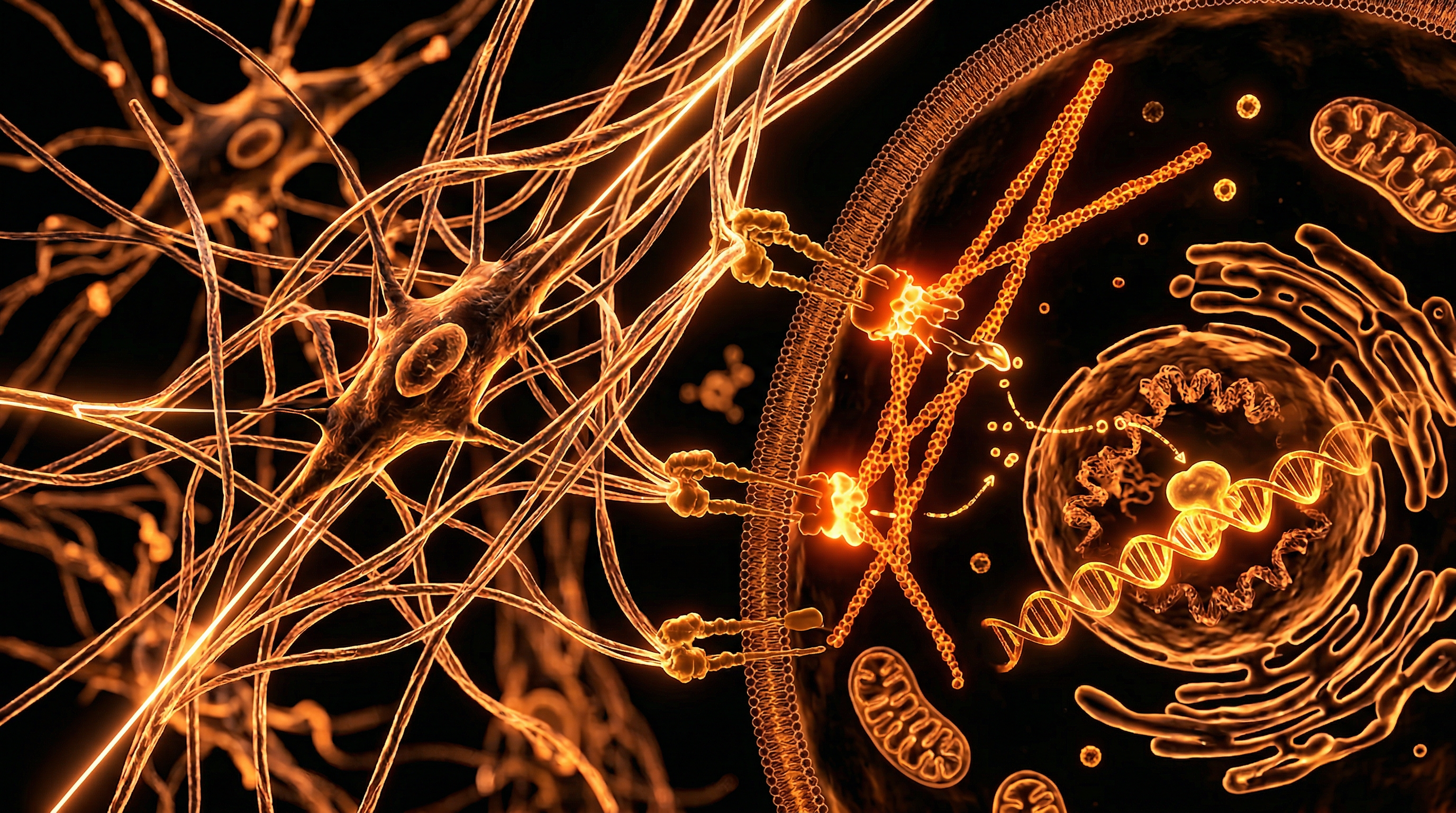
We are not merely a bag of bones and muscles; we are a complex, self-regulating biotensegrity structure. At the heart of this structural intelligence lies a process known as mechanotransduction. This is the biological mechanism by which cells convert mechanical stimulus—the tug of a stretch, the compression of a step, the vibration of a breath—into electrochemical signals. In essence, your movement patterns are a form of biological "code" that instructs your cells which genes to express and which proteins to build.
At INNERSTANDING, we recognize that the current epidemic of chronic pain, metabolic dysfunction, and structural degeneration is not merely a result of "ageing" or "bad luck." It is a failure of mechanotransduction. When we stop moving, or move in repetitive, restricted patterns, our connective tissue literally "downregulates." The fluid architecture of the fascia hardens, the cellular communication lines are severed, and the body begins to signal for its own decay.
This article serves as a comprehensive exposé on the hidden science of mechanobiology. We will explore how the very act of movement recodes your DNA, how modern "sedentary convenience" is a biological toxin, and why the mainstream medical narrative has remained wilfully ignorant of the fascial system’s role in systemic health.
The Biology — How It Works
To understand mechanotransduction, one must first understand the medium in which it occurs. Fascia is a three-dimensional web of collagenous, fibrous, and elastic tissues that infuses every corner of the body. It wraps around every muscle fibre, envelopes every organ, and even penetrates the interior of the cell.
The Extracellular Matrix (ECM) as a Semiconductor
The ECM is more than just "packing material." It is a highly organized, hydrated fibrous network. Recent research suggests that the collagen fibres within the fascia act as semiconductors, capable of transmitting information at speeds far exceeding the nervous system. This is achieved through the piezoelectric effect: when collagen fibres are mechanically stressed (moved), they generate a small electrical charge.
Callout Fact: The fascia contains approximately 250 million nerve endings, making it arguably the body’s largest sensory organ—even more sensitive than the skin.
The Tensegrity Model
The term biotensegrity (biological tensional integrity) was coined by Dr. Stephen Levin to describe how living structures are held together by a balance of continuous tension and discontinuous compression. Unlike a brick building, which relies on gravity and compression, the human body is a "tension-stable" structure.
- Tension is provided by the fascia, ligaments, and tendons.
- Compression is provided by the bones.
Because the system is interconnected, a mechanical pull on the ankle can be felt at the cranium. Mechanotransduction is the process by which the cells residing within this web—primarily fibroblasts—sense these global tensional shifts and adjust the local architecture accordingly.
Mechanisms at the Cellular Level
The "magic" of mechanotransduction happens at the interface between the ECM and the cell interior. This is a journey from the macro to the micro, where physical force becomes chemical destiny.
Integrins: The Transmembrane Bridges
Integrins are specialised proteins that span the cell membrane. They act as the "hooks" that anchor the cell to the surrounding ECM. When you stretch your body, you are physically pulling on these integrins. This mechanical tug initiates a cascade of intracellular signalling.
The LINC Complex and the Nucleoskeleton
The most profound discovery in modern mechanobiology is that the mechanical stress doesn't stop at the cell membrane. Through the LINC complex (Linker of Nucleoskeleton and Cytoskeleton), physical tension is transmitted directly into the cell nucleus.
- The cytoskeleton (the cell's internal scaffolding) is physically connected to the nucleoskeleton.
- When the fascia is tugged, the nucleus changes shape.
- This deformation of the nucleus physically opens up certain segments of the chromatin, allowing transcription factors to access specific genes.
This means that movement is a direct epigenetic regulator. You are literally "unzipping" your DNA through physical activity.
The Role of Fibroblasts and Myofibroblasts
Fibroblasts are the architects of the connective tissue. They monitor the tensional environment and secrete collagen, elastin, and glycosaminoglycans (GAGs) to maintain structural integrity. However, under conditions of chronic inflammation or lack of movement, fibroblasts can transform into myofibroblasts. These cells contain alpha-smooth muscle actin, allowing them to contract like muscle cells. While useful for wound healing, the chronic presence of myofibroblasts leads to fascial densification and fibrosis—the "locking" of the tissue in a state of permanent tension.
Thixotropy and the Fluid State
Fascia is thixotropic, meaning it becomes more fluid when moved and more solid (gel-like) when sedentary. Mechanotransduction relies on the movement of hyaluronan (hyaluronic acid) between fascial layers. When we move, we "melt" the gel, allowing for the smooth gliding of tissues and efficient cellular signalling. When we are still, the hyaluronan becomes "sticky," creating adhesions that block mechanotransductive signals.
Environmental Threats and Biological Disruptors
In the modern era, our mechanotransductive pathways are under siege. We live in an environment designed to minimise the very mechanical stimuli our biology requires to function.
The Sedentary Death Syndrome
The most obvious threat is the lack of movement. Sedentary Death Syndrome (SeDS) is a term used to describe the cluster of conditions—including obesity, type 2 diabetes, and cardiovascular disease—driven by a lack of physical load. Without the "mechanical nutrients" provided by varied movement, the fascia undergoes atrophy. The collagen fibres become haphazardly arranged, like a tangled ball of yarn, rather than the neat, cross-hatched lattices found in healthy tissue.
Advanced Glycation End-products (AGEs)
Dietary choices directly impact fascial elasticity. High consumption of processed sugars and inflammatory seed oils leads to the formation of Advanced Glycation End-products (AGEs). This process, often called "caramelisation," creates cross-links between collagen fibres.
- These cross-links act like biological "superglue," preventing the fibres from sliding.
- Glycated fascia is brittle, prone to micro-tears, and incapable of transmitting mechanotransductive signals effectively.
Dehydration and the "Dry" Matrix
Most people are chronically dehydrated at a cellular level. It is not enough to drink water; that water must be integrated into the structured water (EZ water) zones within the fascial matrix. Without adequate hydration and electrolytes, the "lubrication" of the fascia (hyaluronan) fails. This creates friction, inflammation, and a "muffled" signal for mechanotransduction.
Electromagnetic Interference
While still an emerging field, some researchers posit that non-native Electromagnetic Fields (EMFs) interfere with the piezoelectric signalling of the collagen matrix. If our fascia is a semiconductor, external electrical "noise" may disrupt the delicate bio-electric currents that coordinate cellular repair and structural remodeling.
The Cascade: From Exposure to Disease
When mechanotransduction fails, the body enters a "pro-degenerative" state. This is not a sudden event but a slow, decades-long cascade.
Stage 1: The Loss of Glide
It begins with fascial densification. Due to lack of movement or poor hydration, the layers of fascia that should slide over each other become "glued" together by thickened hyaluronan. You feel this as "morning stiffness."
Stage 2: Adaptive Shortening and Fibrosis
As the lack of signal continues, the body assumes the tissue is no longer needed in its elongated state. The fibroblasts begin to lay down more collagen in a chaotic fashion. This is fibrosis. The tissue loses its elasticity and becomes a "straightjacket" for the muscles and nerves it surrounds.
Stage 3: Ischemia and Neural Compression
The thickened fascia begins to compress the capillary beds and peripheral nerves that run through it. This creates ischemia (lack of oxygen) and chronic pain. Because the nerves are compressed, the brain receives a constant stream of "threat" signals, leading to central sensitisation and chronic pain syndromes like fibromyalgia.
Stage 4: Systemic Inflammation and Metabolic Collapse
The ECM is the reservoir for the immune system. When the fascia is stagnant and fibrotic, waste products (metabolic acids) cannot be cleared efficiently. This creates a localised "acidosis" that triggers systemic inflammation.
Callout Fact: Recent studies have linked fascial stiffness to the progression of cancer. A stiffened ECM can actually "force-feed" mechanical signals to cells that promote oncogenic (cancer-growing) pathways.
What the Mainstream Narrative Omits
The medical-industrial complex has a significant blind spot regarding fascia and mechanotransduction. This is not accidental; it is a byproduct of how medicine is funded and taught.
The Dissection Bias
Traditional anatomy is based on the dissection of cadavers. In a dead body, the fascia is a dry, sticky mess that makes it difficult to see the "important" parts like muscles and organs. For centuries, medical students were taught to "scrape away" the fascia to see the "real" anatomy. Consequently, we have a medical system that focuses on the parts but completely ignores the web that connects them.
The Pharmaceutical Focus
Mechanotransduction is a physical solution to a physical problem. You cannot "pill" your way out of a dehydrated, fibrotic fascial matrix. Since there is no profit in teaching patients how to move their fascia to trigger gene expression, the narrative remains focused on chemical interventions—painkillers, anti-inflammatories, and biologics—that mask the symptoms while the structural decay continues unabated.
The Ignoring of the Interstitium
Only in 2018 did mainstream science "discover" the interstitium—a body-wide network of fluid-filled spaces in the connective tissue. This was hailed as a "new organ," yet fascial researchers had been talking about it for decades. The mainstream narrative’s refusal to acknowledge the body as a continuous fluid system has delayed the treatment of chronic disease by generations.
The UK Context
In the United Kingdom, the crisis of mechanotransductive failure is particularly acute, driven by a combination of cultural habits and a strained healthcare model.
The "Stiff Upper Lip" and the Sedentary Desk
The UK has one of the highest rates of sedentary behaviour in Europe. The typical British "white-collar" lifestyle—commuting on a train, sitting at a desk for eight hours, and "relaxing" on a sofa—is a recipe for fascial collapse. The NHS is currently overwhelmed by "musculoskeletal disorders" (MSKs), which are the leading cause of sickness absence in the UK.
The NHS Paradox
While the NHS provides world-class emergency care, its approach to chronic pain and structural health is often outdated. Patients with chronic back pain are frequently offered:
- Ibuprofen/Naproxen (which can actually inhibit collagen repair).
- Steroid injections (which can weaken connective tissue over time).
- Basic Physiotherapy (which often focuses on isolated muscle strengthening rather than global fascial integration).
There is a desperate need for a "Mechanobiology Revolution" within the UK health system—shifting focus from symptom management to the restoration of the body's tensional integrity.
British Research Pioneers
Despite the institutional lag, the UK is home to some of the world's leading minds in mechanobiology. Institutions like Queen Mary University of London are at the forefront of researching how mechanical loading affects chondrocytes and fibroblasts. However, there is a massive "knowledge gap" between these high-level laboratories and the local GP surgery.
Protective Measures and Recovery Protocols
To "recode" your connective tissue, you must provide the mechanical and chemical inputs your cells are waiting for. This is not about "exercise" in the traditional sense; it is about structural hygiene.
1. Multi-planar Load and Variety
The fascia responds to variety. If you only walk or run in a straight line, you are only stimulating a fraction of your mechanoreceptors.
- Protocol: Incorporate "eccentric" loading (lengthening under tension) and varied angles. Activities like Yoga, Pilates, and certain martial arts are excellent because they challenge the body's biotensegrity in 360 degrees.
- The "Micro-break" Rule: For every 30 minutes of sitting, perform 2 minutes of "interstitial movement"—reaching, twisting, and pulsing to keep the hyaluronan fluid.
2. Hydration and "Wet" Nutrition
Drinking tap water is insufficient. The fascia requires mineralised, structured fluid to maintain its thixotropic properties.
- Protocol: Add a pinch of high-quality sea salt (like Celtic or Maldon) to your water. Consume "fascia-friendly" nutrients: Vitamin C (essential for collagen cross-linking), Proline, Glycine (found in bone broth), and Silica.
- Avoid AGEs: Limit the intake of high-fructose corn syrup and charred meats, which accelerate fascial cross-linking.
3. Manual Therapy and Myofascial Release
Sometimes the "glue" is too thick for movement alone to break.
- Protocol: Seek out practitioners trained in Rolfing, Structural Integration, or Fascial Manipulation. These techniques use external pressure to "melt" densifications and reset the mechanotransductive pathways.
- Self-Care: Use foam rollers or therapy balls not to "mash" the muscle, but to create slow, shearing forces on the skin and fascia to induce fluid flow.
4. Bouncing and Elasticity
The fascia has a "recoil" property. As we age and stop moving, we lose this elasticity.
- Protocol: Incorporate "bouncy" movements—skipping, light jumping, or "Pandiculation" (the natural stretching/yawning cats do). This stimulates the myofibroblasts to maintain a youthful, elastic matrix.
5. Temperature Contrast
Heat and cold therapy are powerful tools for fascial health.
- Protocol: Sauna use "thins" the fascial gel, while cold plunges stimulate a massive sympathetic-to-parasympathetic shift that can reset the tone of the nervous system held within the fascia.
Summary: Key Takeaways
The science of mechanotransduction reveals a profound truth: your body is a living record of how you move.
- Movement is Information: Every physical stressor is a signal that travels from the ECM, through the integrins, and into the DNA. You are not just burning calories; you are "programming" your cellular architecture.
- Fascia is the Interface: This head-to-toe web is the primary sensory system of the body, governing everything from pain perception to gene expression.
- Stagnation is Decay: Lack of movement leads to fascial densification, fibrosis, and a "noisy" biological environment that fosters chronic disease.
- The Narrative is Incomplete: Modern medicine’s focus on chemistry ignores the fundamental physical reality of our biology. We must look beyond the "muscle and bone" model to the fluid, tensegrity-based reality of the living matrix.
- Proactive Restoration: Through varied movement, proper hydration, and an understanding of mechanobiology, it is possible to "un-glue" the body, restore elasticity, and turn on the genetic pathways for structural regeneration.
At INNERSTANDING, we believe that regaining sovereignty over your health begins with understanding these hidden biological laws. Your connective tissue is either your greatest ally in longevity or your most restrictive prison. The difference lies in the way you move.
Stop thinking of yourself as a machine to be fixed, and start seeing yourself as a biological symphony to be conducted. The code is in the movement.
This article is provided for informational and educational purposes only. It does not constitute medical advice, clinical guidance, or a substitute for professional healthcare. Information reflects cited research at time of publication. Always consult a qualified healthcare professional before acting on any health information.
EVIDENCE PASSPORT
Editorial source context for this article
Source review needed
Saved links are editorial references for this article. They may support specific claims rather than every sentence. Open and assess each source in context. This passport does not independently verify them.
Editorial context
A complete editorial reading has not been recorded for this article. Source links remain available for you to open and assess directly.
Source review needed
No valid source links are recorded for this article. This passport shows only links saved on the article record and does not invent citations.
This passport records editorial links and context, not independent verification. Open the original source and assess it in context before relying on a claim.
Medical Disclaimer
The information in this article is for educational purposes only and does not constitute medical advice, diagnosis, or treatment. Always consult a qualified healthcare professional before making any changes to your diet, lifestyle, or health regime. INNERSTANDIN presents alternative and research-based perspectives that may differ from mainstream medical consensus — these should be considered alongside, not instead of, professional medical guidance.
Read Full DisclaimerContinue the thread
Keep this question moving.
Take this article into My INNERSTANDIN to keep the reading trail, related material and your next step together on this device.
Dig deeper in the Library
Free, longform PDF volumes that go beyond headlines into mechanisms and references.