
The Mitochondria Advantage: How Metabolic Flexibility Powers Longevity
Updated May 2026
A look at the cellular impact of metabolic switching on mitochondrial biogenesis and the reduction of systemic oxidative stress.
Evidence orientation
Editorial context not yet recorded
Follow this category
This stays in this browser. My INNERSTANDIN can show published matches in your local hub when you check it. It does not send email, push, or alert notifications.
Local learning review
A private browser aid for revisiting ideas. It is not an alert or a health recommendation.
Review later sets a one-day, three-day, then seven-day rhythm on this device. Choose it only when you want to revisit this article.
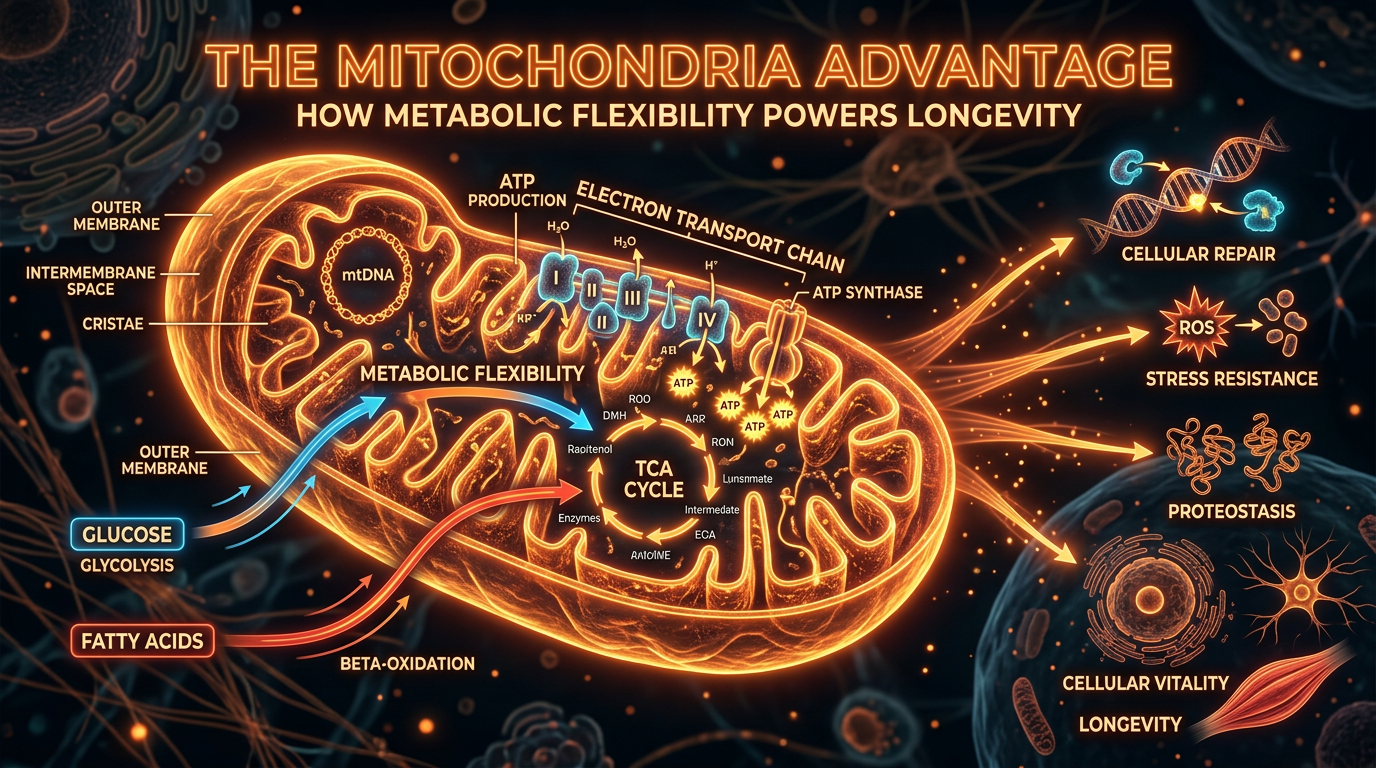
For decades, the mainstream medical narrative has reduced the human body to a simplistic machine—a furnace where calories are burned in a linear fashion. This reductionist view has ignored the fundamental seat of human vitality: the mitochondria. We have been led to believe that chronic fatigue, cognitive decline, and metabolic dysfunction are inevitable consequences of ageing. They are not. They are the symptoms of a bioenergetic crisis.
To achieve 'Innerstanding' of one’s health, we must move beyond the superficial metrics of the bathroom scale and look into the sub-cellular engine room. True longevity is not merely the absence of disease; it is the presence of metabolic flexibility—the ability of the mitochondria to seamlessly transition between fuel sources to maintain cellular homeostasis.
The Biological Mechanism: More Than a Powerhouse
The textbook definition of mitochondria as the "powerhouse of the cell" is an oversimplification that borders on negligence. In reality, mitochondria function as the central sensors of the cellular environment. They are the arbiters of life and death, regulating apoptosis (programmed cell death), calcium signalling, and the production of reactive oxygen species (ROS).
The Dual-Fuel System
At the heart of metabolic flexibility is the transition between glucose (glycolysis) and fatty acids (beta-oxidation). A metabolically flexible individual can utilise glucose when it is abundant—such as after a meal—but can swiftly pivot to burning stored body fat and producing ketones when food is scarce or insulin levels are low.
- Glucose Metabolism: While efficient for high-intensity bursts, chronic reliance on glucose leads to "metabolic rigidity." This creates a constant demand for exogenous substrate (food), leading to the infamous "blood sugar roller coaster."
- Ketone Metabolism: When the body enters ketosis, the mitochondria produce adenosine triphosphate (ATP) more cleanly. Ketones, specifically beta-hydroxybutyrate (BHB), act as signalling molecules that upregulate antioxidant pathways and reduce systemic inflammation.
The Electron Transport Chain and Redox Balance
The actual generation of energy occurs within the Electron Transport Chain (ETC). When mitochondria are healthy, electrons flow smoothly through the complexes to create ATP. However, in a state of metabolic inflexibility, "electron leakage" occurs. These leaked electrons react with oxygen to form superoxide, a highly reactive free radical.
Longevity is dictated by the efficiency of this process. If your mitochondria are "leaky," you are essentially rusting from the inside out. Metabolic flexibility ensures that the ETC is not overloaded, preserving the redox potential of the cell and protecting the DNA from oxidative damage.
The Modern Sabotage: Environmental Disruptors of the Organelle
We are currently living through an evolutionary mismatch. Our mitochondria evolved over millions of years in an environment characterised by seasonal food scarcity, natural light cycles, and physical exertion. The modern British lifestyle is an affront to this biological heritage.
The Insulin Trap
The primary disruptor of metabolic flexibility is chronic hyperinsulinemia. Because the Western diet is dominated by ultra-processed carbohydrates and refined sugars, insulin levels remain perpetually elevated. High insulin acts as a metabolic lock, preventing the release of fatty acids from adipose tissue. Even if an individual has 50,000 calories of stored fat, their mitochondria cannot access it if insulin is high. They are literally starving in a land of plenty.
Anthropogenic Stressors: Blue Light and EMFs
Research is beginning to expose the "invisible" disruptors of mitochondrial function. Mitochondria are sensitive to electromagnetic frequencies (EMFs) and artificial light.
- Blue Light: Exposure to artificial blue light after sunset suppresses melatonin, but it also disrupts the mitochondrial circadian rhythm. Mitochondria have their own internal clocks; when these are de-synced, ATP production falls, and ROS production spikes.
- Non-Ionizing Radiation: Emerging data suggests that excessive exposure to EMFs can trigger the voltage-gated calcium channels (VGCCs) in the cell membrane, leading to an influx of calcium into the mitochondria, which impairs their ability to produce energy efficiently.
According to recent UK health data, approximately 1 in 3 British adults are classified as pre-diabetic, a state characterised by the onset of metabolic rigidity. Furthermore, the NHS reports that metabolic-related conditions now account for over £6 billion in annual spending, highlighting a national crisis of mitochondrial decay.
The Seed Oil Deception
The substitution of stable animal fats with highly processed "vegetable" or seed oils (rich in Linoleic Acid) has been a catastrophe for mitochondrial membranes. These polyunsaturated fatty acids (PUFAs) are highly unstable and prone to lipid peroxidation. When these damaged fats are incorporated into the mitochondrial membrane (specifically the cardiolipin), the mitochondria become structurally compromised, leading to premature cell death and systemic inflammation.
The Recovery Protocol: Restoring Metabolic Sovereignty
Reversing mitochondrial damage and regaining metabolic flexibility requires a multi-pronged approach that mimics the hormetic stressors of our ancestors. We must "train" our mitochondria to be resilient.
1. Nutritional Ketosis and Intermittent Fasting
The most effective way to restore flexibility is to force the body to use fat.
- Time-Restricted Feeding (TRF): By limiting the consumption window to 6–8 hours, you allow insulin levels to drop sufficiently for the mitochondria to initiate beta-oxidation.
- The Ketogenic Transition: Periodically entering a state of nutritional ketosis upregulates the genes responsible for mitochondrial biogenesis (the creation of new mitochondria). It is not about being "keto" forever; it is about having the capability to be keto.
2. Mitohormesis: The Power of Targeted Stress
Hormesis is the biological phenomenon where a low dose of a stressor triggers an adaptive, beneficial response. To strengthen mitochondria, we must challenge them.
- Cold Thermogenesis: Exposure to cold (ice baths or cold showers) activates brown adipose tissue (BAT). This process uncouples the respiratory chain, generating heat instead of ATP, which forces the mitochondria to work harder and become more efficient.
- Hypoxia: Breathwork techniques, such as the Wim Hof Method or intermittent hypoxic training, trigger the release of Hypoxia-Inducible Factor (HIF-1), which helps the body optimise oxygen delivery and mitochondrial density.
3. Mitochondrial Nutrients and Cofactors
While "Innerstanding" begins with lifestyle, certain compounds act as essential cofactors for the Krebs cycle and the ETC:
- Magnesium: Required for every single ATP-related reaction.
- CoQ10 (Ubiquinol): A vital electron shunter in the ETC.
- NAD+ Precursors: Nicotinamide Adenine Dinucleotide (NAD+) is the primary electron carrier. Levels naturally decline with age, but can be supported through precursors like NMN or NR, alongside the avoidance of NAD+ drainers like chronic inflammation.
4. Circadian Optimisation
To protect the mitochondria, one must respect the sun.
- Morning Sunlight: Exposure to natural infrared and full-spectrum light in the morning sets the mitochondrial clock and primes the system for energy production.
- Blue Blocking: Utilising high-quality red lenses after sunset protects the mitochondria from the oxidative stress induced by artificial lighting.
Mitophagy: The Cellular Spring Clean
A critical component of longevity is not just making new mitochondria (biogenesis) but removing the broken ones. This process is called mitophagy.
When we are constantly eating, the body remains in an anabolic (growth) state, mediated by the mTOR pathway. In this state, the "rubbish" accumulates. By inducing metabolic flexibility through fasting or intense exercise, we activate the AMPK pathway, which triggers mitophagy.
- Autophagy vs. Mitophagy: While autophagy is the general recycling of cellular components, mitophagy is the specific targeted destruction of dysfunctional mitochondria.
- The Longevity Link: Centenarians consistently show higher rates of efficient mitophagy. Their cells are not cluttered with the "biological soot" of energy production; they are lean, clean, and efficient.
The Truth Exposed: The Path to Bioenergetic Freedom
The current healthcare system is designed to manage the symptoms of mitochondrial failure, not to cure them. Statins, metformin, and blood pressure medications are often "band-aids" applied to a body that has lost its ability to manage energy.
The "Mitochondria Advantage" is the ultimate insurance policy. When your mitochondria are flexible, you possess:
- Cognitive Resilience: The brain is the most energy-hungry organ. Flexible mitochondria prevent the "brain fog" associated with glucose fluctuations.
- Immune Robustness: Immune cells require massive surges of energy to fight pathogens. Metabolically rigid individuals are often immunocompromised.
- Physical Vitality: Sarcopenia (age-related muscle loss) is essentially a mitochondrial disease. Strong mitochondria preserve muscle tissue and bone density.
Statistics from the British Heart Foundation suggest that cardiovascular diseases—often underpinned by mitochondrial dysfunction in the cardiac myocytes—remain the leading cause of death in the UK. This confirms that the standard advice to "eat less and move more" is failing because it ignores the mitochondrial substrate.
Conclusion: The New Frontier of Longevity
We are standing at a crossroads in human health. We can continue down the path of metabolic rigidity, dependent on a cycle of processed fuels and pharmaceutical interventions, or we can embrace the science of Innerstanding.
Longevity is not a gamble; it is a calculation of mitochondrial efficiency. By eliminating environmental disruptors, embracing hormetic stressors, and restoring our innate ability to burn both fat and glucose, we reclaim our biological sovereignty. The mitochondria are not just powerhouses; they are the light of life within our cells. To optimise them is to optimise the very essence of what it means to be human.
Through metabolic flexibility, we don't just add years to our life; we add life to our years. It is time to stop fueling the fire with damp wood and start running on the high-octane, clean-burning fuel our ancestors evolved to use. The future of medicine is not in a pill; it is in the organelle.
This article is provided for informational and educational purposes only. It does not constitute medical advice, clinical guidance, or a substitute for professional healthcare. Information reflects cited research at time of publication. Always consult a qualified healthcare professional before acting on any health information.
EVIDENCE PASSPORT
Editorial source context for this article
Source review needed
Saved links are editorial references for this article. They may support specific claims rather than every sentence. Open and assess each source in context. This passport does not independently verify them.
Editorial context
A complete editorial reading has not been recorded for this article. Source links remain available for you to open and assess directly.
Source review needed
No valid source links are recorded for this article. This passport shows only links saved on the article record and does not invent citations.
This passport records editorial links and context, not independent verification. Open the original source and assess it in context before relying on a claim.
Medical Disclaimer
The information in this article is for educational purposes only and does not constitute medical advice, diagnosis, or treatment. Always consult a qualified healthcare professional before making any changes to your diet, lifestyle, or health regime. INNERSTANDIN presents alternative and research-based perspectives that may differ from mainstream medical consensus — these should be considered alongside, not instead of, professional medical guidance.
Read Full DisclaimerContinue the thread
Keep this question moving.
Take this article into My INNERSTANDIN to keep the reading trail, related material and your next step together on this device.
Explore this in the Body Map
See where this hits your biology. Interactive anatomy, threats, and protective protocols.
Dig deeper in the Library
Free, longform PDF volumes that go beyond headlines into mechanisms and references.