
Mitochondrial Decay: The Bioenergetic Root of Chronic Fatigue and Pain
Updated May 2026
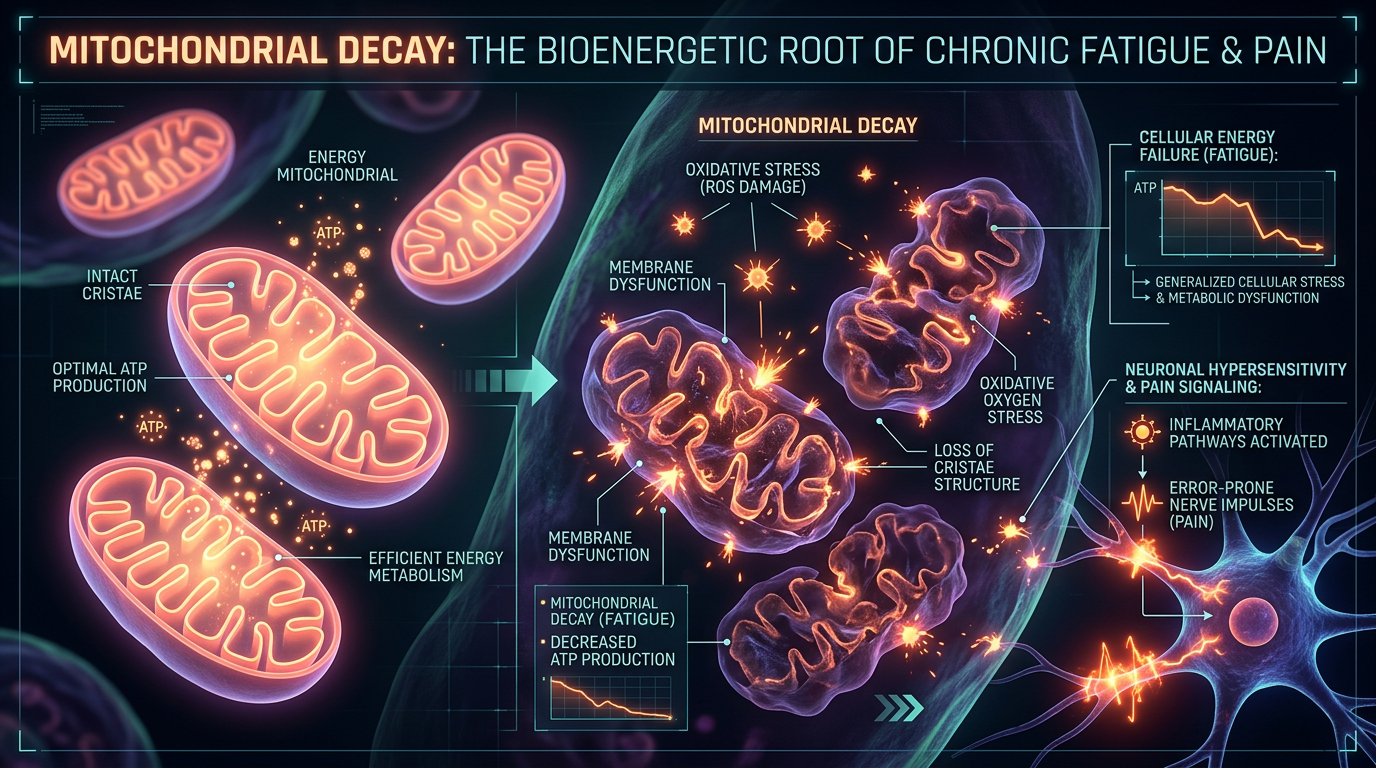
The health of our mitochondria determines the energy available for cellular repair and signal regulation. When mitochondria fail, the resulting oxidative stress sensitizes nociceptors, leading to chronic widespread pain.
Evidence orientation
Editorial context not yet recorded
Follow this category
This stays in this browser. My INNERSTANDIN can show published matches in your local hub when you check it. It does not send email, push, or alert notifications.
Local learning review
A private browser aid for revisiting ideas. It is not an alert or a health recommendation.
Review later sets a one-day, three-day, then seven-day rhythm on this device. Choose it only when you want to revisit this article.
Overview
The modern medical landscape is currently haunted by a phantom. Millions of individuals, particularly within the United Kingdom and the broader Western world, are presenting with a constellation of symptoms that defy conventional diagnostic categorisation: unrelenting exhaustion, diffuse muscular aches, cognitive "fog", and a heightened sensitivity to touch that transforms the mundane into the excruciating. We label these conditions Fibromyalgia, Chronic Fatigue Syndrome (ME/CFS), or Myofascial Pain Syndrome. Yet, for all our nomenclature, the clinical success rate in "treating" these conditions remains abysmal. This failure stems from a fundamental misunderstanding of what pain actually is.
At INNERSTANDING, we recognise that chronic pain is not merely a signal of tissue damage or a psychological manifestation; it is an acute "energy crisis" at the cellular level. Every sensation we experience, every repair our body undertakes, and every neural impulse that travels from the periphery to the brain requires a currency: Adenosine Triphosphate (ATP). When the production of this currency fails, the system does not simply switch off. Instead, it enters a state of high-alert, low-efficiency survival. This state is defined by mitochondrial decay.
The mitochondria are far more than the "powerhouses of the cell," a primary school definition that does a grave disservice to their complexity. They are the primary sensors of our internal environment, the arbiters of cell death, and the governors of our bioenergetic health. When these ancient organelles—descendants of proteobacteria that entered a symbiotic relationship with our ancestors billions of years ago—become dysfunctional, the result is a systemic collapse of biological order. This article serves as an authoritative investigation into how mitochondrial decay acts as the bioenergetic root of chronic fatigue and pain, exposing the mechanisms that the mainstream narrative has long ignored.
##
The Biology — How It Works
To understand why a failure in energy production leads to pain, one must first master the intricate ballet of mitochondrial respiration. Within the folded inner membranes of the mitochondria, known as cristae, lies the Electron Transport Chain (ETC). This is the site of oxidative phosphorylation, where the food we eat and the oxygen we breathe are converted into ATP.
The process involves five distinct protein complexes. Electrons, stripped from nutrients via the Krebs cycle, are passed through these complexes, acting as a current. This flow of electrons powers the pumping of protons across the inner membrane, creating a formidable electrochemical gradient—essentially a biological battery. At the final stage, Complex V (ATP Synthase) uses the pressure of these returning protons to "spin" and forge ATP from precursors.
The Bioenergetic Threshold
Every tissue in the human body has a specific "bioenergetic threshold." The brain and the nervous system possess the highest demands, consuming roughly 20% of total body energy despite being a fraction of its mass. The heart and skeletal muscles follow closely. When mitochondrial efficiency drops below this threshold—due to genetic mutations, environmental toxins, or age-related decay—the cell can no longer maintain its basic functions.
In the UK, it is estimated that over 28 million people live with chronic pain, a figure that is rapidly rising in alignment with the proliferation of metabolic dysfunction.
Mitochondrial DNA: The Vulnerable Blueprint
Unlike the DNA in the cell’s nucleus, Mitochondrial DNA (mtDNA) is not protected by histones—proteins that act as a shield against damage. Furthermore, mtDNA is situated directly next to the Electron Transport Chain, the very site where Reactive Oxygen Species (ROS) are generated as a byproduct of energy production. This makes mtDNA uniquely susceptible to oxidative mutations. When the "blueprint" for the energy machinery is damaged, the subsequent "parts" produced are faulty, leading to a vicious cycle of dwindling energy and rising toxicity.
##
Mechanisms at the Cellular Level
The transition from "low energy" to "chronic pain" occurs through several well-defined molecular pathways. It is here that the bioenergetic crisis translates into the subjective experience of agony.
1. Oxidative Stress and the Sensitisation of Nociceptors
Nociceptors are the sensory neurons responsible for detecting harmful stimuli. In a healthy state, they have a high threshold for firing; you need a significant pinch or heat to trigger a pain signal. However, mitochondria in a state of decay leak excessive ROS into the cytoplasm. This oxidative stress acts as a direct chemical irritant to the nociceptors.
Specifically, ROS activate Transient Receptor Potential (TRP) channels, such as TRPV1 and TRPA1. These are "threat sensors" on the surface of nerves. When bathed in the oxidative exhaust of failing mitochondria, these channels remain "stuck" in the open position. This process, known as peripheral sensitisation, means that even light pressure or normal movement is interpreted by the brain as a threat, resulting in the "widespread pain" characteristic of fibromyalgia.
2. The Failure of Ion Pumps
The maintenance of a resting membrane potential in a nerve cell—the state where it is ready but not firing—is an incredibly energy-intensive process. It relies on the Sodium-Potassium Pump (Na+/K+-ATPase), which consumes nearly one-third of all cellular ATP. When mitochondria decay and ATP levels plummet, these pumps fail.
Without sufficient energy to reset the electrical charge, the nerve cell becomes "hyperexcitable." It sits closer to its firing threshold, meaning it will trigger an action potential (a pain signal) with almost no provocation. This is the bioenergetic explanation for "Allodynia"—pain from stimuli that don't normally provoke pain.
3. The Mitophagy Deficit
Under normal conditions, the body employs a quality-control mechanism called mitophagy, where damaged mitochondria are identified, broken down, and recycled. In chronic pain and fatigue states, this process is frequently impaired. The cell becomes cluttered with "zombie" mitochondria—organelles that cannot produce ATP but continue to leak pro-inflammatory signals and ROS. This internal debris triggers the NLRP3 inflammasome, a multiprotein complex that initiates a cascade of chronic inflammation, further damaging the surrounding healthy tissue.
##
Environmental Threats and Biological Disruptors
We do not exist in a vacuum. The decay of our mitochondria is being accelerated by a modern environment that is fundamentally hostile to our ancient biological architecture.
The Impact of Artificial Light
One of the most overlooked disruptors of mitochondrial health is the prevalence of artificial blue light. Our mitochondria are light-sensing organelles. Cytochrome C Oxidase (Complex IV in the ETC) contains light-absorbing chromophores that are specifically tuned to red and near-infrared light from the sun, which enhances ATP production. Conversely, chronic exposure to high-intensity blue light (from LEDs and screens), especially at night, disrupts the circadian rhythm and suppresses melatonin.
Melatonin is not merely a "sleep hormone"; it is the most potent mitochondrial antioxidant. It is produced locally within the mitochondria to neutralise the ROS generated during the day. By depriving ourselves of natural light cycles, we are effectively removing the "coolant system" from our cellular engines, leading to overheating and structural decay.
Chemical Insults: Glyphosate and Pharmaceuticals
The British food supply is increasingly saturated with glyphosate, the active ingredient in widespread herbicides. Research indicates that glyphosate may act as an analogue for the amino acid glycine. If the body mistakenly incorporates glyphosate into mitochondrial proteins, the structural integrity of the ETC is compromised.
Furthermore, certain classes of common pharmaceuticals are overtly "mitotoxic."
- Fluoroquinolone Antibiotics: These have been shown to cause direct oxidative damage to mtDNA, leading to "floxing," a condition of systemic tendon pain and chronic fatigue.
- Statins: By inhibiting the pathway that produces cholesterol, they also inhibit the production of Coenzyme Q10 (CoQ10), a vital electron carrier in the ETC. Without CoQ10, mitochondrial respiration grinds to a halt.
Statistics from Public Health England suggest that nearly 1 in 4 adults in the UK are prescribed at least one potentially addictive medicine, many of which (like gabapentinoids) merely mask the symptoms of mitochondrial failure rather than addressing the bioenergetic root.
The Electromagnetic Fog
The proliferation of Non-Ionizing Radiation (EMFs) from mobile networks and Wi-Fi has been linked to the activation of Voltage-Gated Calcium Channels (VGCCs) on the cell membrane. When these channels are over-activated, an influx of calcium enters the cell, leading to the production of peroxynitrite—a highly destructive free radical that devastates mitochondrial membranes and DNA.
##
The Cascade: From Exposure to Disease
Mitochondrial decay does not happen overnight. It is a slow, progressive descent that follows a predictable cascade, often referred to as the Cell Danger Response (CDR), a term coined by Dr Robert Naviaux.
Phase 1: The Alarm
When a cell is under threat—whether from a virus, a toxin, or physical trauma—the mitochondria shift their function. They stop focusing on energy production and start focusing on "cellular defence." They stiffen their membranes to prevent viral egress and release ATP into the extracellular space as a signalling molecule. This is a healthy, short-term response.
Phase 2: The Stagnation
In chronic pain sufferers, the mitochondria become "stuck" in this defence mode. They fail to receive the "all clear" signal to return to normal energy production. This results in a persistent state of low-level inflammation. The body begins to prioritise survival over repair. Collagen synthesis slows down (leading to joint pain), and the glymphatic system (the brain's waste clearance) becomes sluggish (leading to brain fog).
Phase 3: The Systemic Shift
Once a critical mass of mitochondria across the body has decayed or entered the CDR, the pathology becomes systemic. The hypothalamic-pituitary-adrenal (HPA) axis becomes dysregulated. Because the body cannot produce enough energy to meet the demands of a "normal" life, the brain interprets this as a perpetual state of danger. The sympathetic nervous system (fight or flight) becomes dominant, leading to the anxiety and sleep disturbances that almost always accompany chronic pain.
##
What the Mainstream Narrative Omits
The current medical orthodoxy views the body as a collection of disparate parts. If you have joint pain, you see an orthopaedic surgeon. If you have fatigue, you might see an endocrinologist. If you have widespread pain, you are sent to a rheumatologist. This "siloed" approach is fundamentally incapable of addressing a bioenergetic crisis, which is by definition holistic.
The Suppression of Metabolic Therapy
There is very little profit to be found in the restoration of mitochondrial health. You cannot patent red light, grounding, or a ketogenic diet. Consequently, these interventions are often dismissed as "alternative" or "unproven," despite a mountain of biochemical evidence supporting their efficacy. The mainstream narrative focuses on "pain management"—a euphemism for the long-term pharmaceutical suppression of symptoms.
Opioids, for instance, are notoriously ineffective for chronic mitochondrial pain (like fibromyalgia) because they do nothing to address the underlying lack of ATP. In fact, long-term opioid use can further damage mitochondrial function, creating a cycle of dependency and escalating pain.
The Psychology Trap
When blood tests come back "normal"—as they often do in the early stages of mitochondrial decay because standard labs do not measure mitochondrial function—patients are frequently told their pain is "psychosomatic" or "centralised." While the brain is certainly involved in the perception of pain, this narrative gaslights the patient, ignoring the very real, measurable cellular deficit occurring in their tissues. The "central sensitisation" the doctors speak of is not a psychological flaw; it is the inevitable result of a bioenergetic system running on empty.
##
The UK Context
The United Kingdom faces a unique set of challenges regarding mitochondrial health. The "British lifestyle," shaped by industrial history and modern economic pressures, is a perfect storm for bioenergetic decay.
The "Ultra-Processed" Crisis
The UK has the highest consumption of ultra-processed foods (UPFs) in Europe. These foods are devoid of the co-factors necessary for mitochondrial function—such as magnesium, B vitamins, and trace minerals—and are loaded with linoleic acid-rich seed oils. When these unstable fats are incorporated into the mitochondrial membrane (specifically into a phospholipid called cardiolipin), they make the mitochondria prone to "leaking" electrons, massively increasing oxidative stress.
Recent data from the British Pain Society indicates that the economic burden of chronic pain in the UK exceeds £10 billion per year in direct healthcare costs and lost productivity.
Environmental Light and Latitude
Living at a higher latitude, the UK population suffers from significant seasonal variations in light. During the long winter months, the lack of infrared light from the sun removes a key stimulus for mitochondrial repair. When combined with the high indoor "blue light" environment of British offices and homes, the bioenergetic deficit is compounded.
The NHS Burden
The National Health Service is currently ill-equipped to handle the mitochondrial decay epidemic. The current "10-minute consultation" model does not allow for the deep-dive nutritional and environmental auditing required to reverse mitochondrial damage. This leads to a reliance on "pathway" treatments—standardised protocols of painkillers and anti-depressants that often exacerbate the underlying cellular issue.
##
Protective Measures and Recovery Protocols
Reversing mitochondrial decay is not about a single "magic pill." It requires a comprehensive bioenergetic restructuring—an effort to "re-tune" the cellular engines.
1. Photobiomodulation (Red Light Therapy)
To bypass the damaged Electron Transport Chain, one can use specific wavelengths of red and near-infrared light (660nm and 850nm). This light penetrates the tissues and is absorbed by Cytochrome C Oxidase, stimulating the production of ATP even when the usual nutrient-to-energy pathway is compromised. For chronic pain patients, daily exposure to red light can lower the inflammatory threshold and provide the energy needed for cellular repair.
2. Nutritional Support: The Mitochondriac Diet
The goal of a mitochondrial recovery diet is to provide "clean-burning" fuel and essential co-factors.
- Ketosis: Switching the body from glucose to ketone metabolism can be transformative. Ketones are a more efficient fuel source, producing fewer ROS per molecule of ATP generated.
- Magnesium: This mineral is a required co-factor for every single ATP-related reaction. Most chronic pain sufferers are profoundly magnesium deficient.
- Coenzyme Q10 and PQQ: Supplementing with ubiquinol (the active form of CoQ10) and Pyrroloquinoline Quinone (PQQ) can support electron transport and even stimulate "mitochondrial biogenesis"—the birth of new mitochondria.
3. Circadian Reset and Grounding
Restoring the natural rhythms of the body is essential for mitochondrial repair.
- Morning Sunlight: Getting natural light into the eyes within 30 minutes of waking sets the circadian clock and prepares the mitochondria for the day.
- Grounding (Earthing): Physical contact with the surface of the Earth allows for the transfer of free electrons into the body. These electrons act as a natural antioxidant, helping to neutralise the positive charge of oxidative stress and "quench" the fires of inflammation in the nerves.
4. Cold Stress (Thermic Conditioning)
Short, deliberate exposure to cold (such as a 30-second cold shower) triggers the production of "brown adipose tissue" and upregulates UCP1 (Uncoupling Protein 1). This process forces the mitochondria to become more efficient and robust, essentially "training" them to handle higher loads of stress without failing.
5. Hormetic Exercise
For those with chronic fatigue, "pushing through" can be disastrous, leading to Post-Exertional Malaise (PEM). Instead, the focus should be on "hormetic" movement—short bursts of activity that stimulate the mitochondria without overwhelming them, followed by significant periods of recovery.
##
Summary: Key Takeaways
The epidemic of chronic fatigue and pain is not a mystery; it is the logical outcome of a species disconnected from its biological requirements. When we understand that pain is the cry of an energy-starved cell, the path to recovery becomes clear.
- Pain is an Energy Crisis: Chronic pain is primarily caused by a bioenergetic deficit. When ATP levels drop, nerves become hyperexcitable and "threat-sensitive."
- The Mitochondria are Central: These organelles are the sensors of our environment. Their decay, driven by mtDNA damage and oxidative stress, is the root cause of systemic fatigue and pain.
- Environment Matters: Artificial light, glyphosate, and EMFs are direct "mitotoxins" that disrupt the Electron Transport Chain.
- Mainstream Medicine is Failing: By focusing on symptom suppression via pharmaceuticals, the medical establishment ignores the cellular root and often worsens mitochondrial function.
- Recovery is Possible: Through photobiomodulation, ketogenic principles, circadian alignment, and targeted supplementation, it is possible to stimulate mitochondrial biogenesis and restore the body's bioenergetic balance.
The transition from a state of chronic agony to one of vitality requires a radical reclamation of our cellular health. We must stop viewing pain as an enemy to be drugged into silence and start viewing it as a vital signal that our internal engines require restoration. The future of pain science is not in the pharmacy; it is in the mitochondria.
This article is provided for informational and educational purposes only. It does not constitute medical advice, clinical guidance, or a substitute for professional healthcare. Information reflects cited research at time of publication. Always consult a qualified healthcare professional before acting on any health information.
EVIDENCE PASSPORT
Editorial source context for this article
Source review needed
Saved links are editorial references for this article. They may support specific claims rather than every sentence. Open and assess each source in context. This passport does not independently verify them.
Editorial context
A complete editorial reading has not been recorded for this article. Source links remain available for you to open and assess directly.
Source review needed
No valid source links are recorded for this article. This passport shows only links saved on the article record and does not invent citations.
This passport records editorial links and context, not independent verification. Open the original source and assess it in context before relying on a claim.
Medical Disclaimer
The information in this article is for educational purposes only and does not constitute medical advice, diagnosis, or treatment. Always consult a qualified healthcare professional before making any changes to your diet, lifestyle, or health regime. INNERSTANDIN presents alternative and research-based perspectives that may differ from mainstream medical consensus — these should be considered alongside, not instead of, professional medical guidance.
Read Full DisclaimerContinue the thread
Keep this question moving.
Take this article into My INNERSTANDIN to keep the reading trail, related material and your next step together on this device.
Explore this in the Body Map
See where this hits your biology. Interactive anatomy, threats, and protective protocols.
Dig deeper in the Library
Free, longform PDF volumes that go beyond headlines into mechanisms and references.