
Nitric Oxide: Ancient Nasal Breathing vs Mouth Breathing Epidemics
Updated May 2026
Explore the vascular benefits of ancient nasal breathing techniques compared to the modern UK epidemic of mouth breathing. We detail the Bohr effect and nitric oxide's role in oxygen delivery.
Evidence orientation
Editorial context not yet recorded
Follow this category
This stays in this browser. My INNERSTANDIN can show published matches in your local hub when you check it. It does not send email, push, or alert notifications.
Local learning review
A private browser aid for revisiting ideas. It is not an alert or a health recommendation.
Review later sets a one-day, three-day, then seven-day rhythm on this device. Choose it only when you want to revisit this article.
Overview
In the modern epoch, humanity finds itself in the grip of a silent, invisible pathology. It is not a viral pathogen or a synthetic toxin, but a fundamental degradation of our most basic biological function: the act of respiration. As a senior biological researcher for INNERSTANDING, I have spent decades scrutinising the intersection of ancient physiological wisdom and modern biochemical degradation. What we are witnessing today, particularly across the United Kingdom and the Western world, is nothing short of a "mouth-breathing epidemic"—a departure from our evolutionary blueprint that is dismantling our vascular health and cognitive clarity.
At the heart of this crisis lies a single, ephemeral molecule: Nitric Oxide (NO). Once dismissed as a mere environmental pollutant, NO was revealed in the late 20th century to be the "miracle molecule" of the cardiovascular system, a discovery that earned the Nobel Prize in 1998. However, what the Nobel committee highlighted as a pharmacological breakthrough, ancient traditions such as Yoga, Pranayama, and the observations of 19th-century explorers like George Catlin had understood for millennia.
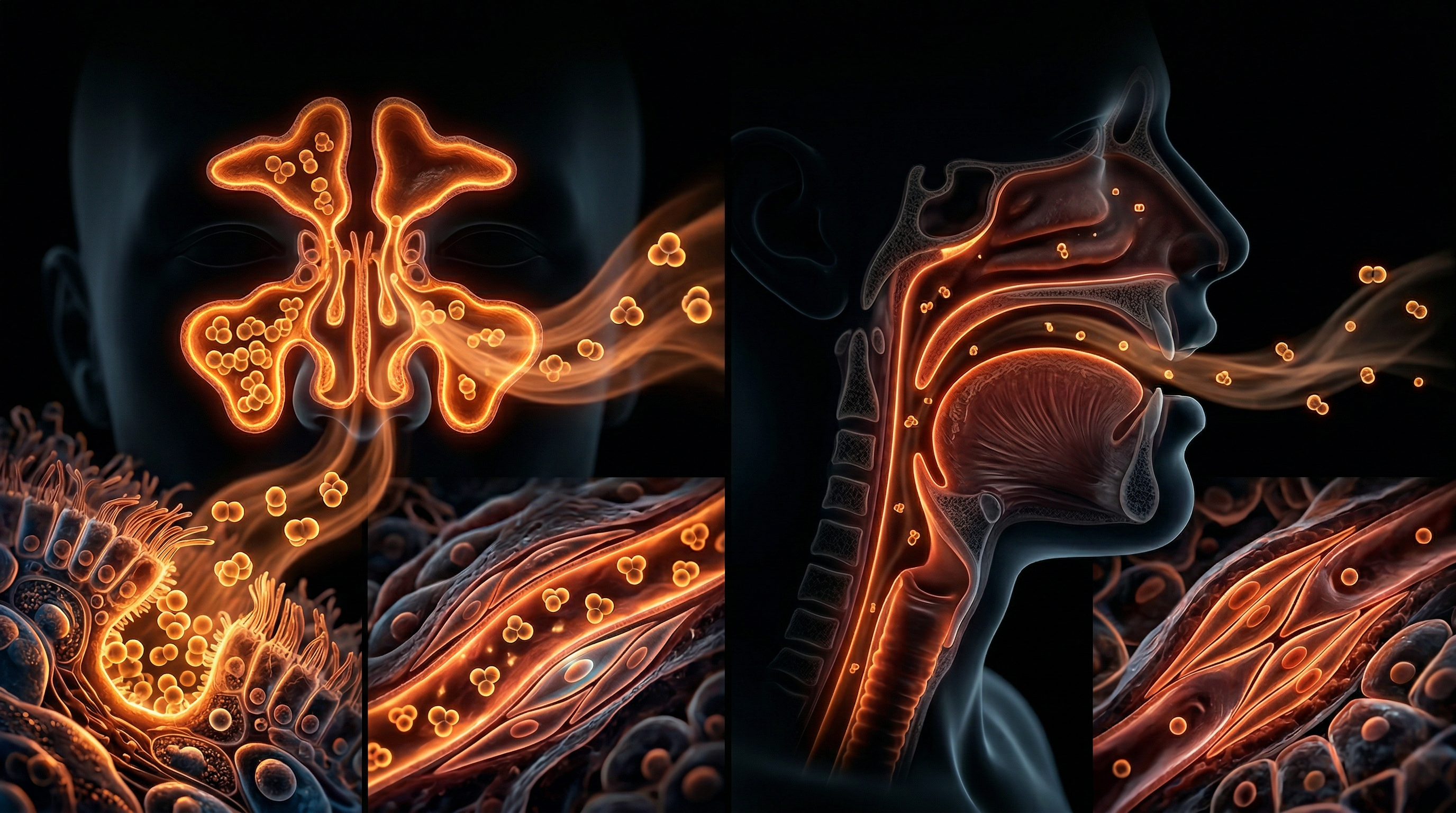
The nose is not merely a passage for air; it is a sophisticated chemical laboratory. When we breathe through the nasal passages, we harness the power of Nitric Oxide produced in the paranasal sinuses. This gas acts as a potent vasodilator, an antibacterial shield, and a critical mediator of oxygen delivery via the Bohr Effect. Conversely, chronic mouth breathing—a habit now ubiquitous in sedentary, high-stress, processed-food-consuming societies—bypasses this laboratory entirely. The result is a cascade of systemic failure, from hypertension and sleep apnoea to erectile dysfunction and neurodegeneration. This article serves as an exhaustive examination of this biological sabotage and a manifesto for reclaiming our most vital ancestral right.
Fact: Nitric Oxide is produced continuously in the human paranasal sinuses. Nasal breathing, particularly during exercise, can increase the uptake of this gas into the lungs by over 10% compared to mouth breathing, significantly enhancing arterial oxygenation.
The Biology — How It Works
To understand the gravity of the mouth-breathing epidemic, we must first master the architectural brilliance of the nasal cavity. Unlike the mouth, which is designed primarily for ingestion and vocalisation, the nose is specifically engineered for the preparation of air.
The Nasal Laboratory
The interior of the nose is lined with convoluted structures called turbinates or conchae. These structures increase the surface area of the nasal mucosa, allowing for the rapid warming and humidification of inhaled air. By the time air reaches the pharynx, it is consistently at 37°C and 100% relative humidity, regardless of external conditions. This prevents the "thermal shock" to the delicate alveolar tissues of the lungs that occurs during mouth breathing.
Furthermore, the nasal passage is lined with cilia—microscopic hair-like projections—and a layer of mucus that acts as a primary immunological barrier. This system filters out particulates, pathogens, and allergens. However, the most profound biological contribution of the nose is the endogenous production of Nitric Oxide.
The Synthesis of Nitric Oxide (NO)
NO is synthesised by a group of enzymes known as Nitric Oxide Synthases (NOS). In the nasal cavity, specifically within the paranasal sinuses, the inducible Nitric Oxide Synthase (iNOS) produces NO at high concentrations. This gas is then drawn into the lower airways and lungs during inhalation.
Once in the lungs, NO performs several critical roles:
- Vasodilation: It relaxes the smooth muscles surrounding the blood vessels in the lungs, particularly in the lower lobes where blood flow is highest due to gravity. This ensures that the air we breathe meets the blood (ventilation-perfusion coupling), maximising the efficiency of gas exchange.
- Bronchodilation: It helps to keep the airways open, reducing the effort required to breathe.
- Antimicrobial Action: NO is a broad-spectrum biocide. It inhibits the replication of viruses, bacteria, and fungi, acting as the first line of defence against respiratory infections.
The Mouth Breathing Deficit
When an individual breathes through their mouth, they bypass the paranasal sinuses. This results in "dry, cold, and dirty" air entering the lungs. More importantly, it creates a state of Nitric Oxide deficiency. Without the constant trickle of NO, the pulmonary blood vessels do not dilate optimally, leading to what is effectively "dead space" in the lungs—areas where air is present but oxygen cannot be efficiently transferred to the blood.
Mechanisms at the Cellular Level
The true brilliance of nasal breathing is revealed at the level of the haemoglobin molecule and the mitochondria. This is where the Bohr Effect and Nitric Oxide converge to dictate the energy status of every cell in the human body.
The Bohr Effect: The Chemistry of Release
Named after the Danish physiologist Christian Bohr, the Bohr Effect describes how the affinity of haemoglobin for oxygen is inversely related to the concentration of carbon dioxide ($CO_2$) and the acidity (pH) of the blood.
Crucial Concept: Most people believe that $CO2$ is merely a waste product. In reality, $CO2$ is the "key" that unlocks oxygen from haemoglobin. Without sufficient $CO_2$ in the blood, haemoglobin holds onto oxygen too tightly, refusing to release it into the tissues and brain.
Mouth breathing typically leads to hyperventilation—even if it is subtle. By exhaling too much $CO2$ through the wide aperture of the mouth, we lower the arterial tension of $CO2$ (a condition called hypocapnia). This shifts the haemoglobin-oxygen dissociation curve to the left. You may have a blood oxygen saturation ($SpO2$) of 99%, but because your $CO2$ levels are low due to mouth breathing, that oxygen remains "stuck" in your blood, unable to reach your mitochondria. Nasal breathing, by providing higher resistance and slower flow, maintains the optimal $CO_2$ balance required for the Bohr Effect to function correctly.
Nitric Oxide and Mitochondrial Respiration
Once oxygen is successfully delivered to the cells, it must be utilised by the mitochondria to produce Adenosine Triphosphate (ATP), the currency of life. Nitric Oxide plays a nuanced regulatory role here. While high levels of NO can actually inhibit mitochondrial respiration (a mechanism used by the immune system to kill pathogens), physiological levels of NO derived from nasal breathing act as a signalling molecule that promotes mitochondrial biogenesis—the creation of new mitochondria.
The Endothelial Sentinel
The endothelium is a thin layer of cells lining every blood vessel in the body. It is the primary site of NO production via endothelial Nitric Oxide Synthase (eNOS). NO produced in the nose helps maintain endothelial health systemically. When NO levels are chronically low due to mouth breathing, the endothelium becomes "sticky" and dysfunctional. This is the foundational step in atherosclerosis (hardening of the arteries).
Statistic: Endothelial dysfunction is detectable years, often decades, before the onset of clinical cardiovascular disease. Mouth breathing is a primary, yet ignored, driver of this dysfunction.
Environmental Threats and Biological Disruptors
The transition from ancient nasal breathing to the modern mouth-breathing epidemic is not an accident of evolution; it is a result of radical changes in our environment and lifestyle that have disrupted our biological "hardware."
The "Industrial Face" and Orthodontic Collapse
One of the most suppressed truths in modern medicine is the link between diet and facial structure. Drawing on the work of Dr. Weston A. Price, we can see that as human populations moved from ancestral diets (rich in fat-soluble vitamins and requiring vigorous chewing) to "industrial" diets (soft, processed, nutrient-void), our jaw structures began to shrink.
- Narrow Maxilla: The upper jaw (maxilla) fails to develop forward and outward. This results in crowded teeth and, crucially, a smaller nasal cavity.
- High Arched Palate: A narrow jaw forces the roof of the mouth (which is also the floor of the nose) to push upwards, further restricting the nasal airway.
- The Feedback Loop: If the nose is too narrow to breathe through easily, the child defaults to mouth breathing. Mouth breathing, in turn, causes the tongue to rest on the floor of the mouth rather than the roof, removing the internal "expander" that helps the jaw grow. This creates a permanent structural deformity that necessitates mouth breathing.
The Sympathetic Overdrive
Modern life is characterised by chronic, low-grade stress. The nervous system perceives mouth breathing as a "fight or flight" signal. High-chest mouth breathing activates the sympathetic nervous system, which increases cortisol and adrenaline. Conversely, nasal breathing activates the vagus nerve and the parasympathetic (rest and digest) system. We are trapped in a cycle: stress makes us breathe through our mouths, and mouth breathing keeps us stressed.
Environmental Toxins and Allergic Rhinitis
The rise of urban pollution and the "hygiene hypothesis" have led to an explosion in allergic rhinitis. When the nasal passages are chronically inflamed due to poor air quality or processed food-induced systemic inflammation, the nasal resistance becomes too high. The individual, seeking the path of least resistance, opens their mouth. This bypasses the filter, allowing even more toxins into the lungs, worsening the inflammation and reinforcing the mouth-breathing habit.
The Cascade: From Exposure to Disease
Mouth breathing is not a benign habit; it is a systemic slow-poisoning that manifests across several physiological domains.
Cardiovascular System: The NO Vacuum
As established, the lack of nasal Nitric Oxide leads to systemic vasoconstriction. The heart must work harder to pump blood through narrowed vessels. This is a direct contributor to Essential Hypertension. Furthermore, the lack of NO reduces the blood's ability to inhibit platelet aggregation, increasing the risk of blood clots, strokes, and myocardial infarctions.
Sleep and Neurological Decay
The most visible manifestation of the epidemic is Obstructive Sleep Apnoea (OSA) and snoring. Mouth breathing during sleep causes the soft tissues of the throat to collapse.
- Hypoxia: Repeated drops in oxygen levels during the night cause oxidative stress in the brain.
- Glymphatic Failure: The brain's waste-clearance system (the glymphatic system) only functions during deep, restorative sleep. Mouth breathers rarely reach these stages, leading to an accumulation of beta-amyloid plaques associated with Alzheimer's disease.
- ADHD Misdiagnosis: In children, the chronic oxygen deprivation and sleep fragmentation caused by mouth breathing often manifest as hyperactivity, lack of focus, and irritability. Thousands of children in the UK are prescribed stimulants for ADHD when their primary issue is an obstructed upper airway.
Metabolic Dysfunction
Recent research suggests a link between mouth breathing and insulin resistance. The chronic activation of the stress response (cortisol) via mouth breathing raises blood glucose levels. Furthermore, NO is involved in the signalling pathway for glucose uptake in skeletal muscle. Low NO = Poor metabolic flexibility.
What the Mainstream Narrative Omits
Why, if the science of Nitric Oxide and the Bohr Effect is so well-established, is the mouth-breathing epidemic ignored by the NHS and mainstream medical bodies?
The Pharmaceutical Bias
There is no "patent" on nasal breathing. Nitric Oxide is a gas produced for free by your own body. The medical-industrial complex thrives on the management of chronic conditions, not their resolution.
- Asthma: Often treated with steroid inhalers that further dry out the airways, while the underlying cause—mouth breathing and the resultant hypocapnia—is never addressed.
- Hypertension: A multi-billion pound industry for ACE inhibitors and beta-blockers, which manage the symptoms of low NO without addressing the respiratory source.
- CPAP Machines: A "band-aid" for sleep apnoea that forces air into the lungs but often fails to transition the patient back to functional nasal breathing.
The Siloing of Medicine
In the current paradigm, the dentist looks at the teeth, the ENT looks at the nose, and the cardiologist looks at the heart. They rarely communicate. The dentist "fixes" crowded teeth by pulling them (further shrinking the mouth), which the ENT ignores, while the cardiologist wonders why the patient's blood pressure won't drop. A holistic, biological view reveals that the airway is the primary driver of craniofacial and vascular health.
The "Deep Breath" Fallacy
Mainstream health advice often encourages people to "take a deep breath" when stressed. This is almost always interpreted as a large, gasping breath through the mouth. This is physiologically illiterate. A "deep breath" in biological terms should be a slow, nasal, diaphragmatic breath that increases $CO_2$ and NO, rather than flushing them out.
The UK Context
The United Kingdom presents a unique and troubling case study in the mouth-breathing epidemic. Several factors converge to make the British population particularly susceptible to the degradation of respiratory health.
The "British Jaw" and Orthodontic Traditions
For decades, British orthodontics was dominated by the "extraction and retraction" model. To fix overcrowding, healthy premolars were frequently extracted, and the remaining teeth were pulled backward with braces. While this created straight teeth, it significantly reduced the volume of the oral cavity, leaving no room for the tongue. When the tongue cannot sit in its natural "garage" on the roof of the mouth, it falls back into the airway, making nasal breathing difficult and mouth breathing inevitable.
The Crisis of the NHS and ENT Waitlists
The current state of the NHS has left thousands of children and adults with untreated nasal obstructions.
- Adenoids and Tonsils: Chronic inflammation of the adenoids is a leading cause of mouth breathing in UK children. However, "watchful waiting" policies and long surgical waitlists mean that many children spend their formative years mouth breathing, leading to permanent changes in facial structure (the so-called "adenoid face").
- The Pollution Factor: UK cities like London, Manchester, and Birmingham consistently exceed WHO limits for nitrogen dioxide and particulates. This environmental assault causes chronic nasal congestion, forcing the population into habitual mouth breathing.
The "Stiff Upper Lip" vs. Chronic Stress
The cultural trope of the "stiff upper lip" often translates to suppressed emotions and chronic tension. This tension is physically held in the jaw and the diaphragm. A tight diaphragm prevents low-abdominal breathing, forcing the use of accessory muscles in the neck and chest, which is synonymous with mouth breathing. The UK's high rates of anxiety and depression are both a cause and a consequence of this respiratory dysfunction.
UK Statistic: It is estimated that up to 40% of British schoolchildren are habitual mouth breathers, a figure that correlates strongly with the rising rates of childhood obesity and developmental delays.
Protective Measures and Recovery Protocols
The journey back to health requires a conscious "re-wilding" of our respiratory system. As a senior biological researcher, I recommend the following evidence-based protocols to restore Nitric Oxide levels and correct the mouth-breathing habit.
1. The Buteyko Method and $CO_2$ Tolerance
Developed by Ukrainian physician Konstantin Buteyko, this method focuses on "reduced breathing." By training the body to tolerate higher levels of $CO_2$, we can reset the respiratory centre in the brain (the medulla oblongata).
- The Control Pause: Measure how long you can comfortably hold your breath after an exhalation. A healthy pause is 40 seconds. Most modern Britons struggle to reach 15.
- Nasal Clearing Exercise: Use a series of breath holds to naturally decongest the nose through the accumulation of $CO_2$ (a natural dilator).
2. Mouth Taping: The Night-time Game Changer
While it sounds "fringe," mouth taping is the most effective way to ensure nasal breathing during the 7-9 hours of sleep. By using a small piece of surgical micropore tape vertically across the lips, you force the body to rely on the nasal-Nitric Oxide pathway.
- Benefits: Elimination of snoring, reduced morning grogginess, and protection of oral health (mouth breathing causes a dry mouth, which shifts the microbiome and leads to tooth decay).
3. Humming and NO Production
A fascinating study published in the American Journal of Respiratory and Critical Care Medicine found that humming increases endogenous Nitric Oxide production by 15-fold compared to quiet exhalation.
- Protocol: 5 minutes of low-frequency humming daily can significantly boost the NO concentration in the paranasal sinuses, helping to sterilise the airways and improve vascular tone.
4. Dietary Nitrates and Oral Microbiome
While nasal breathing produces NO gas, we can also support systemic NO levels through the Nitrate-Nitrite-Nitric Oxide pathway in the gut.
- Consume: Arugula (Rocket), beetroot, spinach, and kale.
- Avoid Antiseptic Mouthwash: Standard mouthwashes kill the beneficial bacteria on the tongue that are responsible for converting dietary nitrates into nitrites. Using these products can actually raise your blood pressure by "cutting off" this NO pathway.
5. Myofunctional Therapy
For those with structural jaw issues, myofunctional therapy involves exercises for the tongue and facial muscles to restore "tongue posture." The tongue should always be pressed against the roof of the mouth, acting as a natural support for the upper jaw and keeping the airway open.
Summary: Key Takeaways
The mouth-breathing epidemic is a silent driver of the modern chronic disease crisis. By bypassing the nose, we forfeit the life-sustaining benefits of Nitric Oxide and sabotage the Bohr Effect, leaving our tissues starved of oxygen despite being bathed in it.
- Nitric Oxide (NO) is a vital vasodilator and antimicrobial produced in the nose, not the mouth.
- Mouth breathing leads to hypocapnia (low $CO_2$), which paradoxically prevents oxygen from being released into the cells.
- Ancient techniques like nasal breathing and humming are biologically superior to modern respiratory habits.
- The UK faces a specific crisis due to historical orthodontic practices and environmental pollution.
- Recovery is possible through mouth taping, the Buteyko method, and myofunctional exercises.
The restoration of nasal breathing is more than a health "hack"; it is a fundamental reclamation of human vitality. We must stop being "over-breathers" through the mouth and return to the quiet, efficient, and potent nasal respiration that defined our ancestors. The "miracle molecule" is already within you—you simply have to breathe correctly to unlock it.
"References & Technical Notes:"
- Ignarro, L. J. (1998). Nitric Oxide: A Unique Endogenous Signaling Molecule in Vascular Biology. (Nobel Lecture).
- Lundberg, J. O., & Weitzberg, E. (1999). Nasal nitric oxide in man. Thorax.
- Price, W. A. (1939). Nutrition and Physical Degeneration.
- McKeown, P. (2015). The Oxygen Advantage.
- Nestor, J. (2020). Breath: The New Science of a Lost Art.
This article is provided for informational and educational purposes only. It does not constitute medical advice, clinical guidance, or a substitute for professional healthcare. Information reflects cited research at time of publication. Always consult a qualified healthcare professional before acting on any health information.
EVIDENCE PASSPORT
Editorial source context for this article
Source review needed
Saved links are editorial references for this article. They may support specific claims rather than every sentence. Open and assess each source in context. This passport does not independently verify them.
Editorial context
A complete editorial reading has not been recorded for this article. Source links remain available for you to open and assess directly.
Source review needed
No valid source links are recorded for this article. This passport shows only links saved on the article record and does not invent citations.
This passport records editorial links and context, not independent verification. Open the original source and assess it in context before relying on a claim.
Medical Disclaimer
The information in this article is for educational purposes only and does not constitute medical advice, diagnosis, or treatment. Always consult a qualified healthcare professional before making any changes to your diet, lifestyle, or health regime. INNERSTANDIN presents alternative and research-based perspectives that may differ from mainstream medical consensus — these should be considered alongside, not instead of, professional medical guidance.
Read Full DisclaimerContinue the thread
Keep this question moving.
Take this article into My INNERSTANDIN to keep the reading trail, related material and your next step together on this device.
Explore this in the Body Map
See where this hits your biology. Interactive anatomy, threats, and protective protocols.