
Phase I and Phase II Detoxification: The Liver's Chemical Processing Plant
Updated May 2026
An in-depth look at how the liver neutralizes toxins and drugs through enzymatic pathways, highlighting the role of glutathione and sulfur-containing compounds.
Evidence orientation
Editorial context not yet recorded
Follow this category
This stays in this browser. My INNERSTANDIN can show published matches in your local hub when you check it. It does not send email, push, or alert notifications.
Local learning review
A private browser aid for revisiting ideas. It is not an alert or a health recommendation.
Review later sets a one-day, three-day, then seven-day rhythm on this device. Choose it only when you want to revisit this article.
The modern human exists within a paradox of unprecedented technological advancement and unprecedented biological siege. While the discourse surrounding 'detoxification' has been largely hijacked by the marketing departments of supplement companies and 'wellness' influencers, the physiological reality of hepatic biotransformation remains one of the most complex and vital functions of the human organism.
The liver is not a passive sieve; it is an incredibly sophisticated chemical processing plant. It is tasked with identifying, modifying, and neutralising an unrelenting stream of endogenous metabolites and exogenous toxins—xenobiotics—ranging from heavy metals and pharmaceutical residues to microplastics and synthetic hormones. To 'innerstand' the liver is to recognise that health is not merely the absence of disease, but the efficiency of these enzymatic pathways.
The Architecture of Hepatic Biotransformation
At the centre of our metabolic integrity lies the hepatocyte. These cells are the functional units of the liver, responsible for the two-stage process of biotransformation. The primary objective of this process is to convert lipid-soluble (fat-soluble) compounds into water-soluble substances that can be safely excreted via the bile or urine.
Most environmental toxins, drugs, and metabolic waste products are lipophilic. In their raw state, they possess an affinity for the fatty tissues of the body, including the brain and the endocrine system. If the liver fails to convert these into a polar, water-soluble form, they remain sequestered in our adipose tissue, leading to chronic low-grade inflammation and systemic dysfunction.
According to the British Liver Trust, liver disease is the only major cause of death still increasing in the UK, with a 400% increase in mortality rates since 1970. While much of this is attributed to lifestyle, the cumulative burden of environmental toxicity—the 'exposome'—is a critical, often ignored factor.
Phase I: Modification and the Cytochrome P450 System
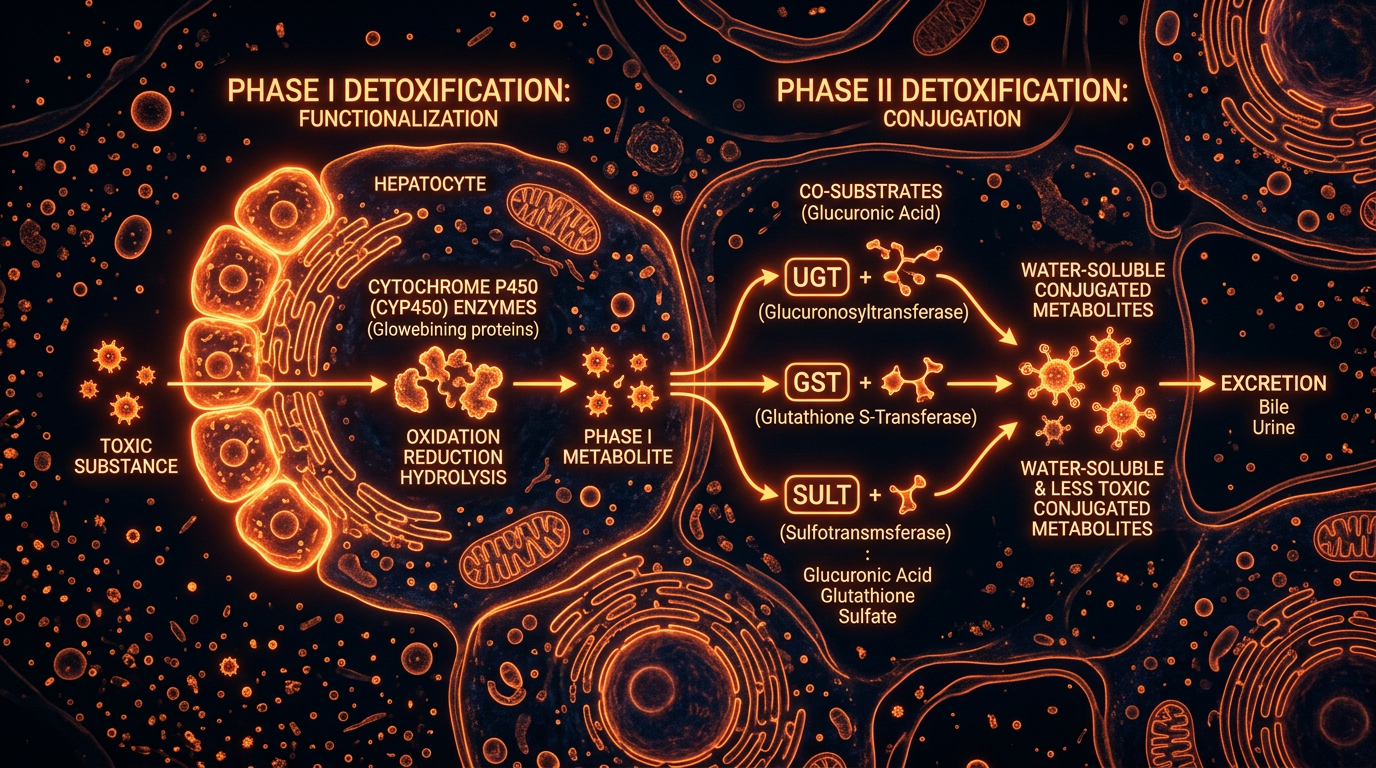
Phase I is the 'Activation' phase. Controlled primarily by the Cytochrome P450 (CYP450) enzyme superfamily, this stage involves the initial transformation of a toxin through oxidation, reduction, or hydrolysis.
The Double-Edged Sword of Phase I
The primary role of Phase I is to prepare a molecule for Phase II. By adding a functional group (such as a hydroxyl group), the liver makes the molecule more reactive. However, there is a biological 'truth' that many miss: the intermediate metabolites produced during Phase I are often significantly more toxic and reactive than the original substance.
These intermediates are frequently 'free radicals'—highly unstable molecules that can damage DNA and cellular membranes if they are not immediately processed by Phase II.
Key Regulators of Phase I
- CYP1A2: Responsible for metabolising caffeine, paracetamol, and heterocyclic amines (found in charred meats).
- CYP2D6: Involved in the processing of many antidepressants and beta-blockers.
- CYP3A4: Perhaps the most critical enzyme, handling approximately 50% of all pharmaceutical drugs and various steroid hormones.
If Phase I is overactive (often due to excessive caffeine, alcohol, or specific environmental pollutants) and Phase II is sluggish, the body enters a state of high oxidative stress. This 'pathway mismatch' is a hidden driver of chronic fatigue, chemical sensitivities, and premature ageing.
Phase II: Conjugation – The Neutralisation Phase
Phase II is where the actual 'detoxification'—the rendering of a substance harmless—occurs. This process is known as conjugation. In this stage, the liver attaches a specific molecule (a conjugate) to the reactive intermediate produced in Phase I. This increases the molecule's water solubility and prepares it for exit.
There are six primary pathways within Phase II, each requiring specific nutrient co-factors to function optimally:
1. Glucuronidation
The most prevalent Phase II pathway. It handles many common medications, ibuprofen, and excess oestrogen. It relies on glucuronic acid.
- The Disrupter: High levels of the enzyme beta-glucuronidase (produced by certain gut bacteria) can 'uncouple' these toxins in the bowel, allowing them to be reabsorbed into the bloodstream.
2. Sulfation
Crucial for the elimination of neurotransmitters, steroid hormones, and environmental phenols. This pathway requires inorganic sulphate, often derived from sulphur-rich amino acids.
- The Nutrient Requirement: Molybdenum and Vitamin B12 are essential co-factors for the conversion of sulphites to sulphates.
3. Glutathione Conjugation
Glutathione is the 'Master Antioxidant'. This pathway neutralises some of the most dangerous Phase I intermediates, including heavy metals like mercury and lead.
- The Vulnerability: Glutathione is rapidly depleted by alcohol, poor diet, and chronic stress. When glutathione levels drop, the liver is left defenceless against oxidative damage.
4. Methylation
Beyond its role in DNA expression, methylation is vital for detoxifying arsenic, oestrogen, and histamine. It requires folate (B9), B12, and B6.
- The Genetic Factor: Variants in the MTHFR or COMT genes can significantly reduce the efficiency of this pathway, leading to hormonal imbalances and mood disorders.
5. Acetylation
This pathway breaks down 'sulfa' drugs and histamine. It is highly dependent on Vitamin B5 (Pantothenic Acid).
6. Amino Acid Conjugation
Specifically uses glycine, taurine, and glutamine to neutralise benzoic acid (a common food preservative) and other xenobiotics.
Phase III: The Exit Strategy (Elimination)
The final stage of the process is Phase III, which involves the transport of these conjugated toxins out of the hepatocyte and into either the bile (for faecal excretion) or the blood (for renal excretion via the kidneys).
This is where the liver's relationship with the gallbladder becomes paramount. Bile is the 'waste bin' of the liver. If bile flow is sluggish (cholestasis) or if the diet is devoid of fibre, these toxins can be reabsorbed in the small intestine—a process known as enterohepatic circulation. This creates a vicious cycle of toxicity where the liver is forced to re-process the same toxins repeatedly.
Data from the Office for National Statistics (ONS) suggests that hospital admissions for non-alcoholic fatty liver disease (NAFLD) have risen sharply in the UK. This condition directly impairs the Phase III transport mechanisms, effectively 'constipating' the liver at a cellular level.
The Modern Siege: Environmental Disruptors
We no longer live in the environment for which our livers evolved. The 'Chemical Processing Plant' is being forced to handle synthetic compounds that did not exist 100 years ago.
- Glyphosate: The world’s most widely used herbicide has been shown to inhibit Cytochrome P450 enzymes. By crippling Phase I, glyphosate inhibits the liver's ability to detoxify other environmental chemicals, creating a 'synergistic toxicity.'
- Endocrine Disruptors (EDCs): Phthalates and Bisphenol A (BPA) mimic oestrogen. They overwhelm the glucuronidation and methylation pathways, contributing to the epidemic of oestrogen dominance in both men and women.
- Heavy Metals: Lead, cadmium, and aluminium (ubiquitous in the UK’s industrial history and modern infrastructure) deplete glutathione stores, leaving the liver vulnerable to lipid peroxidation.
Clinical Manifestations of Hepatic Congestion
When the Phase I and Phase II pathways are compromised, the body begins to signal its distress. These are not 'illnesses' in the traditional sense, but symptoms of a processing plant that has exceeded its capacity:
- Chemical Sensitivity: Intense reactions to perfumes, cleaning products, or petrol fumes (a classic sign of Phase I/II mismatch).
- Hormonal Dysregulation: Severe PMS, endometriosis, or 'man boobs' (gynecomastia) due to poor oestrogen clearance.
- Dermatological Issues: Acne, eczema, and psoriasis. If the liver cannot clear toxins, the skin—the body’s largest organ of elimination—is forced to compensate.
- Brain Fog and Lethargy: The result of neurotoxic intermediates crossing the blood-brain barrier.
The Recovery Protocol: Restoring Hepatic Sovereignty
True detoxification is not a seven-day juice cleanse; it is the lifelong support of enzymatic pathways. To recover liver function, one must address both the input (toxin avoidance) and the output (enzymatic support).
1. Nutritional Optimisation
The liver requires 'fuel' to process 'waste'. Without adequate protein and micronutrients, Phase II stalls.
- Cruciferous Vegetables: Broccoli, kale, and Brussels sprouts contain Indole-3-carbinol and Sulforaphane, which potently induce Phase II enzymes.
- Sulphur-Rich Foods: Garlic, onions, and pasture-raised eggs provide the raw materials for sulfation and glutathione production.
- Amino Acid Support: Glycine (found in collagen/bone broth) and N-Acetyl Cysteine (NAC) are critical for conjugation.
2. Bile Flow and Gut Integrity
- Bitter Herbs: Dandelion root, milk thistle, and artichoke stimulate bile production and flow, ensuring toxins are moved through Phase III.
- Binders: The use of activated charcoal, zeolite, or modified citrus pectin can 'trap' toxins in the gut, preventing their reabsorption.
- Soluble Fibre: Essential for 'mopping up' bile and ensuring it is excreted.
3. Lifestyle Interventions
- Hydration: The kidneys require a high aqueous volume to excrete the products of Phase II.
- Sauna Therapy: Inducing perspiration allows for the excretion of heavy metals and plastics through the skin, bypassing the liver and reducing its total load.
- Circadian Alignment: The liver’s detoxification pathways follow a circadian rhythm, peaking during the night. Late-night eating diverts energy from biotransformation to digestion.
Conclusion: The Truth of Biological Self-Ownership
The prevailing medical narrative often views the liver only when it has reached a state of pathology—cirrhosis or hepatitis. However, there is a vast 'grey area' of sub-clinical hepatic congestion that defines the quality of life for millions.
We must move beyond the reductionist view of the liver as a simple filter. It is an intelligent, reactive system that requires specific biological conditions to function. In an era of chemical saturation, understanding Phase I and Phase II detoxification is not an academic exercise; it is a fundamental requirement for maintaining biological sovereignty.
By providing the necessary enzymatic co-factors and reducing the exogenous burden, we allow the liver to perform its primary directive: the preservation of the internal environment against an increasingly hostile external one. This is the essence of INNERSTANDING—recognising that the body possesses the machinery for healing, provided we stop sabotaging the assembly line.
This article is provided for informational and educational purposes only. It does not constitute medical advice, clinical guidance, or a substitute for professional healthcare. Information reflects cited research at time of publication. Always consult a qualified healthcare professional before acting on any health information.
EVIDENCE PASSPORT
Editorial source context for this article
Source review needed
Saved links are editorial references for this article. They may support specific claims rather than every sentence. Open and assess each source in context. This passport does not independently verify them.
Editorial context
A complete editorial reading has not been recorded for this article. Source links remain available for you to open and assess directly.
Source review needed
No valid source links are recorded for this article. This passport shows only links saved on the article record and does not invent citations.
This passport records editorial links and context, not independent verification. Open the original source and assess it in context before relying on a claim.
Medical Disclaimer
The information in this article is for educational purposes only and does not constitute medical advice, diagnosis, or treatment. Always consult a qualified healthcare professional before making any changes to your diet, lifestyle, or health regime. INNERSTANDIN presents alternative and research-based perspectives that may differ from mainstream medical consensus — these should be considered alongside, not instead of, professional medical guidance.
Read Full DisclaimerContinue the thread
Keep this question moving.
Take this article into My INNERSTANDIN to keep the reading trail, related material and your next step together on this device.
Explore this in the Body Map
See where this hits your biology. Interactive anatomy, threats, and protective protocols.
Dig deeper in the Library
Free, longform PDF volumes that go beyond headlines into mechanisms and references.