
Proprioceptive Feedback: Why Movement is Biological Information
Updated May 2026
The brain requires a constant stream of accurate proprioceptive data to feel safe; without it, it creates pain as a protective mechanism. Restoring the quality of this biological information is the foundation of long-term pain resolution.
Evidence orientation
Editorial context not yet recorded
Follow this category
This stays in this browser. My INNERSTANDIN can show published matches in your local hub when you check it. It does not send email, push, or alert notifications.
Local learning review
A private browser aid for revisiting ideas. It is not an alert or a health recommendation.
Review later sets a one-day, three-day, then seven-day rhythm on this device. Choose it only when you want to revisit this article.
Overview
In the prevailing medical paradigm, movement is frequently categorised as a secondary outcome of health—something we do once we are well. However, at INNERSTANDING, we posit a more radical, biologically grounded reality: movement is the primary source of biological information. It is the currency of the nervous system. The brain does not exist in a vacuum; it is a prediction engine that requires a relentless, high-fidelity stream of data from the periphery to construct a coherent sense of "self" and "safety." This stream of data is known as proprioception.
Proprioception is often colloquially referred to as the "sixth sense," but this description undermines its vital importance. It is the fundamental feedback mechanism through which the central nervous system (CNS) maps the body’s position, tension, and velocity in three-dimensional space. When this stream of information is clear, the brain feels "safe" in its environment. However, when this information becomes degraded, noisy, or absent—a state we define as sensory poverty—the brain loses its ability to predict the consequences of movement.
In the absence of certainty, the brain defaults to a protective state. This state is manifested biologically as chronic pain. Pain, in this context, is not a sign of tissue damage, but a high-priority alarm signal triggered by a "data-starved" brain. The modern world has created an environment of unprecedented proprioceptive deprivation. From the sedentary nature of office work to the sensory-muffling effects of cushioned footwear, we are living through a crisis of biological misinformation. To resolve chronic pain, we must move beyond the superficial treatment of symptoms and focus on the restoration of high-resolution proprioceptive feedback. This article explores the deep biological mechanisms of this feedback loop and why the restoration of movement is, in fact, the restoration of truth to the nervous system.
##
The Biology — How It Works
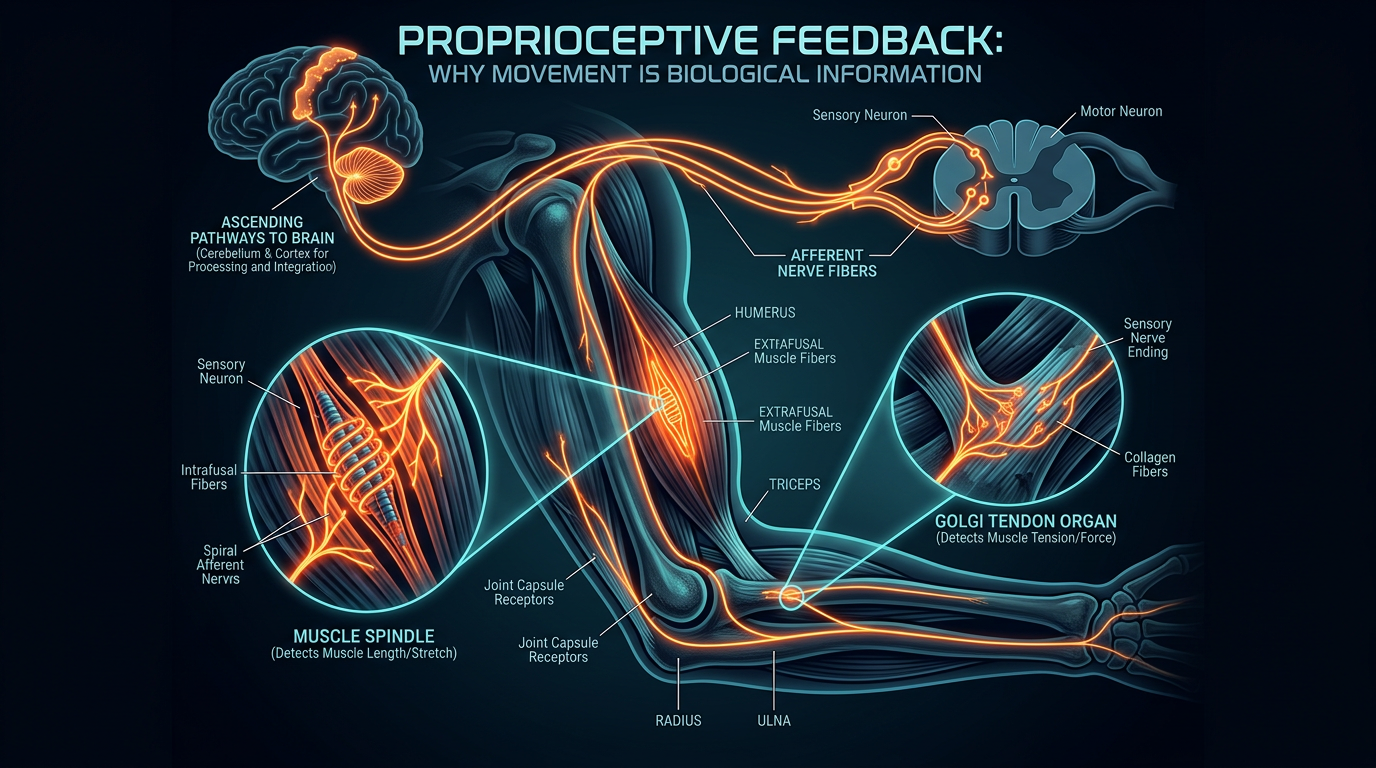
The biological architecture of proprioception is an intricate web of mechanical sensors and neural pathways that operate at speeds exceeding most other sensory modalities. To understand how movement becomes information, we must examine the Dorsal Column-Medial Lemniscus (DCML) pathway. This is the high-speed broadband cable of the nervous system, responsible for transmitting fine touch, vibration, and proprioceptive data from the limbs to the primary somatosensory cortex.
The Feedback Loop of Safety
The brain’s primary objective is survival, and survival is predicated on the ability to predict the environment. This is known as Predictive Processing. The brain maintains an internal map of the body, often referred to as the Cortical Homunculus. This map is not static; it is "written" and updated in real-time by incoming proprioceptive data.
When you move a joint, thousands of mechanoreceptors fire in a coordinated burst. This data enters the spinal cord, ascends the dorsal columns, and terminates in the thalamus before being processed by the parietal lobe. If the incoming data matches the brain's internal prediction (i.e., "I intended to move my arm 45 degrees, and the sensors confirm it moved 45 degrees"), the brain maintains a state of neurological coherence. In this state, the descending inhibitory pathways are active, effectively "muting" unnecessary pain signals.
The "Safety through Certainty" Principle
The moment the feedback loop is disrupted, the brain faces Bayesian Uncertainty. If the brain cannot accurately determine where the lower back is positioned due to hours of static sitting, it can no longer guarantee that a sudden movement won't cause injury. To prevent what it perceives as a potential catastrophe, it increases the "gain" on nociceptive (threat) signals.
UK FACT: Chronic pain affects approximately 28 million adults in the UK, nearly 43% of the population. A staggering proportion of these cases show no evidence of structural tissue damage on MRI scans, suggesting the origin is a functional failure of the nervous system's information processing.
##
Mechanisms at the Cellular Level
At the most granular level, proprioception is a feat of mechanotransduction—the process by which a physical force is converted into a biochemical signal. This occurs via specialised ion channels located in the membranes of mechanoreceptor cells.
PIEZO Channels: The Gatekeepers of Information
Recent breakthroughs in molecular biology have identified the PIEZO1 and PIEZO2 proteins as the primary sensors of mechanical force. These are massive, propeller-shaped proteins embedded in the cell membranes of sensory neurons. When the membrane is stretched or compressed by movement, these propellers rotate, opening a pore that allows an influx of cations (positively charged ions like calcium and sodium).
This influx creates an action potential—an electrical spike. The frequency and pattern of these spikes represent the "code" of the movement. If the tissue is healthy and moving through its full range, these PIEZO channels provide a rich, varied data set. If the tissue is stagnant or fibrotic, the channels remain closed or fire erratically, leading to afferent silence.
The Specialized Receptors
- Muscle Spindles: Located within the belly of the muscle, these detect changes in muscle length and the speed of that change. They are the most complex sensory organs in the body after the eyes.
- Golgi Tendon Organs (GTOs): Situated at the junction of muscle and tendon, these monitor tension. They act as a "circuit breaker," preventing the muscle from exerting force that would tear the tissue.
- Ruffini Endings and Pacinian Corpuscles: These reside in the joint capsules and fascia, detecting skin stretch and high-frequency vibration.
Fascia: The Communication Matrix
For decades, fascia was dismissed as "biological clingfilm." We now know it is the body's largest sensory organ. The fascia is saturated with free nerve endings and mechanoreceptors. It acts as a liquid crystal matrix that conducts information across the entire body. When movement is restricted, the fascia becomes dehydrated and "sticky" (cross-linking of collagen), which physically prevents mechanoreceptors from deforming and firing. This creates a "blind spot" in the brain's body map.
##
Environmental Threats and Biological Disruptors
The modern human environment is a biological mismatch for the proprioceptive system. We have engineered movement out of our lives, and in doing so, we have inadvertently created a state of systemic sensory deafferentation.
The Sedentary Siege
The human body evolved to navigate complex, uneven terrain. Today, we exist in a world of "flatland." Every floor, pavement, and shoe sole is a flat surface. This lack of architectural complexity means that the receptors in our feet—the foundation of our proprioceptive system—are rarely stimulated.
ALARMING STATISTIC: The average UK office worker spends between 9 and 10 hours a day sitting. Research indicates that prolonged sedentariness causes a rapid "downgrading" of the neural pathways connecting the gluteal muscles to the brain, a phenomenon known as Gluteal Amnesia.
Footwear as Sensory Deprivation
Modern footwear is perhaps the greatest disruptor of proprioceptive integrity. The thick, cushioned soles of modern trainers act as acoustic foam for the nervous system. They dampen the vibrations and ground reaction forces that the brain uses to calculate balance and posture. Furthermore, the narrow toe-boxes of conventional shoes deform the hallux (big toe), which is the primary "anchor" for the deep core and vestibular system. Without a functioning foot-to-brain connection, the brain perceives the act of walking as inherently unstable, leading to chronic tension in the calves and lower back as a compensatory strategy.
The Impact of Non-Native EMFs and Blue Light
While seemingly unrelated to movement, the vestibular system (inner ear) and the proprioceptive system are neurologically inextricable. High exposure to artificial blue light and electromagnetic frequencies (EMFs) can disrupt the delicate electrochemical balance of the vestibular hair cells. This creates a "mismatch" between what the eyes see and what the body feels, leading to a state of neural vertigo that the brain interprets as a high-threat environment, further amplifying pain sensitivity.
##
The Cascade: From Exposure to Disease
The transition from a lack of movement to a diagnosed chronic pain condition follows a predictable biological cascade. This is not a sudden event, but a slow erosion of neurological sovereignty.
Phase 1: Cortical Smudging
When a body part is not moved through its full range of motion, the area of the brain dedicated to that part (in the somatosensory cortex) begins to shrink and "blur" into adjacent areas. This is known as Cortical Smudging. For example, in chronic back pain patients, the brain’s map of the lumbar spine becomes fuzzy. The brain can no longer distinguish between L4 and L5 vertebrae. Because the brain cannot "see" the area clearly, it assumes the area is damaged and protects it with muscle guarding (spasm).
Phase 2: Allostatic Load and Central Sensitisation
As the brain's uncertainty grows, it enters a state of high Allostatic Load—the wear and tear on the body caused by chronic stress. The nervous system shifts into a sympathetic-dominant state (fight or flight). In this state, the threshold for firing pain signals is lowered. This is Central Sensitisation: the system becomes so "jumpy" that even a light touch or a normal movement is interpreted as agony.
Phase 3: Morphological Changes and Disease
Finally, the lack of information leads to physical changes in the tissue. Without the "biological information" of movement, cells do not receive the mechanical signals to produce healthy collagen or clear out metabolic waste. This leads to fibrosis, tendinopathy, and osteoarthritis. Mainstream medicine often identifies these as the cause of pain, whereas they are actually the result of a long-term proprioceptive deficit.
##
What the Mainstream Narrative Omits
The current medical approach to pain is fundamentally flawed because it views the body as a machine made of parts, rather than an informational system.
The MRI Fallacy
The mainstream narrative relies heavily on structural imaging. However, studies consistently show that a large percentage of people with "bulging discs" or "bone on bone" arthritis feel no pain at all, while those with "clean" scans suffer intensely. The missing variable is Information Integrity. A bulging disc is only a problem if the brain lacks the proprioceptive data to navigate around it safely.
The Chemical Cover-up
The pharmaceutical industry’s answer to chronic pain is the suppression of signals. Opioids, gabapentinoids, and NSAIDs do nothing to restore the quality of biological information; they simply "cut the wires" of the alarm system. By numbing the body, these drugs actually increase sensory poverty, making the brain feel even less safe in the long run. This is why patients often require higher doses over time—the brain is screaming louder because it is being further blinded.
The Neglect of Interstitial Health
Mainstream science often ignores the role of the Interstitium—the fluid-filled spaces between cells. Movement acts as a pump for this fluid. When we move, we flush out inflammatory cytokines and replenish the area with nutrients. Without movement, the interstitial fluid becomes stagnant and acidic, which chemically sensitises the nociceptors (pain sensors). No pill can replace the "biological irrigation" of movement.
##
The UK Context
The United Kingdom is currently facing a "pain epidemic" that is crippling the NHS and the broader economy. However, the UK's approach remains stubbornly tethered to outdated models.
ALARMING STATISTIC: In 2022, the NHS issued over 70 million prescriptions for analgesics. Despite this, reported pain levels in the population have not decreased, and the number of people out of work due to long-term sickness (primarily musculoskeletal and mental health) has reached record highs of over 2.5 million.
The UK's urban environment also contributes to this crisis. The "commuter culture"—long hours in cramped train seats followed by hours at a desk—creates a "proprioceptive desert." Furthermore, the UK’s climate, which discourages outdoor activity for several months of the year, combined with widespread Vitamin D deficiency (crucial for nerve health and myelination), exacerbates the breakdown of the nervous system's feedback loops.
The NHS's reliance on "Wait and See" and 10-minute consultations means that the complex, neurobiological nature of chronic pain is rarely addressed. Patients are often told their pain is "age-related" or "wear and tear," a narrative that encourages further kinesiophobia (fear of movement) and deepens the cycle of sensory poverty.
##
Protective Measures and Recovery Protocols
Restoring the quality of biological information is the only sustainable path to resolving chronic pain. This requires a systematic re-education of the nervous system.
1. Sensory Refinement (Not Just Exercise)
Recovery should not begin with "working out," but with "working in." This involves slow, mindful movements designed to increase the resolution of the cortical map.
- Somatic Education: Techniques such as the Feldenkrais Method or Hanna Somatics focus on "internal sensing." By moving slowly, the brain has time to process the PIEZO channel feedback and "re-map" the body.
- Differentiation: Practice moving one joint in isolation while keeping the rest of the body still. This forces the brain to sharpen its "image" of that specific area.
2. Grounding and Foot Re-wilding
The feet are the primary data ports for the body.
- Barefoot Exposure: Spend time walking barefoot on diverse textures (grass, sand, pebbles) to stimulate the 200,000 nerve endings in each foot.
- Minimalist Footwear: Transition to shoes with thin soles and wide toe-boxes to allow for natural mechanoreceptor stimulation during daily activities.
3. Loading as Information
Once the "map" is clearer, the tissue must be loaded. Resistance training is not just about building muscle; it is about providing the brain with high-tension data.
- Isometrics: Holding a position under tension (e.g., a wall sit) provides a constant, high-volume stream of data from the Golgi Tendon Organs, which can "reset" the nervous system’s threat threshold.
- Eccentric Loading: Slow, controlled lengthening of muscles under load provides the muscle spindles with the highest quality positional data.
4. Vagal Tone and the Safety Signal
Proprioceptive data cannot be integrated if the brain is in a state of high-alert.
- Diaphragmatic Breathing: The diaphragm is highly innervated with proprioceptors. Deep, rhythmic breathing sends a "safety signal" to the brain via the Vagus nerve, lowering the gain on pain signals.
- Temperature Contrast: Cold water exposure can "flush" the nervous system and reduce the background "noise" of systemic inflammation.
5. Nutritional Support for Nerve Conductance
Biological information requires a healthy medium.
- Magnesium and Potassium: Essential for the electrical function of the PIEZO channels and nerve firing.
- B-Vitamin Complex: Specifically B12 and B6, which are critical for maintaining the myelin sheath (the insulation on the neural "wires").
- Omega-3 Fatty Acids: Critical for cell membrane fluidity, ensuring that mechanoreceptor proteins can move and fire correctly.
##
Summary: Key Takeaways
The resolution of chronic pain is not found in a bottle or under a surgeon’s knife; it is found in the restoration of biological truth.
- Pain is a Request for Information: Chronic pain is the brain’s response to "sensory poverty." It is a protective mechanism triggered by uncertainty.
- Movement is Data: Every movement you make is a packet of information that updates the brain’s internal map of the body. High-resolution movement leads to a high-resolution map.
- The Brain Requires Certainty: When the brain can accurately predict the consequences of movement through clear proprioceptive feedback, it "turns off" the pain alarm.
- Modernity is a Mismatch: Our environment—flat floors, cushioned shoes, and static sitting—actively de-trains our nervous system. We must consciously re-introduce complexity and mechanical load.
- Restoration is Possible: Through mindful movement, foot re-wilding, and proper tissue loading, we can "re-map" the brain and resolve pain at its neurological source.
In the final analysis, we must stop viewing movement as an optional activity and start viewing it as a biological necessity. Your nervous system is a living, breathing information processor. Feed it the high-quality movement data it craves, and it will reward you with the freedom of a pain-free life. Understanding this is the first step toward true biological sovereignty.
This article is provided for informational and educational purposes only. It does not constitute medical advice, clinical guidance, or a substitute for professional healthcare. Information reflects cited research at time of publication. Always consult a qualified healthcare professional before acting on any health information.
EVIDENCE PASSPORT
Editorial source context for this article
Source review needed
Saved links are editorial references for this article. They may support specific claims rather than every sentence. Open and assess each source in context. This passport does not independently verify them.
Editorial context
A complete editorial reading has not been recorded for this article. Source links remain available for you to open and assess directly.
Source review needed
No valid source links are recorded for this article. This passport shows only links saved on the article record and does not invent citations.
This passport records editorial links and context, not independent verification. Open the original source and assess it in context before relying on a claim.
Medical Disclaimer
The information in this article is for educational purposes only and does not constitute medical advice, diagnosis, or treatment. Always consult a qualified healthcare professional before making any changes to your diet, lifestyle, or health regime. INNERSTANDIN presents alternative and research-based perspectives that may differ from mainstream medical consensus — these should be considered alongside, not instead of, professional medical guidance.
Read Full DisclaimerContinue the thread
Keep this question moving.
Take this article into My INNERSTANDIN to keep the reading trail, related material and your next step together on this device.
Explore this in the Body Map
See where this hits your biology. Interactive anatomy, threats, and protective protocols.
Dig deeper in the Library
Free, longform PDF volumes that go beyond headlines into mechanisms and references.