
The Relationship between Trauma and ADHD
Updated May 2026
Differentiating between the symptoms of complex PTSD and ADHD in clinical settings.
Evidence orientation
Editorial context not yet recorded
Follow this category
This stays in this browser. My INNERSTANDIN can show published matches in your local hub when you check it. It does not send email, push, or alert notifications.
Local learning review
A private browser aid for revisiting ideas. It is not an alert or a health recommendation.
Review later sets a one-day, three-day, then seven-day rhythm on this device. Choose it only when you want to revisit this article.
Executive Summary
The intersection of Attention Deficit Hyperactivity Disorder (ADHD) and psychological trauma represents one of the most complex frontiers in contemporary psychiatry and neurodevelopmental science. In the United Kingdom, as awareness of neurodiversity grows alongside a deeper understanding of Adverse Childhood Experiences (ACEs), clinicians and patients alike are grappling with a fundamental question: where does neurodevelopment end and environmental impact begin?
This article explores the bidirectional relationship between ADHD and trauma. It examines the symptomatic mimicry that often leads to misdiagnosis, the neurobiological underpinnings common to both, and the unique challenges faced by the UK healthcare system—from NICE guidelines to the strained resources of Child and Adolescent Mental Health Services (CAMHS). By understanding that ADHD and trauma are not mutually exclusive but often deeply intertwined, we can move towards a more holistic, trauma-informed model of care.
1. Introduction: The Great Mimicker
In clinical practice across the UK, a common scenario unfolds: a child is referred to a paediatrician for being "disruptive," "inattentive," or "unable to sit still." To the untrained eye, these are the hallmarks of ADHD. However, if that same child has experienced domestic instability, neglect, or bereavement, these same behaviours might be the somatic manifestations of a nervous system stuck in a state of hypervigilance.
ADHD is a neurodevelopmental condition characterised by a persistent pattern of inattention and/or hyperactivity-impulsivity that interferes with functioning or development. Trauma, particularly Complex Post-Traumatic Stress Disorder (C-PTSD), is a psychological and physiological response to deeply distressing events that overwhelm an individual’s ability to cope.
The relationship between the two is multifaceted. Trauma can mimic ADHD symptoms; ADHD can increase the likelihood of experiencing trauma; and the two conditions frequently co-occur, creating a "double hit" on the individual’s executive functioning and emotional regulation.
2. Defining the Conditions in a UK Context
2.1 ADHD: The Neurodevelopmental Perspective
In the UK, ADHD is diagnosed according to the criteria set out in the DSM-5 or the ICD-11. It is understood as a highly heritable condition (approximately 70-80% heritability) involving differences in brain structure and dopamine signalling. According to the National Institute for Health and Care Excellence (NICE), ADHD prevalence in the UK is estimated at about 5% in children and 3-4% in adults.
2.2 Trauma and C-PTSD
While "Simple" PTSD usually follows a single traumatic event, the UK clinical community has increasingly adopted the ICD-11 definition of Complex PTSD (C-PTSD). This typically arises from prolonged or repeated trauma (such as childhood abuse or neglect) and is characterised by three additional pillars: emotional dysregulation, negative self-concept, and interpersonal difficulties. These pillars overlap significantly with the "emotional dysregulation" often seen in ADHD.
3. The Symptomatic Overlap: A Diagnostic Minefield
The primary challenge for UK clinicians is that the symptomatic "Venn diagram" between ADHD and trauma is nearly a circle in several key areas.
3.1 Inattention and Dissociation
An ADHD brain struggles to filter out irrelevant stimuli because of a lack of "top-down" control from the prefrontal cortex. A traumatised brain, however, may appear inattentive because it is preoccupied with "bottom-up" scanning for threats (hypervigilance) or because the individual is dissociating as a defence mechanism. In a classroom in Manchester or London, both children look "spaced out," but the internal mechanism is vastly different.
3.2 Hyperactivity and Hyperarousal
The "H" in ADHD manifests as physical restlessness—fidgeting, tapping, or an internal feeling of being "driven by a motor." Trauma-induced hyperarousal looks remarkably similar. A child with an overactive sympathetic nervous system (the "fight or flight" response) is physically unable to remain still. Their body is primed for a threat that isn't there, leading to the same "fidgety" behaviour seen in neurogenetic ADHD.
3.3 Impulsivity and Survival Instincts
ADHD impulsivity is often a result of a seeking for immediate dopamine rewards or an inability to inhibit a response. Trauma-related impulsivity is often a survival strategy. If a child has grown up in an environment where resources are scarce or safety is volatile, "acting now and thinking later" is a logical, albeit maladaptive, developmental response.
4. The Neurobiology of the Overlap
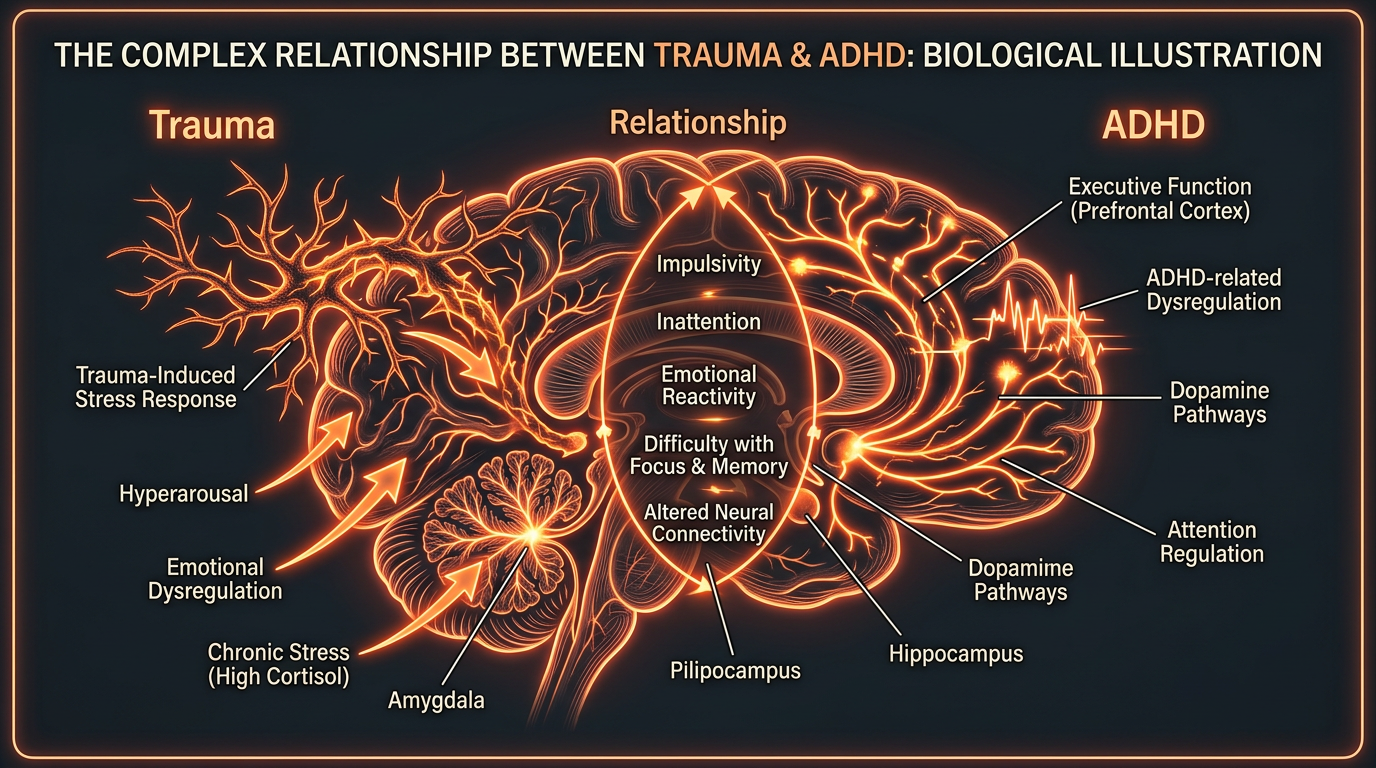
To understand why these conditions look so similar, we must look at the brain architecture. Both ADHD and trauma affect the "orchestra" of the brain, specifically the Prefrontal Cortex (PFC), the Amygdala, and the Hippocampus.
4.1 The Prefrontal Cortex (The CEO)
The PFC is responsible for executive functions: planning, impulse control, and emotional regulation. In ADHD, the PFC shows lower levels of activation and delayed maturation. In trauma, the PFC is essentially "taken offline" by the amygdala. Chronic stress floods the brain with cortisol, which, over time, can impair the PFC’s ability to regulate lower brain centres.
4.2 The Amygdala (The Alarm)
The amygdala is the brain's smoke detector. In traumatised individuals, this detector is set to a "hair-trigger" sensitivity. Interestingly, recent neuroimaging suggests that individuals with ADHD also have differences in amygdala volume and connectivity, which may explain the intense emotional "rejection sensitivity" common in the condition.
4.3 The HPA Axis
The Hypothalamic-Pituitary-Adrenal (HPA) axis manages the stress response. Chronic childhood trauma "re-wires" this axis, leading to either a constant state of high cortisol (anxiety/hyperactivity) or a "crash" into low cortisol (fatigue/inattention). ADHD also involves dysregulation of the HPA axis, suggesting that even "pure" ADHD involves a physiological struggle to manage internal and external stressors.
5. The Bidirectional Relationship: A Two-Way Street
It is a mistake to view the relationship as merely "one mimicking the other." They interact in a "vicious cycle."
5.1 Trauma as a Catalyst for ADHD Symptoms
While you cannot "catch" ADHD from trauma, Adverse Childhood Experiences (ACEs) can exacerbate a genetic predisposition. Epigenetics tells us that environmental stressors can "turn on" certain genes. A child might have the genetic markers for ADHD that would have remained manageable in a stable environment, but severe early-life stress triggers a full symptomatic expression.
5.2 ADHD as a Risk Factor for Trauma
This is perhaps the most overlooked aspect of the relationship in the UK. Individuals with ADHD are statistically more likely to experience trauma. Why?
- Social Vulnerability: Difficulty reading social cues or impulsivity can lead to bullying or social exclusion.
- Increased Risk-Taking: ADHD brains seek stimulation, leading to a higher likelihood of accidents or dangerous situations.
- Parental/Institutional Stress: A child with undiagnosed ADHD often faces constant negative feedback. In the UK, the disproportionate exclusion rates of ADHD children from schools are a form of "institutional trauma." Being repeatedly told you are "lazy," "naughty," or "a failure" is a chronic stressor that can lead to C-PTSD.
6. Rejection Sensitive Dysphoria (RSD) and Trauma
A term frequently used in the UK ADHD community—though not yet a formal diagnosis in the ICD-11—is Rejection Sensitive Dysphoria (RSD). This describes the extreme emotional pain triggered by the perception of being rejected or criticised.
There is a profound overlap here with trauma. A child who has experienced "insecure attachment" (a form of developmental trauma) will naturally be hyper-sensitive to signs of rejection as a survival mechanism. For an adult with both ADHD and a history of trauma, a minor criticism at work can feel like a life-threatening assault on their character, leading to a "shutdown" that looks like a depressive episode or an "outburst" that looks like bipolar disorder.
7. Assessment and Diagnosis in the UK
The UK's approach to diagnosing ADHD in the context of trauma is governed largely by NICE guideline [NG87]. However, the reality of the NHS often complicates this.
7.1 The Problem of "Overshadowing"
Diagnostic overshadowing occurs when a clinician attributes all of a patient's symptoms to one condition while ignoring the other. In the UK, if a patient has a clear history of trauma, clinicians may be hesitant to diagnose ADHD, fearing they are medicalising a social problem. Conversely, a "quick" ADHD diagnosis might miss the underlying trauma that requires specific therapeutic intervention.
7.2 The Developmental History
A hallmark of ADHD diagnosis is that symptoms must have been present before age 12. This is meant to distinguish it from adult-onset trauma. However, for many adults seeking diagnosis in the UK today—the "lost generation" of women and high-masking individuals—recalling their childhood is difficult, especially if that childhood was traumatic. Trauma can cause memory gaps, making the traditional ADHD diagnostic pathway (which often requires parental testimony) fraught with difficulty.
7.3 The Role of CAMHS and Long Waiting Lists
With NHS waiting lists for ADHD assessments often stretching to 2-5 years in some trusts, many families are forced to seek private assessments or remain in a state of limbo. During this waiting period, a child’s "symptoms" (whether ADHD or trauma) often worsen as they internalise the failure of the system to support them, creating further layers of secondary trauma.
8. Treatment Strategies: An Integrated Approach
If we accept that ADHD and trauma are linked, the treatment must be multimodal. Treating ADHD with medication while ignoring trauma is like putting a plaster on a broken leg; treating trauma while ignoring ADHD is like trying to build a house on shifting sands.
8.1 Pharmacological Interventions
Stimulants (such as Methylphenidate or Lisdexamfetamine) are the first-line treatment for ADHD in the UK. For a traumatised individual with ADHD, medication can be a double-edged sword.
- The Benefit: By "quieting" the ADHD noise and improving executive function, medication can give a patient the cognitive "bandwidth" to engage in trauma therapy.
- The Risk: For some with PTSD, stimulants can exacerbate anxiety or hypervigilance. A careful, slow titration is essential, often involving non-stimulant options like Atomoxetine or Guanfacine, which can also help with emotional regulation.
8.2 Trauma-Focused Therapies
For those with a trauma history, the UK's "gold standard" is often Eye Movement Desensitisation and Reprocessing (EMDR) or Trauma-Focused CBT (TF-CBT). These therapies aim to process traumatic memories so they no longer trigger the sympathetic nervous system.
Crucially, these therapies must be adapted for the ADHD brain. Standard CBT, which requires high levels of organisation and "homework," often fails ADHD patients. Therapists must use "ADHD-friendly" adaptations: shorter sessions, visual aids, and a focus on somatic (body-based) experiencing rather than purely talk-based therapy.
8.3 The "Top-Down" and "Bottom-Up" Approach
An authoritative treatment plan should involve:
- Top-Down (Cognitive): Coaching, CBT, and psychoeducation to manage executive dysfunction.
- Bottom-Up (Physiological): Mindfulness, yoga, EMDR, or vagus nerve stimulation to calm the traumatised nervous system.
9. The Role of Schools and the EHCP Process
In the UK context, the school environment is often where the collision of ADHD and trauma is most visible. The Education, Health and Care Plan (EHCP) is the primary mechanism for securing support.
9.1 Trauma-Informed Pedagogy
UK schools are increasingly moving towards "trauma-informed" practices. This involves moving away from punitive "zero-tolerance" policies—which disproportionately harm ADHD and traumatised children—towards "relational regulation." When a child has a meltdown, the question shifts from "What is wrong with you?" to "What happened to you, and how can I help you feel safe?"
9.2 The "Double Burden" in the Classroom
A child with ADHD needs clear structure and stimulation. A child with trauma needs safety and predictability. When a child has both, they require a very specific environment: high nurture, low threat, but with enough engagement to prevent the ADHD brain from seeking stimulation through "naughty" behaviour.
10. Adult ADHD and "Life-Trauma"
For many UK adults, the diagnosis of ADHD comes in their 30s, 40s, or 50s. By this point, they have often accumulated decades of "life-trauma." This isn't necessarily a single catastrophic event, but the "trauma of a thousand cuts":
- The trauma of failed relationships.
- The trauma of persistent financial instability (the "ADHD tax").
- The trauma of workplace failures.
- The internalised shame of feeling "broken."
When treating an adult, a UK clinician must address the grief that comes with a late diagnosis. This grief is a form of trauma processing—processing the life they could have had if they had been supported earlier.
11. Socioeconomic Factors in the UK
We cannot discuss trauma and ADHD without acknowledging the UK’s socioeconomic landscape. The "Cost of Living Crisis," housing instability, and the erosion of community services are significant stressors.
Data from the UK’s Office for National Statistics and various mental health charities suggest a "poverty trap." Children in lower-income households are statistically more likely to experience ACEs (trauma) and are also more likely to be diagnosed with ADHD. Whether this is due to environmental triggers or better detection in state-funded systems is a matter of debate. However, the result is that the most vulnerable individuals in the UK are often the ones facing the most complex overlap of these two conditions with the least access to specialist "dual-pathway" care.
12. Culturally Competent Care
The relationship between trauma and ADHD also has a cultural dimension in the UK. Research indicates that children from Black and minoritised ethnic backgrounds are often under-diagnosed with ADHD but over-diagnosed with "conduct disorders."
Furthermore, the "trauma" experienced by these communities—including systemic racism and migration stress—is often overlooked in standard ADHD assessments. An authoritative approach requires clinicians to be culturally humble, recognising that "hypervigilance" in a child from a marginalised community may be a realistic response to their environment rather than a symptom of a disorder.
13. Practical Advice for Patients and Caregivers
For those navigating this complex intersection in the UK, the following steps are vital:
- Seek a Holistic Assessment: When applying for an ADHD assessment (whether via the NHS or "Right to Choose"), ensure the clinician is experienced in trauma. Ask: "How do you differentiate between ADHD and trauma-related hyperarousal?"
- Focus on Regulation First: Before tackling "focus" or "organisation," focus on safety. A brain that doesn't feel safe cannot learn or plan. This might mean prioritising sleep, diet, and physical safety.
- Validate the Struggle: If you have both, recognise that you are playing the "game of life" on the "hardest" setting. Self-compassion is not a luxury; it is a clinical necessity.
- Use UK Resources: Utilise organisations like ADHD UK, ADHD Foundation, and Mind. Look for "Trauma-Informed ADHD" peer support groups.
14. The Future: A Unified Model?
The future of UK psychiatry is moving away from rigid silos. We are beginning to see the emergence of "Neuro-Somatic" models that look at the nervous system as a whole.
Instead of asking, "Is it ADHD or is it Trauma?", we should be asking, "What is the state of this person's nervous system, and what tools (medication, therapy, environment) will help them find balance?"
There is also promising research into the role of "Neuro-inflammation." Chronic stress (trauma) causes inflammation in the brain, which can mimic or worsen ADHD symptoms. Future treatments may include anti-inflammatory diets or medications, bridging the gap between the biological and the psychological.
15. Conclusion
The relationship between trauma and ADHD is not a simple case of "either/or." It is a complex, symbiotic interaction that defines the lives of millions in the UK.
ADHD provides the neurodevelopmental template—a brain wired for novelty, speed, and intensity, but struggling with regulation. Trauma provides the environmental script—a nervous system conditioned by fear and instability. When they meet, the resulting "symptom profile" is more than the sum of its parts.
For the UK healthcare system, the challenge is clear: we must move beyond the 15-minute consultation and the single-issue waiting list. We need a trauma-informed neurodiversity model that recognises the validity of a person's brain structure and the validity of their life experience.
By unravelling the threads of trauma and ADHD, we don't just find better diagnoses; we find the human being underneath. Only then can we provide the path to true resilience and flourishing, moving from a state of mere survival to one of thriving neurodivergent life.
References & Further Reading (UK Context)
- NICE Guidelines [NG87]: Attention deficit hyperactivity disorder: diagnosis and management.
- The British Psychological Society (BPS): Position Statement on the Classification of Behaviour and Experience.
- YoungMinds UK: Reports on the impact of ACEs on childhood development.
- The ADHD Foundation: Resources on the "Integrated Health" model for neurodiversity.
- ICD-11 (World Health Organization): Criteria for Complex PTSD, as used in NHS clinical coding.
- Brown, T.E. (2005): Attention Deficit Disorder: The Unfocused Mind in Children and Adults (Essential for understanding executive function).
- Van der Kolk, B. (2014): The Body Keeps the Score (The definitive text on how trauma reshapes the brain).
Author’s Note: This article is intended for informational purposes and does not constitute medical advice. If you are concerned about ADHD or trauma, please consult your GP or a qualified mental health professional. In the UK, you can access support via NHS 111 or your local mental health crisis team.
This article is provided for informational and educational purposes only. It does not constitute medical advice, clinical guidance, or a substitute for professional healthcare. Information reflects cited research at time of publication. Always consult a qualified healthcare professional before acting on any health information.
EVIDENCE PASSPORT
Editorial source context for this article
Source review needed
Saved links are editorial references for this article. They may support specific claims rather than every sentence. Open and assess each source in context. This passport does not independently verify them.
Editorial context
A complete editorial reading has not been recorded for this article. Source links remain available for you to open and assess directly.
Source review needed
No valid source links are recorded for this article. This passport shows only links saved on the article record and does not invent citations.
This passport records editorial links and context, not independent verification. Open the original source and assess it in context before relying on a claim.
Medical Disclaimer
The information in this article is for educational purposes only and does not constitute medical advice, diagnosis, or treatment. Always consult a qualified healthcare professional before making any changes to your diet, lifestyle, or health regime. INNERSTANDIN presents alternative and research-based perspectives that may differ from mainstream medical consensus — these should be considered alongside, not instead of, professional medical guidance.
Read Full DisclaimerContinue the thread
Keep this question moving.
Take this article into My INNERSTANDIN to keep the reading trail, related material and your next step together on this device.
Explore this in the Body Map
See where this hits your biology. Interactive anatomy, threats, and protective protocols.
Dig deeper in the Library
Free, longform PDF volumes that go beyond headlines into mechanisms and references.