
Synthetic Substitutes: The Truth Behind UK Margarines
Updated May 2026
Marketed as 'heart healthy', synthetic margarines are often cocktails of interesterified fats and chemical additives. We expose the industrial manufacturing processes used to turn liquid oils into solid spreads.
Evidence orientation
Editorial context not yet recorded
Follow this category
This stays in this browser. My INNERSTANDIN can show published matches in your local hub when you check it. It does not send email, push, or alert notifications.
Local learning review
A private browser aid for revisiting ideas. It is not an alert or a health recommendation.
Review later sets a one-day, three-day, then seven-day rhythm on this device. Choose it only when you want to revisit this article.
Overview
For decades, the British public has been the subject of one of the most successful, yet biologically devastating, marketing campaigns in history. Since the mid-20th century, a concerted effort by industrial food manufacturers, backed by skewed nutritional guidelines, has demonised natural animal fats while elevating synthetic margarines and "vegetable" oil spreads to the status of health foods. Marketed under the guise of "heart health" and "cholesterol-lowering" properties, these products are not foods in the traditional sense; they are highly engineered chemical compositions.
The transition from butter—a substance humans have consumed for millennia—to margarine represents a radical departure from our evolutionary biological requirements. What was once a product born of necessity (a cheap butter substitute for the French navy in 1869) has morphed into a sophisticated cocktail of interesterified fats, solvent-extracted seed oils, emulsifiers, and synthetic vitamins.
In the United Kingdom, brands like Flora, Stork, and Bertolli dominate supermarket shelves, often carrying "heart-healthy" ticks from various health organisations. However, underneath the bright packaging lies a manufacturing process involving high heat, chemical catalysts, and petroleum-based solvents. This article aims to pull back the curtain on the industrial reality of margarine production and the profound biological consequences of consuming these synthetic lipids. We are not merely looking at a "spread"; we are looking at a fundamental disruptor of human lipid metabolism.
The Biology — How It Works
To understand why margarine is a biological mismatch, one must first understand the nature of fatty acids. Natural fats, such as those found in butter, tallow, or cold-pressed olive oil, exist in stable molecular configurations that the human body is evolutionarily primed to recognise and metabolise.
Margarine, conversely, is an attempt to force liquid oils—primarily from seeds like rapeseed (canola), sunflower, and soya—to behave like solid saturated fats at room temperature.
The Industrial Metamorphosis
The journey of a margarine tub begins not in a kitchen, but in a heavy-industrial refinery. The process typically involves several aggressive stages:
- Extraction: Seeds are crushed and heated to high temperatures. To maximise yield, a petroleum-derived solvent called hexane is used to leach the remaining oil.
- Degumming and Refining: The crude oil is treated with phosphoric acid to remove phospholipids (gums) that would otherwise make the oil cloudy.
- Bleaching: Because the extracted oil is often a grey or brown rancid sludge, it is filtered through bleaching clays to "clean" its appearance.
- Deodorisation: High-heat steam distillation (up to 250°C) is used to strip the oil of the foul odours caused by the oxidation that occurred during extraction.
- Solidification: This is the most critical stage. Since liquid seed oils are high in polyunsaturated fatty acids (PUFAs), they are unstable and liquid. To make them spreadable, the industry previously used hydrogenation (creating trans fats). Following the public outcry over trans fats, the industry pivoted to interesterification.
Fact: The deodorisation process in margarine manufacturing is so intense that it actually strips away any natural antioxidants (like Vitamin E) that might have survived the initial extraction, necessitating the addition of synthetic versions later.
The Rise of Interesterified Fats
Interesterification is the new "silent" technology of the margarine world. Unlike hydrogenation, which changes the saturation of the fat, interesterification rearranges the fatty acids on the glycerol backbone of the triglyceride molecule. Using chemical catalysts like sodium methoxide or lipase enzymes, manufacturers swap the positions of saturated and unsaturated fatty acids to create a "designer fat" with a specific melting point.
While the industry claims this is safer than trans fats, the biological reality is that these "randomised" fats do not exist in nature. Our metabolic enzymes (lipases) are highly specific; they expect fatty acids to be in particular positions (Sn-1, Sn-2, or Sn-3) on the glycerol molecule. When we consume interesterified fats, we are forcing our biology to process "molecular puzzles" it has never encountered in its evolutionary history.
Mechanisms at the Cellular Level
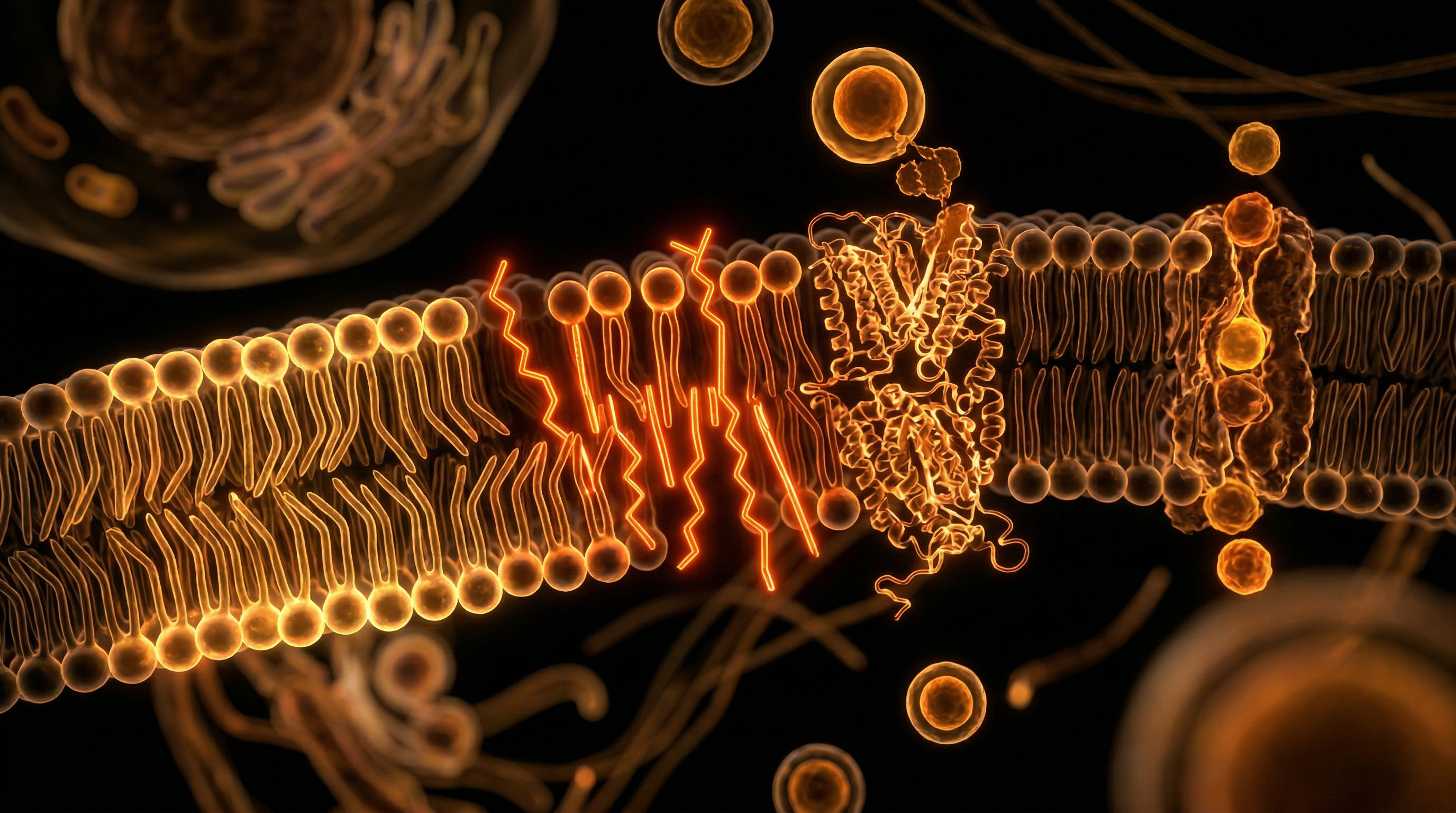
Lipids are not just "fuel"; they are structural components. Every cell in the human body is encased in a phospholipid bilayer—a double layer of fats that governs cellular integrity, communication, and nutrient transport.
Membrane Fluidity and Integrity
When you consume synthetic spreads, the fatty acids within them are incorporated into your cell membranes. Saturated fats provide structure, while polyunsaturated fats provide fluidity. However, the highly processed, often oxidised PUFAs in margarine create "leaky" or overly fragile membranes.
Moreover, the interesterified fats mentioned previously have been shown to alter the way the body handles glucose. Because the structure of the fat is foreign, it can interfere with insulin receptors embedded in the cell membrane. If the membrane is "clogged" with synthetic lipid structures, the signal for insulin to allow glucose into the cell becomes muffled, leading to insulin resistance.
Lipid Peroxidation
The primary ingredients in UK margarines are Omega-6 rich seed oils. These oils are inherently unstable due to their multiple double bonds. Under the heat of manufacturing—and even during storage on supermarket shelves—these bonds break, leading to the formation of lipid peroxides and 4-Hydroxynonenal (4-HNE).
Statistic: Research indicates that 4-HNE is a highly reactive aldehyde that can bind to proteins and DNA, causing "molecular scarring" within the cell.
When these oxidised fats are incorporated into the mitochondria (the powerplants of the cell), they trigger a cascade of oxidative stress. This reduces the cell's ability to produce ATP (energy) and can eventually lead to apoptosis (programmed cell death) or, worse, the kind of cellular dysfunction that precedes oncogenesis (cancer).
Environmental Threats and Biological Disruptors
The "safety" of margarine is often assessed through the lens of individual ingredients, but this ignores the cumulative "toxic load" of the additives and residues inherent in industrial fat production.
Hexane Residues
Despite the industry's claims that solvents are removed during refining, trace amounts of hexane—a neurotoxin—have been detected in refined vegetable oils. For a consumer eating margarine daily, this represents a chronic, low-level exposure to a petroleum derivative that the human liver was never designed to detoxify in such a manner.
The Glyphosate Connection
In the UK, a significant portion of the rapeseed and soya used for margarine is sourced from crops that have been "desiccated" or treated with glyphosate-based herbicides. Glyphosate doesn't just sit on the surface; it can be taken up by the plant. Emerging research suggests glyphosate can act as a "mineral chelator," stripping the body of essential co-factors like magnesium and manganese, and disrupting the shikimate pathway in our gut microbiome—a pathway essential for the production of neurotransmitters like serotonin.
Chemical Additives and Emulsifiers
Because margarine is an emulsion of oil and water (two substances that naturally repel), it requires a heavy load of emulsifiers to remain shelf-stable. Common additives include:
- Mono- and diglycerides of fatty acids (E471): Often sourced from low-quality fats, used to give a smooth mouthfeel.
- Potassium Sorbate: A preservative that inhibits mould but has been questioned regarding its potential for genotoxicity in human white blood cells.
- Synthetic Beta-Carotene: Used to turn the naturally greyish sludge into an "appealing" butter-yellow. Unlike the beta-carotene in carrots, synthetic versions have been linked in some studies to increased risks in specific populations.
The Cascade: From Exposure to Disease
The central irony of the margarine narrative is that the very product sold to prevent heart disease may actually be a primary driver of cardiovascular dysfunction.
The oxLDL Paradigm
Mainstream medicine focuses on LDL cholesterol levels. However, LDL itself is not inherently "bad"—it is a transport vessel. The danger arises when the lipids inside the LDL particle become oxidised. High consumption of linoleic acid (the primary fatty acid in margarine) leads to an abundance of linoleic acid within the LDL particles.
These particles are highly susceptible to oxidation. Oxidised LDL (oxLDL) is what is actually taken up by macrophages in the arterial walls to form foam cells, which are the building blocks of atherosclerotic plaque. By replacing stable saturated fats (butter) with unstable PUFAs (margarine), we are essentially providing the "kindling" for arterial inflammation.
The Inflammation Cascade
The high Omega-6 content of synthetic spreads shifts the body's eicosanoid balance. Omega-6 fatty acids are precursors to pro-inflammatory signalling molecules. While some inflammation is necessary for healing, a diet dominated by margarine creates a state of chronic systemic inflammation.
Callout: Chronic inflammation is now recognised as the "silent killer" behind almost all modern non-communicable diseases, including Type 2 diabetes, Alzheimer's (often called Type 3 diabetes), and metabolic syndrome.
Liver Health: The NAFLD Connection
The liver is the primary organ responsible for processing fats. The deluge of processed seed oils and synthetic fats found in margarines places an immense burden on the liver. Non-Alcoholic Fatty Liver Disease (NAFLD) has skyrocketed in the UK, even among children. While high fructose corn syrup is a known culprit, the role of oxidised industrial fats in causing "hepatic lipid peroxidative stress" is a critical, yet often ignored, factor.
What the Mainstream Narrative Omits
To understand why margarine is still recommended, one must follow the money and the history of "Science for Hire."
The Keys Legacy
The war on saturated fat began with Ancel Keys and his "Seven Countries Study." Keys cherry-picked data to show a correlation between saturated fat and heart disease, conveniently ignoring countries like France and Switzerland where high saturated fat intake coincided with low heart disease rates. This flawed science became the foundation for the UK's nutritional guidelines in the 1970s and 80s.
Corporate Sponsorship of "Health"
Many of the organisations providing "heart-healthy" stamps on margarine tubs receive significant funding from the manufacturers themselves. For example, Unilever (the former owner of Flora) has historically had deep ties to nutritional research funding. When a product's health claims are funded by the company selling the product, the "science" produced is often nothing more than marketing dressed in a lab coat.
The "Saturated Fat" Rebrand
The mainstream narrative omits the fact that the human heart actually prefers saturated fats and ketones as its primary energy sources. Furthermore, the "cholesterol-lowering" effect of margarine is a biological sleight of hand. While seed oils do lower serum cholesterol, they do so by forcing the cholesterol out of the blood and into the tissues, including the arteries, and by increasing the rate of oxidation—a net negative for longevity.
The UK Context
The United Kingdom has a unique relationship with "Yellow Fats" (the industry term for spreads). Since the post-war era, the UK government has pushed "vegetable" spreads as a way to manage public health costs, believing the lipid hypothesis to be settled science.
The NHS Guidelines
Even today, the NHS website encourages citizens to "choose lower-fat spreads" and replace butter with "spreads made from vegetable oils." This advice persists despite a growing body of meta-analyses showing no significant link between saturated fat consumption and heart disease.
British Brand Dominance
In the UK, Flora (now owned by Upfield) has pivoted heavily toward "plant-based" marketing. By leveraging the modern "vegan" and "plant-based" movements, margarine manufacturers have successfully rebranded a highly processed industrial product as an "eco-friendly" health choice.
However, a "plant-based" spread is not a plant. It is a chemical derivative of a plant. The UK public is being led to believe that a tub of chemically interesterified rapeseed oil is somehow more "natural" than butter produced from cows grazing on British pasture.
The "Stork" Heritage
For generations, British bakers were told that Stork margarine produced better cakes than butter. This was a result of specific emulsifiers that allowed for more air to be trapped in the batter. This "functional" benefit helped embed margarine into the British culinary psyche, masking the nutritional cost of these additives.
Protective Measures and Recovery Protocols
If you have been a long-term consumer of synthetic margarines, your cell membranes likely reflect that history. However, the body is resilient. Lipids in the body have a turnover rate, and by changing your intake, you can "remodel" your cellular structure.
Step 1: The Immediate Purge
The first step is total elimination. This includes not just the margarine tub, but also the hidden "industrial fats" in supermarket breads, biscuits, and ready meals. In the UK, checking labels for "vegetable oil," "rapeseed oil," or "hydrogenated/interesterified fats" is essential.
Step 2: Return to Ancestral Fats
Replace synthetic spreads with stable, heat-resistant fats:
- Butter (preferably grass-fed): Contains Butyrate (anti-inflammatory for the gut) and Vitamin K2 (essential for directing calcium to the bones and away from the arteries).
- Ghee (Clarified Butter): Virtually free of lactose and casein, with an even higher smoke point.
- Tallow and Suet: The traditional fats of the British Isles, highly stable and rich in stearic acid.
- Extra Virgin Olive Oil: Use for low-heat cooking or as a dressing. Ensure it is high quality, as the UK market is flooded with "diluted" olive oils.
Step 3: Support Lipid Metabolism
To repair the damage of lipid peroxidation, the body requires specific co-factors:
- Vitamin E (Tocopherols and Tocotrienols): The body's primary fat-soluble antioxidant. Source from avocados and almonds.
- Selenium: Essential for the production of glutathione peroxidase, an enzyme that neutralises lipid peroxides.
- Glycine: Found in bone broth, glycine supports the liver's detoxification pathways.
Step 4: Optimising the Omega Ratio
The goal is to lower the Omega-6 to Omega-3 ratio. Since margarine drives this ratio toward 20:1 (highly inflammatory), you must actively increase Omega-3s from wild-caught oily fish (sardines, mackerel) to bring the ratio closer to the evolutionary ideal of 1:1 or 4:1.
Summary: Key Takeaways
- Margarine is a highly processed industrial product, not a food. It requires hexane extraction, bleaching, and deodorisation to be palatable.
- Interesterification is a modern method of molecularly rearranging fats that creates "unnatural" triglyceride structures, potentially leading to metabolic dysfunction.
- Lipid peroxidation is the true driver of heart disease. The unstable oils in margarine oxidise easily, damaging cell membranes and arterial walls.
- The "Heart Healthy" label is a relic of outdated science and corporate influence. Current UK guidelines do not reflect the latest understanding of lipid biochemistry.
- Recovery is possible by returning to ancestral fats like butter and tallow, which provide the stable saturated fats necessary for cellular integrity and hormonal health.
The British public deserves a nutritional narrative based on biological reality rather than industrial convenience. The "Truth Behind UK Margarines" is that they are a synthetic substitute for the very fats our bodies require to thrive. By choosing the churn over the factory, we reclaim our health from the industrial food complex.
This article is provided for informational and educational purposes only. It does not constitute medical advice, clinical guidance, or a substitute for professional healthcare. Information reflects cited research at time of publication. Always consult a qualified healthcare professional before acting on any health information.
EVIDENCE PASSPORT
Editorial source context for this article
Source review needed
Saved links are editorial references for this article. They may support specific claims rather than every sentence. Open and assess each source in context. This passport does not independently verify them.
Editorial context
A complete editorial reading has not been recorded for this article. Source links remain available for you to open and assess directly.
Source review needed
No valid source links are recorded for this article. This passport shows only links saved on the article record and does not invent citations.
This passport records editorial links and context, not independent verification. Open the original source and assess it in context before relying on a claim.
Medical Disclaimer
The information in this article is for educational purposes only and does not constitute medical advice, diagnosis, or treatment. Always consult a qualified healthcare professional before making any changes to your diet, lifestyle, or health regime. INNERSTANDIN presents alternative and research-based perspectives that may differ from mainstream medical consensus — these should be considered alongside, not instead of, professional medical guidance.
Read Full DisclaimerContinue the thread
Keep this question moving.
Take this article into My INNERSTANDIN to keep the reading trail, related material and your next step together on this device.
Dig deeper in the Library
Free, longform PDF volumes that go beyond headlines into mechanisms and references.