
Trophic Level Magnification: The Food Chain Threat
Updated May 2026
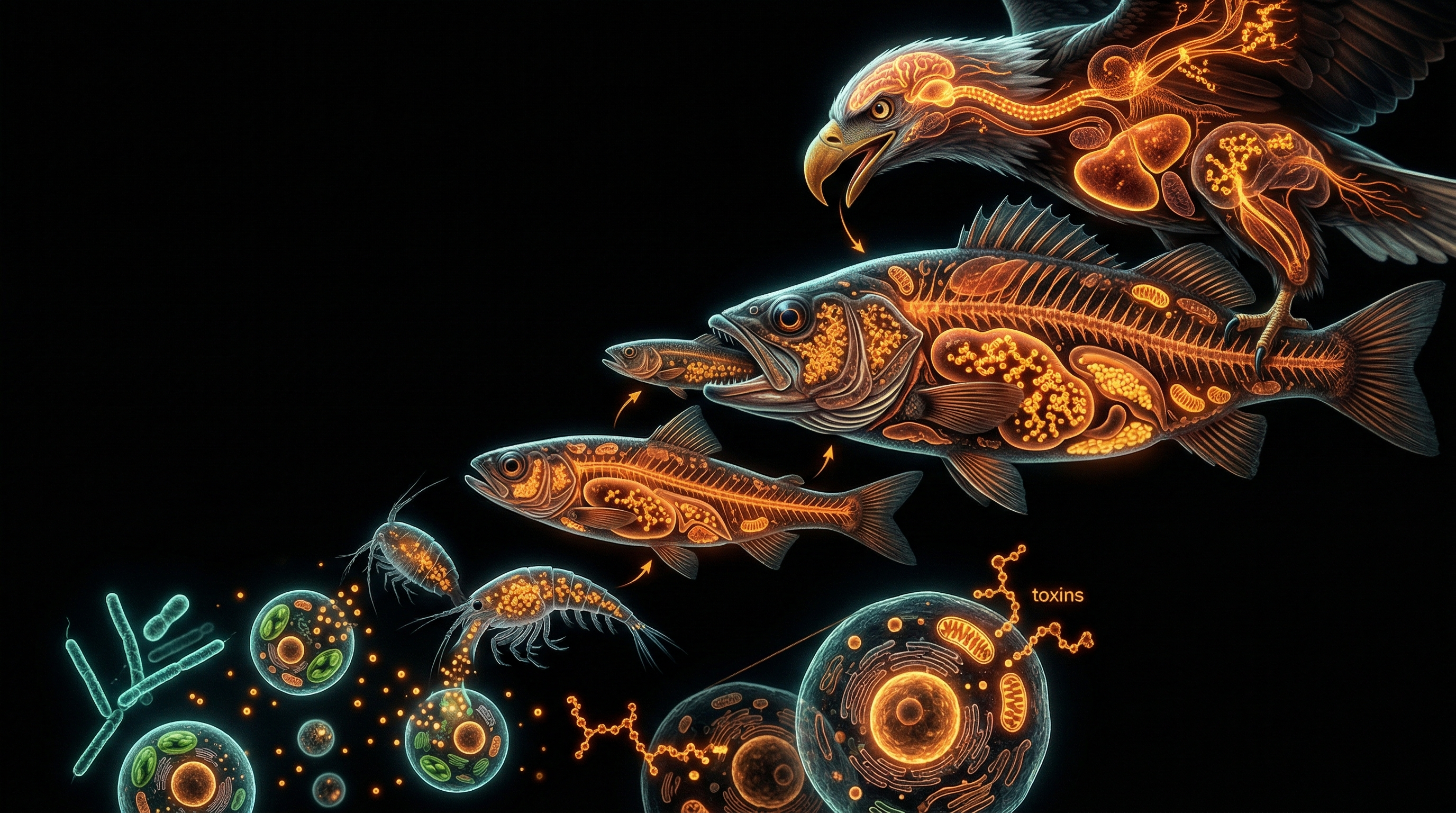
Microplastics accumulate and concentrate as they move up the food chain, from plankton to apex predators. Humans, as top consumers, are exposed to the highest cumulative doses of these pollutants.
Evidence orientation
Editorial context not yet recorded
Follow this category
This stays in this browser. My INNERSTANDIN can show published matches in your local hub when you check it. It does not send email, push, or alert notifications.
Local learning review
A private browser aid for revisiting ideas. It is not an alert or a health recommendation.
Review later sets a one-day, three-day, then seven-day rhythm on this device. Choose it only when you want to revisit this article.
Overview
In the contemporary era, the biosphere is grappling with a pollutant so pervasive and insidious that it has rewritten the foundational chemistry of our ecosystems. Trophic Level Magnification, often referred to as biomagnification, describes the process by which the concentration of a substance increases as it moves through the successive stages of a food web. While historically applied to heavy metals like mercury or persistent organic pollutants (POPs) like DDT, the most pressing biological crisis of the 21st century is the magnification of microplastics and nanoplastics (MNPs).
We are no longer merely living in a world containing plastic; we are living in a Plastisphere. These synthetic polymers, ranging from several millimetres down to the sub-micron level, are not inert. They are biologically active vectors. As a senior researcher for INNERSTANDING, I have observed that the mainstream scientific consensus is only now beginning to admit what the data has suggested for a decade: the human species, sitting at the apex of the global food pyramid, is becoming the ultimate repository for the world’s discarded polymers.
Fact: Recent studies have estimated that the average human may ingest between 39,000 to 52,000 microplastic particles per year from food sources alone, a figure that rises significantly when inhalation is accounted for.
This article explores the mechanics of how these particles migrate from primary producers like phytoplankton through the complex hierarchies of marine and terrestrial life, eventually colonising human tissues, bloodstreams, and even the placenta. We are witnessing a silent, systemic infiltration that threatens the reproductive and metabolic integrity of every living organism on the planet.
The Biology — How It Works
To understand trophic magnification, one must first grasp the distinction between bioaccumulation and biomagnification. Bioaccumulation is the process by which an individual organism absorbs a substance at a rate faster than that at which the substance is lost by excretion and catabolism. Biomagnification is the cumulative result of this process across multiple levels of the food chain.
The Foundation: Primary Producers
The journey begins at the base of the trophic pyramid. In marine environments, phytoplankton and zooplankton mistake nanoplastics for organic matter. Because nanoplastics (particles smaller than 1 micrometre) share the same size range as some species of algae and bacteria, they are ingested indiscriminately.
- Physical Blockage: Ingestion leads to a "false fullness," where the organism's gut is physically distended by non-nutritive plastic, leading to starvation despite a full stomach.
- Surface Adhesion: Even if not ingested, the high surface-area-to-volume ratio of nanoplastics allows them to adhere to the external membranes of microorganisms, inhibiting nutrient exchange and photosynthesis.
The Upward Migration
As small fish and filter feeders (such as mussels and oysters) consume thousands of these primary producers, they concentrate the plastic load. A single blue mussel can filter up to 25 litres of water a day, effectively acting as a biological vacuum for suspended particulates.
When a secondary consumer—for instance, a mackerel—eats a thousand contaminated zooplankton, it does not just inherit the plastic; it inherits the cumulative chemical burden attached to those plastics. This continues up to apex predators: tuna, sharks, seals, and humans. By the time the material reaches the top of the chain, the concentration per unit of body mass can be orders of magnitude higher than in the surrounding environment.
The Bioavailability Factor
The "threat" of trophic magnification is exacerbated by the hydrophobic nature of plastics. In the aquatic environment, microplastics act as "chemical sponges," adsorbing persistent organic pollutants (POPs) such as polychlorinated biphenyls (PCBs) and dioxins from the water.
Statistic: Microplastics can concentrate hydrophobic toxins from the surrounding seawater by a factor of up to 1,000,000 times, making them highly concentrated "poison pills" for any organism that ingests them.
Mechanisms at the Cellular Level
The true danger of micro- and nanoplastics lies in their ability to cross biological barriers. While larger microplastics may pass through the digestive tract and be excreted, nanoplastics possess the ability to translocate from the gut lumen into the circulatory and lymphatic systems.
The Protein Corona Effect
Once a nanoplastic particle enters a biological fluid (such as blood or interstitial fluid), it is immediately coated by proteins and lipids. This is known as the Protein Corona. This "biological cloak" hides the synthetic nature of the plastic, allowing it to interact with cell surface receptors and be internalised via endocytosis.
Translocation and Barriers
Because of their size and their "disguised" surface, these particles can breach:
- The Gut-Blood Barrier: Moving from the intestines into the bloodstream.
- The Blood-Brain Barrier (BBB): Entering the central nervous system, where they can trigger neuroinflammation.
- The Placental Barrier: Recent studies have confirmed the presence of microplastics in human placentas on both the foetal and maternal sides, suggesting that the "plastic burden" begins before birth.
The Trojan Horse Mechanism
Plastics are not just polymers; they are chemical cocktails. They contain additives used to provide flexibility (phthalates), UV resistance (stabilisers), and flame retardancy.
- Leaching: Once inside the warm, acidic, or lipid-rich environment of a human cell, these additives leach out.
- Adsorbed Toxins: As mentioned, the plastics also carry "hitchhiking" toxins from the environment. The plastic serves as a delivery vehicle (a Trojan Horse) that brings concentrated doses of external pollutants directly into the cellular interior.
Environmental Threats and Biological Disruptors
The ecological impact of trophic magnification extends beyond the individual organism to the destabilisation of entire ecosystems. When apex predators are compromised, the "top-down" control of the food web fails.
Endocrine Disruption (EDCs)
Most plastics contain known Endocrine Disrupting Chemicals (EDCs). These molecules mimic natural hormones, particularly oestrogen.
- In Wildlife: We are observing "intersex" fish and amphibians in UK waterways, where male organisms develop female reproductive organs due to plastic-leached endocrine disruptors.
- In Humans: The magnification of EDCs is linked to declining sperm counts, early onset of puberty, and hormone-sensitive cancers (breast and prostate).
Metabolic Syndrome and Obesogens
A growing body of research identifies certain plastic additives as obesogens—chemicals that interfere with lipid metabolism and promote the storage of fat. By magnifying these through the food chain, we are effectively "pre-programming" metabolic dysfunction in top-level consumers.
The Gut Microbiome
The human gut is an ecosystem in itself. Microplastics have been shown to alter the composition of the gut microbiota, a state known as dysbiosis.
- Plastic particles can provide a substrate for the growth of pathogenic "biofilms" (the Plastisphere microbiome).
- When we ingest these plastics, we also ingest a host of concentrated, potentially antibiotic-resistant bacteria that have colonised the plastic surface.
The Cascade: From Exposure to Disease
The progression from ingestion to clinical pathology is a multi-stage cascade. It is not an acute poisoning, but a chronic, low-grade inflammatory state that erodes health over decades.
Stage 1: Physical Irritation and Oxidative Stress
When particles lodge in tissues (such as the lungs or the intestinal lining), the immune system recognises them as foreign. However, unlike bacteria, the body cannot "digest" plastic. This leads to frustrated phagocytosis, where immune cells exhaust themselves trying to destroy the particle, releasing reactive oxygen species (ROS) and causing localised tissue damage.
Stage 2: Systemic Inflammation
The chronic release of pro-inflammatory cytokines in response to plastic particles leads to systemic inflammation. This is the "silent killer" behind most modern chronic diseases, including cardiovascular disease and autoimmune disorders.
Stage 3: Genotoxicity
Nanoplastics are small enough to enter the nucleus of a cell. There is emerging evidence that they can mechanically interfere with DNA replication or that the leached chemicals can cause double-strand breaks in the DNA, leading to mutations and oncogenesis (cancer).
Important Fact: Research has identified "Plasticosis" in seabirds—a specific fibrotic disease caused solely by the ingestion of plastic, resulting in extensive scarring of the digestive tract and a total loss of nutrient absorption capacity.
What the Mainstream Narrative Omits
As an investigator for INNERSTANDING, it is my duty to highlight the gaps in the public discourse. The narrative provided by regulatory bodies and industry-funded "science" is often sanitised to prevent economic panic.
The "Threshold of Toxicological Concern" Fallacy
Regulatory agencies often claim that the levels of plastic found in any single serving of food are below the "Threshold of Toxicological Concern." This is a reductionist deception. It ignores synergistic effects (how plastic additives interact with other environmental pollutants) and bio-persistence. A chemical may be "low dose," but if it is never excreted and its concentration is magnified every time you eat, the threshold is eventually breached.
The Recycling Myth
The public is told that recycling is the solution. In reality, mechanical recycling actually increases the toxicity of plastics. When different types of plastics are melted together, it creates a "toxic soup" of degraded polymers and additives. Furthermore, recycling facilities are themselves major sources of microplastic shedding into local water systems.
Regulatory Capture
In the UK and the EU, the lobbying power of the petrochemical industry is immense. Standards for "food-grade" plastic do not account for the long-term migration of nanoplastics into the food itself. We are essentially conducting a mass-scale biological experiment on the population without informed consent.
The Lag in Diagnostic Technology
The mainstream narrative omits the fact that we currently lack the clinical tools to routinely test for plastic burden in living patients. Most data comes from cadaver studies or high-level academic research using Raman spectroscopy. By the time the "average" GP can test your "Plastic Load," it will likely be too late for preventative action.
The UK Context
The United Kingdom, as an island nation with a dense population and a legacy of industrialisation, faces a unique set of challenges regarding trophic magnification.
The Thames: A Plastic Superhighway
The River Thames has been recorded as having some of the highest concentrations of microplastics in the world. This plastic does not stay in the water; it enters the sediment where it is consumed by bottom-dwellers like the European Eel and various crustacean species, which are then integrated into the broader UK food supply.
UK Agriculture and "Plastic Sludge"
A major and often ignored pathway in the UK is the use of sewage sludge as fertiliser.
- UK wastewater treatment plants are efficient at capturing microplastics from our laundry (synthetic fibres) and personal care products.
- These plastics end up in the "sludge" which is then spread onto British farmland.
- Earthworms ingest these plastics, concentrating them before being eaten by birds or livestock. This means even "grass-fed" British beef can be a vector for microplastic magnification.
Post-Brexit Regulatory Divergence
Following Brexit, the UK moved from the EU’s REACH (Registration, Evaluation, Authorisation and Restriction of Chemicals) framework to UK REACH. There are significant concerns among the scientific community that the UK may lag behind the EU in banning specific phthalates and microplastic "beads" used in industrial applications, potentially making the UK a "dumping ground" for lower-standard plastic products.
The "London Lung"
In urban centres like London, the magnification of microplastics is not just through food but through the inhalation of tyre wear particles. Tyres are made of synthetic rubber (a plastic polymer). These particles are shed into the air, settle on the soil of urban allotments, and enter the local food chain via home-grown produce—a direct path to human magnification in the capital.
Protective Measures and Recovery Protocols
While the systemic issue requires geopolitical intervention, individuals can take specific steps to mitigate their position as the final "sink" for these pollutants.
Dietary Choices and Trophic Awareness
To minimise exposure, one must apply the principle of "eating lower on the food chain."
- Prefer Smaller Fish: Avoid long-lived apex predators like tuna or swordfish, which have had years to magnify toxins. Opt for sardines or anchovies.
- Filter Your Water: Standard carbon filters are often insufficient for nanoplastics. Only Reverse Osmosis (RO) systems with high-quality membranes are capable of significantly reducing the nanoplastic load in tap water.
- Avoid Plastic Packaging: Heat is the primary catalyst for plastic migration. Never microwave food in plastic containers, and avoid hot drinks in plastic-lined paper cups.
Biological Support: Enhancing Elimination
While the body struggles to break down synthetic polymers, we can support the pathways that deal with the leached toxins.
- Up-regulate Phase II Detoxification: Consuming cruciferous vegetables (broccoli, kale) provides sulforaphane, which aids the liver in processing the endocrine disruptors (BPA, phthalates) carried by plastics.
- Soluble Fibre: A diet high in pectin and other soluble fibres can help "trap" some lipophilic toxins in the gut, preventing their reabsorption during the enterohepatic circulation process.
- Sweating: Some plastic additives, particularly phthalates, have been found to be excreted through sweat. Regular exercise or sauna use may reduce the body's chemical burden.
Systemic Recovery: The Precautionary Principle
On a societal level, we must move beyond "waste management" to "source reduction."
- The "Right to Repair": Reducing the production of new plastic by making goods last longer.
- Industrial Redesign: Moving toward truly biodegradable, PHB (Polyhydroxybutyrate) polymers derived from microbial fermentation, which can be broken down by natural enzymes.
Summary: Key Takeaways
- Trophic Magnification is the process where plastics and their associated toxins become more concentrated as they move up the food chain, with humans receiving the highest doses.
- Nanoplastics are the primary threat due to their ability to cross the blood-brain and placental barriers through the "Protein Corona" effect.
- Chemical Synergi: Plastics act as "Trojan Horses," delivering concentrated environmental pollutants (PCBs, DDT) directly into human cells.
- Ecosystem Instability: Microplastics are causing reproductive failure and metabolic disorders in wildlife, particularly in the UK's river systems.
- The "Plasticosis" Reality: We are seeing the emergence of new, fibrotic diseases directly linked to the physical presence of plastic in biological tissue.
- Systemic Failure: Mainstream narratives often downplay the cumulative risk, focusing on individual exposures rather than the lifetime bio-persistence of these materials.
- Precaution is Mandatory: Until global production is curtailed, the only defence is a combination of eating lower on the food chain, using advanced water filtration, and supporting the body's natural detoxification pathways.
The infiltration of our biology by synthetic polymers is the defining ecological crisis of our age. It is no longer enough to "reduce, reuse, recycle." We must understand that our bodies have become the final destination for our industrial waste. Only by acknowledging the reality of trophic magnification can we begin the work of biological and environmental recovery.
This article is provided for informational and educational purposes only. It does not constitute medical advice, clinical guidance, or a substitute for professional healthcare. Information reflects cited research at time of publication. Always consult a qualified healthcare professional before acting on any health information.
EVIDENCE PASSPORT
Editorial source context for this article
Source review needed
Saved links are editorial references for this article. They may support specific claims rather than every sentence. Open and assess each source in context. This passport does not independently verify them.
Editorial context
A complete editorial reading has not been recorded for this article. Source links remain available for you to open and assess directly.
Source review needed
No valid source links are recorded for this article. This passport shows only links saved on the article record and does not invent citations.
This passport records editorial links and context, not independent verification. Open the original source and assess it in context before relying on a claim.
Medical Disclaimer
The information in this article is for educational purposes only and does not constitute medical advice, diagnosis, or treatment. Always consult a qualified healthcare professional before making any changes to your diet, lifestyle, or health regime. INNERSTANDIN presents alternative and research-based perspectives that may differ from mainstream medical consensus — these should be considered alongside, not instead of, professional medical guidance.
Read Full DisclaimerContinue the thread
Keep this question moving.
Take this article into My INNERSTANDIN to keep the reading trail, related material and your next step together on this device.
Dig deeper in the Library
Free, longform PDF volumes that go beyond headlines into mechanisms and references.