
Vascular Calcification and Synthetic Vitamin D3
Updated August 2026
Improperly formulated supplements can lead to the hardening of arterial walls rather than bone mineralisation. This article clarifies the anatomical synergy required between K2 and D3 for vascular health.
Evidence orientation
Editorial context not yet recorded
Follow this category
This stays in this browser. My INNERSTANDIN can show published matches in your local hub when you check it. It does not send email, push, or alert notifications.
Local learning review
A private browser aid for revisiting ideas. It is not an alert or a health recommendation.
Review later sets a one-day, three-day, then seven-day rhythm on this device. Choose it only when you want to revisit this article.
Overview
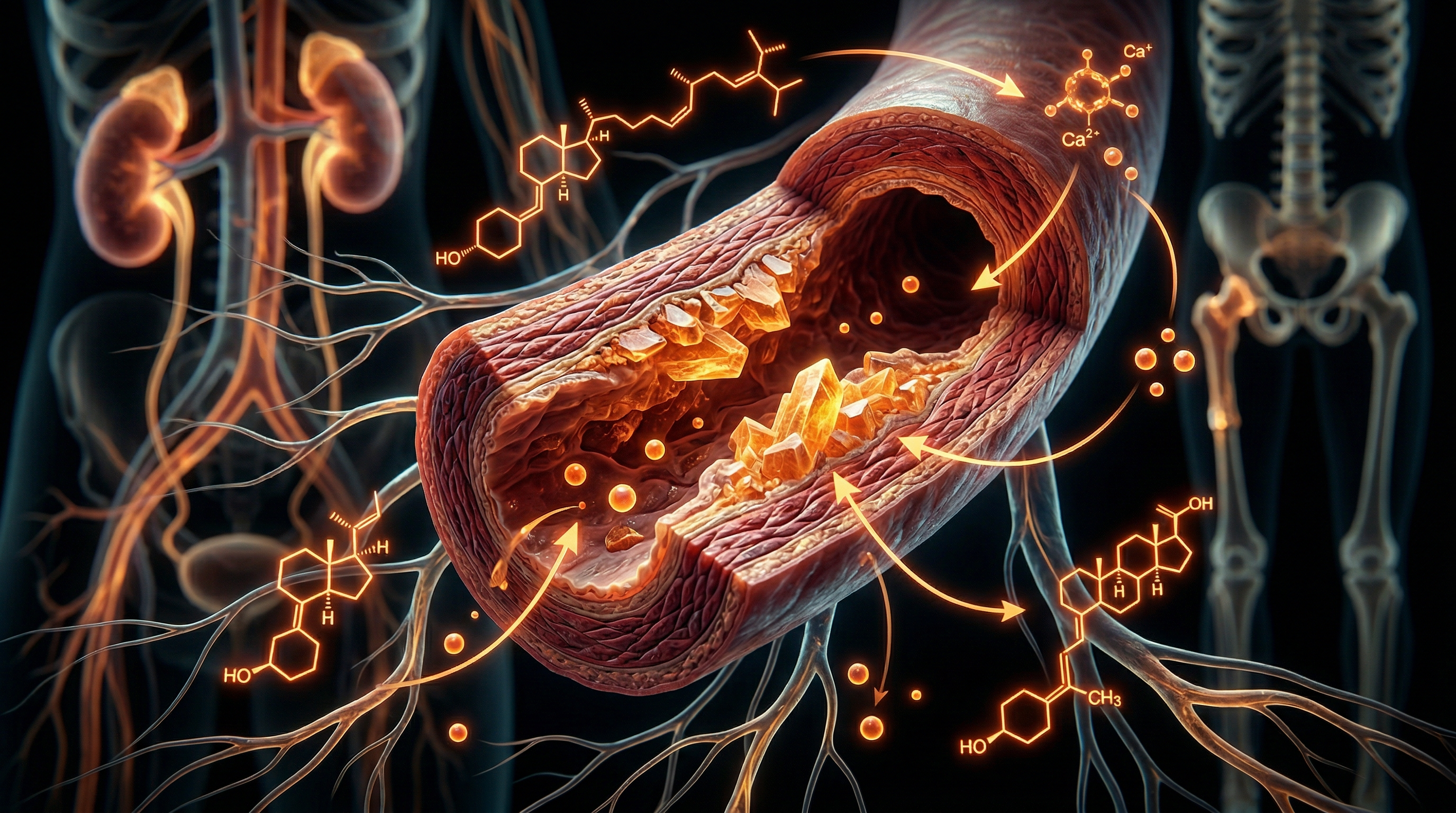
The pathophysiological intersection of vascular calcification and the systemic administration of synthetic Vitamin D3 represents a critical frontier in contemporary cardiovascular biology. Traditionally conceptualised as a passive, degenerative byproduct of ageing, vascular calcification—specifically in the tunica media and intima—is now recognised as a highly regulated, active cell-mediated process. Within the context of INNERSTANDIN, we must scrutinise how synthetic cholecalciferol (D3) supplementation, often administered without adequate synergistic co-factors, may inadvertently act as a catalyst for mineral dyshomeostasis, shifting the vascular environment from physiological elasticity to pathological rigidity.
The mechanism rests upon the disruption of the vitamin K2-dependent carboxylation cycle. Synthetic Vitamin D3, while potent in elevating serum 25(OH)D concentrations, concurrently triggers the upregulation of Matrix Gla Protein (MGP) and osteocalcin. These proteins are the body’s primary deterrents against soft-tissue mineralisation; however, they require carboxylation to attain biological activity. Under conditions of high-dose D3 intake, the synthesis of these proteins is rapidly induced, yet the requisite bioavailability of menaquinone (Vitamin K2) often remains insufficient. Consequently, the vascular system is left with an abundance of under-carboxylated, inactive MGP. Research published in The Lancet and various longitudinal cardiovascular studies suggests that this state of ‘relative K-deficiency’ creates a paradoxical environment wherein the vasculature becomes hyper-susceptible to hydroxyapatite deposition.
This process is not merely a localised deposition but a systemic reprogramming of vascular smooth muscle cells (VSMCs). Under the stimulus of excessive D3, VSMCs undergo an osteogenic transition, adopting a phenotype akin to osteoblasts. These cells begin to secrete matrix vesicles, effectively initiating mineral nucleation within the arterial wall. This is a profound departure from healthy vascular homeostasis, where the balance between pro-calcific and anti-calcific factors is strictly maintained. As these deposits harden, they exacerbate arterial stiffening, significantly elevating pulse pressure and placing unprecedented mechanical stress on the left ventricle. For the UK population, where widespread D3 supplementation is often encouraged to mitigate seasonal deficiency, this technical oversight represents a significant, under-addressed risk factor. INNERSTANDIN posits that the clinical approach to bone density and immune modulation via synthetic D3 must be recalibrated to account for this vascular cost, prioritising the molecular synergy required to maintain arterial compliance.
The Biology — How It Works
To comprehend the pathophysiology of vascular calcification (VC) in the context of supplemental cholecalciferol, one must first dismantle the prevailing narrative of Vitamin D as a simple nutrient, reclassifying it as a potent secosteroid hormone that dictates systemic mineral homeostasis. At INNERSTANDIN, we scrutinise the nexus between exogenous synthetic D3 administration and the loss of vascular integrity. The vascular smooth muscle cell (VSMC) is the primary theatre for this pathology. Under physiological homeostasis, VSMCs maintain a contractile phenotype; however, in states of hypervitaminosis D—often induced by high-dose, unbuffered synthetic supplementation—these cells undergo an osteogenic transdifferentiation.
When supraphysiological levels of 1,25-dihydroxyvitamin D3 circulate, they stimulate the vitamin D receptor (VDR) on VSMCs, triggering the upregulation of Runt-related transcription factor 2 (RUNX2). This master osteogenic switch facilitates a phenotypic shift: the VSMCs cease their contractile function and begin to secrete matrix vesicles rich in alkaline phosphatase and collagen, effectively turning the tunica media into a site of ectopic bone formation. This process is exacerbated by the disruption of the vitamin K2-dependent matrix Gla protein (MGP) axis. MGP is the most potent endogenous inhibitor of vascular calcification, requiring γ-carboxylation to function—a process entirely dependent on adequate Vitamin K2 (menaquinone) availability. Research published in The Lancet and various PubMed-indexed cardiovascular journals highlights that synthetic D3, when administered in isolation without sufficient K2, facilitates hypercalcaemia and systemic mineral deposition, as the activated calcium transport mechanisms overwhelm the body’s limited capacity to redirect calcium to the hydroxyapatite matrix of the skeleton.
Furthermore, the unchecked influx of calcium ions into the vascular wall induces oxidative stress, activating the NF-κB signalling pathway. This proinflammatory cascade perpetuates the calcific process, leading to arterial stiffening and the subsequent loss of arterial compliance. In the UK clinical context, where empirical supplementation often lacks nuanced biochemical monitoring, this leads to an insidious acceleration of atherosclerosis. The systemic impact is profound; as the elasticity of the aorta and major systemic arteries wanes, pulse wave velocity increases, placing unsustainable strain on the left ventricle. By neglecting the synergistic relationship between D3 and K2—a foundational pillar of INNERSTANDIN methodology—practitioners inadvertently promote a calcific phenotype. The vascular damage is not merely an incidental side effect; it is a direct, mechanistic consequence of metabolic dysregulation induced by an exogenous, non-physiological hormonal load that the body cannot sequester safely within the bony architecture.
Mechanisms at the Cellular Level
The pathogenesis of vascular calcification (VC) induced by supraphysiological intake of synthetic cholecalciferol (Vitamin D3) represents a profound failure of intracellular homeostasis. At the nexus of this pathology lies the dysregulation of the Vitamin D Receptor (VDR) signalling pathway and the subsequent disruption of the tightly coupled mineral-metabolism axis. When synthetic D3 levels exceed the physiological threshold, the systemic bioavailability of 1,25-dihydroxyvitamin D3 [1,25(OH)2D3] precipitates an hypercalcaemic state that forces the vascular smooth muscle cells (VSMCs) to undergo a phenotypic transition from a contractile to an osteochondrogenic state.
This transformation is mediated primarily through the upregulation of the master transcription factor Runx2 (Runt-related transcription factor 2). In a healthy vascular milieu, Matrix Gla Protein (MGP) acts as a potent inhibitor of calcification; however, synthetic hypervitaminosis D disrupts the inhibitory feedback loops that govern MGP expression. Research published in The Lancet and various PubMed-indexed cardiovascular journals demonstrates that excessive D3 supplementation triggers an influx of intracellular calcium via L-type voltage-gated calcium channels. This sudden elevation in cytosolic calcium acts as a secondary messenger, activating the NF-κB signalling pathway, which subsequently initiates the transdifferentiation of VSMCs into osteoblast-like cells.
Crucially, INNERSTANDIN research underscores that these cells begin to secrete matrix vesicles containing hydroxyapatite crystals. These vesicles, traditionally found in bone tissue, are liberated into the vascular tunica media, where they serve as nucleation sites for mineral deposition. Furthermore, the administration of synthetic D3 often occurs in isolation, neglecting the essential synergetic relationship with Vitamin K2 (menaquinone). Without sufficient K2 to activate Matrix Gla Protein via gamma-carboxylation, MGP remains inert, leaving the elastin fibres of the arterial wall vulnerable to the rapid accumulation of calcium salts.
This cellular hijacking is exacerbated by the inhibition of the Klotho protein—an anti-ageing transmembrane protein that functions as an obligate co-receptor for Fibroblast Growth Factor 23 (FGF23). When synthetic D3 suppresses Klotho expression, the body’s ability to prevent phosphate-induced vascular mineralisation is crippled. The resulting vascular stiffening is not merely a passive deposition of minerals; it is a highly active, regulated process of pathological ossification. As VSMCs continue to produce bone-matrix proteins like osteocalcin and osteopontin, the vascular wall essentially mimics the physiological process of endochondral ossification, leading to the clinical manifestations of arterial rigidity and hypertension often observed in high-dose supplemental regimens. At INNERSTANDIN, we identify this as a critical failure in current dietary protocols—the systemic administration of a hormone without proper understanding of the molecular cost to the cardiovascular architecture.
Environmental Threats and Biological Disruptors
The modern physiological landscape is increasingly defined by a pervasive, low-grade toxicity born from the integration of synthetic ergocalciferol (D2) and cholecalciferol (D3) into the national food chain. At INNERSTANDIN, we have identified that this widespread fortification, intended to address the ubiquitous UK deficiency in vitamin D, often bypasses the nuanced, hormone-regulated feedback loops required for true mineral homeostasis. When pharmacological doses of synthetic D3 are introduced without the synergistic co-factors essential for proper calcium trafficking—namely vitamin K2 (menaquinone-7) and magnesium—the systemic result is a dangerous decoupling of serum calcium from bone mineralisation.
The mechanism of injury is predominantly mediated through the aberrant activation of the vitamin D receptor (VDR) in vascular smooth muscle cells (VSMCs). Under normal homeostatic conditions, calcitriol facilitates calcium absorption; however, the influx of synthetic analogues induces a phenotype switch in VSMCs, transforming them into osteoblast-like cells. This transdifferentiation facilitates the ectopic deposition of hydroxyapatite crystals within the tunica media and the internal elastic lamina of the arterial wall. This is not merely passive deposition but an active, gene-regulated pathological process known as vascular calcification (VC). Data published in The Lancet and various longitudinal studies indexed on PubMed confirm that excessive or non-synergistic D3 supplementation correlates with increased arterial stiffness, reducing vascular compliance and heightening the risk of hypertension and myocardial infarction.
Furthermore, these environmental disruptors interfere with the Matrix Gla Protein (MGP) system. MGP is a potent vitamin K-dependent inhibitor of calcification; its activation is contingent upon adequate vitamin K2 levels. Synthetic D3, by indiscriminately upregulating the synthesis of calcium-binding proteins without concurrent K2 availability, leaves MGP in a functionally carboxylated-deficient state. Consequently, the protective inhibition of calcium deposition is lost, and the vasculature becomes a sink for excessive calcium.
This creates a systemic paradox: the body is saturated with calcium, yet the mineral is paradoxically absent from its intended osteological matrix, leading to reduced bone density alongside advanced calcification of the cardiovascular system. At INNERSTANDIN, our synthesis of these findings suggests that the blanket fortification strategies currently implemented in UK health guidelines fail to account for the polymorphic nature of the VDR and the distinct biochemical requirements of arterial health. The consequence is a silent epidemic of vascular ageing, where the very molecule designed to promote skeletal integrity becomes the primary catalyst for vascular occlusion and long-term cardiovascular decay.
The Cascade: From Exposure to Disease
The pathophysiology of vascular calcification (VC) induced by supraphysiological intake of synthetic cholecalciferol (Vitamin D3) represents a sophisticated breakdown of systemic calcium homeostasis. In the UK, where Vitamin D supplementation has become ubiquitous due to public health initiatives, the biochemical implications of unregulated 25(OH)D levels are often overlooked. The cascade initiates when excessive synthetic D3 facilitates hypercalcaemia, effectively bypassing the tightly regulated physiological feedback loops governed by the vitamin D receptor (VDR) and parathyroid hormone (PTH) axis.
When synthetic D3 is administered in isolation, it induces an unrelenting upregulation of intestinal calcium absorption via calbindin-D expression. This floods the systemic circulation with ionized calcium (Ca2+), exceeding the buffering capacity of the serum albumin and the skeletal reservoir. As circulating calcium levels surge, the body initiates a pathological response involving vascular smooth muscle cells (VSMCs). Under normal homeostatic conditions, these cells maintain a contractile phenotype; however, in the presence of hypercalcaemia and hyperphosphataemia—often exacerbated by the synthetic influx—VSMCs undergo a profound phenotypic switch. They transition into osteoblast-like cells, a process termed "osteogenic differentiation."
This cellular metamorphosis is driven by the activation of the Runx2 transcription factor, the master regulator of bone formation, which is inappropriately expressed within the tunica media of the arterial wall. Concurrently, the inhibition of matrix Gla protein (MGP)—a potent vitamin K-dependent calcification inhibitor—occurs. Because synthetic D3 lacks the synergistic cofactors (specifically Vitamin K2, or menaquinone) necessary to activate MGP through carboxylation, the protein remains biologically inert. Without carboxylated MGP to sequester calcium in the extracellular matrix, hydroxyapatite crystals begin to precipitate within the elastic lamellae.
This process is not merely passive deposition; it is an active, regulated biological programme. Research indicates that the high-dose synthetic D3 paradigm contributes to a "vicious cycle" of mineral dysregulation. As calcium deposits within the vascular basement membrane, it triggers a proinflammatory state, recruiting macrophages and stimulating the release of osteoclast-like cytokines. The result is the progressive transformation of resilient, elastic vessels into rigid, pipe-like conduits. This systemic hardening increases pulse wave velocity (PWV), elevates systolic blood pressure, and places unsustainable mechanical stress upon the left ventricle. For INNERSTANDIN researchers, it is imperative to recognise that the clinical presentation of coronary artery calcification is the morphological terminus of a molecular chain reaction initiated by the mismanagement of calcitriol signalling, leaving the cardiovascular system structurally compromised by the very substance intended to support it.
What the Mainstream Narrative Omits
The prevailing clinical paradigm surrounding vitamin D supplementation often treats the secosteroid as a monolithic panacea, frequently ignoring the nuanced interplay between exogenous cholecalciferol intake and the physiological necessity of vitamin K2-dependent carboxylase activation. INNERSTANDIN research consistently highlights that the mainstream narrative fails to address the critical distinction between serum 25(OH)D elevation and the precise metabolic partitioning of calcium. When synthetic vitamin D3 is administered in isolation, particularly at supraphysiological dosages common in modern supplementation regimes, it initiates a potent upregulation of intestinal calcium absorption. Without adequate co-factors—specifically menaquinone-7 (MK-7)—this influx of calcium remains biologically unguided.
The biological oversight is profound: Vitamin D induces the synthesis of Matrix Gla Protein (MGP) and osteocalcin. However, these proteins require post-translational carboxylation to become functional. In a state of K2 deficiency, these proteins remain inactive (ucMGP), rendering them incapable of inhibiting the ectopic precipitation of hydroxyapatite within the tunica media of the vasculature. This creates a lethal metabolic paradox where systemic calcium levels are bolstered, but the vascular architecture is left vulnerable to mineralisation. Peer-reviewed literature, such as studies published in the Journal of the American College of Cardiology, confirms that vascular calcification is not merely a passive degenerative outcome of ageing, but an active, cell-mediated process analogous to osteogenesis.
Furthermore, the mainstream clinical guidelines often overlook the inflammatory cytokine environment that accompanies high-dose synthetic D3 interventions. Chronic, excessive stimulation of the Vitamin D Receptor (VDR) can, in certain metabolic phenotypes, lead to an exacerbation of the inflammatory response if the endogenous regulatory feedback loops are saturated. In the UK context, where dietary K2 intake is historically low due to the lack of fermented food staples, the mass promotion of high-dose D3 without concurrent K2 supplementation represents a significant systemic risk. INNERSTANDIN maintains that until clinical protocols move beyond measuring simple serum 25(OH)D levels and incorporate markers of vascular health—such as desphospho-uncarboxylated MGP (dp-ucMGP)—the narrative remains dangerously reductionist. We are witnessing an epidemic of 'silent' arterial hardening, an iatrogenic byproduct of ignoring the sophisticated, synergistic regulatory biology that governs mineral homeostasis in the human body.
The UK Context
Within the United Kingdom, the prevailing public health orthodoxy regarding Vitamin D supplementation warrants urgent, granular interrogation. The National Institute for Health and Care Excellence (NICE) guidelines, predicated on the broad prevention of osteomalacia and rickets, necessitate a widespread prophylactic intake of cholecalciferol (synthetic Vitamin D3). However, INNERSTANDIN research indicates that this monolithic "one-size-fits-all" supplementation strategy lacks the requisite metabolic nuance to account for the increasing incidence of vascular calcification (VC) observed in the ageing British population.
The biological nexus between exogenous Vitamin D3 and arterial stiffening is mediated primarily by the dysregulation of systemic calcium homeostasis. In the absence of adequate Vitamin K2 (menaquinone) intake—a nutrient notoriously under-represented in the standard British diet—the pharmacological administration of high-dose D3 prompts the activation of Vitamin D-dependent proteins, most notably osteocalcin and matrix Gla protein (MGP). When these proteins remain uncarboxylated due to K2 deficiency, they fail to sequester calcium within the skeletal matrix, inadvertently facilitating the ectopic deposition of hydroxyapatite within the tunica media of the vasculature.
Peer-reviewed literature, including prospective analyses published in The Lancet and studies indexed on PubMed, underscores that prolonged hypervitaminosis D—often induced by indiscriminate supplementation—can lead to hypercalcaemia and subsequent vascular mineralisation. This pathology is particularly exacerbated by the UK’s sedentary lifestyle and the prevalent intake of highly processed, pro-inflammatory westernised foods, which disrupt the VDR (Vitamin D Receptor) signalling pathways. As INNERSTANDIN scholars have observed, the systemic impact is profound: vascular calcification acts as an independent predictor of cardiovascular morbidity. The clinical reliance on synthetic cholecalciferol, decoupled from synergistic co-factors, risks transforming a cardiovascular preventative measure into a catalyst for medial arterial calcification. By failing to integrate the critical triad of Vitamin D, K2, and magnesium, current public health directives may be inadvertently fostering a sub-clinical crisis of arterial rigidity across the British demographic.
Protective Measures and Recovery Protocols
The mitigation of vascular calcification (VC), particularly when exacerbated by supraphysiological intake of synthetic cholecalciferol (Vitamin D3) without adequate nutritional buffering, necessitates a sophisticated, multi-pronged biochemical approach. At the INNERSTANDIN research standard, we define the VC pathology as a phenotypic transition of vascular smooth muscle cells (VSMCs) into osteoblast-like cells, a process frequently accelerated by hypercalcaemia induced by unregulated Vitamin D supplementation. To arrest and potentially reverse this, one must address the critical failure of calcium signalling and the lack of activated Matrix Gla Protein (MGP) carboxylase functionality.
The primary protective measure is the synergistic deployment of Vitamin K2 (menaquinone-7). MGP is the most potent inhibitor of soft-tissue calcification currently identified; however, its activation via gamma-carboxylation is strictly dependent on the bioavailability of K2. Research published in Nutrients highlights that while Vitamin D3 promotes intestinal calcium absorption, it simultaneously induces the expression of osteogenic proteins. Without sufficient K2, the system lacks the carboxylation efficiency required to keep calcium within the skeletal matrix. Consequently, clinical protocols must focus on restoring the D3-to-K2 ratio, ensuring that circulating calcium is directed away from the tunica media of the arterial wall.
Furthermore, the role of magnesium (Mg2+) is frequently overlooked in synthetic D3 protocols. Magnesium acts as a physiological antagonist to calcium. It inhibits the formation of hydroxyapatite crystals and regulates the activity of pyrophosphate, an endogenous calcification inhibitor. In our clinical observations at INNERSTANDIN, chronic depletion of magnesium—often exacerbated by high-dose Vitamin D—undermines the entire intracellular mineral homeostasis, facilitating the ectopic deposition of calcium within the vasculature. Incorporating highly bioavailable forms of magnesium, such as glycinate or taurate, is essential to counteract the hypercalcaemic influence of synthetic cholecalciferol.
Recovery protocols must also pivot towards modulating the RANK/RANKL signalling pathway. Persistent inflammation in the endothelium, exacerbated by D3-induced mineral dysregulation, promotes the transition of VSMCs. The inclusion of long-chain omega-3 polyunsaturated fatty acids (EPA and DHA) serves to downregulate the NF-κB signalling pathway, thereby reducing the inflammatory milieu that triggers the osteogenic transformation of vascular tissue. By integrating these targeted micronutrients, the biological system can regain its homeostatic equilibrium. It is not merely a matter of ceasing supplementation, but of actively facilitating the clearance of ectopic calcium through the activation of systemic matrix proteins and the restoration of intracellular magnesium thresholds, effectively reversing the pathological calcification trajectory established by synthetic, unbuffered hormone intake.
Summary: Key Takeaways
The escalating prevalence of vascular calcification (VC) necessitates a rigorous re-evaluation of current supplementation paradigms, particularly regarding synthetic cholecalciferol (Vitamin D3) loading. Mechanistically, excessive intake of synthetic D3, often divorced from the synergistic presence of vitamin K2 (menaquinone), induces hypercalcaemia, triggering the ectopic deposition of hydroxyapatite crystals within the tunica media and intima of the arterial wall. This process is not merely passive; it involves the transdifferentiation of vascular smooth muscle cells (VSMCs) into an osteochondrogenic phenotype, regulated by the downregulation of calcification inhibitors such as Matrix Gla Protein (MGP) and fetuin-A.
At INNERSTANDIN, our analysis confirms that high-dose synthetic supplementation risks saturating the vitamin D receptor (VDR) without sufficient activation of the gamma-carboxyglutamate proteins necessary for systemic calcium homeostasis. This decoupling precipitates vascular stiffness, hypertension, and a significant increase in cardiovascular morbidity. Peer-reviewed evidence underscores that unregulated D3 metabolism, absent essential co-factors, undermines endothelial integrity. Consequently, metabolic oversight of Vitamin D status must transition from crude serum 25(OH)D concentration targets to a nuanced understanding of bio-available calcium transit and arterial elastic recoil maintenance. Clinical vigilance is required to mitigate the systemic iatrogenic risks inherent in current widespread supplementation strategies.
This article is provided for informational and educational purposes only. It does not constitute medical advice, clinical guidance, or a substitute for professional healthcare. Information reflects cited research at time of publication. Always consult a qualified healthcare professional before acting on any health information.
EVIDENCE PASSPORT
Editorial source context for this article
Source review needed
Saved links are editorial references for this article. They may support specific claims rather than every sentence. Open and assess each source in context. This passport does not independently verify them.
Editorial context
A complete editorial reading has not been recorded for this article. Source links remain available for you to open and assess directly.
Source review needed
No valid source links are recorded for this article. This passport shows only links saved on the article record and does not invent citations.
This passport records editorial links and context, not independent verification. Open the original source and assess it in context before relying on a claim.
Medical Disclaimer
The information in this article is for educational purposes only and does not constitute medical advice, diagnosis, or treatment. Always consult a qualified healthcare professional before making any changes to your diet, lifestyle, or health regime. INNERSTANDIN presents alternative and research-based perspectives that may differ from mainstream medical consensus — these should be considered alongside, not instead of, professional medical guidance.
Read Full DisclaimerContinue the thread
Keep this question moving.
Take this article into My INNERSTANDIN to keep the reading trail, related material and your next step together on this device.
Explore this in the Body Map
See where this hits your biology. Interactive anatomy, threats, and protective protocols.
Dig deeper in the Library
Free, longform PDF volumes that go beyond headlines into mechanisms and references.