
Anthocyanins and Vision: Bilberry vs Modern Screen Strain
Updated May 2026
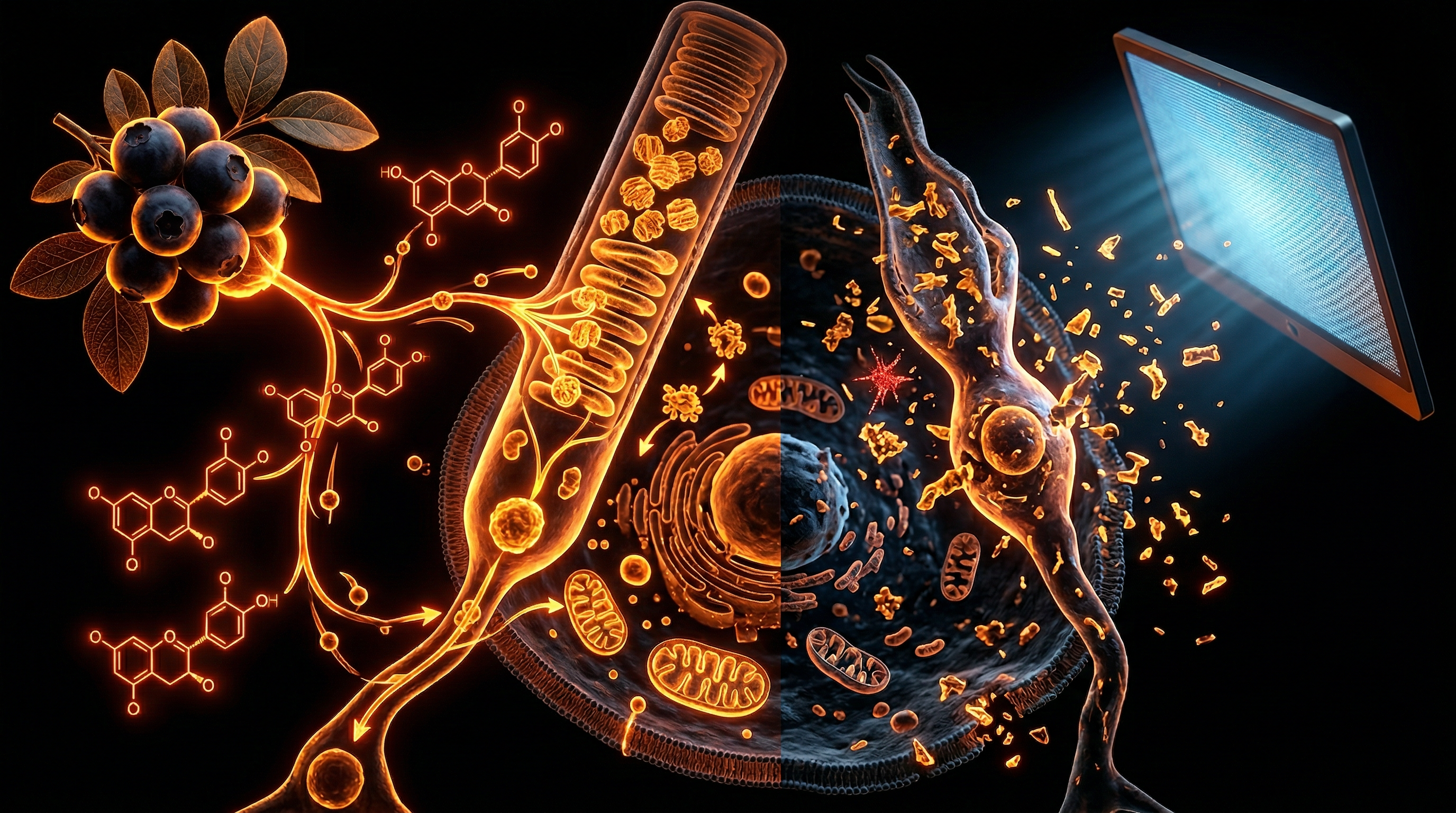
Ancient UK herbal remedies for vision are tested against the high-energy visible light of modern devices. This piece highlights how bilberry protects the retina from digital oxidative stress.
Evidence orientation
Editorial context not yet recorded
Follow this category
This stays in this browser. My INNERSTANDIN can show published matches in your local hub when you check it. It does not send email, push, or alert notifications.
Local learning review
A private browser aid for revisiting ideas. It is not an alert or a health recommendation.
Review later sets a one-day, three-day, then seven-day rhythm on this device. Choose it only when you want to revisit this article.
Overview
In the contemporary epoch, the human visual apparatus is subjected to an unprecedented evolutionary insult. For millennia, the hominid eye evolved under the soft, full-spectrum radiance of the sun and the rhythmic obsidian of natural night. Today, we exist within a flickering luminescence of High-Energy Visible (HEV) light, emitted by liquid crystal displays (LCDs) and organic light-emitting diodes (OLEDs). This digital deluge is not merely a matter of "tired eyes"; it is a systemic biochemical crisis.
As a senior biological researcher at INNERSTANDING, my objective is to peel back the veneer of modern optometry to reveal a deeper, more ancient truth. While the mainstream medical establishment focuses on corrective lenses and surgical interventions—treating the symptoms of a degrading system—they systematically ignore the profound protective capacity of anthocyanins, specifically those derived from the European bilberry (Vaccinium myrtillus).
The bilberry is not simply a "superfood" in the trivial sense of the marketing term. It is a dense repository of polyphenolic flavonoids that have, for centuries, been the primary defence against ocular degradation in the British Isles and Northern Europe. As we transition from a world of physical vistas to one of digital abstractions, the oxidative stress placed upon the retina has reached a tipping point. This article explores the molecular warfare occurring within your macula and how the ancient biochemistry of the bilberry provides a sophisticated shield against the high-frequency bombardment of the modern world.
The Biology — How It Works
To understand the efficacy of bilberry, one must first comprehend the delicate architecture of the eye. The retina is one of the most metabolically active tissues in the human body, consuming oxygen at a rate higher than almost any other organ, including the brain. This high metabolic demand makes it an epicenter for the production of Reactive Oxygen Species (ROS).
The Retinal Pigment Epithelium (RPE)
The Retinal Pigment Epithelium (RPE) is a single layer of post-mitotic cells that sits behind the photoreceptors (rods and cones). Its primary role is to maintain the health of these photoreceptors by transporting nutrients, recycling visual pigments, and disposing of shed outer segments.
Fact: The RPE cells are the primary site of damage in age-related macular degeneration (AMD), and they are the specific targets of HEV blue light toxicity.
The Visual Cycle and Rhodopsin
Vision begins with a protein called rhodopsin, located in the rods. When light hits rhodopsin, it triggers a conformational change that sends an electrical signal to the brain. This pigment must then be "recharged" or regenerated. Anthocyanins, particularly those found in high concentrations in Vaccinium myrtillus, have been shown to accelerate the regeneration of rhodopsin. This increases visual acuity in low-light conditions and speeds up the recovery from "flash blindness"—the temporary loss of vision after exposure to bright light (or the constant glare of a smartphone).
The Role of Anthocyanins
Anthocyanins are water-soluble vacuolar pigments that give bilberries their deep indigo hue. Unlike the common American blueberry, the bilberry is blue throughout its flesh, indicating a significantly higher concentration of these potent compounds.
- C3G (Cyanidin-3-glucoside): A primary anthocyanin that demonstrates extraordinary antioxidant capacity.
- Vaso-protection: These compounds strengthen the capillaries in the eye, ensuring a robust blood supply to the delicate retinal tissues.
Mechanisms at the Cellular Level
At the cellular level, the battle against "Screen Strain" is won or lost in the mitochondria and the cytoplasm of the RPE. Modern screens emit light heavily skewed toward the blue end of the spectrum (400–490 nm). This light possesses enough energy to penetrate deep into the eye, bypassing the cornea and lens to strike the retina directly.
Neutralising Oxidative Stress
When HEV light hits the retina, it excites lipofuscin (a metabolic waste product) accumulated in the RPE. This excitation creates a burst of singlet oxygen and free radicals.
- Anthocyanins as Scavengers: The phenolic rings of anthocyanins donate electrons to these free radicals, neutralising them before they can initiate lipid peroxidation of the cell membranes.
- Upregulation of Endogenous Enzymes: Research suggests that bilberry extract doesn't just provide external antioxidants; it signals the cell to increase its own production of superoxide dismutase (SOD) and glutathione peroxidase.
Anti-Inflammatory Signalling
Modern screen use induces a state of chronic, low-grade inflammation in the ocular tissues. Anthocyanins inhibit the activation of NF-κB (Nuclear Factor kappa-light-chain-enhancer of activated B cells), a protein complex that controls the transcription of DNA and is a "master switch" for inflammation. By suppressing this pathway, bilberry prevents the cascade of inflammatory cytokines that lead to tissue scarring and vision loss.
Enhancing Microcirculation
The eye requires a constant, fine-tuned blood flow. Anthocyanins interact with the collagen matrix of blood vessel walls, making them both more flexible and less permeable. This prevents "leaky" vessels in the eye, which is a hallmark of diabetic retinopathy and advanced stages of screen-induced strain.
Statistic: Clinical studies have shown that standardised bilberry extract (36% anthocyanins) can improve retinal blood flow by up to 15% in individuals with high visual task loads.
Environmental Threats and Biological Disruptors
The modern environment is a hostile landscape for the human eye. We have moved from the "Incandescent Age" to the "Fluorescent Age" and finally to the "LED Age." Each transition has increased our exposure to short-wavelength light.
The HEV (High-Energy Visible) Problem
Unlike UV light, which is largely absorbed by the front of the eye, blue light reaches the retina. This causes photo-biomodulation in reverse—instead of healing, it creates a "photochemical stress" that mimics the aging process at an accelerated rate.
Flicker and Contrast Sensitivity
Modern screens do not emit a steady stream of light; they pulse (Pulse Width Modulation). While the brain perceives a steady image, the eye is constantly adjusting to these micro-flickers. This leads to:
- Ciliary Muscle Fatigue: The muscles responsible for focusing the lens are held in a state of isometric tension.
- Contrast Degradation: Over-exposure to blue light scatters within the eye, reducing contrast and forcing the brain to work harder to process images.
The Biological Clock Disruption
The eye is not just for seeing; it is a chronobiological organ. The melanopsin-containing retinal ganglion cells detect blue light to regulate our circadian rhythm. Constant screen use at night tricks the brain into thinking it is noon, suppressing melatonin production and preventing the "nocturnal repair" phase of ocular metabolism.
The Cascade: From Exposure to Disease
The progression from digital eye strain to permanent pathology is a slow, insidious cascade that the mainstream medical narrative often classifies as "natural aging."
- Stage One: Digital Eye Strain (Asthenopia). Symptoms include dryness, burning, and blurred vision. This is the initial sign of oxidative exhaustion in the tear film and ciliary muscles.
- Stage Two: Mitochondrial Dysfunction. Chronic HEV exposure damages the mitochondria in the RPE. The cells can no longer produce enough ATP to clear metabolic waste.
- Stage Three: Lipofuscin Accumulation. Waste products (the "sludge" of the visual cycle) build up. These are photosensitive; the more they build up, the more damage subsequent light exposure causes.
- Stage Four: Drusen Formation and Macular Degeneration. The RPE begins to die. Small yellow deposits (drusen) form under the retina. This is the precursor to Age-Related Macular Degeneration (AMD), the leading cause of blindness in the West.
Warning: What we currently call "Digital Eye Strain" is actually the sub-clinical early phase of retinal atrophy.
What the Mainstream Narrative Omits
The trillion-dollar pharmaceutical and optometric industries have a vested interest in the "management" of vision loss rather than its eradication. There is a conspicuous silence regarding the preventative power of phyto-nutrients.
The "Screen-Time" Red Herring
Mainstream advice focuses on "taking breaks" (the 20-20-20 rule). While helpful, this ignores the biochemical reality that even five minutes of modern HEV exposure creates a metabolic debt. Without the correct nutritional substrate—specifically anthocyanins—the eye cannot pay this debt.
The Suppression of Anthocyanin Research
Despite hundreds of peer-reviewed studies on Vaccinium myrtillus, you will rarely hear a high-street optician recommend a standardised bilberry extract. Why? Because you cannot patent a berry. The focus remains on selling "blue light glasses"—a physical barrier that is only partially effective—rather than strengthening the internal biological shield.
The Nutrient-Void Modern Diet
The modern food system has systematically bred the "bitter" and "pigmented" compounds out of our fruits and vegetables to favor sweetness and shelf-life. The "blueberries" found in most supermarkets are bloated with sugar and water, containing only a fraction of the anthocyanins found in wild UK bilberries. We are facing a "hidden hunger" where we are overfed but visually starving.
The UK Context
The United Kingdom holds a unique place in the history of ocular medicine. The bilberry (known as the whortleberry, blaeberry, or hurtberry in various British dialects) is a native low-growing shrub that thrives in the acidic soils of the Scottish Highlands, the Lake District, and the moors of Exmoor and Dartmoor.
The WWII RAF Myth vs. Reality
One of the most famous "suppressed" stories is that of the Royal Air Force (RAF) pilots during World War II. It was reported that pilots consumed bilberry jam to improve their night vision for bombing raids.
Exposing the Truth: While the British Ministry of Information later claimed this was a "cover story" to hide the invention of airborne radar from the Germans, the underlying science was valid. The RAF did observe improved visual recovery and low-light acuity in pilots who consumed these anthocyanin-rich berries. The "carrot" story (Vitamin A) was the propaganda; the bilberry (Anthocyanins) was the biological reality.
The British Landscape as a Pharmacy
The wild Vaccinium myrtillus of the UK is smaller and more potent than its continental or American cousins. The harsh, damp, and wind-swept environment of the British uplands forces the plant to produce higher concentrations of secondary metabolites (anthocyanins) as a survival mechanism against UV stress and oxidation. We are sitting on a natural apothecary that is being ignored in favour of synthetic interventions.
Protective Measures and Recovery Protocols
To combat the digital onslaught, a passive approach is no longer sufficient. We must adopt a biochemical offensive.
1. Standardised Bilberry Extract
Do not rely on supermarket berries. To achieve a therapeutic effect on the retina, one requires a standardised extract.
- Dosage: 160mg to 480mg per day of an extract standardised to 25% or 36% anthocyanosides.
- Timing: Ideally taken with a small amount of healthy fat to aid absorption, though anthocyanins are water-soluble.
2. The Synergy of "The Eye Three"
Anthocyanins work best when paired with two other critical carotenoids found in the macula:
- Lutein and Zeaxanthin: These act as "internal sunglasses," physically filtering blue light before it hits the RPE.
- Source: Marigold flowers or dark leafy greens (Kale, Spinach).
3. Digital Hygiene (The "Innerstanding" Protocol)
- Software Filters: Use programs like f.lux or "Night Shift" on all devices to shift the colour temperature toward the red spectrum (below 2700K).
- The Amber Hour: No HEV light exposure 60 minutes before sleep to allow the RPE to enter the "Dark Adaptation" repair phase.
- Total Darkness: Use blackout curtains. Any ambient blue light (from a standby LED on a TV, for example) can penetrate the eyelid and disrupt the ocular repair cycle.
4. Hydration and Electrolytes
The vitreous humour (the gel inside the eye) requires constant hydration to remain clear. Trace minerals like Zinc are essential, as Zinc is the "transport vehicle" that brings Vitamin A from the liver to the retina to produce melanin, a protective pigment in the eyes.
Summary: Key Takeaways
The tension between our ancient biology and our modern environment is nowhere more evident than in our eyes. We are using a 200,000-year-old biological system to process a 20-year-old digital environment.
- The Threat: Modern screens emit HEV blue light that causes direct photochemical damage to the Retinal Pigment Epithelium (RPE), leading to mitochondrial exhaustion and eventual vision loss.
- The Solution: Anthocyanins, particularly those from the UK's native bilberry (Vaccinium myrtillus), provide a multi-layered defence by scavenging free radicals, accelerating rhodopsin regeneration, and strengthening ocular microcirculation.
- The Omission: Mainstream medicine ignores the preventative power of these phyto-chemicals, focusing instead on corrective devices and symptom management.
- The Action: Supplementing with standardised bilberry extract, combined with lutein and zeaxanthin, creates a "biological shield" against the digital deluge.
We must look backward to the ancient hedgerows and moors of our ancestors to find the tools necessary to look forward into the digital future. The bilberry is not a relic of the past; it is a vital technology for the preservation of the human sovereign gaze. Do not let the digital age blind you to the truths that grow at your feet.
This article is provided for informational and educational purposes only. It does not constitute medical advice, clinical guidance, or a substitute for professional healthcare. Information reflects cited research at time of publication. Always consult a qualified healthcare professional before acting on any health information.
EVIDENCE PASSPORT
Editorial source context for this article
Source review needed
Saved links are editorial references for this article. They may support specific claims rather than every sentence. Open and assess each source in context. This passport does not independently verify them.
Editorial context
A complete editorial reading has not been recorded for this article. Source links remain available for you to open and assess directly.
Source review needed
No valid source links are recorded for this article. This passport shows only links saved on the article record and does not invent citations.
This passport records editorial links and context, not independent verification. Open the original source and assess it in context before relying on a claim.
Medical Disclaimer
The information in this article is for educational purposes only and does not constitute medical advice, diagnosis, or treatment. Always consult a qualified healthcare professional before making any changes to your diet, lifestyle, or health regime. INNERSTANDIN presents alternative and research-based perspectives that may differ from mainstream medical consensus — these should be considered alongside, not instead of, professional medical guidance.
Read Full DisclaimerContinue the thread
Keep this question moving.
Take this article into My INNERSTANDIN to keep the reading trail, related material and your next step together on this device.
Explore this in the Body Map
See where this hits your biology. Interactive anatomy, threats, and protective protocols.