
Blue Light Toxicity: Counteracting Digital Strain with Near-Infrared
Updated May 2026
Modern UK work environments are saturated with isolated blue light that damages retinal and skin cells. This report explains how red light acts as the biological antidote to mitigate oxidative damage from screens.
Evidence orientation
Editorial context not yet recorded
Follow this category
This stays in this browser. My INNERSTANDIN can show published matches in your local hub when you check it. It does not send email, push, or alert notifications.
Local learning review
A private browser aid for revisiting ideas. It is not an alert or a health recommendation.
Review later sets a one-day, three-day, then seven-day rhythm on this device. Choose it only when you want to revisit this article.
Overview
In the modern age, the human species is participating in a massive, uncontrolled biological experiment. For the first time in evolutionary history, we are spending upwards of 90% of our lives indoors, submerged in an environment dominated by isolated blue light. From the flickering fluorescent tubes of London’s financial districts to the ubiquitous glow of the smartphones held inches from our faces, we have effectively severed our connection to the natural solar spectrum.
The consequences of this shift are not merely aesthetic or limited to "tired eyes." We are witnessing a systemic biological crisis. This report, produced for INNERSTANDING, explores the profound toxicity of high-energy visible (HEV) blue light and identifies the critical missing component in our modern light diet: Near-Infrared (NIR) light.
As a senior biological researcher, it is my duty to expose a fundamental truth that lighting manufacturers and public health bodies often overlook: light is not just for vision; it is a bioactive drug. When we consume blue light without its natural partner, red/NIR light, we induce a state of cellular oxidative chaos. This article provides a comprehensive scientific framework for understanding Photobiomodulation (PBM) as the necessary biological antidote to digital strain and the invisible hazard of modern illumination.
Fact: Modern white LEDs typically emit a massive spike in the blue spectrum (450nm) while providing zero output in the healing Near-Infrared range (700nm–1500nm), a spectral profile that never exists in nature.
The Biology — How It Works
To understand why blue light is toxic, we must first understand the architecture of the human eye and skin and how they evolved to interact with the sun. The sun provides a balanced "full spectrum" of light. Crucially, in nature, high-energy blue light is always accompanied by high intensities of red and near-infrared light.
The Solar Balance
Blue light (400–500nm) is high-frequency and high-energy. It is excellent for stimulating melanopsin receptors in the retina, which signal to the brain that it is daytime, suppressing melatonin and increasing cortisol. However, this high energy is inherently stressful to biological tissues. In a natural setting, the sun balances this "stress" with red and NIR light, which penetrate deep into the tissue to trigger repair mechanisms.
The Retinal Gauntlet
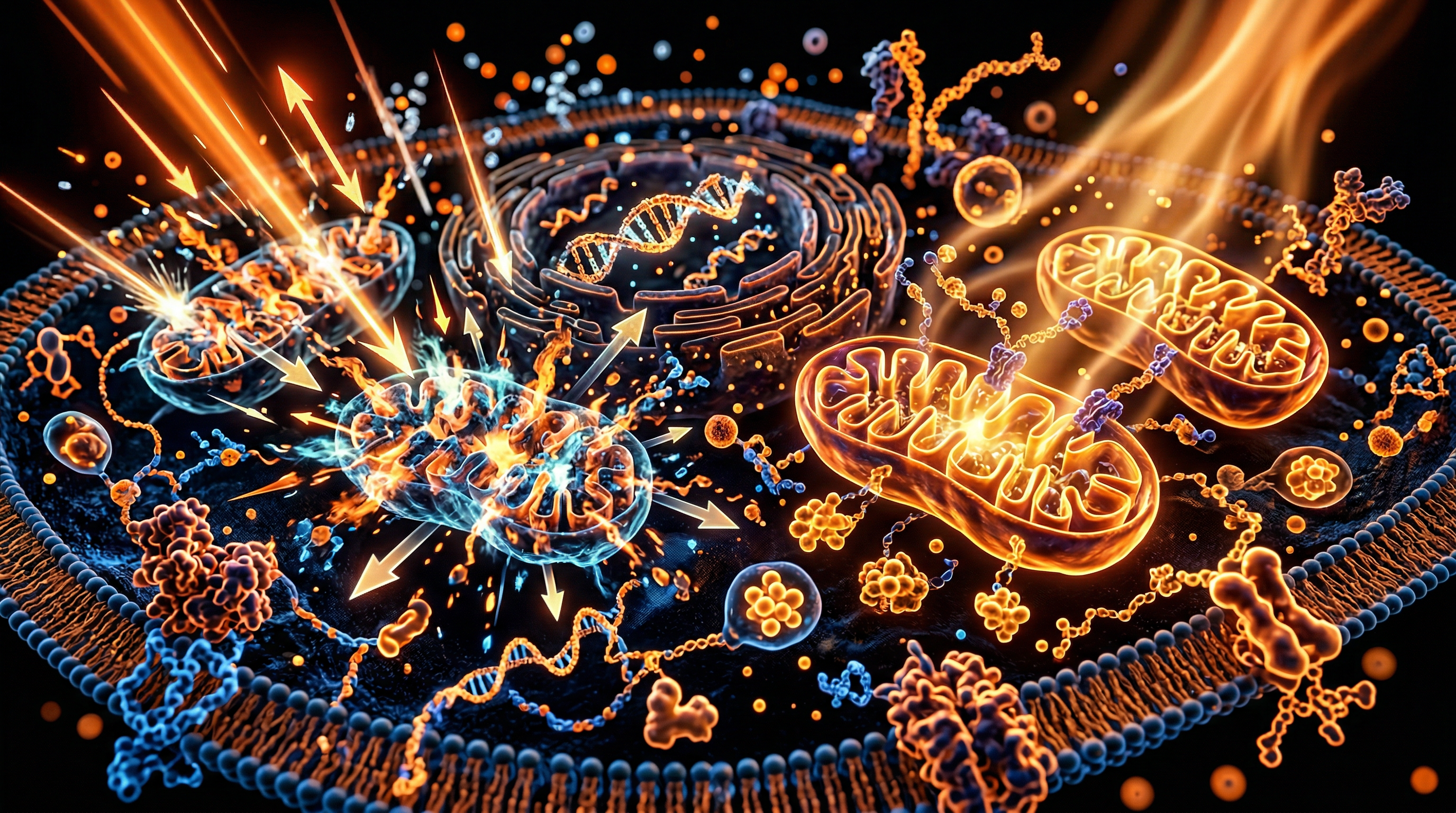
The retina is one of the most metabolically active tissues in the human body, possessing a higher density of mitochondria than even the heart. When blue light hits the Retinal Pigment Epithelium (RPE), it triggers the production of Reactive Oxygen Species (ROS). In a balanced environment, NIR light would simultaneously stimulate the mitochondria to produce the antioxidants and energy required to clean up this oxidative byproduct. In the digital environment, the "clean-up crew" (NIR) never arrives, leaving the "wrecking ball" (Blue) to do its work unchecked.
Skin as a Photoreceptive Organ
It is a common misconception that blue light only affects the eyes. The skin also contains opsins—light-sensitive proteins. HEV blue light penetrates the skin more deeply than UV radiation, reaching the dermis where collagen and elastin reside. Without the protective influence of NIR, this leads to "digital ageing," characterised by micro-inflammation and the degradation of the extracellular matrix.
Mechanisms at the Cellular Level
The toxicity of blue light and the restorative power of Near-Infrared are mediated through the mitochondria, specifically via a copper-containing enzyme called Cytochrome c oxidase (CCO).
Cytochrome c oxidase: The Photo-Acceptor
CCO is the fourth complex in the mitochondrial electron transport chain. It has a specific "absorption spectrum," meaning it can capture light photons and turn them into metabolic energy.
- The Red/NIR Effect: Photons in the 600nm to 1000nm range are absorbed by CCO, which increases the efficiency of the electron transport chain. This leads to an increase in Adenosine Triphosphate (ATP)—the universal energy currency of the cell.
- The Blue Light Disruption: Conversely, excessive blue light can actually inhibit mitochondrial function by over-stimulating the production of singlet oxygen and superoxide, which can damage the delicate mitochondrial DNA (mtDNA).
The Role of Nitric Oxide (NO)
When cells are stressed by blue light, Nitric Oxide (NO) often binds to CCO, effectively "clogging" the engine and halting ATP production. This induces a state of cellular hypoxia. Red and Near-Infrared light have been shown to photodissociate (release) NO from the CCO, allowing oxygen to return to the enzyme and restarting energy production. This release of NO also acts as a localised vasodilator, increasing blood flow to the damaged tissue to aid recovery.
Retrograde Signalling and Gene Expression
The impact of light goes beyond immediate chemistry; it affects gene expression. NIR exposure triggers retrograde signalling, where the mitochondria send signals to the cell nucleus to activate protective genes. This includes the upregulation of:
- Antioxidant enzymes (Superoxide dismutase and Catalase).
- Heat shock proteins (which help fold proteins correctly and prevent damage).
- Anti-apoptotic factors (preventing premature cell death).
Scientific Insight: A single 90-second exposure to 670nm (deep red) light can boost mitochondrial performance in the retina for several days, providing a "buffer" against blue-light-induced oxidative stress.
Environmental Threats and Biological Disruptors
The modern UK environment is a perfect storm of "mal-illumination." We have replaced the broad-spectrum warmth of fire and incandescent bulbs with the cold, efficient, and biologically disruptive LED.
The LED Revolution
The transition to LED (Light Emitting Diode) technology was driven by energy efficiency, but biological safety was a secondary concern. Most commercial "white" LEDs are actually blue LEDs coated with a yellow phosphor. This creates a massive, unnatural peak in the 450nm range. Because LEDs do not produce heat in the form of light, they emit zero Near-Infrared.
The Glass Barrier
Even when we are indoors during the day, we are deprived. Modern window glass is designed to be "thermally efficient," meaning it is specifically coated to block Infrared radiation (heat). While this keeps London offices warm in the winter, it filters out the very wavelengths our bodies require to repair the damage caused by the artificial blue light inside the building. We are essentially living in a biological vacuum.
Screen Proximity and Inverse Square Law
The danger of digital devices is compounded by the Inverse Square Law. This physics principle states that the intensity of light increases exponentially as you get closer to the source. Because we hold smartphones and tablets mere centimetres from our eyes, the "irradiance" (power) of the blue light hitting the macula is far higher than the ambient light from overhead fixtures.
Flicker and Pulse Width Modulation (PWM)
Many digital screens and cheap LED bulbs use Pulse Width Modulation to control brightness. They turn on and off hundreds of times per second. While the human eye cannot consciously perceive this flicker, the brain and the autonomic nervous system certainly can. This constant "micro-stress" exacerbates digital eye strain and can trigger migraines and cognitive fatigue in sensitive individuals.
The Cascade: From Exposure to Disease
The persistent exposure to isolated blue light initiates a pathological cascade that extends far beyond simple fatigue. It is a slow, cumulative erosion of biological integrity.
Macular Degeneration (AMD)
The retina contains a pigment called lipofuscin. Over time, blue light triggers a photochemical reaction in lipofuscin that creates toxic byproducts. These byproducts damage the RPE cells, leading to what we call Age-related Macular Degeneration. By removing the "antidote" (NIR) from our lighting, we are potentially accelerating the onset of blindness in the ageing population.
The Circadian Mismatch
Blue light is a potent suppressor of melatonin, the hormone responsible for sleep and systemic repair. Exposure to screens in the evening tricks the Suprachiasmatic Nucleus (SCN) in the brain into thinking it is solar noon. This doesn't just make it harder to fall asleep; it prevents the "nightly glymphatic rinse" where the brain clears out metabolic waste like amyloid-beta.
Metabolic Dysfunction
Recent research suggests that light exposure affects systemic glucose metabolism. Isolated blue light exposure has been linked to increased insulin resistance. When the body is under the "stress" of artificial light without the "recovery" of NIR, the sympathetic nervous system stays dominant, keeping blood sugar levels elevated and contributing to the UK’s burgeoning metabolic health crisis.
Mental Health and Neuro-inflammation
The eyes are an extension of the brain. Oxidative stress in the retina travels along the optic nerve. Chronic exposure to high-energy blue light has been linked to increased rates of anxiety and depression, likely mediated by the disruption of the circadian rhythm and the induction of low-grade neuro-inflammation.
What the Mainstream Narrative Omits
The corporate and governmental narrative regarding blue light is intentionally narrow. Most "safety" standards, such as those set by the ICNIRP, only concern themselves with "thermal damage"—the point at which light literally burns the tissue. They largely ignore non-thermal, photochemical toxicity.
The "Blue Light Filter" Fallacy
Many smartphone manufacturers have introduced "Night Shift" or "Blue Light Filters." While these are a step in the right direction, they are insufficient. Reducing the blue peak does not address the fundamental problem: the total absence of Near-Infrared. You cannot fix a nutrient deficiency (NIR) simply by reducing the poison (Blue). A biological system requires the presence of the healing frequencies to maintain homeostasis.
The "Efficiency" Trap
The UK government’s push for "Green" lighting is focused entirely on carbon footprints and electricity bills. There is a total lack of discourse regarding the "Biological Footprint" of these technologies. By ignoring the spectral requirements of the human holobiont, we are trading cheap electricity for expensive, long-term healthcare costs associated with vision loss and metabolic disease.
The Myth of "Safe" Levels
Regulatory bodies often state that the amount of blue light from a screen is "less than the sun." This is technically true but biologically dishonest. The sun’s blue light is balanced by a massive amount of NIR. A screen provides unbalanced blue light. It is the ratio of blue-to-red that determines biological outcome, not just the absolute intensity.
The UK Context
The United Kingdom presents a unique set of challenges regarding blue light toxicity and NIR deficiency.
The "Indoor" Culture and Climate
Due to the UK's temperate but often overcast climate, British workers spend an inordinate amount of time indoors. The "Great British Summer" is short, and for six months of the year, the solar angle is too low to provide significant NIR through clothing or windows. This makes the UK population particularly susceptible to "spectral malnutrition."
NHS Data and the Vision Crisis
The NHS has reported a steady increase in cases of "digital eye strain" and a projected rise in AMD cases. Current UK workplace safety regulations (DSE - Display Screen Equipment) focus on posture and desk height but offer almost no guidance on the spectral quality of the office environment.
The London "Tech-Hub" Phenomenon
In cities like London, Manchester, and Reading, the "always-on" corporate culture demands 10–12 hours of screen time daily. This is often followed by a commute under high-intensity LED streetlights and evening relaxation in front of OLED televisions. The average UK professional is effectively under constant "blue-light bombardment" for 16 hours a day.
UK Statistic: It is estimated that 1 in 5 British adults spends more than 11 hours a day looking at screens, a 40% increase over the last decade.
Protective Measures and Recovery Protocols
Understanding the threat is the first step. The second is implementing a protocol to re-establish spectral balance. As a senior researcher, I recommend the following evidence-based interventions to counteract blue light toxicity.
1. Targeted Photobiomodulation (PBM)
The most effective way to counteract blue light is to actively supplement with Red and Near-Infrared light.
- The Morning Dose: Using a 670nm–850nm LED device for 5–10 minutes in the morning can "pre-condition" the retina and skin, making them more resilient to the blue light encountered throughout the day.
- The Recovery Session: A session in the evening (before sunset) can help repair the oxidative damage accrued during the workday.
2. Environmental Modification
- Replace "Cool White" with "Warm" LEDs: In your home, opt for bulbs with a colour temperature of 2700K or lower. These have a reduced blue peak.
- Reintroduce Incandescent Bulbs: Where possible, use incandescent or halogen bulbs for task lighting. These bulbs are "inefficient" because they produce heat—which is actually beneficial Near-Infrared radiation.
- The "Low-Blue" Office: Encourage employers to install spectral filters on overhead lights or provide NIR "desk lamps" to balance the screen's output.
3. Nutritional Fortification
The eye requires specific nutrients to process blue light and maintain the macular pigment.
- Macular Carotenoids: Supplementing with Lutein, Zeaxanthin, and Meso-zeaxanthin is critical. These pigments act as internal "blue light glasses," absorbing HEV light before it reaches the photoreceptors.
- Astaxanthin: This potent antioxidant can cross the blood-retinal barrier and neutralise the ROS produced by digital strain.
- Omega-3 Fatty Acids (DHA): The retina is highly concentrated in DHA. Chronic blue light exposure can oxidise these fats, so a high intake of clean, marine-based Omega-3s is essential for repair.
4. Lifestyle Synchronisation
- The "Sun-Drenching" Practice: Take frequent "micro-breaks" to go outside, even on cloudy days. Natural daylight, even filtered through clouds, provides a more balanced spectrum than any indoor light source.
- Screen-Free "Sunset" Buffer: Stop all blue light exposure at least two hours before bed. If you must use a screen, use high-quality, red-tinted blue blockers that filter out 100% of the 400–500nm range.
- The 20-20-20-20 Rule: Every 20 minutes, look 20 feet away for 20 seconds, and if possible, close your eyes and place your palms over them (palming) to allow the retina to regenerate its photopigments.
Summary: Key Takeaways
The modern epidemic of digital strain and retinal decay is not an inevitability; it is a consequence of a spectral mismatch. We have prioritised visual clarity and energy efficiency over biological coherence.
- Blue Light is Oxidative: Isolated blue light from LEDs and screens triggers the production of Reactive Oxygen Species (ROS) that damage the retina and skin.
- NIR is the Antidote: Near-Infrared light (700nm–1000nm) stimulates the mitochondria to produce ATP and antioxidants, repairing the damage caused by blue light.
- The Gap is Growing: Modern life—characterised by "efficient" LEDs and thermal-pane glass—has created a state of NIR deficiency.
- Mitochondria are the Target: Photobiomodulation (PBM) works by targeting Cytochrome c oxidase, restarting cellular energy production and reducing inflammation.
- The UK is at High Risk: A combination of high screen time and low natural sunlight makes NIR supplementation a biological necessity for the British public.
We must stop viewing light as a mere utility. It is a fundamental environmental input that dictates our cellular health. By reintroducing the "missing" red and near-infrared frequencies into our lives, we can reclaim our vitality and protect our most precious sense from the silent toxicity of the digital age.
"Authored for INNERSTANDING"
Senior Biological Research Division
This article is provided for informational and educational purposes only. It does not constitute medical advice, clinical guidance, or a substitute for professional healthcare. Information reflects cited research at time of publication. Always consult a qualified healthcare professional before acting on any health information.
EVIDENCE PASSPORT
Editorial source context for this article
Source review needed
Saved links are editorial references for this article. They may support specific claims rather than every sentence. Open and assess each source in context. This passport does not independently verify them.
Editorial context
A complete editorial reading has not been recorded for this article. Source links remain available for you to open and assess directly.
Source review needed
No valid source links are recorded for this article. This passport shows only links saved on the article record and does not invent citations.
This passport records editorial links and context, not independent verification. Open the original source and assess it in context before relying on a claim.
Medical Disclaimer
The information in this article is for educational purposes only and does not constitute medical advice, diagnosis, or treatment. Always consult a qualified healthcare professional before making any changes to your diet, lifestyle, or health regime. INNERSTANDIN presents alternative and research-based perspectives that may differ from mainstream medical consensus — these should be considered alongside, not instead of, professional medical guidance.
Read Full DisclaimerContinue the thread
Keep this question moving.
Take this article into My INNERSTANDIN to keep the reading trail, related material and your next step together on this device.
Explore this in the Body Map
See where this hits your biology. Interactive anatomy, threats, and protective protocols.