
Oxidised LDL: The Real Driver of Atherosclerosis
Updated May 2026
Cholesterol is only dangerous when it undergoes oxidation, triggering an immune response in the arterial wall. We expose the environmental and dietary factors that turn essential lipids into toxic compounds.
Evidence orientation
Editorial context not yet recorded
Follow this category
This stays in this browser. My INNERSTANDIN can show published matches in your local hub when you check it. It does not send email, push, or alert notifications.
Local learning review
A private browser aid for revisiting ideas. It is not an alert or a health recommendation.
Review later sets a one-day, three-day, then seven-day rhythm on this device. Choose it only when you want to revisit this article.
Overview
For over half a century, the medical establishment has perpetuated a reductive and increasingly fragile narrative: that cholesterol, specifically Low-Density Lipoprotein (LDL), is the primary villain in the development of cardiovascular disease. This "Lipid Hypothesis" has driven public health guidelines, shaped the modern Western diet, and fuelled a multi-billion-pound pharmaceutical industry centred on statins. However, as we delve deeper into the molecular nuances of vascular biology, it becomes clear that cholesterol in its native state is not a toxin, but a biological necessity—an essential component of cell membranes, a precursor to steroid hormones, and a vital part of the immune system.
The true driver of atherosclerosis is not the presence of LDL, but its oxidation. When LDL particles lose their structural integrity through a process of oxidative stress, they cease to be vital transport vehicles and instead become highly inflammatory, pro-atherogenic toxins. This transformation—Oxidised LDL (oxLDL)—is the molecular "smoking gun" that initiates the cascade of arterial plaque formation.
The tragedy of modern cardiology lies in its obsession with the quantity of LDL-C (LDL cholesterol) rather than the quality and state of the LDL particles. A patient can have "optimal" LDL levels while their arteries are being ravaged by oxidised sub-fractions. Conversely, another may have "high" LDL but remain perfectly healthy because their lipids are protected from oxidative damage.
This article exposes the biochemical reality of atherosclerosis. We will move beyond the simplistic "clogged pipe" analogy and explore the complex cellular interplay that turns essential lipids into drivers of systemic disease. We will examine how environmental toxins, modern dietary habits, and metabolic dysfunction conspire to oxidise our LDL, and how the mainstream narrative has largely ignored these factors in favour of a more profitable, yet less effective, pharmaceutical approach.
The Biology — How It Works
To understand why LDL becomes dangerous, we must first understand what it is. LDL is not "cholesterol" per se; it is a lipoprotein—a spherical transport vehicle composed of a phospholipid shell, a single protein molecule called ApoB-100, and a core containing triglycerides and cholesterol esters.
The Role of Native LDL
In its native, un-oxidised state, LDL serves as a critical delivery system. It transports cholesterol to tissues that require it for repairing cell membranes or synthesising hormones like cortisol, oestrogen, and testosterone. The body recognizes native LDL via the LDL Receptor (LDLR) on the surface of cells, allowing for regulated uptake and clearance from the bloodstream.
Callout: Native LDL is a vital biological resource. The body has no mechanism for the spontaneous "clogging" of arteries with healthy, un-oxidised lipids.
The Alchemy of Oxidation
The transition from a healthy LDL particle to a pathological one occurs when the polyunsaturated fatty acids (PUFAs) within the LDL’s phospholipid shell are attacked by Reactive Oxygen Species (ROS) or free radicals. This process, known as lipid peroxidation, creates a chain reaction that damages the ApoB-100 protein and produces toxic by-products such as malondialdehyde (MDA) and 4-hydroxynonenal (4-HNE).
Once the ApoB protein is modified by these aldehydes, the LDL particle changes shape. It is no longer recognised by the standard LDL receptors. Instead, it becomes a "stranger" to the body—a molecular intruder.
Particle Size and Susceptibility
Not all LDL particles are equally prone to oxidation.
- Pattern A (Large Buoyant LDL): These particles are large, fluffy, and relatively resistant to oxidation.
- Pattern B (Small Dense LDL): These particles are smaller, carry less antioxidant protection (like Vitamin E), and can easily penetrate the arterial wall (the endothelium).
Because of their small size and specific surface chemistry, Small Dense LDL (sdLDL) particles spend longer in circulation and are significantly more susceptible to oxidative damage. This is why a standard LDL-C test is often useless; it does not differentiate between the harmless Pattern A and the highly dangerous Pattern B.
Mechanisms at the Cellular Level
The development of an atherosclerotic plaque is not a passive process of grease building up in a pipe; it is an active, immune-mediated inflammatory response to the presence of oxLDL.
Endothelial Dysfunction and Entry
The endothelium is the single-cell thick lining of our blood vessels. In a healthy state, it is protected by a slippery, hair-like coating called the glycocalyx. When the glycocalyx is damaged by high blood sugar (glycation) or high blood pressure, the endothelium becomes "leaky."
Oxidised LDL particles exploit this vulnerability, migrating from the bloodstream into the sub-endothelial space (the layer beneath the lining of the artery). Once trapped there, the oxidation process accelerates as the particle is further exposed to oxidative enzymes like myeloperoxidase (MPO) and lipoxygenase.
The Scavenger Receptor Trap
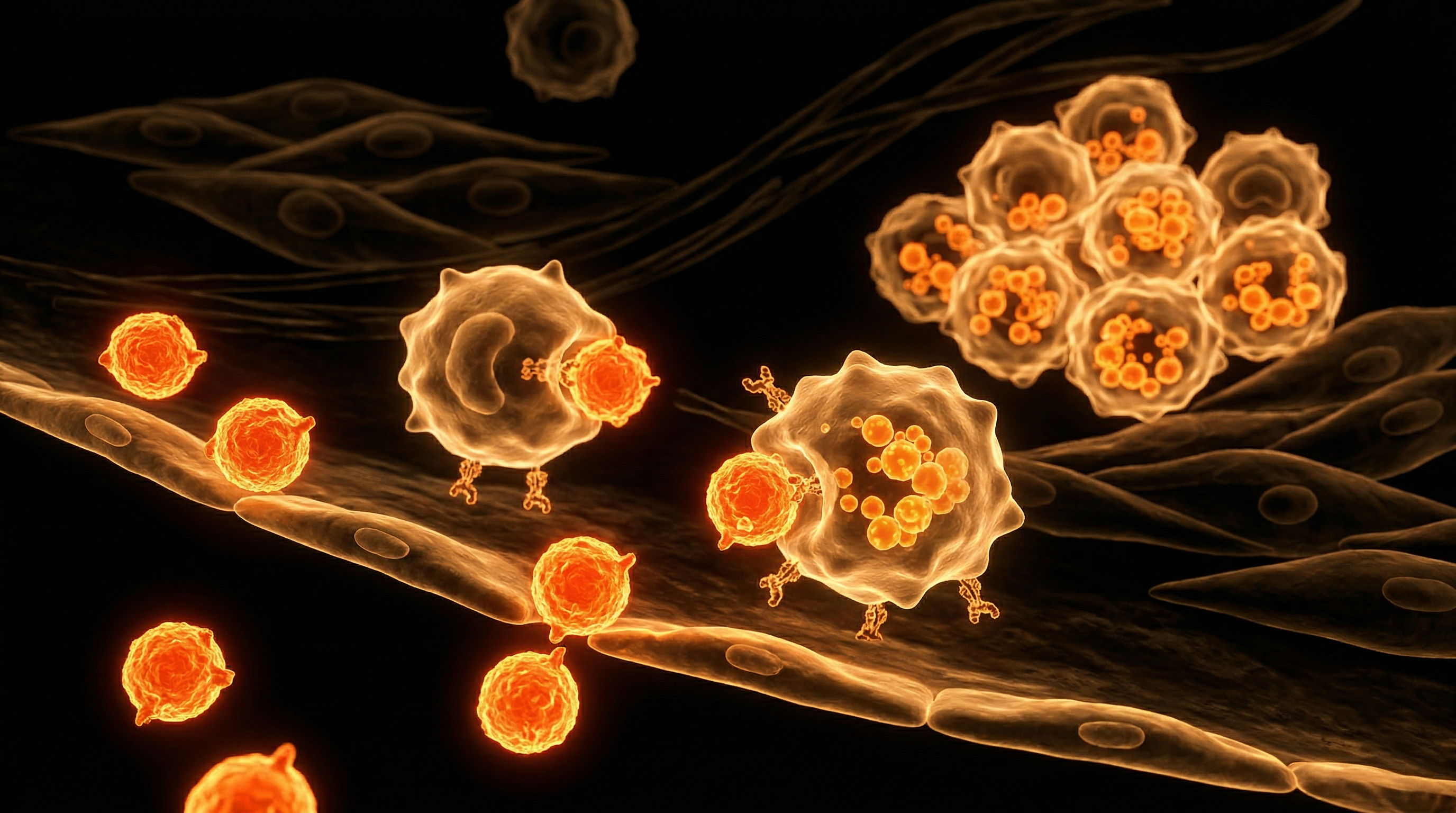
Because the body no longer recognises oxLDL as a "friend," the immune system is alerted. Monocytes (white blood cells) are recruited to the site of the "infection." These monocytes transform into macrophages—the "big eaters" of the immune system.
Unlike the regulated uptake of native LDL, macrophages possess Scavenger Receptors (such as CD36 and SR-A). These receptors do not have a "shut-off" switch. They are designed to clear toxins at any cost. The macrophages begin to engorge themselves on the toxic oxLDL.
Foam Cell Formation
As the macrophages become bloated with oxidised lipids, they take on a foamy appearance under a microscope. These are known as Foam Cells. This is the foundational stage of atherosclerosis: the Fatty Streak.
Callout: A "fatty streak" is not composed of cholesterol; it is a graveyard of immune cells that have died trying to sequester oxidised lipids.
These foam cells eventually undergo apoptosis (programmed cell death) or necrosis, spilling their toxic contents into the arterial wall. This creates a "necrotic core," triggering further inflammation and the recruitment of smooth muscle cells to form a fibrous cap over the mess. If this cap becomes thin and ruptures, it leads to a blood clot, causing a heart attack or stroke.
Environmental Threats and Biological Disruptors
If oxidation is the spark, what provides the fuel? Our modern environment is saturated with factors that promote the oxidation of our internal lipids.
The Role of Linoleic Acid (Seed Oils)
Perhaps the most significant dietary driver of oxLDL is the massive increase in the consumption of Omega-6 polyunsaturated fatty acids (PUFAs), specifically linoleic acid, found in industrial seed oils (sunflower, rapeseed, corn, and soya oils).
PUFAs are chemically unstable because they contain multiple double bonds that are highly reactive with oxygen. When you consume a diet high in these oils, your LDL particles become enriched with linoleic acid. This makes the LDL particle structurally "fragile." Research has shown that the amount of linoleic acid in the LDL particle is the single greatest predictor of how easily that particle will oxidise.
Glycation: The Sugar Connection
High levels of circulating blood glucose lead to glycation, where sugar molecules bond to proteins and lipids without an enzyme. This creates Advanced Glycation End-products (AGEs). When the ApoB protein on an LDL particle becomes glycated, it is much more likely to become oxidised. This is why diabetics, even those with "normal" cholesterol, have such a high risk of heart disease—their LDL is both glycated and oxidised, making it doubly toxic to the arteries.
Iron Overload and Fenton Reactions
Iron is a powerful catalyst for oxidation. Through the Fenton Reaction, free iron can turn hydrogen peroxide into the highly reactive hydroxyl radical. Excess iron stores (high ferritin levels) have been linked to increased LDL oxidation. This may explain why men and post-menopausal women (who do not lose blood monthly) have higher rates of heart disease than pre-menopausal women.
Environmental Toxins and Air Pollution
Inhaling fine particulate matter (PM2.5) from vehicle exhausts and industrial emissions triggers systemic oxidative stress. These particles can enter the bloodstream or trigger an inflammatory response in the lungs that spills over into the vascular system, providing the oxidative "fire" needed to transform LDL.
- Smoking: Cigarette smoke contains billions of free radicals per puff, which directly oxidise LDL in the lungs and blood.
- Heavy Metals: Lead, cadmium, and mercury interfere with the body's natural antioxidant enzymes, such as Glutathione Peroxidase.
The Cascade: From Exposure to Disease
The progression from a healthy artery to a clinical event is a decade-long cascade driven by a feedback loop of oxidation and inflammation.
Stage 1: The Initiation
It begins with oxidative stress. Whether through a poor diet, smoking, or metabolic syndrome, the balance between pro-oxidants and antioxidants is lost. LDL particles, particularly the small dense variety, become oxidised.
Stage 2: The Invasion
The oxLDL penetrates the arterial intima. The endothelium expresses adhesion molecules (like VCAM-1) that act like molecular "Velcro," snagging passing white blood cells and pulling them into the vessel wall.
Stage 3: The Inflammation
The macrophages that ingest the oxLDL don’t just sit there; they secrete cytokines (inflammatory signalling molecules) like IL-1β and TNF-alpha. These signals tell the body there is a persistent "infection" in the artery, causing more immune cells to pile into the site.
Stage 4: The Inflammasome Activation
The presence of oxLDL crystals within the macrophage activates a protein complex called the NLRP3 Inflammasome. This is a master switch for inflammation. It triggers a massive release of inflammatory markers, including C-Reactive Protein (CRP), which is a much more accurate predictor of heart disease than LDL cholesterol levels.
Stage 5: Plaque Stability and Rupture
As the plaque grows, the body attempts to heal it by forming a fibrous cap made of collagen. However, if the environment remains oxidative, enzymes called Matrix Metalloproteinases (MMPs) are released. These enzymes "eat" the collagen cap, making it thin and brittle.
Callout: Most heart attacks occur when a "minor" plaque (not one that blocks the vessel entirely) ruptures because it is inflamed and unstable, not because it was "too big."
What the Mainstream Narrative Omits
The current medical paradigm focuses almost exclusively on lowering LDL-C. This is akin to trying to prevent house fires by banning the presence of firemen (LDL) because they are always seen at the scene of the fire.
The LDL-C Proxy Fallacy
The standard blood test measures LDL-C—the amount of cholesterol inside the particles. It does not measure the number of particles (LDL-P), the size of the particles, or, most importantly, the oxidation state of those particles.
A person with an LDL-C of 100 mg/dL could have a few large, safe particles, or thousands of tiny, oxidised ones. The standard test cannot tell the difference. This mechanistic myopia leads to over-prescription of statins for people who are not at risk, and a false sense of security for those who are "within range" but metabolically unhealthy.
The Statin Paradox
Statins are effective at lowering LDL-C by inhibiting the HMG-CoA reductase enzyme in the liver. While they do show a modest reduction in cardiovascular events (primarily in people who have already had a heart attack), their effect may be due to their "pleiotropic" (secondary) effects—such as a slight reduction in inflammation—rather than their ability to lower LDL itself.
Furthermore, statins have a significant "dark side":
- They deplete Coenzyme Q10 (CoQ10), a vital antioxidant that protects LDL from oxidation.
- They can increase the risk of insulin resistance and Type 2 diabetes.
- They do nothing to address the oxidation of the remaining LDL particles or the dietary drivers of the disease.
The Suppression of the "Response to Injury" Hypothesis
In the mid-20th century, two competing theories emerged: the Lipid Hypothesis (Ancel Keys) and the Response to Injury Hypothesis (Russell Ross). The latter argued that atherosclerosis begins with an injury to the arterial wall, and the lipids are simply part of the repair process. The Lipid Hypothesis won the "marketing war," largely because it was easier to create a pill for cholesterol than it was to address the complex environmental and dietary causes of arterial injury.
The UK Context
In the United Kingdom, the approach to cardiovascular health is heavily governed by NICE (National Institute for Health and Care Excellence) guidelines, which heavily favour the "lower is better" approach to LDL.
The Rise of Ultra-Processed Foods (UPFs)
The UK has one of the highest consumptions of ultra-processed foods in Europe. These foods are the primary delivery mechanism for the three pillars of LDL oxidation: Refined Sugars, Industrial Seed Oils, and Excessive Sodium.
The "Heart Age" calculators and NHS health checks focus predominantly on total cholesterol and blood pressure, often ignoring more relevant markers like the Triglyceride-to-HDL ratio (a proxy for insulin resistance and sdLDL) or HbA1c (a measure of long-term glycation).
The British Heart Foundation and Industry Influence
While the British Heart Foundation (BHF) does vital work, its dietary advice has historically been slow to move away from the "low-fat, high-carbohydrate" model that inadvertently increased the consumption of seed oils and sugars—the very substances that drive LDL oxidation.
The NHS Statin Drive
Recent years have seen a push to put millions more Britons on statins, including those with "low risk." This "mass-medication" approach ignores the underlying metabolic crisis facing the UK: a population that is increasingly insulin resistant, sedentary, and deficient in fat-soluble antioxidants.
Protective Measures and Recovery Protocols
If oxidised LDL is the true driver of disease, the goal of any cardiovascular protocol should be to prevent oxidation and stabilise existing plaques.
1. Dietary Reform: Eliminate the "Oxidative Three"
To protect your lipids, you must remove the triggers:
- Seed Oils: Eliminate sunflower, rapeseed (canola), corn, and vegetable oils. Replace them with stable fats like butter, tallow, coconut oil, or extra virgin olive oil (which is rich in polyphenols that protect LDL).
- Refined Sugar and Fructose: Reducing sugar intake lowers glycation and prevents the formation of small dense LDL.
- Ultra-Processed Foods: These are chemically designed to be inflammatory and are devoid of the antioxidants needed to protect your blood vessels.
2. Strategic Supplementation
The goal is to reinforce the LDL particle's "shield" and enhance the body's internal antioxidant systems.
- Coenzyme Q10 (Ubiquinol): A primary lipid-soluble antioxidant that lives inside the LDL particle to prevent oxidation.
- Vitamin E (Tocopherols and Tocotrienols): Works synergistically with CoQ10 to quench free radicals in the phospholipid shell.
- Glutathione Precursors: N-Acetyl Cysteine (NAC) helps the body produce glutathione, the "master antioxidant" that recycles other antioxidants.
- Magnesium: Essential for endothelial function and preventing the calcification of plaques.
3. Metabolic Health and Monitoring
Instead of a simple LDL-C test, patients should insist on:
- Oxidised LDL (oxLDL) Test: Directly measures the concentration of oxidised particles.
- Lipoprotein(a): A genetic variant of LDL that is highly susceptible to oxidation.
- ApoB / ApoA1 Ratio: A far superior predictor of risk than total cholesterol.
- Triglyceride-to-HDL Ratio: Aim for a ratio below 1.5 (in mmol/L). High triglycerides and low HDL are the hallmark of Pattern B (small dense) LDL.
4. Lifestyle Interventions
- Grounding and Sunlight: Exposure to the sun’s near-infrared light stimulates the production of mitochondrial melatonin, a powerful antioxidant.
- High-Intensity Interval Training (HIIT): Can help improve insulin sensitivity and clear small dense LDL particles more efficiently.
- Cold Exposure: Improves metabolic flexibility and reduces systemic inflammation.
Summary: Key Takeaways
The "Cholesterol Myth" is a half-truth that has led to a misunderstanding of the most common cause of death in the Western world. To protect ourselves, we must move beyond the numbers on a lab report and focus on the biochemical state of our lipids.
- LDL is not a poison. It is a vital transport vehicle that only becomes dangerous when it is chemically altered through oxidation.
- Small Dense LDL (Pattern B) is the most susceptible to oxidation because it lacks antioxidant protection and can easily enter the arterial wall.
- Oxidised LDL is treated as a foreign invader by the immune system, leading to the formation of foam cells and the inflammatory cascade of atherosclerosis.
- The primary drivers of oxidation are industrial seed oils (linoleic acid), refined sugars (glycation), and environmental toxins.
- Mainstream medicine's focus on LDL-C ignores the quality of the particles and the underlying metabolic health of the patient.
- True prevention involves stabilising the LDL particle through a diet rich in stable fats and antioxidants, and ensuring the endothelium remains intact.
We must shift the conversation from "How do we lower cholesterol?" to "How do we stop our lipids from becoming toxic?" Only then can we truly address the root cause of cardiovascular disease and reclaim our vascular health from a narrative that has prioritised convenience and profit over biological reality.
"References & Further Reading:"
- The Great Cholesterol Con by Dr Malcolm Kendrick
- Deep Nutrition by Dr Cate Shanahan
- The Clot Thickens by Dr Malcolm Kendrick
- Oxidized LDL as a therapeutic target in atherosclerosis, Journal of Lipid Research.
- Role of Oxidized LDL in Atherosclerosis, Circulation Research.
This article is provided for informational and educational purposes only. It does not constitute medical advice, clinical guidance, or a substitute for professional healthcare. Information reflects cited research at time of publication. Always consult a qualified healthcare professional before acting on any health information.
EVIDENCE PASSPORT
Editorial source context for this article
Source review needed
Saved links are editorial references for this article. They may support specific claims rather than every sentence. Open and assess each source in context. This passport does not independently verify them.
Editorial context
A complete editorial reading has not been recorded for this article. Source links remain available for you to open and assess directly.
Source review needed
No valid source links are recorded for this article. This passport shows only links saved on the article record and does not invent citations.
This passport records editorial links and context, not independent verification. Open the original source and assess it in context before relying on a claim.
Medical Disclaimer
The information in this article is for educational purposes only and does not constitute medical advice, diagnosis, or treatment. Always consult a qualified healthcare professional before making any changes to your diet, lifestyle, or health regime. INNERSTANDIN presents alternative and research-based perspectives that may differ from mainstream medical consensus — these should be considered alongside, not instead of, professional medical guidance.
Read Full DisclaimerContinue the thread
Keep this question moving.
Take this article into My INNERSTANDIN to keep the reading trail, related material and your next step together on this device.