
Telomere Length: The Biological Clock Hidden Within Your Chromosomes
Updated May 2026
Telomeres are protective caps on DNA strands that shorten as cells divide, serving as a marker for biological aging. This article explores how chronic stress and diet influence the rate of telomere attrition in the UK population.
Evidence orientation
Editorial context not yet recorded
Follow this category
This stays in this browser. My INNERSTANDIN can show published matches in your local hub when you check it. It does not send email, push, or alert notifications.
Local learning review
A private browser aid for revisiting ideas. It is not an alert or a health recommendation.
Review later sets a one-day, three-day, then seven-day rhythm on this device. Choose it only when you want to revisit this article.
Overview
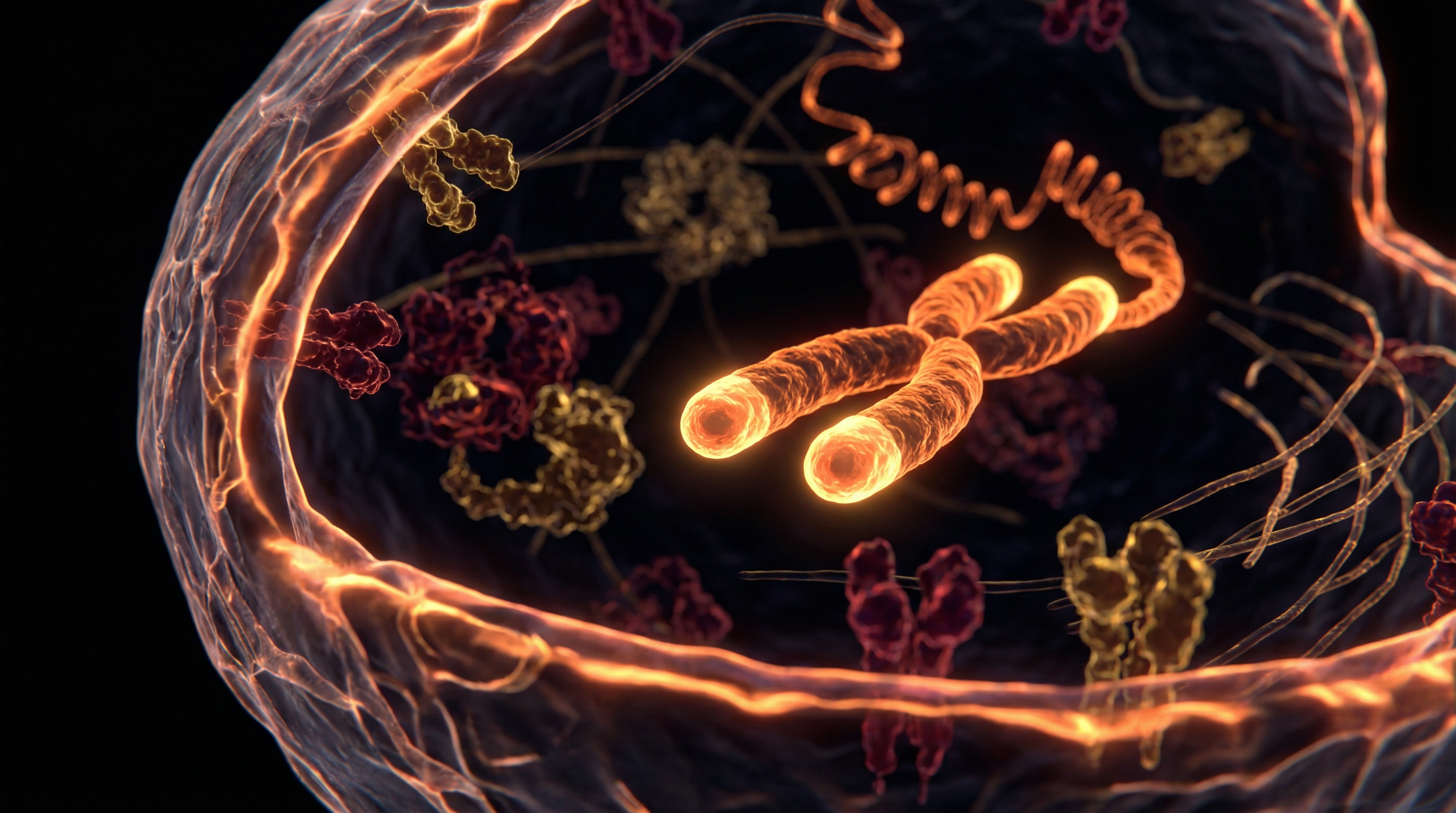
At this very moment, deep within the nucleus of every cell in your body, a silent countdown is underway. It is a biological timer that dictates not just how long you will live, but how well you will age. This is the world of telomeres—the specialised protein-DNA structures found at the termini of our linear chromosomes. For decades, mainstream gerontology viewed ageing as a vague, inevitable decline. However, the emergence of telomere biology has exposed a more precise, and perhaps more unsettling, reality: we are essentially disposable containers for our genetic material, equipped with a finite fuse that shortens with every breath, every meal, and every stressor we encounter.
Telomeres are often likened to the plastic tips on the ends of shoelaces, known as aglets. Just as an aglet prevents the lace from fraying, telomeres prevent the ends of our chromosomes from sticking to one another or unraveling. Without them, the genetic information that makes you "you" would dissolve into a chaotic mess of genomic instability. Yet, there is a catch. Each time a cell divides to repair tissue or facilitate growth, these protective caps lose a small portion of their length. When they reach a critically short threshold, the cell receives a signal to stop dividing and enters a state of permanent "retirement" or death.
This process is not merely a background biological quirk; it is the fundamental driver of human senescence. In the United Kingdom, where chronic lifestyle diseases and mental health crises are at an all-time high, understanding the rate of telomere attrition is no longer a matter of academic curiosity—it is a matter of national survival. We are witnessing a systemic "molecular erosion" of the British population, driven by environmental toxins, a nutrient-void food system, and the relentless psychological pressure of modern life. This article will strip away the euphemisms of the pharmaceutical industry and expose the raw biological mechanics of how we are ageing from the inside out.
Fact: The average human infant is born with telomeres approximately 10,000 base pairs long. By the time we reach old age, this can drop to fewer than 5,000, leading to total cellular collapse and the onset of age-related pathology.
##
##
The Biology — How It Works
To understand the telomere, one must understand the fundamental flaw in how our DNA replicates. The human genome is composed of roughly 3 billion base pairs of DNA, organised into 23 pairs of chromosomes. When a cell prepares to divide, it must create an exact copy of its DNA so that both daughter cells receive a full set of instructions. This task is performed by an enzyme called DNA polymerase.
However, DNA polymerase has a limitation known as the "End Replication Problem." It can only synthesise new DNA in one direction and requires a short "primer" to get started. When it reaches the very end of a linear chromosome, there is no room for the primer on the "lagging strand," meaning the very tip of the DNA cannot be copied. If our essential genes were located at these tips, we would lose vital instructions with every single cell division. Nature’s "solution" was the evolution of telomeres: long, repetitive sequences of non-coding DNA—specifically the sequence TTAGGG repeated thousands of times.
The Anatomy of the Telomere
Telomeres are not just "naked" DNA. They are guarded by a highly specialised protein framework known as the Shelterin Complex. This complex consists of six specific proteins: TRF1, TRF2, POT1, TIN2, TPP1, and RAP1. These proteins work in unison to fold the end of the telomere back on itself, creating a structure called a T-loop.
- TRF1 and TRF2 (Telomere Repeat Binding Factors) bind directly to the double-stranded TTAGGG repeats.
- The T-loop hides the "raw" end of the DNA strand from the cell’s own repair machinery.
- Without the Shelterin complex, the cell would mistake the chromosome end for a broken piece of DNA (a double-strand break) and attempt to "fix" it by fusing it to another chromosome, leading to catastrophic genetic mutations and cancer.
The Hayflick Limit
In the 1960s, Dr Leonard Hayflick discovered that normal human foetal cells in a cell culture will divide between 40 and 60 times before becoming senescent. This is known as the Hayflick Limit. It is the biological barrier that prevents our cells from being immortal. Telomere length is the "counting mechanism" for this limit. Every time the cell divides, between 50 and 200 base pairs of telomeric DNA are lost. Once the telomeres are "worn down" to a critical length (the Progerin threshold), the cell enters a state of replicative senescence, ceasing all function and contributing to the overall ageing of the organ it inhabits.
##
##
Mechanisms at the Cellular Level
While the "End Replication Problem" is a constant, the rate at which telomeres shorten is highly variable. This is where the biological clock turns into a programmable device. Two primary mechanisms dictate whether your telomeres are being preserved or incinerated: the activity of the enzyme Telomerase and the impact of Oxidative Stress.
Telomerase: The Immortaliser
Telomerase is a ribonucleoprotein enzyme that possesses the remarkable ability to add TTAGGG repeats back onto the ends of chromosomes, effectively "rewinding" the biological clock. It consists of two main components: hTERT (human Telomerase Reverse Transcriptase) and hTR (the RNA template).
Scientific Truth: In most of your "somatic" cells (skin, liver, heart), the gene for telomerase is switched off. It is only active in your germ cells (sperm and eggs), stem cells, and, unfortunately, in 90% of cancer cells. Cancer cells hijack telomerase to achieve biological immortality, allowing them to divide indefinitely.
The suppression of telomerase in adult cells is an evolutionary trade-off. By limiting the number of times a cell can divide, the body protects itself from the uncontrolled growth of tumours. However, this trade-off is the very reason we age. The challenge of modern medicine—one that the MHRA and mainstream research often skirt around—is how to safely upregulate telomerase in healthy cells without triggering oncogenesis (cancer formation).
The Role of G-Quadruplexes
Telomeric DNA is rich in guanine (the 'G' in TTAGGG). These guanine-rich sequences can fold into complex four-stranded structures called G-quadruplexes. These structures act as physical "knots" that can block DNA polymerase and telomerase from accessing the DNA. Emerging research suggests that the stability of these G-quadruplexes is a key regulator of telomere maintenance. Disruptors in our environment can stabilise these knots, preventing repair and accelerating the attrition of the chromosome tips.
The Damage Response: ATM and ATR Pathways
When telomeres become too short, they "uncap." This exposes the DNA end, triggering a massive cellular alarm system. Two primary kinases, ATM (Ataxia-Telangiectasia Mutated) and ATR, recognise this as a DNA break. They activate the p53 and p21 pathways. These are the "braking" proteins of the cell cycle. Once p53 is activated by telomere dysfunction, the cell is locked into senescence. It doesn't die; it becomes a "zombie cell," secreting pro-inflammatory cytokines that poison the healthy cells around it.
##
##
Environmental Threats and Biological Disruptors
In the UK, the rate of telomere shortening is being accelerated by a cocktail of environmental stressors that the Environment Agency and Food Standards Agency (FSA) have largely failed to mitigate. We are living in a "pro-ageing" environment where our cellular integrity is under constant siege.
Chronic Cortisol and the HPA Axis
The most potent "telomere killer" is chronic psychological stress. When the brain perceives a threat—whether it’s a predatory animal or a mounting pile of debt—it activates the Hypothalamic-Pituitary-Adrenal (HPA) axis. This results in the flood of cortisol into the bloodstream.
Research has shown that chronic exposure to cortisol directly suppresses telomerase activity. A landmark study led by Dr Elizabeth Blackburn (Nobel laureate for her work on telomeres) found that women under high chronic stress (specifically carers) had telomeres that were significantly shorter—equivalent to 10 years of additional biological ageing—compared to women of the same chronological age with low stress. In the UK, with the cost-of-living crisis and the erosion of social support systems, the "cortisol burden" is a national health emergency.
Oxidative Stress: The Invisible Fire
Telomeres are particularly sensitive to Oxidative Stress. The guanine-rich TTAGGG sequence is highly susceptible to attack by Reactive Oxygen Species (ROS), such as the hydroxyl radical. When ROS attack telomeres, they cause single-strand breaks that are difficult for the cell to repair.
- Air Pollution: In cities like London, Birmingham, and Manchester, levels of Nitrogen Dioxide (NOx) and Particulate Matter (PM2.5) frequently exceed safe limits. These pollutants enter the bloodstream, triggering systemic oxidative stress that "cleaves" telomeric DNA.
- Glycation: The British diet, high in refined carbohydrates and sugars, leads to the formation of Advanced Glycation End-products (AGEs). These sticky proteins cross-link with DNA and cell membranes, generating a storm of free radicals that accelerate telomere attrition.
Endocrine Disruptors and Xenobiotics
The UK environment is saturated with synthetic chemicals that mimic hormones. Bisphenol A (BPA) from plastics and certain pesticides allowed in UK agriculture (such as glyphosate-based formulas) have been linked to DNA damage. These "xenobiotics" interfere with the Shelterin complex, causing telomeres to uncap prematurely even if they still have significant length remaining.
Alarming Statistic: Research indicates that individuals living in the most deprived areas of the UK have telomeres that are up to 5% shorter than those in affluent areas, a disparity driven by the cumulative impact of poor air quality, nutritional poverty, and chronic psychosocial stress.
##
##
The Cascade: From Exposure to Disease
The shortening of telomeres is not an isolated event; it is the first domino in a catastrophic biological cascade. When telomeres reach the "critical length," the resulting cellular senescence leads to a state known as Inflamm-ageing.
The SASP Phenomenon
Senescent cells are not metabolically silent. They develop a Senescence-Associated Secretory Phenotype (SASP). This means they pump out a toxic "broth" of inflammatory cytokines (like IL-6 and TNF-alpha), growth factors, and proteases.
- These SASP factors circulate through the blood, damaging the lining of the arteries (endothelium).
- They break down the extracellular matrix in the skin, causing wrinkles and loss of elasticity.
- Most dangerously, they spread the "ageing signal" to neighbouring healthy cells, forcing them into senescence even if their own telomeres are still long.
Cardiovascular Decay
Telomere shortening is a primary driver of atherosclerosis (hardening of the arteries). The endothelial cells that line our blood vessels must divide frequently to repair damage from high blood pressure and turbulence. If these cells reach their Hayflick limit prematurely, the vessel wall becomes thin and prone to plaque buildup. A study of UK heart disease patients found that those with the shortest leucocyte (white blood cell) telomeres had a three-fold higher risk of myocardial infarction.
Immunosenescence: The Failing Defence
The immune system relies on rapid cell division. When you encounter a virus, your T-cells and B-cells must multiply exponentially to mount a defence. If your stem cell pools have exhausted their telomeres, your immune system cannot respond. This is immunosenescence. It explains why the elderly are more susceptible to infections and why vaccine efficacy wanes with age. In the context of the recent global health crises, those with "biologically older" immune systems (short telomeres) were significantly more vulnerable to severe outcomes.
##
##
What the Mainstream Narrative Omits
The mainstream medical establishment in the UK, dominated by the NHS and the British Medical Association (BMA), remains fixated on a "one pill for every ill" model. This approach ignores the upstream cause of most diseases: cellular degradation. There are several uncomfortable truths about telomere biology that are frequently omitted from the public discourse:
- The UPF Trap: The UK consumes more Ultra-Processed Foods (UPF) than any other country in Europe. These "industrial edible substances" are designed for shelf-life, not human life. They lack the essential micronutrients (like folate and B12) required for DNA methylation—the process that protects the telomere sequence. The FSA's failure to regulate these products effectively is a direct assault on the nation's telomeres.
- The Futility of Post-Symptomatic Care: By the time a patient is diagnosed with Type 2 Diabetes or Alzheimer’s, their telomeres are already catastrophically short. We are spending billions on "managing" the symptoms of senescent cells rather than preventing the attrition in the first place.
- The Epigenetic Inheritance of Trauma: We now know that telomere length can be "programmed" in the womb. Mothers under extreme stress during pregnancy in the UK—often due to socio-economic instability—give birth to infants with shorter telomeres. We are literally "baking" shorter lifespans into the next generation before they have even taken their first breath.
- The "Normalisation" of Decline: The medical system views the decline of health in one's 50s and 60s as "normal." From a biological standpoint, it is not. It is a result of a mismatch between our ancient DNA and our modern, toxic environment. The "normal" lifespan is a product of environmental failure, not biological necessity.
##
##
The UK Context
The United Kingdom presents a unique "laboratory" for the study of telomere attrition. Our history of industrialisation, combined with the modern "North-South divide," has created a stark biological inequality.
The "Glasgow Effect"
In parts of Glasgow, life expectancy is among the lowest in the developed world. While lifestyle factors play a role, researchers have found that the biological age of residents in these deprived areas far exceeds their chronological age. The combination of historical heavy metal contamination (lead, arsenic), damp housing, and the psychological weight of "learned helplessness" creates a perfect storm for telomere destruction.
The Impact of UK Water Quality
While the UK's tap water is often touted as "world-class," it contains levels of chlorine and fluoride that some researchers argue contribute to oxidative stress in the gut microbiome. Since 70% of our immune cells are in the gut, and immune cells require long telomeres for function, the chronic ingestion of these chemicals is a neglected variable in the UK's ageing profile.
The Vitamin D Crisis
Due to our northern latitude and lack of sunshine, a vast majority of the UK population is Vitamin D deficient for six months of the year. Vitamin D is a potent activator of telomerase. By failing to implement a mandatory, high-dose Vitamin D fortification programme, the Public Health England (now UKHSA) guidelines have left the population’s telomeres "unshielded" against winter stressors.
##
##
Protective Measures and Recovery Protocols
While the shortening of telomeres is a natural process, the acceleration of that process is entirely within our control. To preserve your biological clock, you must move beyond the basic advice of the NHS and adopt a protocol designed for molecular preservation.
1. Nutritional Shielding
- Sulforaphane: Found in broccoli and kale, this compound activates the Nrf2 pathway, the body’s master antioxidant switch. It neutralises the free radicals that specifically target telomeric DNA.
- Polyphenols: Consume high-quality British berries (blackberries, bilberries) and dark chocolate (85%+). These contain anthocyanins that protect the Shelterin complex.
- Omega-3 Fatty Acids: High-dose, purified fish oils (specifically EPA and DHA) have been shown to correlate with longer telomeres. They reduce systemic inflammation, slowing the rate of division-induced attrition.
- Avoid UPFs: Eliminate foods containing "emulsifiers," "flavour enhancers," and "seed oils" (high in linoleic acid), which are the primary drivers of cellular oxidative stress.
2. Metabolic Flexibility
- Intermittent Fasting: Periods of caloric restriction trigger autophagy—the cell’s "rubbish disposal" system. This clears out damaged proteins and reduces the burden on the DNA repair machinery.
- Resistance Training: Lifting weights triggers the release of myokines, signalling proteins from the muscles that have a systemic anti-ageing effect. Studies show that middle-aged adults who engage in regular strength training have significantly longer telomeres than their sedentary peers.
3. Stress Decoupling
- Vagus Nerve Stimulation: Techniques such as deep diaphragmatic breathing or cold-water immersion (the "cold shower" method popular in UK wellness circles) activate the parasympathetic nervous system, lowering cortisol and allowing telomerase to function.
- Nature Immersion: The Japanese practice of Shinrin-yoku (forest bathing) has been shown to lower cortisol. Even in the UK, regular walks in ancient woodland (where available) can have a measurable impact on cellular stress markers.
4. Targeted Supplementation
While the FSA remains cautious, several compounds have shown promise in "re-lengthening" or at least halting the attrition of telomeres:
- Astragalus Membranaceus: Contains TA-65, a molecule that has been shown in some studies to temporarily activate telomerase.
- Magnesium: Magnesium is a co-factor for almost every enzyme involved in DNA repair. Most UK diets are chronically deficient in this mineral.
- Nicotinamide Adenine Dinucleotide (NAD+) Boosters: Compounds like NMN or NR support the Sirtuin family of proteins, which work alongside the Shelterin complex to maintain genomic stability.
Callout: True longevity is not about living longer in a state of frailty; it is about extending the "healthspan"—the period of life spent in optimal physical and cognitive function. This is only possible if you protect your telomeres today.
##
##
Summary: Key Takeaways
The science of telomeres has stripped away the mystery of ageing, revealing it to be a quantifiable, mechanical process of cellular erosion. In the UK, we face an unprecedented challenge as our environment and lifestyle conspire to accelerate our biological clocks at an alarming rate.
- The Telomere is the Timer: These TTAGGG caps are the physical manifestation of your remaining cellular potential. Once they are gone, the cell’s "fuse" has burned out.
- Stress is the Catalyst: Cortisol is a chemical poison for telomeres. The psychological landscape of the modern UK is a major contributor to premature ageing.
- Inflammation is the Result: Short telomeres create senescent "zombie cells" that fuel the fire of chronic disease through the SASP.
- The System is Failing You: Mainstream UK health guidelines are decades behind the cutting edge of telomere biology. You must take personal responsibility for your cellular health.
- Preservation is Possible: Through aggressive nutritional intervention, metabolic management, and stress mitigation, you can slow the ticking of your biological clock and potentially even reclaim lost ground.
We are not merely victims of time. We are the architects of our own biological destiny. By understanding and protecting the telomeres hidden within our chromosomes, we can defy the mainstream narrative of inevitable decline and forge a path toward true, lasting vitality. The clock is ticking—how will you spend your base pairs?
This article is provided for informational and educational purposes only. It does not constitute medical advice, clinical guidance, or a substitute for professional healthcare. Information reflects cited research at time of publication. Always consult a qualified healthcare professional before acting on any health information.
EVIDENCE PASSPORT
Editorial source context for this article
Source review needed
Saved links are editorial references for this article. They may support specific claims rather than every sentence. Open and assess each source in context. This passport does not independently verify them.
Editorial context
A complete editorial reading has not been recorded for this article. Source links remain available for you to open and assess directly.
Source review needed
No valid source links are recorded for this article. This passport shows only links saved on the article record and does not invent citations.
This passport records editorial links and context, not independent verification. Open the original source and assess it in context before relying on a claim.
Medical Disclaimer
The information in this article is for educational purposes only and does not constitute medical advice, diagnosis, or treatment. Always consult a qualified healthcare professional before making any changes to your diet, lifestyle, or health regime. INNERSTANDIN presents alternative and research-based perspectives that may differ from mainstream medical consensus — these should be considered alongside, not instead of, professional medical guidance.
Read Full DisclaimerContinue the thread
Keep this question moving.
Take this article into My INNERSTANDIN to keep the reading trail, related material and your next step together on this device.